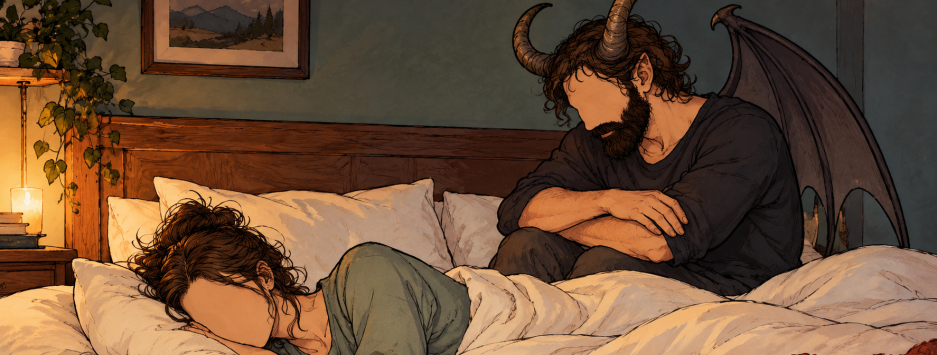
Inevitably, after five days or so, the emotional pain began to set in.
I had been here many times before.
It always seemed to start somewhere in that first week apart. The initial determination would begin to fade, the novelty of having some space would wear off, and something much more difficult would take its place.
Only a few days earlier, I had been sleeping better, feeling more energetic and enjoying the simple pleasures of everyday life.
Now, almost without warning, everything began to feel harder.
Getting out of bed required more effort.
Having a shower seemed like an inconvenience.
Going to work became something I had to make myself do, rather than something I simply got on with.
When someone spoke to me, I could answer them perfectly well, but the smile and genuine engagement that usually came so naturally to me were missing.
Going home to an empty house began to feel lonely.
Falling asleep became difficult.
Nothing about the practicalities of my life had changed. I was still getting up, going to work, coming home, eating and sleeping.
But somehow, the colour seemed to have drained from everything.
The ordinary pleasures of life no longer seemed particularly pleasurable. Things I had been enjoying only a few days earlier suddenly required effort.
And the effort was exhausting.
At work, I found it increasingly difficult to concentrate.
I could still carry out my responsibilities. I could speak to people, make decisions and do the things that needed doing.
But I felt strangely detached from it all.
It was as though I was moving through my day without being entirely present in it.
People spoke, things happened around me, and I responded as I was supposed to. Yet much of the time I felt spaced out, as though there was some invisible distance between me and the world.
I wasn’t necessarily thinking about Stephen.
Sometimes I wasn’t consciously thinking about him at all.
But I couldn’t seem to engage properly with anything else either.
Tasks that ordinarily held my attention became things I simply had to get through. Conversations required more concentration than usual. Even small decisions felt unnecessarily demanding.
I found myself going through the motions, waiting for the day to end.
And when it finally did, I was exhausted.
Not the satisfying tiredness that comes from having worked hard or achieved something.
It was a deep, miserable exhaustion that seemed to have very little to do with how much I had actually done.
I could spend an entire day feeling as though I had barely been there, yet arrive home feeling completely drained.
And then I had the evening to get through.
I wanted to be left alone, but being alone was beginning to hurt.
It was a miserable contradiction.
The emotional discomfort was also beginning to find its way into my body.
I might wake with aching muscles, feeling as though I hadn’t rested properly.
A fog would settle over my thinking, making even straightforward tasks seem unnecessarily complicated.
Sometimes I lost my appetite. Other times I ate without really enjoying anything.
My phone might ring, and even if it was someone I loved, I wouldn’t particularly want to answer.
Not because I didn’t care about them.
I just didn’t feel I had much of myself to offer.
And then came the real anguish.
A knot would form in my stomach, an uncomfortable sensation that seemed to sit there regardless of what I was doing.
There was an ache in my chest that felt almost as though grief had found a physical place to live.
Sometimes my skin would tingle, as though my whole nervous system had become unusually sensitive.
It wasn’t a sharp pain that arrived and disappeared.
It was persistent.
Gnawing.
Almost impossible to ignore.
I could distract myself from it occasionally, but the moment my attention wandered, there it was again.
I could be driving, preparing a meal, watching television or lying in bed, and the feeling would follow me.
There was no comfortable position to adopt. No particular activity that made it disappear. No simple way to reason myself out of it.
And it went on for days.
That was perhaps the most debilitating part.
There was no real respite.
I could have a perfectly ordinary conversation, carry out a task at work or sit watching something on television, but underneath it all the discomfort remained.
Sometimes it was stronger than at other times, but it rarely seemed to leave me altogether.
It was exhausting to feel so miserable for so long.
And there was something particularly difficult about suffering in a way that nobody else could see.
To anyone looking at me, I was simply going about my day.
Inside, I was struggling to get through it.
I knew what was happening.
I had experienced it after previous separations from Stephen, and I recognised the pattern almost immediately.
For the first few days, I could usually manage. Sometimes I even felt surprisingly good.
But then the emotional pain would begin to build.
And after a couple of days of living with it, I would reach a point where I felt compelled to contact him.
I had always told myself there was something I needed to say.
Perhaps I wanted to understand something he’d done. Perhaps I wanted to know how he was feeling. Perhaps I wanted to remind him of what we had shared or ask whether he still believed there might be a future for us.
There was nearly always a reason.
But I was beginning to suspect that beneath all those reasons lay something much simpler.
I wanted the pain to stop.
And Stephen had become the person I instinctively turned to when it became too much.
The strange thing was that his response didn’t necessarily have to be reassuring.
If he said something loving, the anguish could be replaced almost instantly by excitement, affection and the wonderful feeling of being wanted.
A kind word, an expression of longing, a suggestion that he still loved me — any of these could lift me out of the misery I had been feeling.
Suddenly, there was hope again.
I would feel lighter, more animated, more alive.
But if he said something hurtful, something that suggested he didn’t love me or didn’t want to be with me, the anguish would change then too.
It would become anxiety.
Confusion.
Rejection.
I would find myself questioning what he meant, trying to understand his feelings or searching for a way to change his mind.
My thoughts would become busy again.
There would be something to analyse, something to challenge, something to resolve.
And although those feelings were painful in their own right, they were different from the hollow, persistent anguish I had been experiencing before I contacted him.
Either way, the original pain had been interrupted.
That was what I was beginning to recognise.
I wasn’t necessarily finding relief.
I was exchanging one emotional state for another.
And sometimes, simply feeling something different was enough to create the illusion that I was feeling better.
Of course, it never lasted.
A loving conversation might bring us closer again, but sooner or later the familiar uncertainties would return.
An upsetting conversation might leave me distressed, but it would also draw me back into trying to understand him.
And so the cycle would begin again.
I would become emotionally involved, hopeful, disappointed, hurt and exhausted.
Eventually, I would reach another point where I knew I needed to leave.
Then, after a few days apart, the anguish would return.
It was a pattern I had repeated so many times that I could almost predict when the worst of it would begin.
And yet, recognising it had never been enough to stop me.
There was an enormous difference between understanding something intellectually and being able to endure it emotionally.
I knew that contacting Stephen would probably draw me back into the same difficulties I was trying to escape.
But when the pain became sufficiently intense, the possibility of immediate relief could seem far more important than the consequences that might follow.
I could tell myself that I was strong, that I was determined, that this time would be different.
But determination was easy when I wasn’t hurting.
The real test came when I was.
And now that moment had arrived again.
Only this time, I had made a decision.
I wasn’t going to contact Stephen simply to change how I felt.
I was going to stay with the pain and see what happened next.
That sounded rather straightforward in principle.
In practice, it was anything but.
I still had to get out of bed every morning.
I still had to work.
I still had to function in a world that carried on perfectly normally, regardless of how miserable I felt.
And I had no idea how long I was going to feel like this.
Would it get worse before it got better? Would it come and go? Would I wake one morning and discover it had lifted?
I didn’t know.
In all our previous separations, I had rarely allowed myself to find out.
I had interrupted the process by reaching out to him.
Perhaps I had never really experienced what happened on the other side of that anguish because I had always found a way to escape it before I got there.
This time, I wanted to know.
Not because I believed there was anything noble about suffering, or because I thought I deserved to endure it.
Quite the opposite.
I wanted to stop suffering in the same way over and over again.
And I was beginning to understand that avoiding the immediate pain might be one of the reasons I kept returning to a situation that caused me so much more of it.
Then the weeping started.
As before, it could happen at almost any time of day.
There didn’t have to be a particular thought or memory to trigger it.
Sometimes I would simply become aware of a sadness rising inside me, and the tears would begin to fall.
It wasn’t dramatic.
There was no great sobbing or desperate outpouring of emotion.
Just quiet, miserable tears.
I might be sitting on the sofa, driving home from work or getting ready for bed.
And suddenly I would be crying.
Sometimes I knew exactly what I was grieving.
The man I loved.
The future we had imagined.
The companionship I had wanted so badly.
Other times, I couldn’t have explained it at all.
I just felt terribly sad.
And the sadness was tiring too.
There was something deeply wearing about trying to carry on with ordinary life while feeling so disconnected from it.
I missed feeling like myself.
I missed being able to laugh without effort, to enjoy a conversation without having to concentrate on it, to wake up in the morning without immediately becoming aware of the heaviness inside me.
I missed the simple pleasure of feeling well.
And of course, I missed Stephen.
But something was different.
Even when the tears came, I didn’t feel the same urge to reach for my phone.
I knew Stephen could probably change how I felt in a matter of minutes.
A few loving words might be enough to make me feel wanted again.
But I also knew what would happen afterwards.
I had spent years returning to the same source of comfort, even though that comfort was so often followed by more pain.
And I didn’t want to do it anymore.
I wasn’t suddenly immune to longing. I wasn’t enjoying the experience. There was nothing pleasant about lying awake with an aching chest or trying to get through an ordinary working day when everything inside me felt heavy.
But I was beginning to separate two things I had previously treated as inseparable.
Feeling the pain of missing Stephen.
And doing something about it.
For the first time, I was allowing the first without automatically resorting to the second.
I didn’t have to like the feeling.
I didn’t have to understand every part of it.
And I didn’t have to make it disappear.
I only had to allow it to exist without letting it make my decisions for me.
I knew why I had left.
Those reasons hadn’t changed simply because I was hurting.
And although the pain was real, it wasn’t proof that I had made the wrong decision.
That didn’t make the days any easier.
I still felt miserable, exhausted and strangely detached from everything around me.
I still woke up wondering how I was going to get through another day feeling like this.
And I still had no idea when it would end.
But I had spent years finding my way back to Stephen whenever the pain of separation became too much.
This time, however difficult it became, I wanted to find out what happened if I didn’t.


