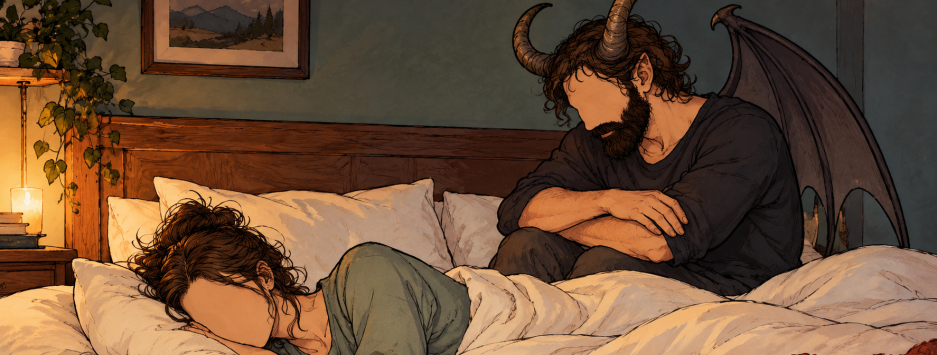
It began with a rational decision.
That was what made this time different.
Of course, the hurtful things Stephen had said to me had triggered something. But I hadn’t reacted in haste. I hadn’t stormed off, issued an ultimatum or declared that I never wanted to see him again.
I had still driven him to the station. I had still said I would speak to him later.
But something had shifted.
That weekend, I thought long and hard about everything that had happened, everything I had tried and everything I could reasonably expect to change.
So I made a choice.
It was time to leave.
For the first time, I wasn’t simply reacting to another painful episode in our relationship. I was consciously preparing to end my part in it.
I wasn’t waiting until I stopped loving Stephen. I wasn’t waiting for him to do something so terrible that leaving became inevitable. And I wasn’t waiting for my feelings to catch up with what I already knew.
I was choosing to leave because, rationally, I understood that staying was no longer good for me.
As I drove away from Stephen that day, I expected to cry.
Surprisingly, there were no tears.
I wondered why.
Perhaps I had simply exhausted them. Perhaps, after everything that had happened, I had finally run out of sadness. Or perhaps the absence of tears was evidence that I really was getting over him. That there was so little left of the relationship I had once cherished that there was very little left to grieve.
But it wasn’t simply that I wasn’t crying.
I didn’t feel particularly sad. Neither did I feel happy, relieved or liberated.
I had just made one of the most significant decisions of my life, and yet emotionally, there seemed to be almost nothing happening.
I felt strangely detached from the enormity of what I had done.
I didn’t know what to make of it.
What I did know was that I wanted this to be the final time.
I understood by now that if I went back, I would simply begin the cycle all over again. And it was the cycle, more than anything, that I wanted to escape.
The hope, the disappointment, the hurt, the reconciliation, the renewed hope.
Round and round we had gone, and I knew what it had been doing to me.
This time, I wasn’t going to embark on some grand reinvention of myself. I wasn’t going to devise an ambitious plan for a wonderful new life or fill my diary with activities designed to distract me from my sadness.
I had no particular enthusiasm for any of that.
But neither was I going to force myself to feel something simply because I thought I ought to.
I couldn’t make myself feel sad, and I couldn’t make myself feel happy. And I certainly wasn’t going to manufacture excitement about a new life simply because I had decided to leave my old one behind.
It was much simpler than that.
I had made a decision, and my only task was to stick to it.
Whatever emotions came, I would allow them. Whatever consequences followed, I would deal with them.
I wasn’t going to demand anything more of myself.
So I went home and expected nothing.
If I wanted to sleep, I slept.
If I wanted to eat, I ate.
If I wanted to cry, I cried.
And if I wanted to do absolutely nothing, that was fine too.
I had to expect nothing except the unexpected.
That evening, I began writing.
Now that I had decided to move on, I felt able to look back over the entire relationship and try to make sense of what had happened. Nearly five years of experiences, conversations, betrayals, reconciliations and extraordinary events that, even to me, sometimes seemed almost impossible to comprehend.
I wanted to document it all.
Partly because I wanted to understand how something that had begun with so much love and promise had become so complicated and destructive.
But also because I didn’t know what recovery was going to look like.
I had some idea of what the next few weeks might bring. I expected moments of sadness, longing and doubt. What I couldn’t imagine was how I would feel in a month’s time, or three months, or six.
Would I miss him? Would I regret leaving? Would I eventually feel indifferent? Would I ever really understand why I had stayed for so long?
I thought writing might help me find out.
It was something I could do without demanding that I feel any particular way. I didn’t have to be happy, hopeful or even especially motivated. I only had to tell the truth about what had happened and what I was experiencing.
I had also asked Stephen for a favour.
I explained that if I was going to move on, I needed him to help me in one very specific way.
If I contacted him, I wanted him to resist replying.
Even if I begged him to.
It felt rather like trying to give up a drug and asking the supplier not to give you any more, however desperately you might plead.
Stephen understood what I was asking and said he would try.
There was something rather extraordinary about that arrangement. I was asking the person I was trying to free myself from to help me stay away from him.
But I knew how powerful the attachment was. I knew how many times I had convinced myself that one more conversation might make a difference. One more explanation, one more opportunity to understand, one more chance to put things right.
I didn’t trust myself not to want those things again.
In many ways, I was trying to overcome something that felt like an addiction, largely on my own, and without knowing quite what withdrawal might look like.
All I knew was that this time I couldn’t allow myself to give up.
Because I wasn’t simply walking away from a painful and destructive relationship.
I was also trying to free myself from everything that had grown around it.
The secrets I had kept. The guilt I had carried. The shame I had felt about returning to someone whose behaviour had caused me so much pain.
And the uncomfortable knowledge that the relationship my friends and family believed I had finally left was one I had continued to return to, sometimes without their knowledge.
For a long time, I had been living with two versions of my life. The one other people knew about, and the one I was actually living.
I wanted to stop hiding.
I wanted to be able to look at my own decisions without feeling I had to defend them, explain them or conceal them.
More than anything, I wanted to find out who I was when I was no longer caught up in trying to make things work with Stephen.
And yet, for all the certainty of my decision, I knew that leaving wasn’t going to be straightforward.
I imagine leaving someone you no longer love must be considerably easier than leaving someone you still do.
Sometimes anger, hatred, fear or disgust can provide the momentum to propel you away. Sometimes the love has simply disappeared, leaving little reason to stay.
But what happens when you still love someone? When you can still see their good qualities, remember the happiness you shared and imagine the future you once hoped to have together?
What happens when the person you need to leave is also the person you instinctively turn to for comfort?
That was the difficulty I faced.
I wasn’t leaving because all my feelings for Stephen had disappeared. I was leaving because those feelings, however genuine, were no longer enough to justify staying.
And I was beginning to understand that I might never feel entirely ready to go.
Yet despite knowing all of this, that first evening remained strangely quiet.
I had expected an emotional battle to begin almost immediately.
Sooner or later, I imagined, the longing would return. The memories would soften. I would remember the good times and begin questioning whether things had really been as bad as I thought.
I had made a rational decision, but I couldn’t expect my emotions to fall obediently into line.
For now, though, there was no argument taking place inside my head.
There was just quiet.
It was an unfamiliar kind of quiet.
For so long, Stephen had occupied an enormous amount of emotional space in my life. Even when we weren’t together, I had been thinking about him, worrying about him, trying to understand him or imagining how things might turn out.
Now I was choosing to stop.
And in the space where all that emotional activity had once existed, there was almost nothing.
I found that unsettling.
I had imagined that leaving might bring an immediate sense of liberation. That I would feel lighter, happier, perhaps even excited about the possibilities ahead.
Instead, I was confronted with an emptiness I had no idea how to fill.
And perhaps that was what frightened me most.
Not the prospect of being alone, but the prospect of having nothing to occupy the space that Stephen had consumed for so long.
I couldn’t quite understand how I could still love someone, know that I was walking away from him, and yet feel so little about it.
I wondered whether the sadness was waiting somewhere beneath the surface. Whether it would arrive tomorrow, or the day after, or catch me unexpectedly in the middle of something ordinary.
I had no way of knowing.
Yet something about my attitude had changed.
In the past, I might have tried to escape that emptiness. I might have mistaken it for evidence that I needed him, that life without him was somehow less meaningful.
This time, I was prepared to experience it.
I didn’t need to fill the space immediately. I didn’t need to turn my recovery into another project, another challenge, another thing I had to get right.
Perhaps, for a while, there would simply be nothing.
No excitement. No inspiration. No great sense of purpose.
Just me, living my ordinary life, without the constant emotional turmoil that had become so familiar.
I had no idea how long it would last, or what might emerge from it.
But for the first time, I wasn’t going to run away from the emptiness.
I was going to let it come.


