Until that evening, Stephen’s ability to connect with people had been one of the things I loved most about him.
I was proud to introduce him.
That feeling matters because what happened with my aunt wasn’t simply an isolated uncomfortable interaction. It emerged from something I genuinely admired.
Stephen was curious about people.
He could enter somebody else’s world with extraordinary enthusiasm. He asked questions. He listened. He found connections. He made people feel interesting.
I’d watched my uncle light up while showing him around the house.
I’d watched my parents enjoy him.
I’d watched my sons engage with him.
And I’d felt proud.
Stephen could go anywhere with me.
Then I watched exactly the same quality turn into something I didn’t recognise.
His curiosity narrowed.
His attention intensified.
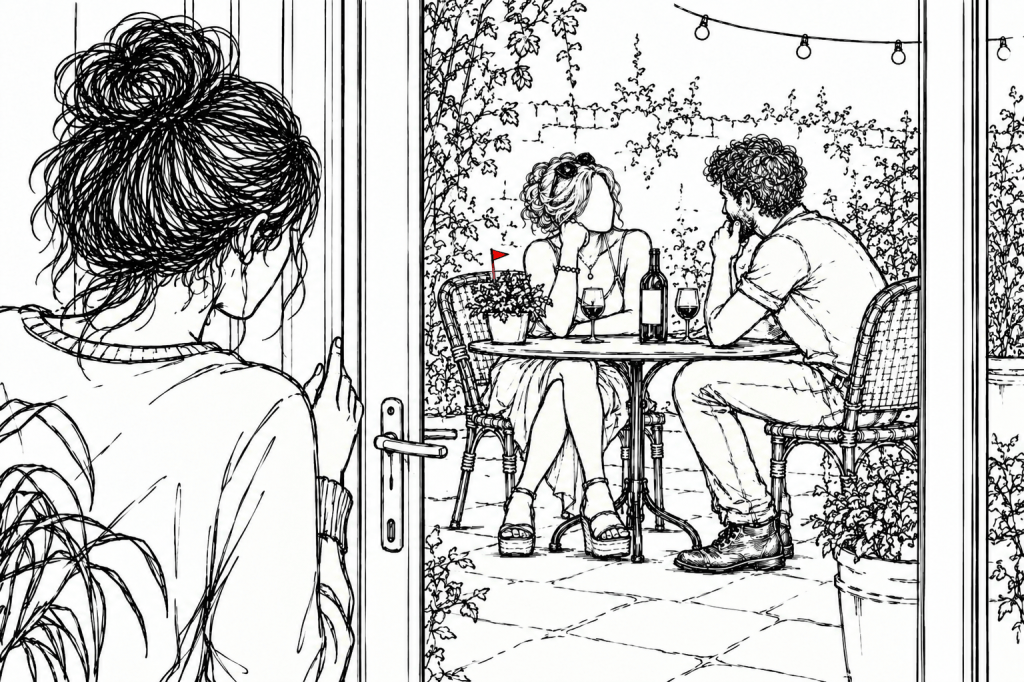
His body moved towards my aunt.
The rest of us seemed gradually to disappear.
And I felt something I hadn’t expected to feel while sitting beside the man who had made me feel so extraordinarily seen.
Invisible.
That contrast hurt.
Perhaps because Stephen’s attention had been so powerful when it was directed towards me.
I already knew what it felt like to occupy the centre of it.
His curiosity could make you feel fascinating. His enthusiasm could make an ordinary story seem extraordinary. His physical attention could make you feel intensely desirable.
Now I was watching another woman respond to the same energy.
And she was responding.
Whatever Stephen believed he was doing, the interaction appeared reciprocal to me.
My aunt seemed captivated by him.
And he seemed captivated by her.
I don’t know what was happening inside Stephen.
That’s one of the questions I still find interesting.
Perhaps he genuinely wasn’t consciously flirting.
Maybe when Stephen said he didn’t know how to flirt, he meant it.
There are people who consciously deploy flirtation: they know they’re creating sexual tension and enjoy doing it.
Perhaps Stephen experienced something different.
Maybe attention simply intensified when he found another person interesting. Maybe he enjoyed the response he received without consciously identifying the interaction as sexual. Perhaps the boundary between curiosity, charm, attraction and flirtation was genuinely less distinct for him than it was for me.
Or perhaps he knew perfectly well that he was flirting and didn’t want to admit it once he saw how upset I was.
I can’t know.
What matters is that his explanation and my observation were suddenly very far apart.
I watched you flirt with her.
I don’t know how to flirt.
Those two realities couldn’t easily coexist.
And that was becoming familiar.
After the night with his ex, I had tried repeatedly to reconcile what Stephen told me with what I knew had happened.
Now I found myself doing it again.
Was I misunderstanding him?
Was he misunderstanding himself?
Was he minimising something because admitting it would make him uncomfortable?
Or was I becoming suspicious because my trust had already been damaged?
That last possibility mattered enormously to me.
I didn’t want what had happened with his ex to turn me into someone who saw danger everywhere.
I didn’t want to become jealous.
I didn’t want to police harmless conversations or interpret every interaction with another woman as a threat.
That wasn’t the relationship I wanted.
So I examined myself as carefully as I examined Stephen.
Am I overreacting?
That question was beginning to appear more often.
There is a psychological reason that makes sense to me now.
Once trust has been damaged, the brain becomes more attentive to information associated with the original threat. It starts scanning.
That’s often described as hypervigilance.
But hypervigilance doesn’t necessarily mean the things being noticed aren’t real.
That’s an important distinction.
Sometimes increased vigilance produces false alarms.
Sometimes it simply means you’re noticing genuine information more quickly because you’ve learned that it might matter.
The difficult part is knowing which is which.
My concern about Stephen and women hadn’t appeared from nowhere.
Only weeks earlier, I’d expressed discomfort about him staying with an ex, received reassurance, then discovered he’d shared her bed.
Now I was sitting beside him while he became intensely absorbed in another woman and apparently forgot I existed.
Of course my nervous system connected those events.
The question was whether they actually belonged together.
I didn’t know yet.
So I did what I had increasingly learned to do.
I tried to understand.
And this time, understanding became almost educational.
Stephen gave me the impression that he genuinely didn’t understand what I meant by flirting.
So I explained it.
I distinguished charm from sexual or romantic signalling.
I talked about context.
I explained that the issue wasn’t that either of us must never enjoy attention from another human being. It was about protecting the sense of security between us.
At the time, I found that conversation strangely hopeful.
If Stephen hadn’t understood the boundary before, perhaps now he did.
That meant what had happened didn’t necessarily reveal something fundamental about him.
Perhaps it revealed something he simply hadn’t learned yet.
And once again, I found myself drawn towards potential.
Now that we’ve talked about it, things can be different.
There is something appealing about a problem that can be solved through communication.
It gives you something to do.
If the problem is misunderstanding, explain more clearly.
If the problem is an unclear boundary, define it.
If the problem is lack of experience, teach.
That approach suited me because communication was something I believed strongly in.
Relationships weren’t supposed to arrive perfectly formed. Two people learned each other.
So I didn’t ask myself why I was having to explain to a man in his forties that directing sexualised attention towards another woman while his partner sat beside him might be uncomfortable.
I asked myself how I could explain it in a way he would understand.
That’s another subtle shift I can see now.
Increasingly, when Stephen’s behaviour troubled me, my mind moved towards solving the problem.
What does he need to understand?
How can I communicate this differently?
What information is he missing?
Perhaps that was partly because I still believed the problem was informational.
If Stephen understood how something affected me, surely he wouldn’t want to do it again.
That belief depended on something fundamental.
That my feelings mattered to him even when his immediate impulses were pulling his attention somewhere else.
And then there was my aunt.
Her age mattered to me, although perhaps not for the reason one might assume.
Stephen had already reassured me repeatedly that his attraction wasn’t governed by conventional ideas about age or body type.
I’d found that beautiful.
It had made me feel safer.
Now I was beginning to understand that the same openness I’d admired could have another implication.
If Stephen could see sensuality and attractiveness in women irrespective of age, size or conventional ideals, then perhaps the category of women who might capture his attention was much broader than I’d imagined.
Again, that wasn’t inherently a problem.
Being in a relationship doesn’t make other people cease to be attractive.
The question was what someone did with that attraction.
Could Stephen notice another woman and still remain emotionally anchored to me?
That was what frightened me in the garden.
For those minutes, he didn’t seem anchored to me at all.
I asked him to leave.
He didn’t respond.
I stood up.
He remained seated.
My parents and I waited in the doorway while his attention remained somewhere else.
It wasn’t merely jealousy.
It was the experience of temporarily ceasing to matter.
And then, later, came the familiar transformation.
Stephen was defensive.
I was upset.
We argued.
He fell asleep.
And I remained awake carrying the emotional consequences.
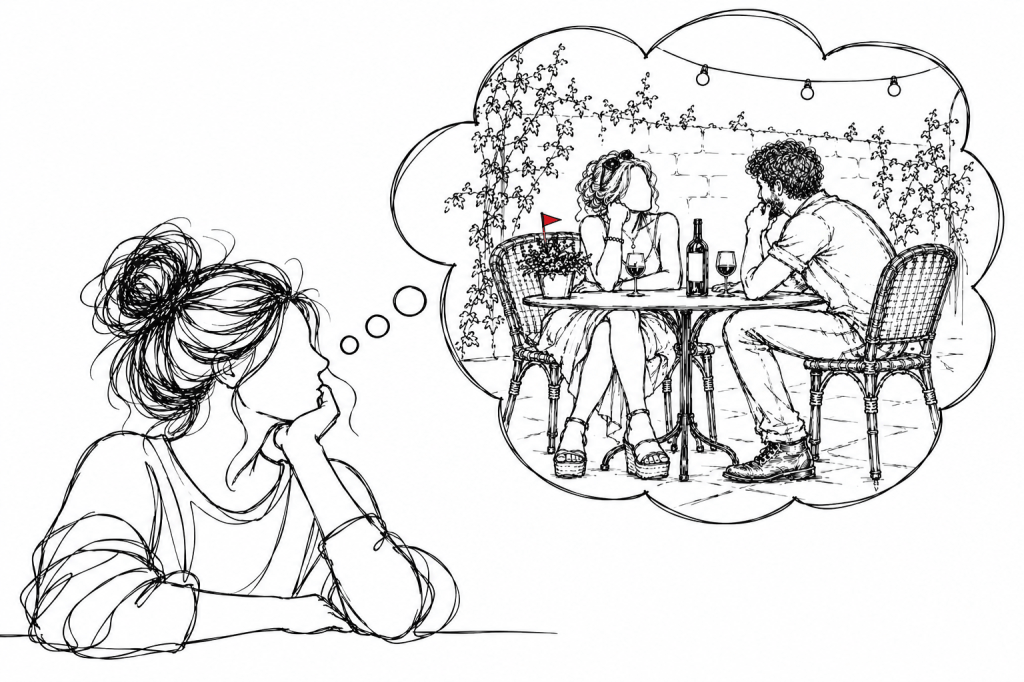
I can still picture myself sitting on that windowsill.
Smoking.
Looking out over London.
Trying to understand the man asleep behind me.
That image feels important now.
Stephen could switch off and sleep.
I couldn’t.
My mind needed resolution.
If something didn’t make sense, I turned it over repeatedly, looking for the interpretation that would make the pieces fit.
Perhaps that difference between us mattered more than I understood.
Stephen could apparently leave an unresolved conflict for the night.
I carried it into the early morning.
And increasingly, I was becoming the person doing the psychological work of the relationship.
Observing.
Questioning.
Explaining.
Connecting.
Trying to understand.
Trying to repair.
None of this meant Stephen didn’t care about our relationship.
I believe he did.
Perhaps he was doing his own internal work in ways I couldn’t see.
But from inside my experience, I was beginning to feel responsible not only for communicating my boundaries, but for helping Stephen understand why those boundaries existed.
And because I loved him, that still felt reasonable.
The conversation with my aunt hadn’t destroyed anything.
Stephen was still the funny, affectionate, fascinating man I was proud to introduce to people.
Most of our relationship remained extraordinarily happy.
But the night had given me another piece of information.
The man whose attention made me feel more visible than almost anyone I’d ever known could direct that same extraordinary attention elsewhere.
And when he did, I could disappear remarkably quickly.
After his ex, I had begun asking:
Can I trust Stephen?
Now another question was forming underneath it.
What happens to us when something —or someone else — captures his attention?
I didn’t know why that question frightened me.
Not yet.