
Just before Stephen moved back in, he bought four more Billy Connolly paintings from the gallery.
I was beginning to feel uneasy about how much money he was willing to spend on art when there were so many other areas of his life — and now our life together — that could benefit from it.
Stephen understood my concern, although he explained that these particular pieces had been especially good value. The gallery had accidentally framed them, so he had been able to buy them for the original unframed price.
That may well have been true, but I told him I thought buying art should be something he did with genuinely disposable income. We were trying to build a future together now.
We had already talked about what we wanted the next year to look like. It was going to be about getting our lives in order, working, saving and putting ourselves in a position where we might eventually buy somewhere of our own. Moving to Scotland was still somewhere we talked about too. Whatever the destination turned out to be, there was a dream taking shape between us, and getting there would require us to think carefully about money.
Every penny mattered because, in my mind, every penny was taking us somewhere.
Once Stephen actually moved in, things began happening remarkably quickly.
He reorganised the garage to make room for a workshop and brought all his tools over. His desk went into the new craft room, and I bought a daybed for the space so it could be somewhere to sit, read and daydream, while also doubling as a spare bed when we had guests.
He started taking care of the garden.
One of the first things he made in his new workshop was a bookshelf for his collection of books. I loved seeing him in there designing and building something with his hands. There was a purposefulness about him that I hadn’t seen consistently before.
Everywhere I looked, there seemed to be evidence that our plan was working.
Then he bought another piece of art, a portrait of Keith Richards by Johnny Depp.
It was his most expensive purchase yet, although after our previous conversation he chose to buy it with interest-free credit rather than paying for it outright.
That concerned me. It wasn’t simply the amount of money anymore; I was beginning to wonder why he seemed unable to stop buying art. To my eye, much of what he was buying was quite commercial. It didn’t feel as though he was searching galleries and falling in love with individual works that spoke to him. He seemed to keep walking into the same little high-street gallery and coming home with something else.
But there was another side to it.
Stephen hung the paintings around my house, and for the first time it began to feel less like the home I had previously shared with my children and more like something we were creating together.
Our home.
That mattered to both of us.
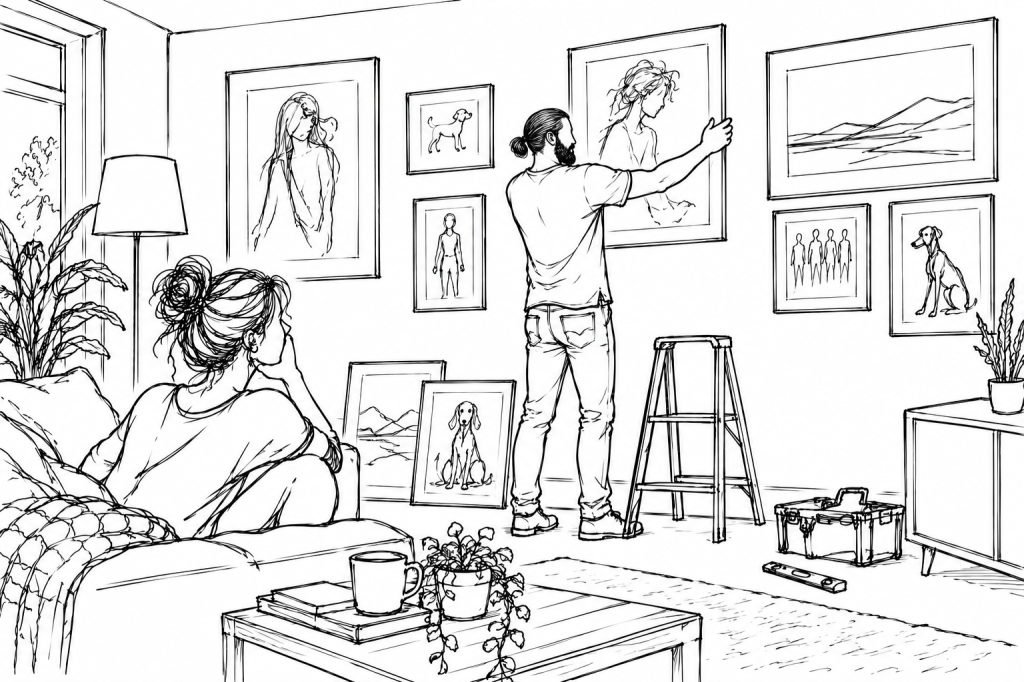
After all the years of fitting our relationship around other people’s lives and living arrangements, we finally had a space that felt like ours.
And Stephen seemed to be flourishing in it.
His progress gave me the confidence to suggest something I had quietly been considering for a while.
I had wondered for some time whether I might like to offer Stephen to return to my place of work as a groundskeeper. I wasn’t prepared to put his name forward simply because he was my partner. I needed to see evidence that he could be productive, proactive and, importantly, conduct himself professionally.
The change I had witnessed in him since the beginning of the year — and particularly since moving in — made me believe he was ready.
So I approached my bosses.
They agreed to give him work a couple of days a week.
It felt like another piece falling into place.
At almost exactly the same time, however, I was becoming increasingly disillusioned with my own job after what had, for most of the previous sixteen years, been a good working relationship.
Renovations had begun in 2020 and were originally supposed to last around a year. We were now entering our third year of effectively working on a building site, with little evidence that it was ever going to end.
My female boss’ obsessive attention to detail was becoming increasingly difficult for me to manage. Although I was the house manager, I had been largely omitted from discussions about the renovation, yet somehow I was expected to know everything that was happening. I found myself being asked to manage builders and aspects of the project despite being kept in the dark about decisions and never having agreed to become a project manager.
Inevitably, it created friction.
So, even though Stephen had only just started working there again, I told him I was going to begin looking at what else might be available to me. There was no urgency. After sixteen years, I wasn’t going to leave for the sake of leaving. But for the first time in a long time, I was ready to consider something new.
Stephen appeared to understand.
What followed was a period of about two months that I would come to remember as one of the happiest stretches of our entire relationship.
More than that, it gave me a glimpse of what I thought our future could actually look like if we eventually found a place of our own, somewhere we could both thrive.
Our lives developed structure and routine.
I had always wanted that, and Stephen appeared to benefit from it too.
We worked.
We shopped.
We cooked.
We spent our evenings and weekends together.
There was an ordinary domestic rhythm to our life that I found deeply comforting.
We also began having Stephen’s youngest son stay with us rather than them always spending their weekends together at Stephen’s dad’s house. His son had tennis practice, so we would take him and then spend an hour together waiting for him to finish.
They were such simple things.
But my own sons had grown up and moved out, and suddenly the house had family life in it again.
The three of us felt like a little family.
I liked that enormously.
Stephen’s driving lessons were going well too. He was making steady progress and becoming increasingly confident behind the wheel. It might have seemed like another small thing, but to me it belonged to the much bigger picture of what we were trying to achieve. Being able to drive would give him greater independence, open up more opportunities for work and make the life we were imagining together that little bit easier, especially if all the driving didn’t just rest with me.
It was another sign that things were moving in the right direction.
Working at the house also began opening doors for Stephen. He met one of our tradespeople, who would offer him additional work. He got to know people in the local village who needed handyman jobs doing. For a short time, he even joined the building team working on the renovation.
Finally, Stephen was beginning to establish himself as self-employed.
After all the years of uncertainty around work, I could see something solid beginning to emerge.
And while Stephen was finding his feet, I was making plans of my own.
I registered with an agency to explore jobs that might pay significantly more. Part of my motivation was personal: I had become unhappy where I was and needed a new challenge. But our future was never far from my mind either.
If I could substantially increase my salary, we could save much more quickly.
Perhaps buying our own home wouldn’t have to remain a distant dream.
I expressed interest in several positions before my agent put me forward for a job she had been trying to fill for some time.
The recruitment process was long and demanding. I went through several interviews, completed a psychometric assessment and travelled to see the property because it was a considerable distance from home.
There were sacrifices to consider.
The commute would be much longer. The working days would be longer too. I would be giving up much of the comfort and flexibility I had built up over sixteen years.
But the salary was £25,000 a year more.
That was difficult to ignore.
When I laid everything out for Stephen, he seemed concerned about how much I would be giving up, and he wasn’t wrong. But I was ready for something different, and I kept thinking about what that additional money could do for us.
Even if I only stayed for a year, I reasoned, we could save hard during that time. If I hated it, I could find another job afterwards.
It didn’t have to be forever.
It only had to move us forward.
In May, I was offered the position.
I believed I could make it work.
Around this time, another conversation between Stephen and me seemed to belong to the same question of what it meant to build a life together.
Stephen encouraged me to open a joint bank account with him. It would give us somewhere to save together, but there was another reason too. He told me it would reassure him that I was taking our relationship seriously — that I saw us as a couple and a team, rather than simply two people whose lives happened to overlap.
This wasn’t the first time Stephen had expressed doubts about that.
Occasionally, something I said or did would leave him feeling that I wasn’t fully embracing him as part of my life. I knew this was particularly sensitive for him because of the way he had described his previous relationship. There had been times, particularly when his ex-girlfriend was angry with him, when he felt she kept him at arm’s length emotionally. To Stephen, it had seemed as though she could decide when he was part of the relationship and the family around them and when he wasn’t.
He had hated that feeling, and it was something he believed had contributed to him eventually leaving.
Now, sometimes, he suggested that I made him feel something similar.
I didn’t entirely understand it.
From where I stood, there seemed to be so much evidence of my commitment already. I had stood beside him through some incredibly difficult things. I had tried to understand him when I had been hurt, forgiven things I had struggled to make sense of, and continued believing in our relationship when walking away might have been easier.
To me, all of that said: I am here. I am choosing us.
But I also understood that the way we intend our love to be felt isn’t necessarily the way another person experiences it. If there were things I was doing that left Stephen feeling pushed out or less secure in our relationship, I wanted to know.
So I listened.
I put caution aside and we opened the joint account.
I also started paying more attention to the things I said and did — wondering whether something that felt perfectly ordinary or independent to me might make Stephen feel excluded, pushed away or not fully embraced.
It seemed like a reasonable thing to do when you loved someone. Relationships required compromise. They required you to consider another person rather than simply yourself.
And if Stephen needed to feel more strongly that there was an us behind the decisions I made, I wanted to give him that reassurance.
At the time, I thought I was learning to think more as we.
I was offered the job. I handed in my notice and gave my employers six weeks to replace me. I would finish in June, take a week off and then begin my new job. They found my replacement fairly quickly, and I spent my final weeks training her and preparing to hand over a role that had been part of my life for sixteen years.
It was an enormous change.
But so much seemed to be changing for the better.
Stephen had found his feet. I hoped my employers would continue giving him work after I left, while the contacts he had made were already beginning to give him opportunities elsewhere.
I was about to start a new job, take on a new challenge and earn considerably more money.
At home, we had begun creating a life that felt settled, productive and shared.
For once, it didn’t feel as though I was waiting for our future to begin.
It felt as though we were already building it.
And although I was nervous about leaving the security of a job I had known for sixteen years, underneath the fear was excitement.
There was a reason I was prepared to take the risk.
I could see where I thought we were going.
And almost every choice I was making was intended to help us get there.
Reflection
Looking back, this was probably the point when hope became investment. Until then, much of our future had existed in conversations: places we might live, things Stephen might do, the kind of relationship we hoped we could have. Now those ideas were becoming tangible. There was a workshop in the garage, a craft room upstairs, Stephen’s paintings on the walls and money beginning to accumulate for a future we both believed we were building. For perhaps the first time, our imagined life seemed to be becoming our actual one.
And for a while, it was genuinely lovely. That matters when I look back on it. I wasn’t clinging to a relationship that felt relentlessly unhappy. I was living through one of its happiest periods. Stephen was working, learning to drive and becoming more independent. We cooked and shopped together. His son stayed with us. There was family life in the house again. The ordinary domesticity I had wanted for so long had finally arrived, and its very ordinariness made it convincing. I wasn’t waiting for some dramatic transformation anymore. I thought I was watching lasting change settle quietly into everyday life.
Perhaps that was why my own decisions began to feel inseparable from our future. Leaving a job I had held for sixteen years was a huge step, and I was doing it partly for myself. I needed change and I wanted a new challenge. But the additional money also represented possibility. Every extra pound shortened the distance between the life we had and the one I imagined ahead of us. The joint account carried a similar meaning. It wasn’t simply somewhere to put money. It was another declaration that there really was an us now, with plans that extended beyond the present.
There was something subtler happening too. When Stephen told me that some of my independence made him feel as though he wasn’t fully part of my life, I took that seriously. I began examining myself more closely. Was I holding something back? Was I making decisions as an individual when I should be thinking as part of a couple? Compromise seemed like one of the ordinary responsibilities of loving someone, and I wanted Stephen to feel secure. At the time, adjusting myself in small ways didn’t feel like losing anything. It felt like learning how to build a partnership.
The art was perhaps the one place where something didn’t quite fit. I could see Stephen becoming more purposeful in almost every other area of his life, while simultaneously watching him spend increasingly large amounts of money on something I couldn’t quite understand. But even those paintings became part of our home. They were evidence of Stephen taking up space there, making the house his as well as mine. That made it easier to accommodate the discomfort alongside everything else that appeared to be going right.
I can see now how much of myself I was beginning to place into the future we had imagined: my home, my earnings, my financial security, my decisions and increasingly the way I thought about myself within the relationship. But it didn’t feel like sacrifice. It felt like momentum. We weren’t talking about building a life anymore. We appeared to be doing it. And because I could finally see that life taking shape around me, investing more of myself in it felt less like a risk than the natural next step.


