
The year of 2024 seemed, for the most part, to be a continuation of the one before it.
Stephen continued building his self-employment, taking work with the stone specialist and travelling periodically to Scotland, while I continued trying to find my feet in my demanding new job.
Life became very routine.
We worked. We came home. We ate. We slept. Then we got up and did it all again.
We still had his youngest son with us every other weekend and that continued to involve tennis practice. However, we had not heard from his eldest son since Christmas and he wasn’t responding to text messages. It was clearly starting to worry Stephen.
I was managing to save around £500 a month, which pleased me because saving had always been part of the reason I had taken the job. In my mind, every month I endured was putting us a little closer to whatever came next.
But earning more money also seemed to have created a more expensive life. Petrol swallowed a ridiculous amount of it. Vapes kept me sane through difficult working days. And far too often, when neither of us had the energy to cook, we resorted to fast food.
My diet deteriorated. I developed a dependance on fizzy cola that was readily available at work. I gained weight. My energy disappeared.
The house wasn’t kept in the way I liked it anymore. On my days off, instead of catching up with everything, I increasingly wanted to stay in bed or do very little at the weekends.
I wasn’t particularly happy about any of that, but I saw it as temporary.
There was still a purpose underneath it.
We were working. We were saving. Stephen was gaining experience through self-employment. I was gaining experience working in another household. Scotland remained somewhere in the distance.
I never lost sight of where I thought we were going.
Earlier in the year, however, there was another difficult conversation between Stephen and me.
He was due to return to Scotland, and shortly before he left we had a huge argument.
It followed a conversation in which Stephen told me how much it bothered him that he had missed out on those younger years when many people date different people, experiment and have casual relationships.
He explained that because of what had happened during his childhood, by the time he was fifteen he had become angry and difficult. He smoked marijuana, struggled to make and maintain friendships and lacked confidence with women.
That continued at university, where he eventually met the woman who became his wife. Before her, I think he had only slept with one other person — the girl he had lost his virginity to.
Now, in middle age, he seemed to be wondering whether he had missed some important stage of growing up.
I didn’t dismiss that completely.
Perhaps he had.
But I tried to explain that the reality of sleeping around wasn’t necessarily as exciting or fulfilling as he imagined. Novelty could be exciting for a while, but for many people it quickly lost its appeal. There was also something much deeper to be found in knowing another person intimately, feeling secure with them and building a life together.
Coming so soon after our earlier conversations about polyamory, though, his curiosity unsettled me.
Why was he thinking about this now?
Once again, I found myself wondering whether I was enough for Stephen.
My attempts to reassure him didn’t appear to extinguish his curiosity, and when I became frightened I sometimes tried to protect myself by pushing the decision back towards him.
“If I’m not what you want, then tell me. Go and try that life.”
It wasn’t really what I wanted.
It was closer to saying: Please decide that you don’t want it.
But I didn’t react with fear to these conversations like I would have in the past. Since the programme, I was reassured that Stephen was simply being honest and authentic with me now. If he had realised something had changed in him, he would tell me before betraying me.
Stephen left for Scotland leaving a bad atmosphere between us.
I remember us arguing on the telephone while he was there too. Eventually, I think I told him to enjoy the rest of his trip, think about what he wanted while he was there and tell me what he had decided when he came home.
There was still some awkwardness between us when he returned.
It didn’t stop me leaving work at six o’clock and driving in the dark to Gatwick to collect him.
It was a long round trip at the end of an already long working day, but I loved him. I hated the thought that his entire trip had been tainted by the argument between us.
When our eyes met in the airport car park, we both had tears in them.
For a moment it reminded me of that morning beside the lake in Denmark, when our eyes had met after he had disappeared with my cousin.
Once we were home and talking properly again, Stephen told me how different the hostel had been with tourists staying there. It was hard to stay focused on the maintenance.
He had met lots of new people and had enjoyed some interesting conversations, particularly with a German woman. But he had also reached a conclusion about the transient lifestyle of hostels.
He didn’t like it.
He didn’t like meeting people, becoming interested in them and then watching them disappear from his life.
I took considerable comfort from that.
Perhaps he had discovered for himself something similar to what I had been trying to explain. Novelty and new people could be exciting, but perhaps what Stephen really wanted was permanence.
Something familiar.
Something that stayed.
So although he had gone to Scotland with doubts hanging between us, I felt he returned more certain.
Around the same time, Stephen went away for a couple of nights with the stone specialist for another job.
When he came home, he told me about an interesting woman I’ll call E. She had been travelling alone, and Stephen, his employer and E had eaten together in the hotel restaurant. Stephen said it had generated some good conversation and made dinner considerably more interesting than two male colleagues sitting together every evening.
I thought nothing of it.
In fact, I found it reassuring when Stephen told me about women he met when I wasn’t there.
It felt like openness.
After everything we had been through, openness mattered enormously to me.
In February, Stephen and I took what would become one of my favourite holidays of our entire relationship.
We rented a log cabin near the Black Mountains in Wales, close to the beautiful town of Hay-on-Wye.
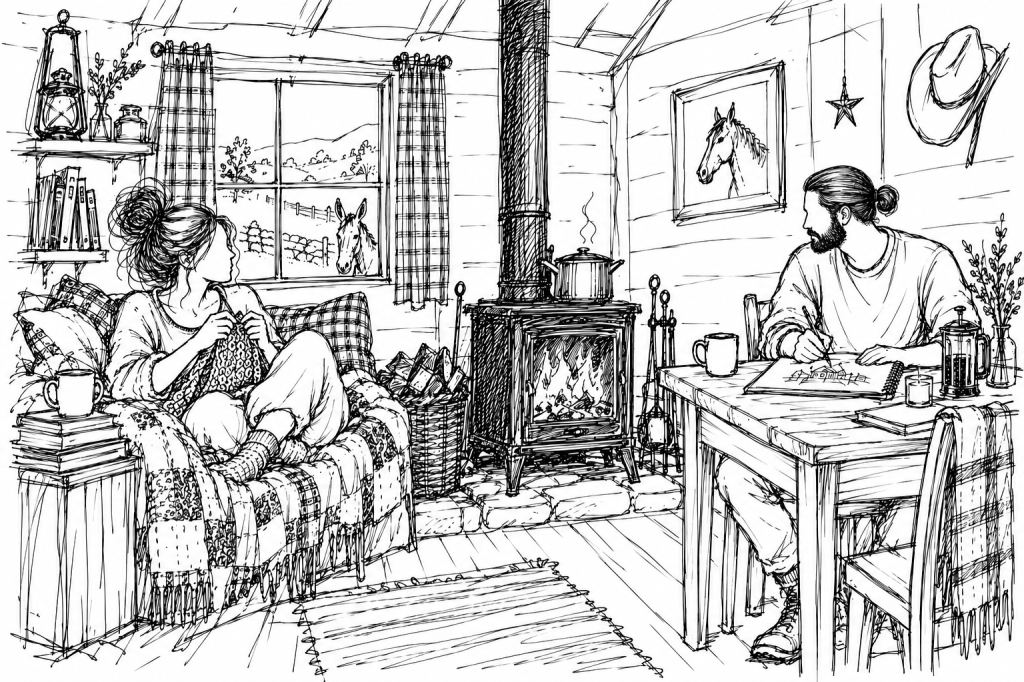
From the outside, the cabin looked slightly like an oversized shed. Inside, though, it was gorgeous.
There was a double bedroom, a shower room and a small main living space with a dining area, a basic kitchen and a large stove for heating and cooking. Tucked away to one side was a cosy nook with a sofa, armchair and television.
It was decorated with gingham and patchwork fabrics, pictures of horses and bits of cowboy paraphernalia.
We were miles from almost everything.
The owners lived in the large house nearby and had donkeys, horses, chickens, geese and dogs wandering around the property.
There wasn’t actually very much to do.
And I loved it.
Some days I crocheted for hours. Other days I read.
Before we arrived, I had announced to Stephen that I was going to use the holiday time to reorganise my life. Since starting my new job, the housekeeping at home had deteriorated, my diet had become terrible and I spent far too much of my spare time lying in bed recovering.
I intended to make lists and plans and somehow return home as a completely reorganised woman.
I never really got around to it.
Stephen remained annoyed with me for a long time that I hadn’t fulfilled the promise.
But I was enjoying myself too much.
Instead, I crocheted, read and cooked.
I particularly loved making our meals. The nearest little shop was around twenty-five minutes away, so I took enormous pleasure in creating comforting dinners from whatever we could find, using only a handful of utensils and the stove.
There was something immensely satisfying about feeding the two of us in that tiny kitchen.
Every evening we settled down and watched a film on the DVD player.
It reinforced something I had suspected for years.
I didn’t need a huge house or an impressive lifestyle to be happy.
Give me somewhere cosy, some books, my crochet, a kitchen, a fire and someone I loved, and I could imagine being perfectly content.
It made the future Stephen and I had talked about feel almost tangible.
Stephen seemed to enjoy it too, although I noticed that when I disappeared into a book or my crochet, he sometimes seemed at a loose end.
He didn’t settle into inactivity in quite the same way I did.
For a moment, it concerned me.
If we really did create a quieter life somewhere one day, would Stephen actually be happy living it?
He reassured me that it would be different if the place belonged to us. There would always be jobs to do, things to repair, projects to build and land or a property to maintain.
That made sense.
My concern disappeared almost as quickly as it had arrived.
There was another moment during the holiday that was harder to dismiss.
During our recent conversations about sex and relationships, Stephen had told me that he wished I would sometimes simply take charge and initiate things.
I was surprised because I had always thought I did my fair share of initiating intimacy. Earlier in our relationship I had sometimes deliberately created occasions where I was completely in charge.
Perhaps I had done less of that since starting the new job.
That I could believe.
Most evenings I barely had enough physical or mental energy left for myself, let alone anything else.
So one evening at the cabin, I decided to make the effort.
I set everything up beside the fire and took the initiative.
Almost immediately, something felt different.
Stephen wasn’t responding with his usual enthusiasm and eventually he couldn’t perform.
What followed became our first major argument during — and about — sex.
That upset me almost as much as the problem itself.
Sex had always been one of the places where Stephen and I communicated beautifully. The conversations afterwards could sometimes feel almost as intimate and important as the sex itself.
Now we were abandoning the whole thing and arguing.
I felt rejected.
He had asked me to initiate more. I had taken what felt like a small emotional risk by doing exactly that, only to find myself wondering why he didn’t seem to want me when I did.
It left a black mark on an otherwise wonderful holiday, but it didn’t define it.
And there was something else that reassured me.
Stephen began making notes about the cabin. He drew little plans and thought about how he might design something similar for us one day.
Whatever difficulties existed between us, I looked at those drawings and saw evidence that he hadn’t lost sight of our future either.
To be continued…
Reflection
Looking back, I think this was one of the periods when it was easiest to believe that Stephen and I had finally become an ordinary couple. There were no enormous crises. We worked, worried about money, got tired, argued occasionally and looked forward to holidays. After everything we had already survived, there was something reassuring about the mundanity of it. I didn’t need our relationship to be extraordinary anymore. I wanted it to be dependable.
There were difficult conversations, but even those seemed to demonstrate progress. Stephen was telling me things I might once have feared he would keep to himself: his curiosity about other sexual experiences, the women he met while he was away, the thoughts that unsettled him. Because we had placed so much importance on honesty after the programme, I interpreted disclosure as safety. I believed that if Stephen could tell me something uncomfortable, I didn’t need to fear what he wasn’t telling me. His honesty became one of the reasons I trusted him.
What I didn’t fully appreciate was how much energy I was spending turning uncertainty into reassurance. Stephen wondered whether he had missed out sexually, but returned from Scotland talking about the emptiness of transient connections. He met interesting women, but told me about them. He seemed restless at the cabin, but explained that a home of our own would be different. We struggled sexually, but he was simultaneously drawing plans for our future. Whenever something unsettled me, there seemed to be something else nearby that allowed me to settle again.
The cabin probably revealed more about me than I realised at the time. Stripped of work, commuting, money and all the complications of ordinary life, what I wanted was remarkably simple. Somewhere warm. Something to cook. Books and crochet. A person I loved beside me. I had spent years imagining a future with Stephen, but sitting in that tiny cabin I could almost touch it. His drawings seemed to tell me he could see it too.
Perhaps that was why the argument about sex hurt so much. It wasn’t simply that Stephen couldn’t perform. I had responded to something he said he needed from me and made myself vulnerable, only to feel rejected when I did. After his questions about other women, other experiences and other ways of having relationships, it inevitably touched the insecurity that had already begun growing in me. For the first time, something that had always made me feel particularly connected to Stephen became another place where I could wonder whether I was enough.
And yet I came home remembering that holiday as one of our happiest. I think that’s important. The difficult moments weren’t hidden from me; they simply existed alongside genuine happiness. There was always enough love, companionship and evidence of a shared future to prevent any single concern from becoming the whole story. Our life didn’t feel as though it was falling apart. It felt ordinary. I hadn’t yet understood how much uncertainty can live inside an ordinary life without disturbing its surface.


