Planning To Meet Stephen (REFLECTION)

When I look back at those Christmas Day conversations, one question stands out more clearly than any other.

Why me?

It wasn’t false modesty.

I knew I had things to offer. I was intelligent, independent, loving and capable of being great fun. I wasn’t sitting there believing myself unworthy of someone’s attention.

But Stephen was younger than me, extremely attractive to me, funny, intelligent and intensely enthusiastic. We hadn’t even met, yet he already seemed remarkably certain about the potential between us.

I wasn’t certain at all.

That difference matters.

There is a version of this story in which I was swept unquestioningly into an intense new romance because I desperately wanted to be loved.

That isn’t what happened.

I questioned him.

I questioned myself.

I questioned the speed.

I reminded Stephen that however extraordinary our conversations felt, we hadn’t actually stood in front of each other yet. Digital chemistry was not physical chemistry. Either one of us might take one look at the other and realise that whatever had existed through a screen simply wasn’t there in person.

Stephen seemed far less troubled by that possibility than I was.

Why?

I still can’t know.

Perhaps he was simply confident in what he felt. Perhaps attraction worked differently for him. Perhaps he was caught up in exactly the same excitement I was, only without my instinct to keep one foot on the brake.

Or perhaps Stephen had a tendency to become certain about things emotionally before reality had been given enough time to test them.

That possibility wouldn’t have occurred to me then.

What did occur to me was that he might be a player.

I find that interesting now because it tells me my instincts weren’t asleep.

Something about the intensity had registered.

I was attracted to it, certainly. I loved waking up to his messages. I loved that he wanted to speak to me on Christmas Day when I had assumed I’d barely hear from him. His attention made me feel special.

But another part of me was standing slightly outside the excitement, watching.

What does he want?

Why is he so interested?

Is this real?

I even formed two competing versions of him in my mind.

In one, Stephen was sophisticated enough to know exactly how charming he was and was perhaps using that charm to get what he wanted.

In the other, he was almost the opposite: a slightly naïve, romantic man who desperately wanted connection and had finally encountered somebody willing to reciprocate his enthusiasm.

I preferred the second explanation.

Perhaps unsurprisingly, it was also the explanation that fitted most comfortably with what I was beginning to feel.

Psychology sometimes describes this as motivated reasoning: we don’t necessarily ignore uncomfortable information, but our hopes can influence which explanation feels most convincing when several are possible.

That doesn’t mean the explanation was wrong.

Stephen may genuinely have been excited. I believe he probably was.

Those two versions of him might not even have been mutually exclusive. Human beings rarely divide neatly into innocent and calculating, sincere and selfish, confident and insecure. Stephen could be remarkably perceptive in some situations and strikingly naïve in others. He could understand the effect he had on people without necessarily understanding himself.

I was only beginning to discover those contradictions.

Something else happened that Christmas Day that would become important to me.

I showed Stephen an insecurity.

I told him I was conscious of being older. I’d had children. My body carried evidence of the life I’d lived, and I knew he could potentially choose somebody younger.

He didn’t dismiss my fear impatiently.

He reassured me.

Age was only a number. Attraction wasn’t simply about appearance. Beauty was only skin deep. His previous relationships seemed to support what he was telling me.

I believed him.

Why wouldn’t I?

There is a particular intimacy in revealing something you’re insecure about and having another person respond in exactly the way you need.

It doesn’t merely make you feel attractive.

It makes you feel safe being imperfect.

That was enormously appealing to me.

I don’t think Stephen necessarily understood the significance of what he was giving me in those conversations. I certainly don’t think every reassurance should now be reinterpreted as some calculated attempt to gain my trust. He may simply have meant what he said.

People can mean things when they say them and still struggle to live consistently by them later.

That distinction would eventually become very important to me.

But on Christmas Day, his words gave me another piece of evidence.

The unemployed man had confessed the lie about his occupation.

The man with a significant mental health diagnosis had told me about it almost immediately.

The younger man I worried might judge my ageing body was telling me that appearance wasn’t particularly important to him.

And the man I worried might disappear once Christmas arrived was messaging me throughout the day.

Every concern I raised seemed to meet a reassuring answer.

So my caution didn’t disappear.

It simply kept being satisfied.

That is different.

I sometimes wonder what Stephen was discovering about me at exactly the same time.

Perhaps he was learning that I would ask difficult questions rather than pretending not to have them.

Perhaps he was discovering that vulnerability didn’t frighten me.

Perhaps my willingness to listen made him feel unusually accepted.

And perhaps that acceptance intensified something in him too.

We were both receiving something.

I was beginning to feel desired without having to pretend to be younger, less complicated or physically perfect.

Stephen, perhaps, was beginning to feel that he could reveal imperfect parts of himself without immediately being rejected.

If that was happening, it isn’t difficult to understand why the connection accelerated.

We hadn’t met, yet intimacy was already being created.

Not physical intimacy.

Something potentially more powerful.

The feeling of being seen and still wanted.

And then we made our plan for the lake.

There is something wonderfully innocent to me about it now: two people beginning at opposite sides and walking towards one another, excited about the moment when they would finally meet.

Neither of us knew exactly where on the path that would happen.

We simply started walking.

Perhaps that’s why the memory has stayed so vivid.

At the time, the uncertainty was part of the romance.

I had no idea how much of loving Stephen would eventually involve walking towards something without knowing what I would find when I got there.
Planning To Meet Stephen

It’s Christmas Day 2020, and we’re back in lockdown because of Covid-19. We’re encouraged to stay within our bubbles, so I’m heading down to southeast London to spend Christmas with my parents for a couple of days.

I don’t expect to hear much from Stephen.

It’s Christmas, after all. I assume he’ll be occupied with his own family, and it’s been my experience that people tend to become consumed by the demands of an important holiday.

But as I’m getting ready to leave, my phone starts lighting up.

It’s Stephen.

I’m surprised, but I’m also rather flattered.

Since he first replied to my initial message, I’ve been quietly questioning his motivation for connecting with me. Is he a player? Is he simply looking for sex? Is he a fantasist who has become caught up in the excitement of a new connection?

I don’t know.

What I do know is that he seems genuinely enthusiastic about getting to know me, and he’s already talking with considerable excitement about the potential between us.

It’s exciting, but it’s also moving faster than I’m comfortable with.

So I try to rein it in.

I tell him that although we’re getting on remarkably well, we have to remember that we haven’t actually met. Once we are standing in front of each other, everything could change. We might discover that the chemistry we’ve felt through our messages simply isn’t there in person.

Stephen doesn’t seem particularly concerned.

He tells me he doesn’t think that will happen.

I find his confidence both flattering and slightly bewildering.

I’m conscious of the age difference, too. I’m an older woman. I’ve had two children. I know that, if Stephen wanted to, he could potentially be dating someone younger than me.

I tell him as much.

His response is reassuring.

He tells me that his attraction to women isn’t simply about physical appearance. Age is just a number. Beauty is only skin deep.

I find his attitude incredibly encouraging.

He tells me that both of his previous girlfriends were older than him, and with that new information, I start to wonder whether perhaps he simply has a preference for older women.

Maybe I’m worrying unnecessarily.

He even tells me more about one of his former girlfriends, describing her as a very large woman who had significant scarring.

I find myself reassured by this.

It suggests that Stephen isn’t looking for some particular physical ideal. Perhaps I don’t need to be self-conscious about my age or the changes my body has gone through after having children.

For the first time in a long while, I’m talking to a man who seems to be telling me that those things don’t matter.

And I like hearing that.

Our messages continue throughout Christmas Day.

That surprises me, too.

I’d expected the conversation to naturally quieten while we both got on with our families and Christmas celebrations, but Stephen seems keen to keep me updated about what he’s doing and equally interested in what I’m doing.

I like it.

There’s something lovely about being connected to someone on Christmas Day, even though we’ve never met. It gives me the strange feeling that, in some small way, we’re sharing the day together.

At one point, he sends me a video of his torso wearing a Christmas jumper.

Across it is the familiar quote from Home Alone:

“Keep the change, you filthy animal.”

I laugh.

I like the fact that he’s willing to send me something so silly and self-deprecating rather than trying to present himself as impossibly cool or sophisticated.

And, if I’m honest, I also notice that he has a good physique.

There is definitely an attraction developing.

But alongside the excitement, that little question in the back of my mind refuses to disappear.

Why me?

Why is this man so interested in me?

I find myself considering two possibilities.

Either Stephen is a very clever man who knows exactly what he’s doing and exactly how to get what he wants…

Or he’s a rather naïve man who simply hasn’t yet experienced the kind of love and reciprocation he’s looking for.

I don’t know which it is.

Perhaps, I think, I’ll find out when we meet.

By now, the idea of meeting has become something we’re both genuinely excited about.

We make arrangements for 27 December.

It will be our opportunity to discover whether the chemistry we’ve been feeling through our messages actually exists when we’re standing in front of each other.

Covid and the restrictions around Christmas mean we can’t simply meet in a café or go somewhere for a drink. So we come up with something that feels almost wonderfully romantic in its simplicity.

There’s a park with a lake close to Stephen’s home.

We’ll meet there.

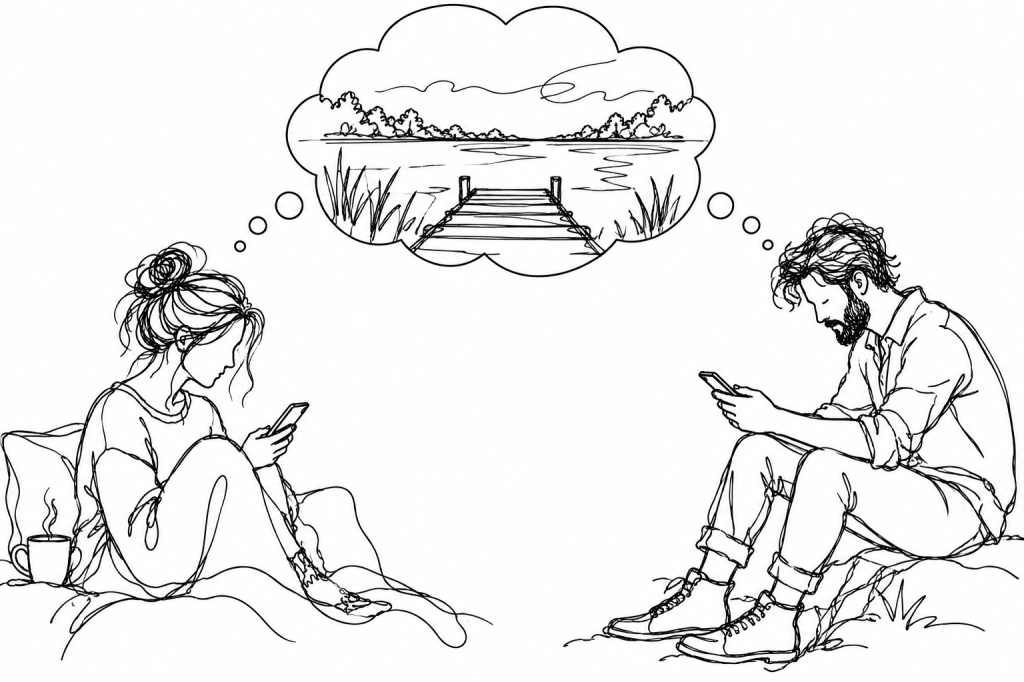
The plan is to start at different points and walk around the lake in opposite directions until we eventually meet somewhere along the path.

Then we’ll see what happens.

It’s such an unusual way to meet someone for the first time that I find myself rather charmed by it.

There is something playful about the whole thing.

And I like that.

Stephen seems romantic, just as I am, and already there is a sense that we could have a lot of fun together.

For now, that’s enough.

Christmas Day is coming to an end, and tomorrow I’ll be one day closer to finding out whether the man I’ve been talking to so intensely really is the man I’ve imagined him to be.

Getting To Know Stephen (REFLECTION)

There is an uncomfortable irony in the fact that one of the first significant things Stephen ever told me was that something he had already told me wasn’t true.

He wasn’t a property developer.

He was unemployed.

On paper, perhaps that should have mattered more than it did. Stability was one of the things I was actively looking for, and financial and employment insecurity were things I specifically hoped not to carry into another relationship.

Yet I didn’t experience Stephen’s confession primarily as dishonesty.

I experienced it as honesty.

That distinction interests me now.

He hadn’t been caught. I hadn’t challenged him. He volunteered the truth almost immediately and gave me an explanation I could understand. Dating profiles are advertisements of sorts, and unemployment isn’t something many people would enthusiastically offer as their opening line. Property development was something he aspired to do. He had simply presented the man he hoped to become as though he already existed.

I could understand the insecurity behind that.

Perhaps because I could understand it, the confession actually reassured me. Someone determined to deceive me, I reasoned, would surely have maintained the lie.

Stephen hadn’t.

So instead of thinking, This man has lied to me, I found myself thinking, This man is willing to tell me uncomfortable truths.

And throughout that day, he appeared to keep proving it.

He told me about his previous relationship without turning his ex-partner into someone I needed to dislike. He told me he had EUPD. He hinted at childhood trauma without using it to demand sympathy or revealing details I hadn’t earned the right to hear.

None of those things felt manipulative to me.

They felt vulnerable.

I wonder sometimes what that conversation felt like from Stephen’s side.

Perhaps telling me about his diagnosis so quickly was simply openness. Perhaps he had learned that it was better to disclose it early rather than risk somebody discovering it later and feeling misled. Perhaps there was also an element of testing involved: Here are the less straightforward parts of me. Are you still interested?

I can’t know.

What I do know is that I stayed.

More than that, I remained fascinated.

And perhaps Stephen learned something about me that day too.

He learned that difficult information didn’t automatically frighten me away.

At the time, I would have considered that a good thing.

I still do, in many ways.

I don’t believe a mental health diagnosis should disqualify somebody from being loved, nor do I think childhood trauma makes someone inherently dangerous or incapable of a healthy relationship. If anything, Stephen’s willingness to name his difficulties suggested to me that he had some understanding of himself.

What I didn’t yet appreciate was the enormous distance that can exist between knowing something about yourself and being able to manage it.

A diagnosis is a description, not an explanation for every behaviour that follows. And self-awareness, however valuable, doesn’t automatically create self-regulation, accountability or change.

But those were distinctions I had no reason to be making on Christmas Eve.

I was simply listening to a man tell me about himself.

And I liked what his openness seemed to say about him.

There was something else happening between us that was much less intellectual.

I was becoming intensely attracted to him.

His voice changed things.

Until then I had been responding to photographs and words, but suddenly there was tone, rhythm, laughter and personality. The giggle particularly disarmed me. There was something unexpectedly boyish about it, something that seemed at odds with the handsome, confident man in the photographs.

I found that contrast incredibly appealing.

Perhaps it also awakened something very familiar in me: tenderness.

I had always been drawn to complexity in people. Strength didn’t interest me nearly as much when it stood alone. Stephen seemed to possess confidence and vulnerability simultaneously. There appeared to be a capable adult and something softer underneath him.

I wanted to know both.

And already we were talking about dreams.

His woodland. My home.

Neither of us was proposing that we build those things together. We had known each other for barely a day. But when two people are strongly attracted to each other, similarities can begin to feel disproportionately meaningful.

There is a psychological phenomenon called confirmation bias: once we begin hoping something might be true, we naturally notice information that supports that possibility.

I wasn’t planning a future with Stephen.

But I was beginning to notice how easily he might fit into one.

The differences hadn’t disappeared. I was still conscious of his unemployment. I knew EUPD could potentially make a relationship more complicated. And somewhere in the conversation sat that first small lie.

But beside those things were intelligence, humour, attraction, vulnerability, apparent self-awareness and dreams that didn’t seem incompatible with mine.

The balance felt overwhelmingly positive.

And perhaps that is one of the things hindsight can distort most cruelly.

Once we know that something eventually hurt us, we can become obsessed with identifying the point at which we should have recognised the danger. We turn ordinary decisions into evidence against our former selves.

I don’t think that’s fair.

I noticed the lie.

I noticed the diagnosis.

I considered them.

Then I made a judgement based on the person Stephen appeared to be and the information available to me.

What I couldn’t know was which pieces of information would eventually matter.

Nor could I know that one of the qualities I was beginning to admire most in Stephen — his apparent willingness to tell me uncomfortable truths — would become far more complicated for me to understand.

For now, honesty seemed simple.

You told someone the truth.

They listened.

And if the truth was difficult, perhaps accepting it was one of the ways you showed someone that they were safe with you.

I had no idea how often, in the years ahead, I would find myself trying to work out where understanding another person should end and protecting myself should begin.

Getting To Know Stephen

Christmas Eve 2020 was the busiest day of my working year. Normally, it would have been impossible to give anything else much attention, with important tasks to complete and an impossible long list of things that needed doing before Christmas could properly begin. 

But somehow, Stephen and I managed to keep talking all day.

Messages flew back and forth between us whenever I had a spare moment. Each one seemed to open another door into the other’s life, and beneath the practicalities of my busy day, we were quietly assessing the chemistry between us.

There was definitely a spark.

Our communication seemed to work effortlessly. We shared a similar sense of humour and enjoyed playing with ideas, and the more we talked, the more common ground we discovered. We were beginning to recognise similarities in our pasts, but perhaps more excitingly, we were discovering that some of our hopes for the future weren’t so different either.

It was during those conversations that I learned my first surprising fact about Stephen.

He wasn’t actually a property developer.

He confessed that he had listed it on his dating profile because, although property development was something he aspired to, it sounded considerably better than putting ‘unemployed’ on his profile.

It was, technically, a lie.

It raised an eyebrow.

But I also appreciated that he had told me himself, rather than allowing me to continue believing something that wasn’t true. He was remarkably open about other aspects of his life, and I could understand the embarrassment behind wanting to present yourself in a better light when entering the dating world. I decided not to make too much of it.

There were more important things I was discovering about him.

Stephen spoke warmly about his previous girlfriend, describing her as a lovely and kind woman but explaining that, despite those qualities, he couldn’t see a future with her.

I remember finding that refreshing.

There was something reassuring about hearing a man speak kindly about an ex-partner rather than dismissing her or turning her into the villain of his story. It suggested a degree of maturity and compassion that I found attractive.

Then Stephen told me something else.

He had EUPD — Emotionally Unstable Personality Disorder.

He suggested that it had developed as a consequence of something traumatic during his childhood, although he didn’t tell me what had happened. I didn’t push him. We’d only known each other for a day, and there were some things that I felt belonged to a later conversation, if and when we got to know each other properly.

I listened carefully, though.

I was aware enough to understand that entering a relationship with someone who had a significant mental health diagnosis could bring its own complexities. I wondered what it might mean for him, and potentially for me, if our relationship developed.

But at that point, what stood out more strongly than the diagnosis was his apparent openness about it.

He seemed self-aware. He wasn’t hiding it or pretending that everything in his life had always been straightforward. There was something quite compelling about that honesty.

I suspected that whatever had happened in his childhood had been serious, possibly involving abuse, but I didn’t need to know everything immediately.

There was plenty about Stephen that I found fascinating already.

My curiosity about him was stronger than my reservations.

We talked about the sort of lives we imagined having one day. Stephen dreamed of owning some woodland and creating a self-sufficient life for himself. I had rather more modest ambitions.

I simply wanted a lovely home to come back to after a day’s work.

Somewhere I could feel safe. Somewhere I could feel secure. Somewhere I could build a happy life.

When we talked about it, neither dream seemed incompatible with the other.

In fact, they seemed as though they might fit surprisingly well.

It was far too soon to be imagining a future with a man I’d met on a dating app only the day before, and I was perfectly aware of that.

But it was difficult not to entertain the possibility.

Something exciting and, perhaps, surprisingly realistic seemed to be taking shape.

That evening, I think we had our first telephone conversation.

Until then, Stephen had existed as words on a screen and a handful of photographs. Suddenly, there was a voice attached to him.

I loved it instantly.

It was quite low and textured, with a slightly silky quality that I found incredibly attractive. There was something almost contradictory about the way he spoke — occasionally quite polished and almost posh, then suddenly dropping into much more ordinary, familiar pronunciations.

And when I made him laugh, he would giggle.

Not a restrained, self-conscious laugh, but something much more childlike and spontaneous.

I found it adorable.

Hearing his voice made the attraction I’d already felt through our messages grow stronger. There was something about Stephen that seemed to combine confidence with an almost boyish naivety, and I found the combination irresistible.

It was Christmas Eve.

The timing somehow made everything feel even more exciting. There was something wonderfully surreal about being on the threshold of Christmas, surrounded by all the usual preparations, while at the same time beginning something completely unexpected with a man I’d only just met.

I was already pretty hooked.

I wanted to know more about him. I wanted to hear his voice again. I wanted to see where this extraordinary conversation might lead.

But I also knew that the next couple of days would probably put everything temporarily on hold.

Christmas was here.

For the moment, I had to put my phone down, finish my work and get on with the festivities.

I had no idea then that the conversation I’d started just a few days earlier would become the beginning of a relationship that would change my life.

For now, it was simply Christmas Eve, and I was excited about a man I had only just met.

The Beginning (REFLECTION)

When I think about the woman who opened that message now, I don’t think of her as vulnerable in the way the word is often used. I wasn’t broken, desperate or searching for somebody to rescue me. I had already survived the ending of a long relationship and, although I was lonely, I was looking forward.

I wanted love again.

Perhaps more importantly, I still believed I was good at it.

I thought patience was one of my strengths. I was proud of my capacity to understand another person, to forgive mistakes, to work through difficulties rather than walking away from them. Fifteen years in a mostly loving relationship had taught me that lasting love wasn’t something that simply happened to you. It required compromise, generosity and the willingness to remain curious about another person’s experience.

Those were qualities I valued in myself.

I couldn’t have known then that our greatest strengths can become complicated things when they meet the wrong circumstances. Patience can sometimes keep us waiting long after something has begun to hurt. Empathy can encourage us to search for explanations when perhaps we should be looking more closely at behaviour. Forgiveness can be beautiful, but without change on the other side of it, it can become permission to try again.

I knew none of that when Stephen appeared on my screen.

I chose to call him by his full name because he just didn’t seem like a Steve to me

What I did know was that I wanted something different from what I had just left behind. I wanted companionship and excitement, but I also wanted security. I wanted someone settled. Someone who knew what he wanted. Someone with whom I wouldn’t have to struggle quite so hard to build an ordinary life.

And before Stephen had written a single word to me, I had already begun constructing a version of him.

It wasn’t foolish. We all do it.

A handful of photographs and a dating profile can only provide fragments, so the mind supplies the rest. I saw intelligence, humour and adventure. I saw someone attractive and interesting. I saw a property developer and translated that into independence and stability. I imagined yoga and healthy food from photographs that had never actually promised me either.

Psychologists sometimes talk about projection in much more complicated circumstances, but there is an ordinary version of it too. When information is incomplete, we fill the spaces with our own expectations, preferences and hopes.

Stephen was doing exactly the same thing with me.

I sometimes wonder what he imagined when he looked at my photographs.

What did he think I might offer him?

Perhaps he simply thought I was attractive and interesting. Perhaps, after his own experiences, he was lonely too. Perhaps there was something about my warmth or enthusiasm that felt particularly inviting. Perhaps neither of us was doing anything more psychologically interesting than two single people becoming unexpectedly excited about each other.

I don’t want hindsight to steal that possibility from us.

Because something genuine happened during those first conversations. Whatever difficulties came later, I don’t believe the connection I felt existed only in my imagination. We were fascinated by each other. We made each other laugh. We wanted to know more.

And there is something intoxicating about being wanted by somebody you had already decided was unlikely to want you.

Only days earlier, dating had left me wondering whether I was attractive enough, interesting enough, perhaps simply enough. Then the man I considered least likely to respond wasn’t merely interested; he seemed exceptionally interested.

Of course that affected me.

His attention didn’t manufacture my attraction to him, but it amplified it. After the ambiguity and disappearing acts of the men before him, Stephen’s enthusiasm felt wonderfully uncomplicated.

Here was someone who wasn’t making me guess.

Or so I thought.

Looking back, I’m interested in how quickly we began exchanging pieces of ourselves. There is an intimacy peculiar to meeting online: two strangers can reveal things through a screen that might take considerably longer to emerge across a table. By the time you finally stand in front of each other, you can feel as though you’re meeting somebody you already know.

But knowing about someone and knowing them are very different things.

At that point, neither Stephen nor I could possibly know who the other would become inside a relationship. We knew the stories we told about ourselves. We knew what we hoped for. We knew what attracted us.

Everything else would have to reveal itself slowly.

There is a temptation, knowing what I know now, to return to those first messages searching for clues — to identify the moment when I should have known better.

I don’t want to tell the story that way.

There was no reason for the woman sitting with her phone on 23 December 2020 to know where any of this was going.

She had met an interesting man.

He seemed equally interested in her.

And she was excited.

The things that would eventually become difficult to understand had not happened yet.

For now, there were simply two strangers on opposite sides of a screen, each imagining the person they might have found.

And neither of us yet knew how much those imaginings would matter.

The Beginning

After my previous relationship came to an end, I had grieved its loss.

It had been a long, mostly loving and successful relationship, and although its demise had been shaped largely by the complexities and restrictions of Covid-19, six months later, I was no longer mourning what we had lost. What remained was the loneliness.

I was 47, and although I didn’t feel old, I was conscious that time was moving on. I didn’t want to waste any more of it. I was ready to put myself back out there and see whether love might have another chapter in store for me.

I had always been proud of the love and patience I brought to a relationship. I wanted to find someone who was deserving of those things, but I also wanted something for myself: companionship, comfort, security and someone with whom I could genuinely thrive.

I knew it might take some time, so I initially entertained myself with the idea of dating quite liberally. In my imagination, I would meet men of different ages, backgrounds and occupations, perhaps keeping a little black book of possibilities and choosing who to see depending on my mood.

It didn’t take long to discover that this was completely incompatible with who I am.

The moment I’m genuinely interested in someone romantically, I give them my full attention. I don’t have the inclination, or frankly the mental capacity, to divide my time and energy between several people. I can flirt with the idea of being a serial dater, but in reality I am an all-or-nothing kind of woman.

So I downloaded a respected dating app and began the strange process of assessing strangers from photographs and carefully constructed profiles.

I spoke to a few men and met two of them.

Neither experience was particularly pleasant.

In both cases, there was initially some rapport and chemistry, only for things to become awkward and confusing. I remained consistent, while the men seemed to have sudden changes of heart that they weren’t honest enough to communicate. Instead, I was left trying to decipher mixed messages until, eventually, both disappeared.

Ghosting is a peculiar experience. There is no proper rejection to process, no conversation that allows you to understand what happened. You are simply left with the silence and your own imagination to fill it.

I found I was questioning myself.

Perhaps I wasn’t attractive enough. Perhaps I’d said something wrong. Perhaps I had misread the connection entirely.

My confidence took a knock, and I began to wonder whether I could really be bothered with dating at all.

Then I decided to try one more time.

This time, I broadened my search and started closer to home. One evening, quite late, I saved perhaps ten profiles and opened conversations with five of them.

One of those five immediately caught my attention.

He was the youngest and, in my opinion, the best-looking man I had ever approached on a dating app.

His profile contained only a few photographs, but they were quite different from one another, and together they created an impression of someone who might be intellectual, funny and outdoorsy. He appeared to be mixed-race, and there was certainly something about his look that I found very attractive.

As I studied the photographs, I found myself filling in the gaps, imagining the sort of person he might be. I wondered whether he might be interested in yoga and healthy eating, both things I was keen to bring more of into my own life. His profile was funny and intelligent, and I remember thinking that this was someone I could probably have really interesting conversations with.

He was also a property developer.

That was less important to me than the other things I’d noticed, but it was certainly a bonus. After the financial and employment insecurities I’d experienced in my previous relationship, the idea of meeting someone grounded and financially independent was appealing.

And then there was the practical advantage.

He lived less than five miles away.

No more long, nervous journeys to meet someone who might ultimately give me the cold shoulder.

Of all the men I messaged that night, though, he was the one I considered least likely to respond.

In my mind, he was out of my league.

So when I opened the app the following morning and saw that he had replied, I was pleasantly surprised.

His name was Steve. He was 42.

And he hadn’t simply sent a polite response.

He had written me a long, personal message.

It was thoughtful, well written and full of interest and enthusiasm. There was something immediately different about it. On the surface, it felt genuine and promising.

I was still cautious.

My recent experiences had taught me that early attention didn’t necessarily mean anything. I knew how easily charm and enthusiasm could be used to create attraction, and I was wary of men who might say whatever was necessary to get a woman into bed.

So I kept my guard up, but I also kept an open mind.

It was the 23rd of December 2020.

By the end of that day, Steve and I couldn’t stop messaging each other.

The conversation flowed almost effortlessly. We talked about our pasts, our lives as they were, and the things we hoped for in the future. We discovered shared interests and a mutual curiosity about one another. We made each other laugh.

There was an ease to it.

Our intellects seemed to match, and there was just enough flirting to create a spark without either of us feeling uncomfortable. We were curious about each other, but neither seemed in a hurry to force anything.

It was only days before Christmas, and we were both busy with preparations, yet somehow that didn’t stop us.

The messages continued late into the night.

I had no idea then where that conversation would lead.

I simply knew that, after a few disappointing attempts to find someone, I had finally met a man who had made me want to keep talking.

And for the first time in a while, I was excited to see what might happen next.