
In the new year, once Stephen’s new employers had returned from their holiday, we officially moved into the flat.
It was a one-bedroom apartment attached to the main house, with a large bathroom and an open-plan kitchen and living area. We arrived with only a couple of bags each — enough clothes for the working week, toiletries, towels and the other bits and pieces we thought we would need.
It was supposed to be the beginning of our new life.
Almost immediately, though, I was surprised by the state the flat had been left in.
The kitchen and bathroom appeared to have been cleaned only superficially and the bedding was stained. Considering how immaculate the main house was, I couldn’t understand why the same standards hadn’t extended to the place they were giving us to live.
Stephen mentioned it to his employers and they seemed surprised. Their cleaner had apparently cleaned it.
Perhaps she had, but not particularly well.
Still, it wasn’t a major problem. We could sort it out.
We began making lists of everything we needed. There were some kitchen utensils and equipment, but nowhere near enough to cook properly five nights a week, so we found the nearest supermarket and gradually started stocking the cupboards. We bought some nice decorative things to give the flat a personal touch.
That part I enjoyed.
Cooking and eating together had always been one of the simple pleasures of our relationship, and this felt like an opportunity to establish some healthier routines. We planned meals, shopped for them and cooked together.
Our working hours were much more aligned now too. I could get up and make us a decent breakfast before Stephen left for work, usually about an hour before I needed to leave for mine.
His first few days seemed to go well.
He learned how to service the swimming pool, familiarised himself with the extensive grounds and outbuildings and began walking the family’s three dogs. He would come back at the end of the day enthusiastic, pleased with what he had accomplished and full of stories about what he had been doing.
For a while, it really did seem as though everything might be falling into place.
The village itself was beautiful. Quiet and picturesque, with a couple of pubs but no shops, it felt a world away from the life we had been living before.
My own commute was only around twenty minutes, mostly through lovely country lanes.
Stephen’s solicitor had also been corresponding with his brother for several months about the house they jointly owned, and it was beginning to look increasingly likely that his brother would buy Stephen out. If that happened, Stephen would receive his half of the property’s value.
Suddenly there were possibilities.
If the job worked out and we continued enjoying the area, perhaps we could even buy somewhere nearby.
At weekends, we returned to my house. Stephen’s youngest son still stayed with us on his weekends and we continued taking him to tennis.
On paper, there was a great deal to feel hopeful about.
But as the first few weeks passed, something began to change.
Stephen became increasingly up and down.
Some evenings I would come home to the Stephen who had been there at the beginning — proud of what he’d achieved, enthusiastic about the estate and pleased with himself.
Other evenings I came home to someone completely different.
He would be despondent, pessimistic and anxious.
Part of it was his eldest son. It had now been around a year since they had properly spoken, with no clear explanation beyond his son apparently not wanting contact with his dad. The longer it continued, the more it seemed to weigh on Stephen.
But I was also becoming concerned about his relationship with his employer.
I watched the two of them together and listened carefully to the things Stephen told me about his working day, and my intuition was telling me they weren’t particularly well matched.
His boss was cut from a very different cloth. A farmer’s son, former athlete and very much a man’s man, he was physically and mentally robust, always moving quickly and frequently firing instructions at Stephen from several directions at once.
Stephen was strong too, but in a different way. He was sensitive and more easy-going. He liked to take his time over things and do them properly. He worked best when he understood clearly what was expected of him.
Here, the instructions sometimes changed. Stephen felt micromanaged. If something wasn’t completed quickly enough, or wasn’t done in exactly the way his boss expected, the frustration was obvious.
I felt sorry for him.
Having known Stephen for years, I could see how hard he was trying. In many ways, I thought he was performing better than I had ever seen him perform before.
But somewhere underneath my encouragement was a growing worry.
I wasn’t sure it was going to be enough for these people.
And increasingly, at the end of my own working day, I didn’t know which Stephen I would be coming home to.
The flat wasn’t helping.
I discovered that I couldn’t use the washing machine without dirty water backing up into the kitchen sink. Twice the water overflowed onto the floor. Sometimes the opposite happened: clean washing sitting in the machine would become wet and dirty again when water from the kitchen drained back into it.
There were days when I didn’t have clean clothes or even a dry towel.
Stephen reported the problem and his employers replaced the washing machine, but within days exactly the same thing happened. Clearly the problem wasn’t the machine at all but a blockage somewhere further down the plumbing.
Stephen told them.
Nothing happened.
He told them again.
Still nothing happened.
Eventually I started taking our washing back to my house at weekends.
By then, the flat itself was beginning to feel less like an exciting new home and more like somewhere I was trapped.
We could hear the family and their adult children talking and sometimes shouting late into the evening. At the bottom of our stairs was a locked door connecting our accommodation to the main house. Although there was supposed to be separation between the two spaces, occasionally we could hear somebody from the family entering that part of the property.
I began to feel observed.
I didn’t feel entirely at home there.
Strangely, I didn’t feel entirely at home in my own house anymore either.
Every weekend we returned, my son and his girlfriend had been living there without us all week. They were doing nothing wrong — quite the opposite. They were looking after the house and feeding the cat, and I was grateful.
But gradually it began to feel as though Stephen and I were the visitors.
I had somehow ended up belonging properly to neither place.
The days became repetitive.
There wasn’t much to do in the village and very little opportunity for a spontaneous change of scene. In the evenings, after dinner, I began spending more and more time playing the game on my phone.
Initially it had just filled some empty time.
Increasingly, it became somewhere to disappear.
Stephen, meanwhile, was becoming more openly unhappy about work. He loved the grounds, the animals and the practical nature of the job, but he was beginning to say that he was frightened of his boss. His employer could be highly critical and made little effort to disguise his frustration when Stephen hadn’t completed something or had misunderstood what he wanted.
I could understand why Stephen was struggling with him.
At the same time, things with his family were getting worse.
Some days he seemed able to talk about little else but his eldest son. He couldn’t understand why he wouldn’t speak to him and became increasingly emotional and confused about the estrangement.
Then problems developed with his youngest son at school. Eventually his mother reached the point where she felt unable to deal with it alone and asked Stephen to step in.
Stephen asked his employers whether his son could stay with us at the flat for a couple of days.
They agreed.
But by then I had developed an ominous feeling that they were quietly assessing far more than Stephen’s ability to do the work.
I began to wonder whether they were deciding that he wasn’t the right person to employ and have living on their property.
I didn’t know what to do with any of these concerns.
I could feel myself sinking too.
I still loved my own job, but some of my enthusiasm had disappeared. My body was beginning to hurt in ways it hadn’t before. My joints ached. My muscles felt tired. On the worst days, climbing a flight of stairs felt disproportionately difficult.
I was gaining weight.
I was spending more and more time escaping into my phone.
I didn’t feel at home in the flat, yet increasingly I didn’t feel at home in my own house either.
Our physical relationship was suffering too. Intimacy had almost disappeared and sex was becoming uncomfortable and sometimes painful for me.
Then I noticed something that frightened me more than any of the practical problems.
For the first time in our relationship, I sometimes left work and didn’t look forward to seeing Stephen.
There were evenings when I fantasised about driving back to my own house instead. Or going into town alone, wandering around the shops and perhaps having something to eat by myself.
I never actually did it.
But I thought about it.
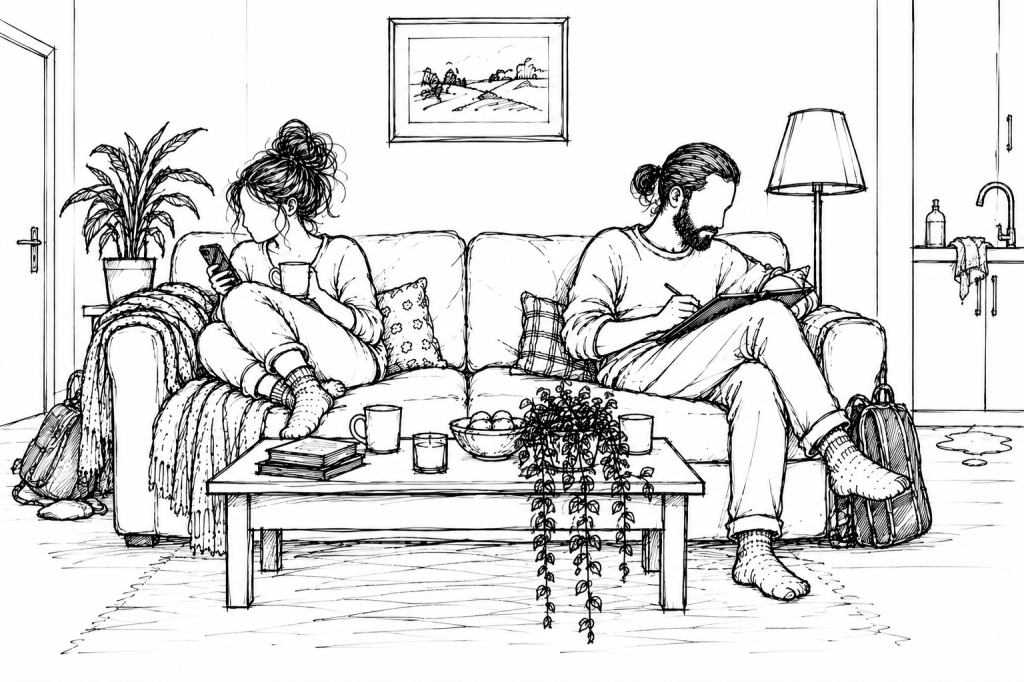
There had always been something about seeing Stephen again at the end of the day that lifted me, even during difficult periods. Now, sometimes, there wasn’t.
Something between us was changing.
The irony was that I had been on the other side of this before.
When I had taken my new job, Stephen hadn’t been happy with what it did to our life together. He had struggled to communicate that to me, and I hadn’t fully understood how deeply unhappy he had become.
Now I was the one struggling to say it.
This was Stephen’s dream job. He had wanted an opportunity like this for so long. I could see how desperately he wanted it to work, and I didn’t want to be the person who told him that the life surrounding it was making me miserable.
So instead of saying, I don’t want this, I kept hoping it would get better.
There were still other futures being imagined too.
With the money from the house likely to arrive soon, Stephen began looking at woodland for sale. He found a small plot in Scotland with a disused building on it and became excited by the idea of turning it into some kind of bunker-style dwelling.
He travelled up alone to see it.
It was extraordinarily difficult to reach. After arriving at the nearest station, he had to walk for miles just to get there. He took videos for me, spent some time exploring the land and eventually began the long walk back.
By then he was exhausted and his body was hurting so badly that he ended up hitching a lift back towards his hotel.
And yet he wanted to buy it.
I couldn’t understand why.
It was in Scotland, inaccessible by car and would require an enormous amount of work. I couldn’t see how we could realistically keep travelling there, let alone undertake the project Stephen imagined.
I suggested he look for something closer to home.
Perhaps that was another small indication of what was happening between us.
We were still talking about the future, but we weren’t always imagining the same one.
Stephen began saying that he had nothing to look forward to. His eldest son wouldn’t speak to him. His youngest was struggling. The job that had initially excited him was becoming a source of anxiety.
So we booked things.
Trips. Events. Things to put on the calendar.
Things to look forward to.
Perhaps I needed them just as much as he did.
Because despite everything that was happening, I still wasn’t thinking about leaving Stephen.
I wasn’t looking at our relationship and concluding that it should end. I was looking at our life and thinking that something had gone badly wrong with it.
I wanted us to find our way out of this strange, constricted period. I wanted Stephen’s job to either improve or lead to something better. I wanted us to find somewhere that felt like home. I wanted my body to feel like mine again. I wanted Stephen to be happier. I wanted to feel happier.
Most of all, I wanted us to get back to being us.
The opportunity that had seemed as though it might open up the world for us had somehow done the opposite. Our lives had become smaller. We were more isolated, more restricted and increasingly retreating into ourselves.
I could feel something between us beginning to come apart.
I just never imagined that the answer would be for us to come apart too.
Reflection
The flat was supposed to give us something we had never really had before: a little life that belonged only to the two of us. For a brief period, it seemed to do exactly that. We cooked together, our working hours aligned and Stephen came home excited by everything he was learning. There were possibilities everywhere I looked — his job, the money from the house, somewhere we might eventually buy, perhaps even the couple’s position we had talked about for years. It felt as though several separate threads of our lives might finally be coming together.
What I hadn’t anticipated was how quickly that sense of possibility could become one of confinement. The flat never really felt like ours. My own house gradually stopped feeling entirely like mine. Stephen became increasingly anxious about his job and his sons, while I became tired, physically uncomfortable and strangely detached from myself. Even the game on my phone, which had begun as a silly way of filling spare time, became somewhere I could retreat when I didn’t particularly want to be present in the life around me.
The most unsettling change was much simpler. Sometimes I didn’t look forward to seeing Stephen. That was new. Whatever had happened between us before, seeing him had almost always brought some kind of emotional lift. Now I occasionally imagined driving somewhere else after work simply to have a few hours alone. I noticed that change in myself, but I didn’t interpret it as wanting to leave him. I thought I wanted to escape the circumstances we had somehow created around us.
Perhaps that was why I found it so difficult to tell Stephen how unhappy I was. I knew what this job represented to him. I had watched him work towards independence for years, and this was the closest he had come to the kind of opportunity we had always hoped he would find. Telling him that I hated living there felt dangerously close to asking him to give it up. So I did what I had done many times before: I waited, adjusted, made plans and looked for ways to improve the situation. We booked things to look forward to. Stephen imagined woodland in Scotland. I imagined somewhere closer to home. We were still talking about a future, although increasingly we weren’t always describing the same one.
I could feel something changing between us, but I still believed the relationship itself was underneath it somewhere, waiting to be recovered. I didn’t think I wanted a life without Stephen. I wanted a different life with him — somewhere we felt at home, where he wasn’t frightened of his employer, where his children were okay, where my body felt better and where we had enough happiness and energy left to find each other again. The life that was supposed to open everything up had somehow made our world smaller. I could see that clearly. What I couldn’t yet imagine was that making it bigger again might eventually mean living it apart.


