
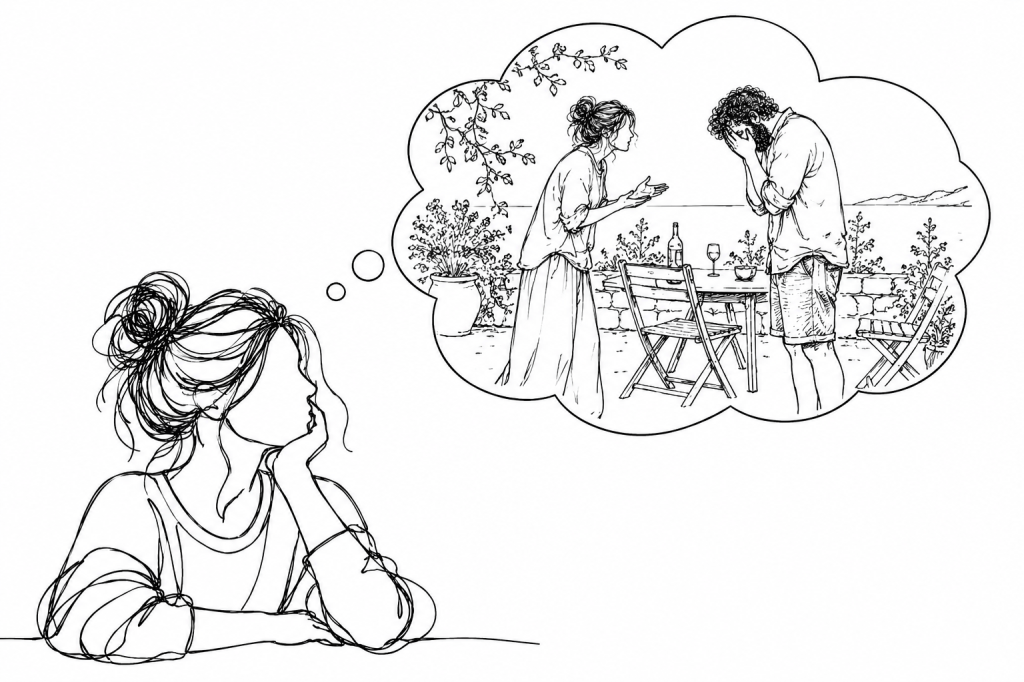
Looking back, I think the deepest pain of Denmark was not simply what Stephen did.
It was what his actions destroyed.
For almost a year, I had been quietly rebuilding my faith in him. After his dismissal, I had made what felt like one of the hardest decisions of our relationship: I had asked him to leave my home. I hadn’t done it because I wanted our relationship to end. I had done it because I desperately wanted it to survive.
I loved him, but I had begun to understand that loving someone did not mean absorbing every consequence of their behaviour. I needed Stephen to stand on his own feet. I needed him to reflect on what had happened. Most of all, I needed to know whether the things that had frightened me during those first eight months were signs of something fundamental in him, or mistakes he was capable of learning from.
The year that followed seemed to give me my answer.
We became happier.
The chaos settled. We travelled, climbed mountains, went to concerts and parties, watched films, spent time with our families and created memories that had nothing to do with crisis or suspicion. Our physical relationship became more relaxed and intimate. Stephen seemed calmer.
I became calmer too.
Gradually, almost imperceptibly, I stopped waiting for something to go wrong.
That mattered enormously.
Because the first rupture had not really come out of nowhere.
Before Stephen’s dismissal there had been a succession of things that had unsettled me: comments, disappearances, blurred boundaries with women, moments when his behaviour hadn’t quite matched the reassurance he gave me. I hadn’t known where those alarm bells were leading, and the eventual complaints at work had shocked me, but looking backwards I could see that something in me had been frightened for some time.
Denmark was different.
There had been no months of escalating unease.
No gathering storm.
No obvious trail of incidents warning me that something enormous was approaching.
Quite the opposite.
We had just lived through what I believed had been one of the happiest and most stable years of our relationship.
That was part of what made Denmark so devastating.
I wasn’t braced for impact.
I had relaxed.
Underneath my happiness there had always been another question: Can I ever really be safe with this man?
For almost a year, the answer seemed to be becoming yes.
I began to believe that perhaps the frightening beginning of our relationship had been exactly that—a beginning. A turbulent period belonging to a man who had been struggling, living unhappily with his father and trying to find his feet after years of mental-health difficulties.
Perhaps asking him to leave had been the turning point.
Perhaps he had grown.
Perhaps we had grown.
And perhaps my own task now was to stop looking backwards.
That was why the moment I noticed his attention towards M mattered, even though nothing had happened yet.
The old sensation returned.
I recognised the slight change in him because I had seen versions of it before: the increased attentiveness, the nervous energy, the peculiar narrowing of his focus when a particular woman interested him.
But it was only a moment.
After almost a year without the kinds of incidents that had once frightened me, there was no obvious reason to believe I was standing at the beginning of another catastrophe.
So this time I did something different.
I questioned myself.
I had spent a year learning not to be frightened. I didn’t want to police where Stephen looked or who he spoke to. I didn’t want every attractive woman to become a threat. I wanted to be secure enough to notice something and let it pass.
At the time, I thought I was learning to trust Stephen.
Looking back, I wonder whether I was also beginning to distrust myself.
There is a psychological concept called self-abandonment. It doesn’t necessarily happen dramatically. Sometimes it begins in tiny moments when we override an instinct because acknowledging it would threaten something we desperately want to preserve.
I don’t think every uncomfortable feeling is intuition, and I certainly don’t believe anxiety should always be obeyed. But there had been enough previous incidents for my unease around Stephen and other women to have a history.
In Denmark, I felt it again.
And I talked myself out of it.
That is one of the things that hurts when I remember that night.
Not because I believe I could have prevented what happened by staying in the conservatory or demanding that Stephen come to bed. For a long time afterwards, my mind tortured me with those possibilities.
Why did I leave them alone?
Why didn’t I insist?
Why didn’t I stop him?
There was a terrible desperation in those questions because they created the illusion that somewhere inside that night there had been a moment I could have controlled.
If only I could find it.
If only I had stayed in the room.
If only I had been firmer.
If only I hadn’t tried so hard to appear trusting.
Perhaps the story would have ended differently.
But those questions placed responsibility in the wrong place.
I should never have needed to guard my relationship by physically remaining in a room.
Stephen knew I was lying in bed waiting for him.
He knew I was uncomfortable when I discovered M in his arms.
He knew I was devastated when I telephoned him.
He knew I was begging him to come back.
And still, at every point where there was an opportunity to turn towards me, he continued moving away.
That was the part I couldn’t reconcile.
Even now, I can see that there may have been more happening inside Stephen that night than simple sexual attraction.
He had recently returned from Scotland emotionally depleted after spending a night supporting a suicidal young man. At the party he appeared to become absorbed in the distress of several members of my family. M was vulnerable, frightened and upset, and Stephen seemed to identify strongly with her pain.
Perhaps being needed by someone activated something powerful in him.
Perhaps rescuing another distressed person gave him a sense of purpose or connection that was difficult for him to step away from. Perhaps M’s vulnerability, his attraction to her and his identification with her became tangled together until he was no longer making clear distinctions between compassion, intimacy, responsibility and desire.
I can wonder about all of that now.
What I cannot do is make those explanations erase the choices he made.
Because I was distressed too.
That is the contradiction at the centre of Denmark that I could never resolve.
Stephen seemed capable of extraordinary sensitivity towards someone he had known for a matter of hours while becoming strangely unreachable to the woman he said he loved.
I was on the telephone crying, pleading and telling him that our relationship was in danger, yet somehow my distress did not summon the same instinct to protect me.
M’s did.
And perhaps that was why his explanation that he had been “looking after her” hurt almost as much as the attempted kiss.
Because I needed looking after too.
I had spent so much of our relationship trying to understand Stephen’s vulnerabilities that I think I had unconsciously developed the belief that if I understood him deeply enough, I could make sense of almost anything.
Denmark confronted me with the limits of that belief.
There was no explanation that could make his refusal to come back feel loving.
There was no psychological insight that could change what it felt like to hear him say “no” while I begged.
There was no account of trauma, emotional exhaustion or feeling overwhelmed that could explain away climbing into my cousin’s bed and trying to kiss her.
And when he told me that I had said we were finished, something inside me sank even further.
Because I knew why I had said it.
I hadn’t calmly ended our relationship and released him from it. I had been desperately trying to stop him from doing something I feared neither of us could undo.
I had wanted the possibility of losing me to matter.
Instead, he seemed able to use my desperation as permission.
There was another painful realisation waiting for me when I asked why he had eventually left M’s flat.
Some part of me wanted to hear that he had suddenly thought of me.
That perhaps, even after everything, love had broken through.
Instead, he told me that M had not wanted things to go any further.
She had drawn the final boundary.
Not him.
I think something changed in me when I heard that.
The frantic questions continued. The tears continued. I continued trying to understand.
But somewhere underneath all that activity was a terrible stillness.
I knew.
I didn’t want to know, and I certainly wasn’t ready to understand what that knowledge meant, but I knew.
Something between us had ended in Denmark.
Perhaps it was innocence.
Perhaps it was the belief that the previous year proved Stephen had changed.
Perhaps it was my confidence that love, patience and understanding could eventually make our relationship safe.
But the relationship we had arrived in Denmark with was gone.
In fact, there was something strangely unspoken about that between us.
We didn’t need a dramatic declaration.
And perhaps that tells me something important about the woman I was then.
For all the ways I would later question my own boundaries, I did know that something unacceptable had happened.
I knew something fundamental had broken.
I knew that love did not automatically mean staying.
What complicated everything was that my love for Stephen had not disappeared simply because my trust had been devastated.
Neither had my concern for him.
That had already become painfully apparent on the morning after the betrayal.
I had changed my flight.
I had packed my suitcase.
I had walked through the darkness towards the station.
For a brief period that morning, however devastated I was, I had chosen myself.
Then Stephen told me he might end his life.
Immediately, his crisis became more important than my heartbreak.
I turned around.
I withdrew money, climbed into a taxi and went looking for him.
I don’t regret responding to someone threatening suicide. I could not have knowingly left him alone in that state. But when I look back at that morning, I can see something larger beginning to take shape.
My pain could wait.
His couldn’t.
My needs could be postponed.
His felt urgent.
Even after a night in which I had felt abandoned by him, I was still able to abandon myself when I believed he needed saving.
And then, sitting on a bench with M later that day, something similar happened again.
I was the betrayed person, yet somehow I found myself comforting her.
Her grief became understandable to me. Her childhood trauma mattered. Her confusion mattered.
Everybody’s pain seemed to have a story behind it.
Including Stephen’s.
I think that was both one of my greatest strengths and one of my greatest vulnerabilities in this relationship.
I could nearly always find my way into somebody else’s experience.
What I was becoming less skilled at doing was remaining inside my own.
My own experience that night was actually very simple.
The man I loved had left me for another woman while I begged him not to.
Everything else came afterwards.
The explanations.
The diagnoses.
The trauma.
The circumstances.
The questions.
The endless search for why.
Perhaps I needed all those layers because the simplest version was unbearable.
I loved Stephen profoundly. That hadn’t disappeared overnight. When we finally returned to my aunt’s house and lay together in bed, I still wanted him to reach for me.
That memory breaks my heart in a different way.
After everything that had happened, I wanted comfort from him.
I wanted his arm around me.
I wanted him to tell me he was sorry.
I wanted somehow to crawl back inside the relationship we had possessed twenty-four hours earlier and close the door behind us.
He didn’t touch me.
And I cried quietly beside him.
There are moments in relationships when the ending happens long before anybody actually leaves.
I didn’t understand that then.
I thought a relationship ended when someone said the words, packed their belongings or walked out of the door.
Now I think some endings are almost silent.
They happen when something essential is lost.
Trust.
Safety.
Hope.
Innocence.
And perhaps the strangest thing is that love can survive all of them.
That was what made Denmark so unbearably sad.
I hadn’t stopped loving Stephen.
I hadn’t suddenly stopped wanting the life I thought we were building.
But wanting something and still believing in it are not quite the same thing.
For almost a year, I had believed the frightening beginning of our relationship was behind us.
Denmark forced me to confront something I had desperately hoped was no longer true: I could love Stephen deeply and still not be safe from being hurt by him.
There was a particular hopelessness in that realisation.
If Denmark had followed months of warning signs, perhaps I could have told myself I had ignored the evidence.
But it hadn’t.
It had followed happiness.
It had followed stability.
It had followed nearly a year in which I had gradually lowered my guard and allowed myself to believe in us again.
That frightened me more than anything.
Because if betrayal could arrive when everything appeared to be going well, what was I supposed to watch for?
How could I protect myself from something I couldn’t see coming?
I think that was the real loss of innocence in Denmark.
Not the discovery that Stephen could hurt me.
I already knew that.
It was the discovery that I might not receive a warning first.
Some part of me remained on that railway platform with my suitcase beside me, watching daylight arrive after a betrayal I had never seen coming.
I had spent the previous year believing I was learning how to trust Stephen again.
Denmark left me wondering whether trust itself had made me vulnerable.
And although I couldn’t possibly have known where our story would go from there, I knew one thing with a certainty that required no words between us.
Whatever happened next, we could never go back to being the people who had arrived in Denmark.


