The time eventually came for me to leave the job I had been in for sixteen years.
I was ready to go, but that didn’t make leaving easy.
I had first met my employers when I was working part-time as a cleaner for a friend’s cleaning company. They were among our regular clients and also among our favourites, largely because they allowed us enough time to actually do the job properly. There was none of the frantic rushing from one house to another that often came with cleaning work. Their house was somewhere I enjoyed going.
After a couple of years, though, I decided I’d had enough of cleaning and wanted to try something new.
On my final day, I happened to be working at their house. When I told them I was leaving, their eyes lit up. They immediately turned towards one another and began whispering.
Then they came back to me with an offer.
They were planning to build a large new house and, when it was finished, they would need a full-time housekeeper. Would I be interested? In the meantime, I could work for them part-time.
I said yes.
I was thrilled.
Sixteen years later, I was still there.
The role had grown enormously during that time. I wasn’t simply cleaning anymore. By the end, I was effectively managing the household, with five people working beneath me and responsibility for keeping everything running smoothly.
And I was good at it.
I had grown with the job.
Eventually, though, I began to feel I had grown beyond it too.
I wanted a new challenge. I was confident that the skills I had accumulated over sixteen years could transfer to another household, and I was ready to earn the kind of salary I now felt my experience deserved.
So when my final day arrived, there was sadness.
Sixteen years is a long time. I had spent a significant part of my adult life working for this family. I knew the house, the routines, the expectations and the people almost instinctively. Walking away from something so familiar felt strange.
But underneath the sadness was excitement.
I was ready.
That Friday evening, after finishing work for the last time, Stephen and I went out with his old friend from martial arts and his girlfriend. I really liked her and remember thinking that perhaps she and I could become friends.
Stephen and this man had become quite close since reconnecting. His friend did DIY work and had started giving Stephen occasional jobs with him, which meant a little extra money as well as some useful practical experience.
At some point, however, Stephen told me something about him that made me uneasy.
He said his friend could sometimes be inappropriate with some of the younger women at their martial arts classes.
I didn’t particularly like hearing that.
Given everything that had already happened with Stephen and women, I wasn’t thrilled by the idea of him becoming close to a man whose own boundaries with women apparently weren’t always great.
I didn’t make a huge issue of it.
But I noticed it.
The following day, Stephen and I travelled to Worthing for a music gig.
It was a small, intimate venue and the music was good. It should have been exactly the kind of evening we enjoyed together, but Stephen was drinking heavily. During the performance, he kept disappearing from my side and spending time hanging around the bar.
I remember wondering why.
There was nothing dramatic about it. He wasn’t doing anything obviously wrong. It just seemed strange that we had travelled there together to see the concert and yet he appeared increasingly interested in being somewhere other than beside me.
By the time we left, he was very drunk.
The walk back to our hotel should have taken about half an hour, but Stephen was moving slowly, becoming distracted by everything around him and repeatedly trying to strike up conversations with people we passed.
I found myself guiding him along and, at times, practically holding him up.
There was something funny about it too. He was drunk and sociable and easily distracted, and I couldn’t help laughing at some of his antics.
But as I watched him, another thought occurred to me.
So this is what he must have been like before he met me.
I had heard plenty of stories about Stephen’s old nights out, but this was one of the first times I felt I had actually caught a glimpse of that version of him.
Then it was time for my own new life to begin.
I had deliberately given myself a few days between jobs to relax and reset, but they disappeared quickly, and suddenly my first morning had arrived.
Almost immediately, there was a problem I hadn’t properly anticipated.
The commute.
I had estimated it would take about an hour, but rush-hour traffic made it considerably longer. Still, I arrived excited and determined to make a good impression.
The day began well.
I was issued with a laptop and phone, shown around and introduced to the workings of the household. Everything felt new and unfamiliar, but also exciting.
This was what I had wanted.
Something that would stretch me.
It was a full and varied day with an enormous amount to absorb. By six o’clock, I was tired. I gathered my things and prepared to leave.
The family’s executive assistant, who was also my manager, looked at me.
“Oh, the dinner service is about to start,” she said. “You can go if you want, though.”
I looked around.
Nobody else was leaving.
How could I possibly walk out?
It was my first day.
I messaged Stephen to tell him I was going to be late and stayed.
What followed was one of the most chaotic dinner services I had ever witnessed.
For much of it, I stood to one side of the kitchen trying to understand what everyone was doing. Everyone was present. Two housekeepers, a personal assistant, the executive assistant and the very stressed and flustered chef. People moved around one another, food appeared and disappeared, and there seemed to be far too many people tripping over each other without any obvious system.
At one point, I watched my manager spend what felt like an entire minute trying to balance a sprig of parsley on top of a plate of food.
By the end of the evening, the chef was sitting on the floor, rocking and crying.
I stood there taking it all in.
And somewhere amid the chaos, a thought occurred to me.
Is this why they’ve brought me here?
Was I expected to find a solution to this?
Eventually dinner was finished, but nobody simply went home. We stayed to clear the kitchen, wash everything, put things away and prepare for the following day.
By the time I finally reached home, it was around ten o’clock.
I had left the house fifteen hours earlier.
I walked through the front door, saw Stephen and fell into his arms.
Then I burst into tears.
“I’ve made a mistake,” I told him. “I can’t do this.”
All the confidence I had felt about leaving my old job had disappeared in the space of a single day.
Stephen held me and comforted me, although I don’t remember him saying very much.
Perhaps there wasn’t much he could say.
I was exhausted, overwhelmed and frightened that I had walked away from sixteen years of security for something I simply wasn’t capable of doing.
But I am also incredibly stubborn.
And conscientious.
So I slept on it.
The following morning, I got up, pulled myself together and went back.
This time, I approached it differently.
Instead of thinking, I can’t do this, I began thinking, I need to work out how to do this.
By the end of that first week, simply making it to Friday felt like an achievement.
So I was especially happy that we already had something planned for the weekend.
Stephen and I travelled to Bristol for an outdoor music festival. Four or five bands were playing, with one of my favourite bands, James, headlining.
The weather was lovely, the atmosphere relaxed and, after the intensity of my first week, it felt wonderful to be somewhere with nothing expected of me except to enjoy myself.
We watched the bands. We sang along.
Stephen stood behind me with his arms wrapped tightly around me.
It felt good.
His eldest son was studying in Bristol at the time, so we arranged to meet him while we were there. We ended up sitting together in a pub, talking and catching up.
During the conversation, his son tried to raise something with Stephen.
He was concerned about the way his dad sometimes spoke about his own father and his ex-wife — his son’s mother.
There was a sadness in what he was saying. He seemed to be trying to explain that he didn’t think Stephen was always fair to either of them, particularly considering how much they both continued to do for Stephen’s sons.
I listened as he tried to make his point.
His son wasn’t denying that Stephen had grievances with them. He seemed to accept that they both had their faults. What he wanted his dad to recognise was that, whatever had happened in the past, they were still there.
They were still helping.
They were still doing their best.
And that meant a great deal to his son.
It hurt him to hear Stephen be so critical of them.
I wasn’t sure Stephen was really hearing what his son was trying to tell him.
Then life moved on.
A month into my new job, things already looked very different from that first terrible evening.
The commute remained difficult and the days could be long, but I was beginning to find my feet. I was learning the rhythms of the household, understanding the personalities involved and, most importantly, beginning to see where I fitted.
There were problems to solve.
And I liked solving problems.
The chaos that had terrified me on my first day was gradually becoming something I could understand and organise. Every week I became a little more confident.
Perhaps I hadn’t made a terrible mistake after all.
Perhaps I could actually be good at this.
At almost exactly the same time, however, things were moving in the opposite direction for Stephen.
Not long after I left my old job, my previous employers emailed him to tell him they no longer required him as their groundskeeper.
The explanation they gave was that they were restructuring things and redistributing the work among the remaining team.
Perhaps that was all it was.
But I couldn’t help wondering whether my departure had played a part. I had been with them for sixteen years. Stephen had come into their lives through me. Perhaps once I had gone, they simply wanted a clean slate.
Whatever the reason, Stephen was angry and upset.
And somewhere beneath his anger, I couldn’t shake the uncomfortable feeling that some of it was directed towards me.
I wondered whether, in his mind, my decision to leave had somehow cost him his job.
That hadn’t been my intention at all.
In fact, in my mind, I had taken the new job partly because of us.
We had been talking about our future—working, saving, getting ourselves into a stronger financial position and eventually creating a life of our own. The increased salary mattered to me because I saw it as a way of moving us towards that.
The long commute, the responsibility, the exhausting days and even that first night when I had come home in tears were things I was prepared to endure because I believed they were taking us somewhere.
But while I was slowly establishing myself in a new working life, Stephen had suddenly lost part of his.
And there were other changes too.
Some of the projects he had begun at home lost momentum. The spaces he had been creating were left unfinished. He stopped going to his dad’s house to help tidy things there.
At home, though, he took on more.
He did a fantastic job of shopping and cooking for us, and most evenings there would be food waiting when I eventually made it through the door.
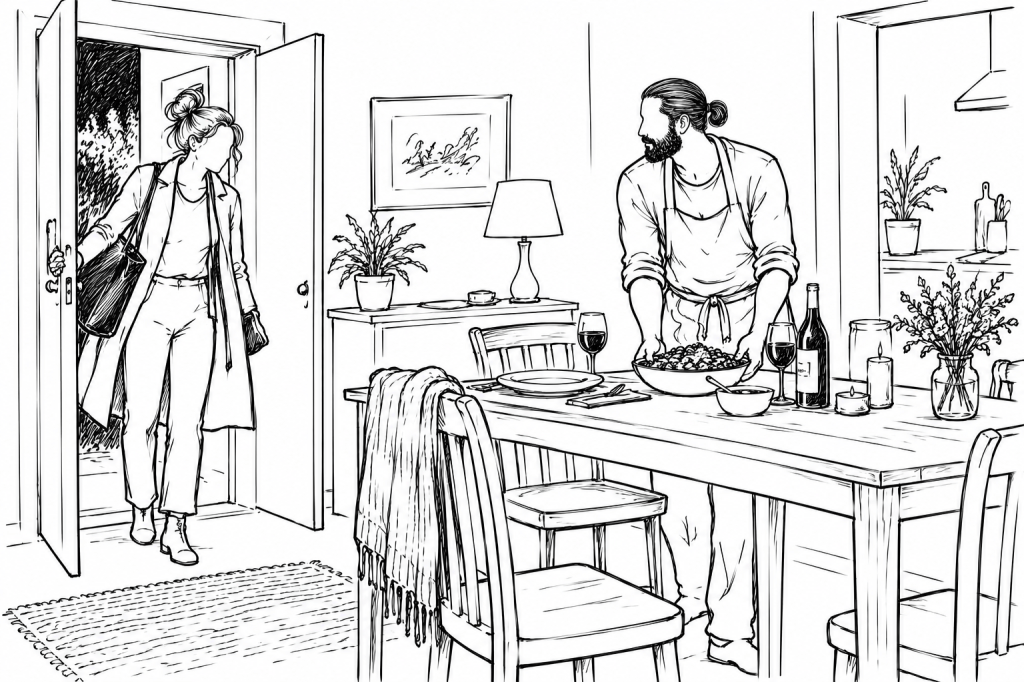
It must have been frustrating for him when I arrived home later than I had promised, sometimes after dinner had gone cold, or when I finally sat down only to open my laptop again or answer another work call.
The job followed me home in ways I hadn’t anticipated.
And so did the exhaustion.
There were evenings when Stephen wanted us simply to relax together and I was too preoccupied with work. There were nights when I was less interested in sex.
He rarely made a fuss about it at the time. He quietly got on with things, cooked our meals and adapted around my new hours.
But I knew it affected him.
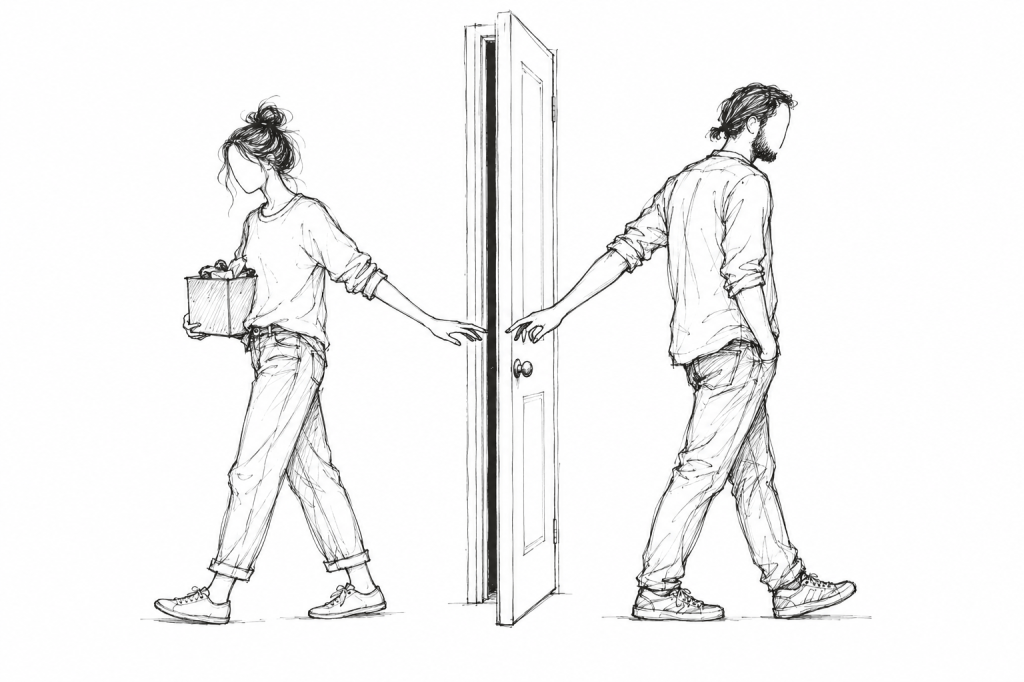
We had imagined this new chapter as something that would move both of us forward. Instead, within weeks, our lives had begun moving at very different speeds.
I was becoming busier, more challenged and increasingly absorbed in proving myself.
Stephen had lost one of the few pieces of work he had, some of his projects had stalled, and more of his days were being spent at home.
Neither of us had planned it that way.
Still, autumn was approaching. Other work opportunities for Stephen were still in the pipeline, and we had some lovely things planned together.
I hoped they would give him something to look forward to.
More than anything, I hoped these were simply the uncomfortable first weeks of a transition we would eventually settle into.
We had wanted our lives to move forward together.
I hadn’t yet considered what might happen if, for a while, they didn’t.
Reflection
Looking back, I think this was the first time our carefully constructed plan encountered ordinary life. We had spent months imagining how things would work: Stephen would become more independent, I would earn more, we would save, and gradually we would move towards the future we had chosen together. On paper, my new job belonged completely to that plan. What I hadn’t anticipated was how differently change might affect each of us once we were actually living through it.
For me, the new job was initially terrifying, but it also gave me something I had been craving. I was being challenged. There were problems to solve, people to organise and an unfamiliar world to master. The harder it became, the more determined I was to prove that I could do it. Within weeks, something that had reduced me to tears on my first night was beginning to give me confidence. My world was expanding at precisely the moment Stephen’s seemed to be contracting.
That created a tension I didn’t immediately recognise. The more absorbed I became in work, the less available I was at home. I arrived late. I answered calls. I opened my laptop. I was tired and sometimes uninterested in sex. Stephen rarely complained, and in many ways he supported me beautifully. He shopped, cooked and made sure there was food waiting when I eventually came through the door. From where I stood, this was simply what partnership looked like during a demanding period: one person carried more at home while the other adjusted to something new, knowing that eventually the balance would shift again.
But I also knew enough about Stephen to understand why the change might be difficult for him. We had deliberately tried to build him a life that didn’t depend upon my constant availability. Now, almost by accident, we were testing whether that life was strong enough to sustain him when my attention really did have to go elsewhere. Losing his groundskeeping work mattered in that context. So did the projects that gradually stalled. I could see that something was changing, but I still believed it was temporary.
Perhaps the most revealing moments were the ordinary ones. Stephen wandering away from me at the bar in Worthing. His son trying to tell him something difficult about the way he saw other people. My own discomfort about the friend whose boundaries with women concerned me. None of those moments seemed especially significant by themselves. They were simply things I noticed and then carried on from. There was no reason yet to turn them into anything larger.
What mattered most to me was that we were still together and still moving towards the same destination. I believed my long hours were an investment in us, just as I believed Stephen’s quieter period would eventually give way to new opportunities of his own. I hadn’t yet understood that two people can agree completely about the life they want to build and still experience the journey towards it very differently. For the first time since Stephen moved back in, our lives were no longer moving at quite the same pace. I noticed the distance beginning to open, but I still believed it would close again.