
In the weeks after Denmark, Stephen and I seemed to be constantly moving towards and away from each other.
One moment, I was certain it had to end.
The next, we were talking again.
Sometimes we were discussing practicalities: money, belongings, how we would begin separating the lives that had become so intertwined.
At other times, we were talking about love.
About loss.
About what had happened.
About whether there might ever be a way through it.
It was during one of those conversations that I told Stephen I didn’t want to lose him completely.
“I don’t want to lose you. By that I mean contact.”
And then I said something that probably described the weeks that followed better than I could have known at the time.
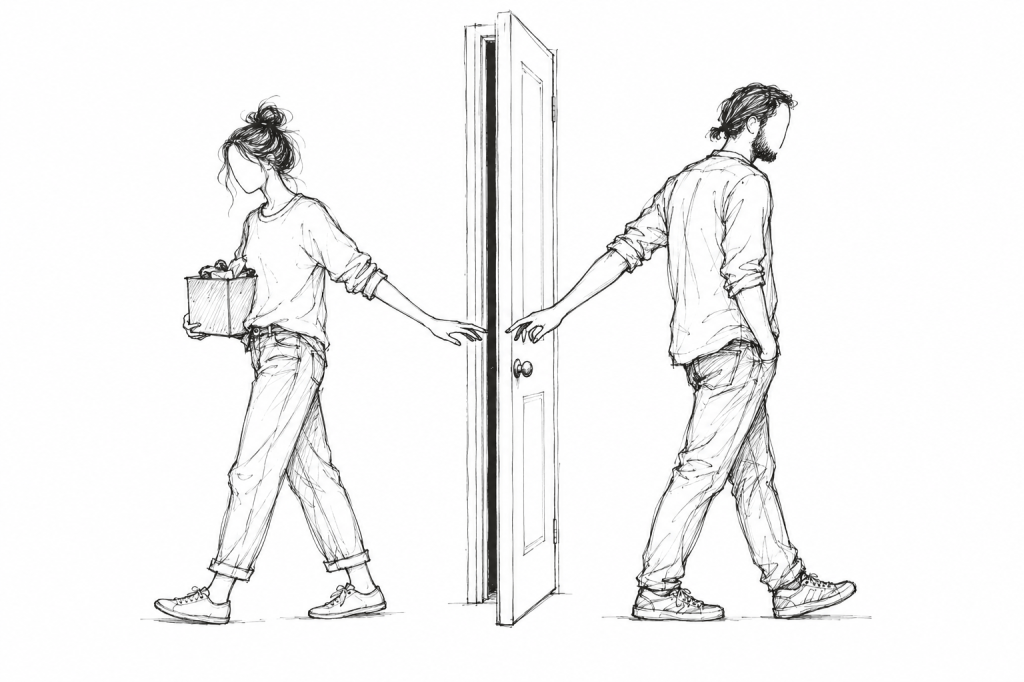
“I’ll always keep the door ajar.”
I wasn’t offering to resume our relationship.
I didn’t know whether I could ever trust him again.
But despite everything that had happened in Denmark, I couldn’t imagine simply removing Stephen from my life.
I still loved him.
And now I had another reason not to close the door completely.
I had suggested the personal-development programme I had attended many years earlier.
Stephen had been receptive almost immediately. He had looked into it, asked questions and seemed genuinely interested in what it might offer him.
That mattered to me.
I had spent so much time trying to understand Stephen myself. Perhaps this was something he needed to do without me.
But suggesting the programme didn’t suddenly make everything between us easier.
We were still raw.
Still grieving.
Still capable of hurting each other almost effortlessly.
I had begun trying to separate our lives.
There was enough of Stephen in my house to fill my car. Clothes. Possessions. The ordinary accumulation of a relationship that had gradually spread itself through drawers, cupboards and rooms.
Among it was his birthday present.
For the second year in a row, his birthday had become tangled up with betrayal.
I made arrangements to return everything to his dad’s.
I wanted the reminders gone.
At one point, I told Stephen I needed to eradicate the things that kept the wound open.
I deleted the photographs of us from my phone.
There had been hundreds.
Trips.
Christmases.
Walks.
Concerts.
Ordinary evenings.
Pictures of a relationship that, until Denmark, I had largely thought of as extraordinarily happy.
Deleting them felt brutal.
Stephen would remember that act for a very long time.
So would I.
There were other reminders that life was beginning to continue without him.
Only days after returning from Denmark, I attended a family celebration without Stephen.
I had been looking forward to going with him. Instead, I sat there alone, surrounded by people celebrating something wonderful, trying to participate while feeling as though part of me was somewhere else entirely.
Later, my sons and their girlfriends invited me out for drinks.
We went to a cocktail bar that Stephen frequented. The same one he stayed out late at, striking up conversations with strangers.
I knew what they were doing.
They were trying to look after me.
Trying to get me out of the house.
Trying, perhaps, to remind me that there was still a life around me that had nothing to do with Stephen.
I was grateful.
But I wasn’t free of him.
Part of me wondered whether he might walk through the door.
Even now, knowing everything that had happened, some part of my attention remained tuned to the possibility of Stephen appearing.
And Stephen and I were still talking.
That evening, another conversation began to unravel.
The exact argument is difficult to reconstruct because some of it happened by telephone, and Stephen and I subsequently disagreed about what had actually been said.
What I remember—and what my messages afterwards make very clear—is how I experienced it.
Stephen wanted to continue talking about something that felt urgent to him.
I was with my sons.
I felt that he was asking me to put his emotional needs above the people I was actually with and, once again, M became part of the conversation.
On the telephone, I understood Stephen to be telling me that the conversation couldn’t wait.
That if I wasn’t prepared to deal with it then, perhaps we needed to cut ties.
I was devastated.
I blocked him.
My sons, who had taken me out to try to cheer me up, ended up consoling me while I cried and panicked.
Hours later, Stephen and I were arguing about the argument.
He insisted I had misunderstood him.
He said he had known I needed to spend time with my boys. He had intended to continue writing down his thoughts while he waited for me to become available.
That wasn’t how I remembered the phone call.
“You said you couldn’t wait and hung up,” I told him.
Stephen said that wasn’t what he had meant.
I wished aloud that I had a recording of the conversation.
There was something painfully familiar in that.
Once again, Stephen and I weren’t only disagreeing about what should happen between us.
We were disagreeing about what had happened between us.
I told him I took him at his word.
If someone told me something, I believed that was what they meant.
Stephen believed there had been a misunderstanding.
Neither of us seemed capable of persuading the other.
And eventually I told him I didn’t want to speak to him.
That is where the surviving WhatsApp record from this period ends.
Perhaps that is appropriate.
Because there was no clean conclusion.
No final message in which we calmly accepted that the relationship was finished.
No dramatic declaration that we were going to try again.
Just another rupture.
Another attempt to close a door I had already admitted I wanted to leave ajar.
What happened between us over the following weeks is much less clearly preserved.
Without the messages, I don’t want to pretend I can reconstruct every conversation or place every moment precisely.
What I remember is the strange in-between state of it.
Stephen was no longer my partner.
But he wasn’t quite absent either.
I was trying to build a life that didn’t include him while still carrying the emotional weight of one that had.
And somewhere in the background was the programme.
The idea had been planted.
But Stephen wouldn’t actually attend until the end of September.
There were more than two months between me suggesting it and him finally walking through the doors.
During that time, life continued.
We weren’t speaking to each other much.
Then, in September, Queen Elizabeth II died.
Stephen told me he was going to London to see her lying in state.
There were queues stretching for miles, with people waiting through the night for the opportunity to walk through Westminster Hall and pay their respects.
It was such a Stephen thing to do.
The event was broadcast continuously, and as Stephen slowly made his way through the queue, I knew roughly when he was getting close.
I opened the live broadcast on my laptop at work.
And I waited.
For almost two hours, I watched the endless procession of strangers filing through Westminster Hall, searching for one familiar face.
Then suddenly, there he was.
Stephen.
His hair had grown long enough to pull into a tiny ponytail.
He looked solemn.
Almost painfully so.
I hadn’t felt particularly emotional about the Queen’s death myself, but there was something strange about seeing him there.
This man who had hurt me so profoundly only weeks earlier was walking quietly through Westminster Hall, looking humble, respectful and deeply moved.
Again, there were those two versions of him.
The man whose behaviour I sometimes found impossible to reconcile with love.
And the man I knew could be thoughtful, curious, sentimental and deeply affected by the world around him.
I captured several stills as he passed the coffin and lowered his head.
Within moments, he had disappeared from the screen.
I sent him what I had captured.
He was incredibly touched.
And once again, kindness found its way back between us.
That was the difficulty.
Love didn’t disappear simply because trust had been damaged.
Affection didn’t vanish because I was angry.
Stephen could hurt me profoundly and still be the person whose face I searched for amongst thousands of strangers.
I could decide that our relationship was over and still want to give him something I knew would matter to him.
The door moved constantly.
Sometimes I pushed it almost shut.
Sometimes Stephen did.
Then one of us would reach through the gap.
By late September, however, something was finally approaching that felt different.
Not another argument.
Not another explanation.
Not another promise between Stephen and me.
On 29 September, more than two months after I had first suggested it, Stephen was due to begin the programme.
I had no idea what would come from it.
I didn’t know whether it would change him.
I joked that once he found out who he really was, he might not actually want me. But at least I’d have my answer.
I didn’t know whether it would change anything between us.
I didn’t even know whether change would bring us closer together or finally make it clear that we needed to let each other go.
Reflection
Looking back, I don’t think I was indecisive about what Denmark meant. I knew something fundamental had been broken. I was returning Stephen’s belongings, deleting photographs and beginning to imagine a life without him. Those were real attempts to separate. But ending a relationship practically and detaching from someone emotionally turned out to be very different things.
I had imagined that once something sufficiently terrible happened, love would somehow fall into line with reason. It didn’t. I could be furious with Stephen and still worry about him. I could believe we shouldn’t be together and still want to hear his voice. I could remove hundreds of photographs from my phone and then spend two hours staring at a screen filled with strangers because somewhere among them was a face I knew intimately. None of those things cancelled the others out.
The arguments made the separation even harder. Stephen and I were still trying to establish what had happened, what had been meant and whose understanding of a conversation was correct. I wanted certainty at precisely the point when everything felt uncertain. Perhaps that was part of why I kept engaging. It is difficult to put something down when you still feel you haven’t completely understood it.
Seeing Stephen in Westminster Hall captured the contradiction particularly clearly. There was no crisis for me to solve and no argument to untangle. I simply saw someone I loved doing something I knew mattered deeply to him, and my instinct was to give him something that would matter too. Capturing those photographs wasn’t a decision to take him back. It was an act of affection. I was beginning to learn that affection could survive even when a relationship perhaps shouldn’t.
That was what I meant when I said I would always keep the door ajar. At the time, I thought I was describing contact. With hindsight, I think I was also describing my emotional position. I was trying to leave without completely letting go. The programme gave that open door somewhere to lead. I didn’t know whether Stephen would change, whether we would find our way back to each other, or whether understanding himself might take him further away from me. I only knew that I wasn’t yet ready to close the door and stop wondering.


