
As Stephen’s unhappiness with living with his father continued, he began hinting more frequently about living with me.
I reminded him that he had told me about moving in with his former girlfriend very quickly. His story was surprisingly similar to what was now happening between us. He had been in a very difficult place mentally, and she had driven to collect him and brought him back to her home. Before long, he had effectively moved in.
I could see the temptation for Stephen to repeat that pattern with me.
So I set a boundary.
I told him that he couldn’t move into my home until he had found a job.
He accepted that, but he was becoming increasingly desperate to get away from his father’s house. Instead, he arranged to rent a bedsit.
I didn’t think it was necessarily a bad idea. In fact, I thought it might be good for him. It would give him some independence, some privacy and a place of his own while he worked out what he wanted to do next.
He put some effort into making it feel like home. He bought things he needed to cook and some nicer touches to make the little room more comfortable.
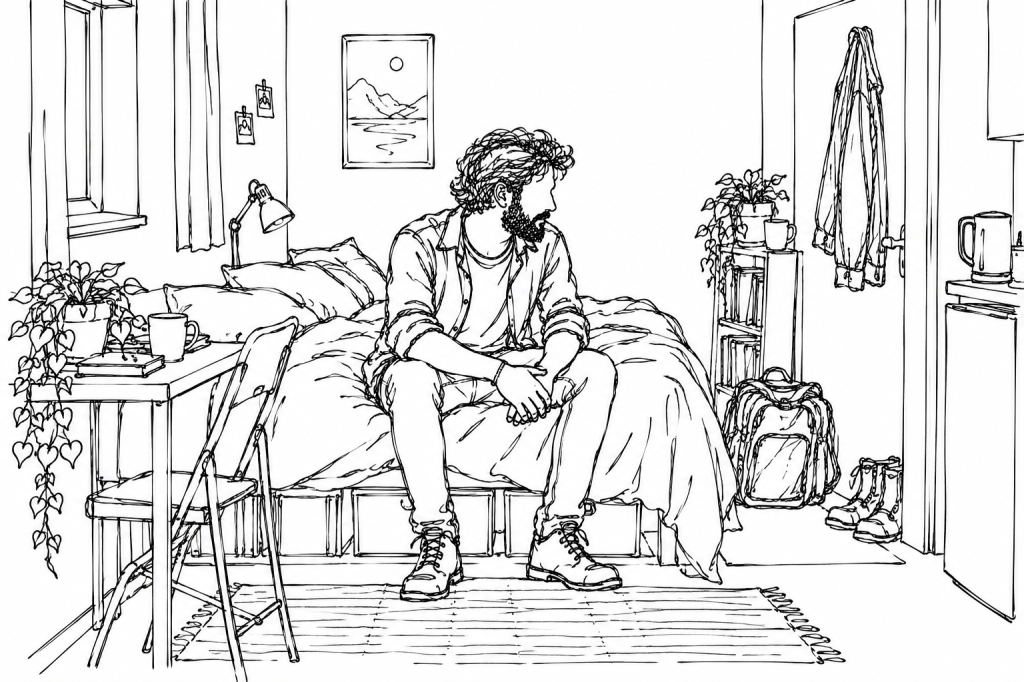
I was pleased for him.
The first time I visited, we were both excited about having somewhere of our own to spend time together. We joked that we needed to christen the new place.
What followed was an unexpectedly intense and intimate experience, and I remember leaving with a real glow of happiness.
I felt incredibly close to Stephen.
But there was something else I was carrying home with me.
I had pretended to have reached a level of sexual pleasure that I hadn’t quite reached.
It was a tiny lie, but it bothered me enormously.
The following day, I was still thinking about it at work. I felt guilty. I was falling deeply in love with this man, and the last thing I wanted was to start our relationship by hiding things from him. I didn’t want to create a pattern where I pretended everything was fine when it wasn’t.
So I decided to tell him.
I imagined we’d laugh about it.
Perhaps he’d tease me.
Perhaps we’d simply talk about it and move on.
Instead, his reaction was completely disproportionate to what I had expected.
He became extremely upset.
He compared me to his ex-wife and spoke at length about how much her lying had hurt him. He seemed to experience my admission as though I had deliberately deceived him, rather than what it was: something I had admitted to less than twenty-four hours later because I didn’t want to be dishonest with him.
I tried to explain.
I tried to reassure him.
Nothing seemed to help.
I was shocked by the intensity of his response and frightened that something so small might somehow cost me the relationship.
I went home from work that evening feeling ashamed and deeply upset.
Then things became much more serious.
Later that night, Stephen had returned to his father’s house and called me.
He was in an awful state.
He was crying, distressed and increasingly paranoid, and he had been drinking. I was so worried about him that I got in the car and went to collect him.
I brought him back to mine.
I remember him sitting on the edge of my bed, confused and barely coherent. He seemed completely overwhelmed by whatever was happening inside his head.
I didn’t know what to do.
Until then, I had known that Stephen had mental health difficulties. I knew about his EUPD and I knew about his traumatic childhood.
But this felt different.
This was the first time I began to understand that his difficulties could be much more serious than I had appreciated.
There wasn’t much I could do except stay with him, apologise for upsetting him and try to comfort him until eventually he slept.
Thankfully, the episode passed.
We got through it.
And from that point onwards, I never deliberately lied to Stephen again throughout the rest of our relationship.
The bedsit itself, however, soon became another source of difficulty.
Stephen moved in just as the UK entered its third national lockdown in January 2021. Restrictions meant that there was very little for him to do, and he quickly found the isolation difficult.
He struggled with the empty days and lonely nights.
He would try to cook, but often ended up bringing takeaway food back instead. He didn’t seem to know how to fill his time or settle into living alone.
I tried to help.
Sometimes I stayed over, even when I had work the next day, because I knew how difficult he was finding the loneliness. We still spent some weekends together when he didn’t have his sons, and I suggested different things he might do to occupy himself.
But nothing seemed to make much difference.
Within only a couple of weeks, I noticed that he was spending more and more time back at his father’s house.
When he had his sons, his father would often collect him on a Thursday, and Stephen wouldn’t return to the bedsit until the following Tuesday.
By the end of this period, my impression was that he was spending only two or three nights a week there, although I know Stephen may remember this differently.
I could see that the independence I had hoped the bedsit would give him wasn’t working out quite as I had imagined.
Then, sometime in March, Stephen told me he wanted to visit his ex-girlfriend to collect belongings he had left behind.
He planned to stay for two nights.
I wasn’t entirely comfortable with the idea.
Why did he need to stay for two nights?
Why couldn’t he collect his things and come home?
And why was he relying on her rather than asking me?
But I didn’t want to become the jealous or difficult girlfriend. I’d started this relationship wanting to be trusting and easy-going, and I wanted to maintain that part of myself.
So I didn’t make too much of it.
When the day came for his ex-girlfriend to collect him from the bedsit, I asked him for just one thing.
One promise.
“Just please don’t share the bed with her.”
He reassured me immediately.
“No way. I’ll be sleeping on the sofa.”
I believed him.


