
Stephen And The Changing Shape Of Our Lives

​The time eventually came for me to leave the job I had been in for sixteen years.

I was ready to go, but that didn’t make leaving easy.

I had first met my employers when I was working part-time as a cleaner for a friend’s cleaning company. They were among our regular clients and also among our favourites, largely because they allowed us enough time to actually do the job properly. There was none of the frantic rushing from one house to another that often came with cleaning work. Their house was somewhere I enjoyed going.

After a couple of years, though, I decided I’d had enough of cleaning and wanted to try something new.

On my final day, I happened to be working at their house. When I told them I was leaving, their eyes lit up. They immediately turned towards one another and began whispering.

Then they came back to me with an offer.

They were planning to build a large new house and, when it was finished, they would need a full-time housekeeper. Would I be interested? In the meantime, I could work for them part-time.

I said yes.

I was thrilled.

Sixteen years later, I was still there.

The role had grown enormously during that time. I wasn’t simply cleaning anymore. By the end, I was effectively managing the household, with five people working beneath me and responsibility for keeping everything running smoothly.

And I was good at it.

I had grown with the job.

Eventually, though, I began to feel I had grown beyond it too.

I wanted a new challenge. I was confident that the skills I had accumulated over sixteen years could transfer to another household, and I was ready to earn the kind of salary I now felt my experience deserved.

So when my final day arrived, there was sadness.

Sixteen years is a long time. I had spent a significant part of my adult life working for this family. I knew the house, the routines, the expectations and the people almost instinctively. Walking away from something so familiar felt strange.

But underneath the sadness was excitement.

I was ready.

That Friday evening, after finishing work for the last time, Stephen and I went out with his old friend from martial arts and his girlfriend. I really liked her and remember thinking that perhaps she and I could become friends.

Stephen and this man had become quite close since reconnecting. His friend did DIY work and had started giving Stephen occasional jobs with him, which meant a little extra money as well as some useful practical experience.

At some point, however, Stephen told me something about him that made me uneasy.

He said his friend could sometimes be inappropriate with some of the younger women at their martial arts classes.

I didn’t particularly like hearing that.

Given everything that had already happened with Stephen and women, I wasn’t thrilled by the idea of him becoming close to a man whose own boundaries with women apparently weren’t always great.

I didn’t make a huge issue of it.

But I noticed it.

The following day, Stephen and I travelled to Worthing for a music gig.

It was a small, intimate venue and the music was good. It should have been exactly the kind of evening we enjoyed together, but Stephen was drinking heavily. During the performance, he kept disappearing from my side and spending time hanging around the bar.

I remember wondering why.

There was nothing dramatic about it. He wasn’t doing anything obviously wrong. It just seemed strange that we had travelled there together to see the concert and yet he appeared increasingly interested in being somewhere other than beside me.

By the time we left, he was very drunk.

The walk back to our hotel should have taken about half an hour, but Stephen was moving slowly, becoming distracted by everything around him and repeatedly trying to strike up conversations with people we passed.

I found myself guiding him along and, at times, practically holding him up.

There was something funny about it too. He was drunk and sociable and easily distracted, and I couldn’t help laughing at some of his antics.

But as I watched him, another thought occurred to me.

So this is what he must have been like before he met me.

I had heard plenty of stories about Stephen’s old nights out, but this was one of the first times I felt I had actually caught a glimpse of that version of him.

Then it was time for my own new life to begin.

I had deliberately given myself a few days between jobs to relax and reset, but they disappeared quickly, and suddenly my first morning had arrived.

Almost immediately, there was a problem I hadn’t properly anticipated.

The commute.

I had estimated it would take about an hour, but rush-hour traffic made it considerably longer. Still, I arrived excited and determined to make a good impression.

The day began well.

I was issued with a laptop and phone, shown around and introduced to the workings of the household. Everything felt new and unfamiliar, but also exciting.

This was what I had wanted.

Something that would stretch me.

It was a full and varied day with an enormous amount to absorb. By six o’clock, I was tired. I gathered my things and prepared to leave.

The family’s executive assistant, who was also my manager, looked at me.

“Oh, the dinner service is about to start,” she said. “You can go if you want, though.”

I looked around.

Nobody else was leaving.

How could I possibly walk out?

It was my first day.

I messaged Stephen to tell him I was going to be late and stayed.

What followed was one of the most chaotic dinner services I had ever witnessed.

For much of it, I stood to one side of the kitchen trying to understand what everyone was doing. Everyone was present. Two housekeepers, a personal assistant, the executive assistant and the very stressed and flustered chef. People moved around one another, food appeared and disappeared, and there seemed to be far too many people tripping over each other without any obvious system.

At one point, I watched my manager spend what felt like an entire minute trying to balance a sprig of parsley on top of a plate of food.

By the end of the evening, the chef was sitting on the floor, rocking and crying.

I stood there taking it all in.

And somewhere amid the chaos, a thought occurred to me.

Is this why they’ve brought me here?

Was I expected to find a solution to this?

Eventually dinner was finished, but nobody simply went home. We stayed to clear the kitchen, wash everything, put things away and prepare for the following day.

By the time I finally reached home, it was around ten o’clock.

I had left the house fifteen hours earlier.

I walked through the front door, saw Stephen and fell into his arms.

Then I burst into tears.

“I’ve made a mistake,” I told him. “I can’t do this.”

All the confidence I had felt about leaving my old job had disappeared in the space of a single day.

Stephen held me and comforted me, although I don’t remember him saying very much.

Perhaps there wasn’t much he could say.

I was exhausted, overwhelmed and frightened that I had walked away from sixteen years of security for something I simply wasn’t capable of doing.

But I am also incredibly stubborn.

And conscientious.

So I slept on it.

The following morning, I got up, pulled myself together and went back.

This time, I approached it differently.

Instead of thinking, I can’t do this, I began thinking, I need to work out how to do this.

By the end of that first week, simply making it to Friday felt like an achievement.

So I was especially happy that we already had something planned for the weekend.

Stephen and I travelled to Bristol for an outdoor music festival. Four or five bands were playing, with one of my favourite bands, James, headlining.

The weather was lovely, the atmosphere relaxed and, after the intensity of my first week, it felt wonderful to be somewhere with nothing expected of me except to enjoy myself.

We watched the bands. We sang along.

Stephen stood behind me with his arms wrapped tightly around me.

It felt good.

His eldest son was studying in Bristol at the time, so we arranged to meet him while we were there. We ended up sitting together in a pub, talking and catching up.

During the conversation, his son tried to raise something with Stephen.

He was concerned about the way his dad sometimes spoke about his own father and his ex-wife — his son’s mother.

There was a sadness in what he was saying. He seemed to be trying to explain that he didn’t think Stephen was always fair to either of them, particularly considering how much they both continued to do for Stephen’s sons.

I listened as he tried to make his point.

His son wasn’t denying that Stephen had grievances with them. He seemed to accept that they both had their faults. What he wanted his dad to recognise was that, whatever had happened in the past, they were still there.

They were still helping.

They were still doing their best.

And that meant a great deal to his son.

It hurt him to hear Stephen be so critical of them.

I wasn’t sure Stephen was really hearing what his son was trying to tell him.

Then life moved on.

A month into my new job, things already looked very different from that first terrible evening.

The commute remained difficult and the days could be long, but I was beginning to find my feet. I was learning the rhythms of the household, understanding the personalities involved and, most importantly, beginning to see where I fitted.

There were problems to solve.

And I liked solving problems.

The chaos that had terrified me on my first day was gradually becoming something I could understand and organise. Every week I became a little more confident.

Perhaps I hadn’t made a terrible mistake after all.

Perhaps I could actually be good at this.

At almost exactly the same time, however, things were moving in the opposite direction for Stephen.

Not long after I left my old job, my previous employers emailed him to tell him they no longer required him as their groundskeeper.

The explanation they gave was that they were restructuring things and redistributing the work among the remaining team.

Perhaps that was all it was.

But I couldn’t help wondering whether my departure had played a part. I had been with them for sixteen years. Stephen had come into their lives through me. Perhaps once I had gone, they simply wanted a clean slate.

Whatever the reason, Stephen was angry and upset.

And somewhere beneath his anger, I couldn’t shake the uncomfortable feeling that some of it was directed towards me.

I wondered whether, in his mind, my decision to leave had somehow cost him his job.

That hadn’t been my intention at all.

In fact, in my mind, I had taken the new job partly because of us.

We had been talking about our future—working, saving, getting ourselves into a stronger financial position and eventually creating a life of our own. The increased salary mattered to me because I saw it as a way of moving us towards that.

The long commute, the responsibility, the exhausting days and even that first night when I had come home in tears were things I was prepared to endure because I believed they were taking us somewhere.

But while I was slowly establishing myself in a new working life, Stephen had suddenly lost part of his.

And there were other changes too.

Some of the projects he had begun at home lost momentum. The spaces he had been creating were left unfinished. He stopped going to his dad’s house to help tidy things there.

At home, though, he took on more.

He did a fantastic job of shopping and cooking for us, and most evenings there would be food waiting when I eventually made it through the door.
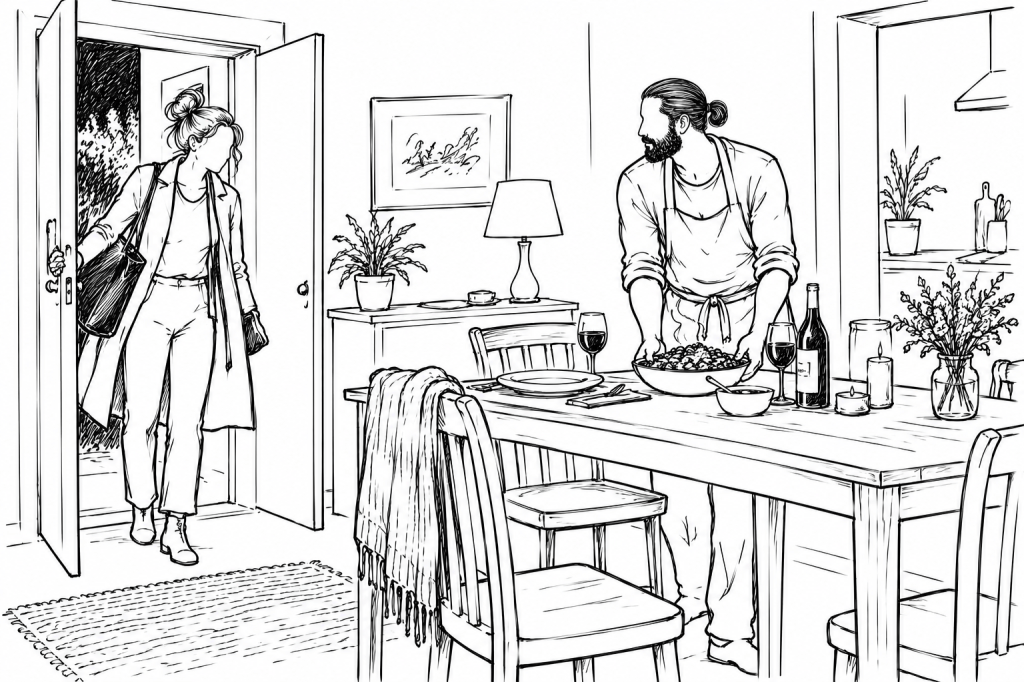
It must have been frustrating for him when I arrived home later than I had promised, sometimes after dinner had gone cold, or when I finally sat down only to open my laptop again or answer another work call.

The job followed me home in ways I hadn’t anticipated.

And so did the exhaustion.

There were evenings when Stephen wanted us simply to relax together and I was too preoccupied with work. There were nights when I was less interested in sex.

He rarely made a fuss about it at the time. He quietly got on with things, cooked our meals and adapted around my new hours.

But I knew it affected him.

We had imagined this new chapter as something that would move both of us forward. Instead, within weeks, our lives had begun moving at very different speeds.

I was becoming busier, more challenged and increasingly absorbed in proving myself.

Stephen had lost one of the few pieces of work he had, some of his projects had stalled, and more of his days were being spent at home.

Neither of us had planned it that way.

Still, autumn was approaching. Other work opportunities for Stephen were still in the pipeline, and we had some lovely things planned together.

I hoped they would give him something to look forward to.

More than anything, I hoped these were simply the uncomfortable first weeks of a transition we would eventually settle into.

We had wanted our lives to move forward together.

I hadn’t yet considered what might happen if, for a while, they didn’t.

Reflection

Looking back, I think this was the first time our carefully constructed plan encountered ordinary life. We had spent months imagining how things would work: Stephen would become more independent, I would earn more, we would save, and gradually we would move towards the future we had chosen together. On paper, my new job belonged completely to that plan. What I hadn’t anticipated was how differently change might affect each of us once we were actually living through it.

For me, the new job was initially terrifying, but it also gave me something I had been craving. I was being challenged. There were problems to solve, people to organise and an unfamiliar world to master. The harder it became, the more determined I was to prove that I could do it. Within weeks, something that had reduced me to tears on my first night was beginning to give me confidence. My world was expanding at precisely the moment Stephen’s seemed to be contracting.

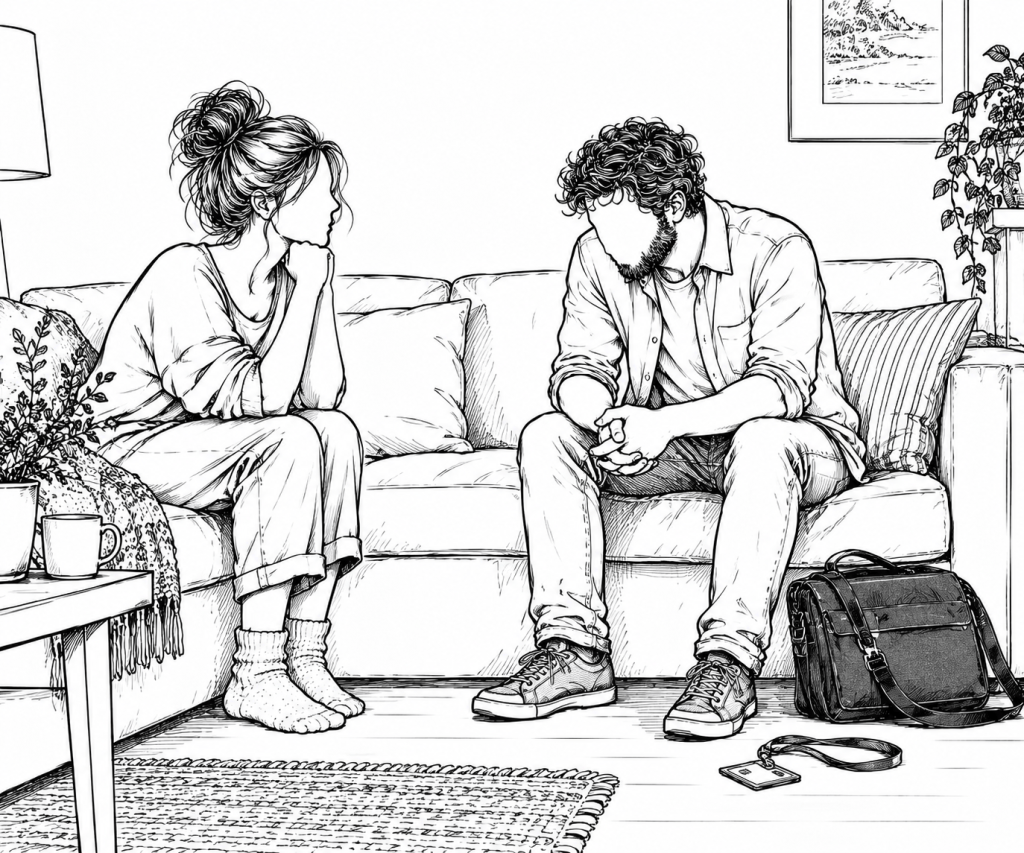
That created a tension I didn’t immediately recognise. The more absorbed I became in work, the less available I was at home. I arrived late. I answered calls. I opened my laptop. I was tired and sometimes uninterested in sex. Stephen rarely complained, and in many ways he supported me beautifully. He shopped, cooked and made sure there was food waiting when I eventually came through the door. From where I stood, this was simply what partnership looked like during a demanding period: one person carried more at home while the other adjusted to something new, knowing that eventually the balance would shift again.

But I also knew enough about Stephen to understand why the change might be difficult for him. We had deliberately tried to build him a life that didn’t depend upon my constant availability. Now, almost by accident, we were testing whether that life was strong enough to sustain him when my attention really did have to go elsewhere. Losing his groundskeeping work mattered in that context. So did the projects that gradually stalled. I could see that something was changing, but I still believed it was temporary.

Perhaps the most revealing moments were the ordinary ones. Stephen wandering away from me at the bar in Worthing. His son trying to tell him something difficult about the way he saw other people. My own discomfort about the friend whose boundaries with women concerned me. None of those moments seemed especially significant by themselves. They were simply things I noticed and then carried on from. There was no reason yet to turn them into anything larger.

What mattered most to me was that we were still together and still moving towards the same destination. I believed my long hours were an investment in us, just as I believed Stephen’s quieter period would eventually give way to new opportunities of his own. I hadn’t yet understood that two people can agree completely about the life they want to build and still experience the journey towards it very differently. For the first time since Stephen moved back in, our lives were no longer moving at quite the same pace. I noticed the distance beginning to open, but I still believed it would close again.
Stephen Drops A Bombshell

After Stephen returned from the Lake District, we finally had the weekend at Claridge’s that we had been looking forward to for months.

It had been extraordinary.

We had dressed up, stayed in one of London’s finest hotels, eaten wonderful food, laughed, smoked far too many cigarettes and experienced something neither of us was likely to forget.

There had been the incident with the young woman whose hand I had seen Stephen holding, and that had unsettled me.

But I had no idea there was something much bigger happening in the background.

A few days later, Stephen dropped a bombshell.

He told me he wouldn’t be returning to work after his holiday.

He had been suspended.

Not that morning.

Not even the day before.

The suspension had happened around two weeks earlier, before the Lake District holiday.

While Stephen had been away with his father and sons, while we had celebrated his birthday, while we had been at Claridge’s, this had been sitting silently in the background.

I had known nothing about it.

He knew only that there had been complaints about his behaviour involving two female colleagues.

I was floored.

How could something so serious have been happening without me knowing?

I had spent weeks watching Stephen become increasingly unsettled at work. I had worried about his smoking, his agitation, his disengagement from the training and his preoccupation with other women.

I had even asked him one evening, when he seemed distracted and remained online without answering me:

“Are you talking to someone else?”

Now women were at the centre of the reason he had been suspended.

My first instinct was not simply to condemn him.

I needed to know what had happened.

But the fact that there were two women troubled me immediately.

How could two separate female colleagues have independently raised concerns about Stephen’s behaviour at roughly the same time?

I couldn’t dismiss that.

One of the women was J, the colleague Stephen had told me was his type.

The other was a much younger colleague called H.

He said the messages with H were a misunderstanding. He said J had exaggerated things to make him look bad.

A few days later, I asked Stephen if I could read the WhatsApp conversation between him and H.

I wanted to know what had happened between them.

Stephen allowed me to read it.

It began innocently enough.

On 6 July, Stephen contacted her because he was having trouble with Microsoft Teams and wanted to know whether his profile photograph was visible.

She helped him.

They chatted.

But the conversation moved away from work remarkably quickly.

Stephen became interested in her religion. H was Muslim and wore a hijab, and he asked her questions about Islam, relationships and the boundaries she observed.

At first, I could understand his curiosity. Stephen was naturally inquisitive and loved learning about people.

But there was a difference between curiosity and what I was reading.

Within that first day, he was commenting on the fact that she was a “Young Attractive Woman.”

They discussed their ages.

H was twenty-two.

Stephen was about to turn forty-four.

He explicitly acknowledged that he was roughly twice her age.

And still the conversation became increasingly personal.

He told her that theirs was one of the most interesting conversations he had had for a while.

The following day, he told her she was fascinating.

He asked about her anxiety and sleeping problems. They began talking about personal experiences and emotional difficulties.

I could recognise Stephen in the conversation.

This was the same intensity I knew.

The same curiosity.

The same desire to get underneath somebody’s surface very quickly.

And then it became impossible for me to interpret what I was reading as merely friendly conversation between colleagues.

Stephen told H that he couldn’t seem to get her out of his mind and that he was having trouble concentrating.

That hurt.

There is something very different about noticing that another woman is attractive and telling her that you cannot get her out of your mind.

This was no longer the harmless appreciation of attractive people I had always been comfortable with.

This was emotional attention.

Personal attention.

Attention I believed belonged inside our relationship.

And it continued.

At one point Stephen himself referred to their interaction as “casual flirting.”

He told her that even without the flirting, he wanted to know much more about her.

H repeatedly talked about lines and boundaries.

Eventually, when she reminded him that he wasn’t even single, Stephen indicated that if he were single and available, there would be no line from his side.

By then, I couldn’t accept that this was simply a misunderstanding.

The messages showed that boundaries were something they had actually discussed.

H had talked about them.

Stephen had talked about them.

He had described their interaction as flirting.

And when H told him that some of his comments had made her uncomfortable, Stephen acknowledged that he needed to check his own emotions and behaviour.

He admitted that he should have been more aware of boundaries.

He told her that he had got carried away.

That did not tell me exactly what Stephen had intended.

But it made it impossible for me to believe that the problem was simply that nobody had made the boundary clear.

There was something else in the dates that disturbed me too.

I recognised one of them.

On one of the evenings when these conversations were taking place, I had sensed something was wrong with Stephen. He had seemed distracted and remained online without answering me.

Without knowing why, I had asked:

“Are you talking to someone else?”

Reading the conversation with H, I discovered that he had been.

I remember how unsettling that was.

I hadn’t known what was happening.

I had simply sensed that something was.

When I finished reading the conversation, I told Stephen what I thought.

I did not think it was innocent.

I did not think it was simply two colleagues having an interesting conversation.

I thought he had shown a romantic interest in her and made himself emotionally available to another woman in a way that was inappropriate within our relationship.

Stephen didn’t really argue.

He became quieter.

His explanation was that he had been struggling with the training, that he had been bored and unhappy with what he was doing and that talking to H had provided something stimulating.

He was also genuinely interested in her religion.

I could believe that.

But it didn’t answer the important question.

Why had boredom or unhappiness led him there?

Why, when he was struggling, had he sought emotional stimulation from another woman rather than finding some other way of managing those feelings?

For perhaps the first time, I described what had happened in language that felt painfully accurate to me.

I told Stephen that I felt emotionally cheated on.

The following morning, I wrote:

“I feel I’ve been emotionally cheated on and that until now, I haven’t been enough to prevent you from showing emotional and romantic interests in other women.”

But I also told him something else.

I knew what I wanted for myself now, and I was willing to see whether he still wanted to be part of it.

Stephen replied that he did.

“I only want you.”

Later that day, he acknowledged more.

“I think that I do sometimes look for interesting chat and fun with other people.”

He said there was nothing inherently wrong with enjoying conversation, but admitted that the way he had done it had been inappropriate and disrespectful to me and to our relationship.

He also recognised something I had already begun to notice.

“Most of the time when I behave like that (flirty or seeking attention) it is when I am bored or unhappy.”

He insisted that he wasn’t bored or unhappy with me.

He said that when the conversations with H happened, he had been bored and unhappy with what he was doing at the time.

“This is not an excuse,” he added.

I agreed.

“You will be bored and unhappy again,” I told him, “but our life will only improve if you find other ways to deal with it.”

When I was bored, I told him, I learned Danish or played Overcooked.

I didn’t seek fun, flirtatious conversations with men.

“The solution to this is to make yourself happy and regain control of your life, not escape the lack of them in ways that could make your life worse.”

I was not blindly accepting an explanation.

I was identifying the problem remarkably clearly.

And I told Stephen that our relationship was now on thin ice.

“This has changed how I feel about you and how I feel about us, but not that it can’t be reclaimed again. It will just take time.”

And then I told him something that feels important to me now:

“Beautiful, sincere words aren’t enough anymore.”

I needed actions.

I needed to feel that I was enough.

I needed to feel exclusive.

Stephen apologised.

He told me he knew what he needed to do.

I told him it wasn’t really a question of forgiveness.

I was giving him an opportunity to show me that he genuinely believed I was enough for him and that I was the only one.

I even gave him an alternative.

If part of him felt that he had missed out on sexual freedom and wanted a year to “sow his wild oats”, I told him to take it.

Perhaps we would find our way back to one another afterwards.

Stephen rejected the idea.

“I know in my heart that I do not want any other woman.”

He told me he wanted everything with me for the rest of our lives.

So I asked him directly whether he was choosing a monogamous, devoted, loyal, long-term relationship with me over sexual and relationship freedom.

“Yes,” he replied.

“I do.”

I asked him to take his foot out of the other door he seemed to be keeping slightly ajar.

He denied seeing other women as potential partners.

He said he enjoyed conversation and company without intending anything more.

I told him:

“You like emotional and flirty intimacy with others.”

Stephen then said something revealing.

Having spent so much of his life believing he was unattractive and unlikeable, attention from other people felt good.

“I guess it is nice when it happens.”

He said he needed not to let it go to his head.

I told him that relying on validation from other people could go on forever.

He needed to believe in his own attractiveness and worth without constantly requiring somebody else to reflect it back to him.

And I knew my own worth too.

“I know I deserve integrity, truth and respect.”

Stephen agreed that he needed to behave differently.

“I need to show you the respect you deserve.”

“I promise to be more considerate.”

For the moment, I chose to give him the opportunity to do that.

The weekend after the revelation, we spent time with my oldest and best friend, her partner, her sisters and one of their partners.

After everything that had happened, there was something almost surreal about sitting together in the warm summer weather, drinking, smoking, laughing and catching up.

I was finally introducing Stephen to some of my favourite people in the world.

And despite everything going on behind the scenes, I was still proud to have him beside me.

My friend, however, was nobody’s fool.

She knew some of what had happened between us and asked Stephen what it was he loved about me.

I was fascinated to hear his answer.

He didn’t hesitate.

“She’s really cool, but she doesn’t know it.”

I adored his answer.

It felt as though he saw something in me that I sometimes struggled to see in myself.

We had a wonderful time.

Stephen was funny, intelligent, attentive and engaging. At one point he even treated us to an impromptu tap dance, one of the many unexpected talents he possessed.

This was part of what made everything so confusing.

There wasn’t one Stephen who hurt me and another who loved me.

The man capable of making me feel profoundly uncertain could also be the man who fitted beautifully amongst the people I loved, made everybody laugh and looked at me as though I was the most important person in the room.

Both experiences felt real.

But underneath that weekend, the suspension remained unresolved.

Stephen had still been given very little information by his employers.

On 25 August I had written to him that it was wrong they had left him for around two weeks without a proper explanation.

He received formal confirmation of his suspension, but the investigation continued.

Days became weeks.

We waited.

Stephen chased HR.

A union representative became involved.

There were arguments about procedure and delays in receiving information.

Meanwhile, I was trying to work out what all of this meant for our relationship.

One night, unable to settle, I told Stephen:

“I miss us.”

He replied:

“I miss us too. The way we were.”

“It’s like a shattered illusion,” I said.

Stephen disagreed.

“Not an illusion…”

“Can we just start again?”

I wanted to.

Or at least, I wanted to try.

But I was scared.

I told him I had no certainty and no security.

Stephen promised that when he came home he would give me both.

“Security, comfort, certainty….”

“All of Me.”

And once again I allowed myself to hope that perhaps this crisis might become the thing that finally changed something.

Then, in early October, the full written grievances finally arrived.

By then the suspension had dragged on for weeks.

Stephen allowed me to read them.

H’s account broadly corresponded with the conversation I had already seen.

That mattered.

Whatever arguments might be made about interpretation, I had read Stephen’s own words.

I knew the central complaint had substance.

J’s grievance was different.

It contained a series of allegations about behaviour she considered inappropriate: trying to take her hand while crossing the road, telling her that she was his type, making comments about what he might do if he did not have a girlfriend, touching himself during conversation, drinking alcohol while working, appearing in online meetings without a shirt and behaving inappropriately during meetings generally.

Some of those allegations involved things I had either witnessed myself or already knew something about.

That made it impossible for me simply to dismiss J as a woman trying to cause trouble.

But one allegation hurt me more than the others.

According to J, Stephen had told her that she was his type and indicated that he would go for her, but he had a girlfriend.

The wording mattered enormously to me.

If the message was, I might find you attractive, but I choose my girlfriend, then the emphasis was on commitment.

What I heard instead was:

I would, but I can’t.

And suddenly I felt less like the woman Stephen was actively choosing and more like the obstacle preventing him from pursuing somebody else.

I was furious.

Stephen struggled to understand why the distinction mattered so much to me.

But it did.

Because months earlier, when I had questioned him about temptation and fidelity, he had told me that when he found the right woman he wouldn’t need to fight temptation.

“You are all I will ever need.”

Now I was reading allegations that suggested a very different relationship with temptation, attention and possibility.

By this point, I was no longer prepared simply to take Stephen’s version of events because he was my partner.

He had the right to respond to the allegations.

He had the right to explain context, dispute anything he believed was inaccurate and receive a fair process from his employer.

But I had the right to make my own judgement about what his behaviour meant for me.

On 7 October, after reading the grievances, I wrote Stephen an email.

He asked me:

“Are we splitting up?”

“I don’t know,” I replied.

That was the truth.

I loved him.

But everything I had feared seemed to be materialising.

I told him I was reaching a place of acceptance.

“Now I have to make my life secure.”

The following day, Stephen returned to his father’s house.

The separation was not intended as the end of our relationship.

In fact, we both talked about it as something we were doing to give the relationship its best chance.

It would hurt to be apart.

But I needed space.

Stephen needed to deal with the investigation, think about his behaviour and take responsibility for what had happened.

And I needed to stop trying to hold everything together around him.

I wrote him a letter to take with him.

Stephen later described parts of it as hard truths he needed to hear.

He also called it the most beautiful letter he had ever received.

I still wanted us to succeed.

That is important.

I wasn’t throwing him out because I no longer loved him.

I was asking him to leave because I did love him, and because I could no longer see how allowing everything to continue unchanged could possibly help either of us.

I wanted him to use the separation to think about the kind of man he wanted to be and, more importantly, how he wanted to treat me.

I wanted him to find other ways of dealing with boredom, unhappiness, insecurity and his need for attention.

I wanted his behaviour to begin matching the beautiful things he continually told me.

And I still believed that perhaps consequences would make that happen.

Somewhere deep inside me, I had been expecting something like this.

There had already been enough cracks.

Enough moments that made me question what I was seeing.

Enough occasions when I had wondered whether my instincts were warning me about something real.

But anticipating that something might happen does not make discovering it hurt any less.

Perhaps the most disturbing part was realising that, while it had been happening, I had sensed something without understanding what I was sensing.

I had watched Stephen become distracted.

I had sensed a change.

And on one particular evening, without knowing why, I had looked at my phone and asked:

“Are you talking to someone else?”

He had been.

I hadn’t known what was happening.

I had simply been missing the information that would have allowed me to understand it.

Now some of that information was finally in front of me.

I still loved Stephen.

I still hoped we could survive this.

I still believed he might learn from it, change and come back to me having understood something important about himself.

But something had shifted.

Beautiful words were no longer enough.

I needed actions.

Because the things I had been quietly questioning were beginning to acquire a shape.

And once you can see the shape of something, it becomes much harder to convince yourself that it isn’t there.

Stephen And The Bedsit

As Stephen’s unhappiness with living with his father continued, he began hinting more frequently about living with me.

I reminded him that he had told me about moving in with his former girlfriend very quickly. His story was surprisingly similar to what was now happening between us. He had been in a very difficult place mentally, and she had driven to collect him and brought him back to her home. Before long, he had effectively moved in.

I could see the temptation for Stephen to repeat that pattern with me.

So I set a boundary.

I told him that he couldn’t move into my home until he had found a job.

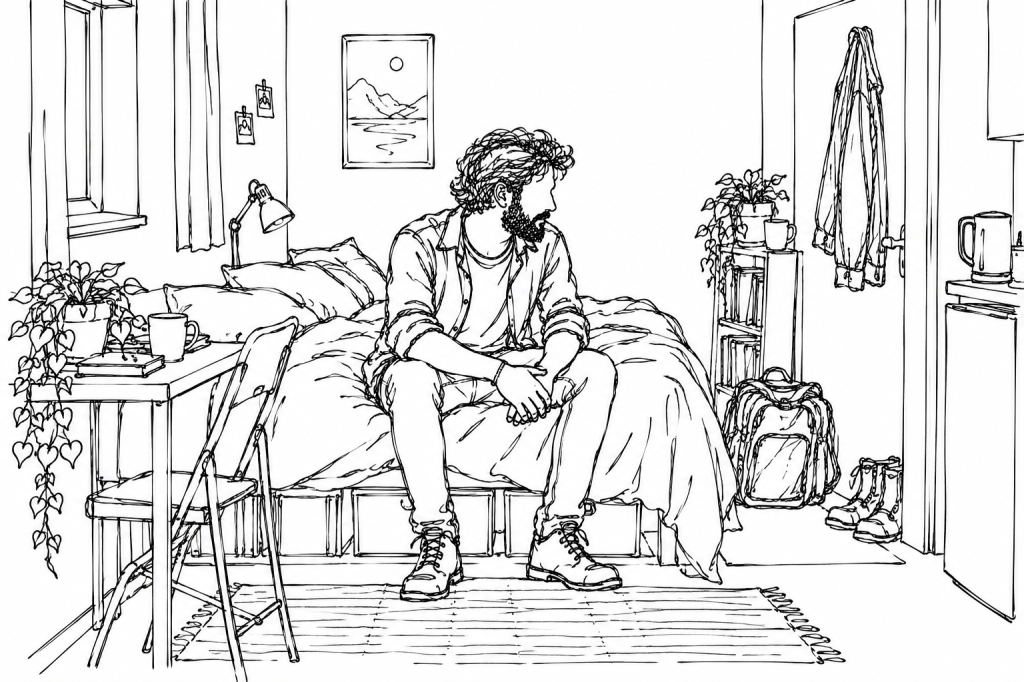
He accepted that, but he was becoming increasingly desperate to get away from his father’s house. Instead, he arranged to rent a bedsit.

I didn’t think it was necessarily a bad idea. In fact, I thought it might be good for him. It would give him some independence, some privacy and a place of his own while he worked out what he wanted to do next.

He put some effort into making it feel like home. He bought things he needed to cook and some nicer touches to make the little room more comfortable.

I was pleased for him.

The first time I visited, we were both excited about having somewhere of our own to spend time together. We joked that we needed to christen the new place.

What followed was an unexpectedly intense and intimate experience, and I remember leaving with a real glow of happiness.

I felt incredibly close to Stephen.

But there was something else I was carrying home with me.

I had pretended to have reached a level of sexual pleasure that I hadn’t quite reached.

It was a tiny lie, but it bothered me enormously.

The following day, I was still thinking about it at work. I felt guilty. I was falling deeply in love with this man, and the last thing I wanted was to start our relationship by hiding things from him. I didn’t want to create a pattern where I pretended everything was fine when it wasn’t.

So I decided to tell him.

I imagined we’d laugh about it.

Perhaps he’d tease me.

Perhaps we’d simply talk about it and move on.

Instead, his reaction was completely disproportionate to what I had expected.

He became extremely upset.

He compared me to his ex-wife and spoke at length about how much her lying had hurt him. He seemed to experience my admission as though I had deliberately deceived him, rather than what it was: something I had admitted to less than twenty-four hours later because I didn’t want to be dishonest with him.

I tried to explain.

I tried to reassure him.

Nothing seemed to help.

I was shocked by the intensity of his response and frightened that something so small might somehow cost me the relationship.

I went home from work that evening feeling ashamed and deeply upset.

Then things became much more serious.

Later that night, Stephen had returned to his father’s house and called me.

He was in an awful state.

He was crying, distressed and increasingly paranoid, and he had been drinking. I was so worried about him that I got in the car and went to collect him.

I brought him back to mine.

I remember him sitting on the edge of my bed, confused and barely coherent. He seemed completely overwhelmed by whatever was happening inside his head.

I didn’t know what to do.

Until then, I had known that Stephen had mental health difficulties. I knew about his EUPD and I knew about his traumatic childhood.

But this felt different.

This was the first time I began to understand that his difficulties could be much more serious than I had appreciated.

There wasn’t much I could do except stay with him, apologise for upsetting him and try to comfort him until eventually he slept.

Thankfully, the episode passed.

We got through it.

And from that point onwards, I never deliberately lied to Stephen again throughout the rest of our relationship.

The bedsit itself, however, soon became another source of difficulty.

Stephen moved in just as the UK entered its third national lockdown in January 2021. Restrictions meant that there was very little for him to do, and he quickly found the isolation difficult.

He struggled with the empty days and lonely nights.

He would try to cook, but often ended up bringing takeaway food back instead. He didn’t seem to know how to fill his time or settle into living alone.

I tried to help.

Sometimes I stayed over, even when I had work the next day, because I knew how difficult he was finding the loneliness. We still spent some weekends together when he didn’t have his sons, and I suggested different things he might do to occupy himself.

But nothing seemed to make much difference.

Within only a couple of weeks, I noticed that he was spending more and more time back at his father’s house.

When he had his sons, his father would often collect him on a Thursday, and Stephen wouldn’t return to the bedsit until the following Tuesday.

By the end of this period, my impression was that he was spending only two or three nights a week there, although I know Stephen may remember this differently.

I could see that the independence I had hoped the bedsit would give him wasn’t working out quite as I had imagined.

Then, sometime in March, Stephen told me he wanted to visit his ex-girlfriend to collect belongings he had left behind.

He planned to stay for two nights.

I wasn’t entirely comfortable with the idea.

Why did he need to stay for two nights?

Why couldn’t he collect his things and come home?

And why was he relying on her rather than asking me?

But I didn’t want to become the jealous or difficult girlfriend. I’d started this relationship wanting to be trusting and easy-going, and I wanted to maintain that part of myself.

So I didn’t make too much of it.

When the day came for his ex-girlfriend to collect him from the bedsit, I asked him for just one thing.

One promise.

“Just please don’t share the bed with her.”

He reassured me immediately.

“No way. I’ll be sleeping on the sofa.”

I believed him.