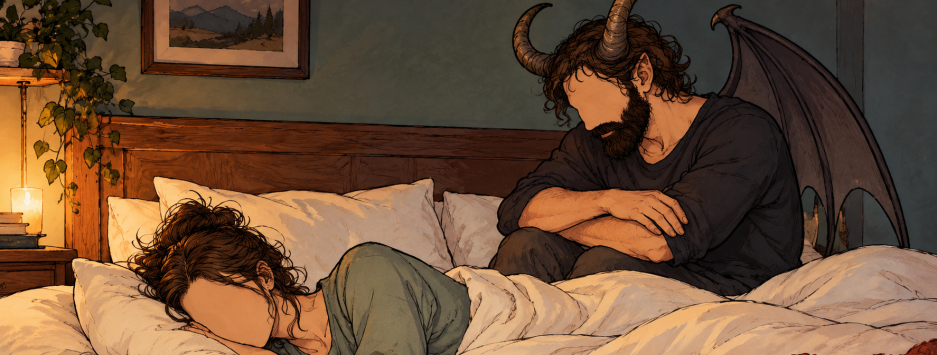
Stephen and I didn’t speak for several days.
But inevitably, I reached out again.
Why did I keep doing that?
I think part of the answer was that Stephen’s betrayals never seemed to arrive with clean endings.
There was always ambiguity.
His explanations were confusing. His feelings for me seemed unfinished. His feelings about us seemed unfinished. Even when something happened that should perhaps have provided an answer, I was somehow left with more questions.
And Stephen was the only person who could answer them.
So we began talking again.
This time, we spoke more openly about what seemed to happen in his relationships with women.
Stephen said that he “blurred friendships.”
A connection would develop, become intense very quickly and then cross into something sexual. By the time it reached that point, he said, he didn’t have the strength to resist it — either literally, or because he became plagued by obsessive thoughts.
It seemed as though he simply couldn’t maintain straightforward friendships with women without the possibility of attraction or sex entering the picture.
And his attractions seemed to encompass almost everybody.
Different ages.
Different body types.
Different intellects.
Married, divorced or single.
Mothers.
The more we talked about it, the less special I felt.
I felt as though I was simply another name on a very long list.
Stephen continued trying to tell me that I was different. That I was special to him.
But by then, I struggled to understand what “special” actually meant.
It reminded me of the idea that everybody is special in God’s eyes.
If everybody is special, what does being special mean?
Stephen told me he wished he wasn’t like this.
He wished he could manage his relationships with women differently.
My head and my heart were still going stir-crazy trying to understand how Stephen could have done this to me after all the assurances he had given me, all the promises he had made and all the conversations we had had about honesty and trust.
So we kept talking about what he now described as his problem, and where that problem might have come from.
Stephen wondered whether he had missed out on some crucial stage of growing up. Whether, in some ways, he still had the emotional age of a teenager.
He preferred the company of women to men and found it difficult to form friendships with men. Yet whenever he did form a connection with a woman, he said, it seemed to become blurred. Emotional connection and sexual chemistry somehow became entangled.
I kept asking the obvious question.
Why did he allow it to get that far?
Why put himself in situations where he was spending enough time alone with a woman for those feelings to develop, particularly when he knew he was in a relationship?
He didn’t really know.
And whatever the explanation for his behaviour ultimately was, one thing seemed increasingly clear to me.
It wasn’t something I could fix for him.
If it was ever going to change, Stephen would have to understand it himself.
This time, I booked myself onto a five-day health retreat.
I needed space and time to think about everything, but I also needed an opportunity to regenerate. To feel healthier. To get stronger emotionally and physically.
I told Stephen we wouldn’t talk while I was there.
As usual, we couldn’t help ourselves.
I wanted to share the new things I was experiencing with him, and he wanted my companionship.
And the conversations were nice.
We didn’t focus too much on what had happened. We simply slipped back into that familiar, lovely way we had always related to each other.
That was part of the difficulty too.
There was still so much between us that worked.
After I returned, and throughout the remainder of March, we talked a great deal about intimacy.
I found myself trying to explain something to Stephen that seemed obvious to me, but which he appeared never to have properly understood.
Intimacy wasn’t just sex.
It could be the conversations you had with someone. The amount of time you spent alone together. The emotional closeness you created. The special things you did for one another. The private little world that could begin forming between two people long before either of them kissed or took their clothes off.
When you were in a committed relationship, I told him, some forms of intimacy belonged inside that relationship.
That didn’t mean you couldn’t have friends of the opposite sex. Of course you could.
But there was a difference between friendship and creating a closeness with somebody else that began occupying territory that should belong to your partner.
And that was why I kept returning to the question of how Stephen’s friendships with women reached the point where he became sexually attracted to them.
The betrayal didn’t suddenly begin at the moment he kissed someone or slept with them.
There were choices before that.
Being alone together.
Allowing conversations to become increasingly personal.
Seeking each other out.
Creating emotional closeness.
Doing things together that began to feel special.
Letting a connection develop while telling yourself that, because nothing sexual had happened yet, no boundary had been crossed.
Stephen and I even watched a couple of films together that explored some of these ideas. Afterwards, we talked about what we had seen and how emotional intimacy could develop outside a relationship before anyone necessarily recognised what was happening.
For the first time, he seemed to be understanding what I had been trying to explain.
He had also discovered that I had told U about the affairs.
She had written to him.
Stephen told me he was glad I had told her because I was right.
He was a danger to women.
He said he could see why those situations were dangerous for him too.
He admitted that any kind of positive attention would simply ‘go to his head.’
More importantly, he seemed to understand why I experienced them as a betrayal even before they became physical.
That felt significant to me.
Perhaps if Stephen could finally recognise where the boundary actually was, he could learn to stop himself before he crossed it.
There was something else he admitted too.
He couldn’t seem to stop looking at different women and wondering what it would be like to be with them.
That admission explained something I had been observing for years.
Stephen had always noticed attractive women. In the car, walking down the street, sitting outside a café — his eyes would follow them, often obviously enough for me to notice.
I had never expected him not to find other women attractive. I noticed attractive people too. Looking wasn’t cheating, and I didn’t want to become the sort of partner who policed where somebody else’s eyes went.
But over time, something strange had happened.
I had started noticing the women too.
If an attractive woman appeared ahead of us, I would register her almost automatically. I would notice what she looked like, what she was wearing, whether she seemed like Stephen’s type.
And then I would wait to see whether he noticed her.
Usually, he did.
I don’t remember consciously deciding to do this. It simply became a habit. Somewhere along the way, instead of merely walking down a street or sitting beside Stephen in the car, a small part of my attention had begun tracking where his attention might go.
At the time, I don’t think I understood what that was doing to me.
To this day, I still do it on my own. A habit I can’t appear to give up. But Stephen isn’t beside me now to confirm what I suspect.
Now, listening to Stephen tell me that he couldn’t stop looking at women and wondering what it would be like to be with them, all those little moments suddenly felt more significant.
Even women who had passed only briefly through our lives could apparently become part of that internal world.
On one occasion, Stephen accompanied me to a house where I needed to collect something. When the woman opened the door, she visibly blushed at the sight of him. It was something we both noticed.
Later, she told me she thought Stephen was “hot.”
I told him.
At the time, I had thought it was harmless and flattering. I hadn’t imagined there was any danger in telling my partner that another woman found him attractive.
Now Stephen told me that afterwards he hadn’t been able to stop thinking about what it would be like to be with her.
It was astonishing to hear.
For years, I had been noticing where Stephen’s eyes went.
I was only now beginning to understand something about where his mind sometimes went with them.
Between us, we began reaching for explanations.
Was there some kind of sexual dysregulation? Some problem in the way Stephen experienced attraction?
Whatever it was, it didn’t sound to either of us like the conversations we had previously had about polyamory. It didn’t sound like a considered desire to have more than one loving relationship.
It sounded like something Stephen himself didn’t feel entirely in control of.
He told me he was very sorry he had cheated on me.
He wished he could take it back.
There was one thing I still couldn’t understand.
Why hadn’t he told our therapist?
We had gone to therapy specifically because our relationship was in trouble. There could hardly have been a more appropriate place to reveal something so important.
Stephen said he had been too frightened.
During one of our sessions, the therapist had referred to her understanding that there had been no infidelity between us.
Stephen had let that assumption stand.
I could understand fear.
But I also couldn’t escape another thought.
If he had genuinely wanted us to find our way back to each other, surely that had been the moment to tell the truth.
I told him there was no possibility of a future between us while this remained unresolved.
Whatever was happening, he needed proper help.
He needed therapy.
But therapy never seemed to make its way to the top of Stephen’s list.
Instead, he seemed determined to prove that he could learn to have friendships with women without them becoming sexual.
K was becoming one of those friendships.
One evening, he went to her flat and spent the evening playing games with her and some of her female friends. Afterwards, he wanted to update me on how well he had done — evidence, apparently, that he could spend time with women he found attractive and simply be their friend.
I wanted to believe that meant something.
As March progressed, Stephen and I were occasionally intimate. It seemed to coincide with his growing expressions of regret and his insistence that he wanted to change.
But intimacy had changed completely for me.
I was no longer alone with Stephen in those moments.
U was there.
E was there.
B was there.
The German tourist was there.
And K was beginning to peek through.
Not literally, of course.
They were faceless women inside my head, but once they appeared, I couldn’t make them leave.
Sex had become one endless, imagined tangle of bodies and betrayal. Sometimes I was among the women, competing for Stephen’s attention. At other times, I was merely a spectator, watching him give someone else the intimacy I had once believed belonged to us.
I imagined Stephen with them and whatever closeness had existed between us disappeared.
This is the lingering cruelty of infidelity. Even when you want to feel close again, the betrayal finds its way between you.
I didn’t feel loved by him anymore.
Increasingly, I felt as though I was only there for emotional and physical support.
A companion. A concubine.
Sometimes almost a carer.
And yet some small part of me was still waiting.
Waiting for Stephen to say something profound enough, remorseful enough or loving enough to somehow undo the enormous mess our relationship had become.
Meanwhile, Stephen himself was deteriorating.
His flat had barely progressed. Six months after buying it, it looked much as it had after the first month.
He went to work perhaps two or three days a week. On the days in between, he often stayed in bed, went for walks to eat in local restaurants, or spent time with me.
The excitement he had once had about transforming the flat seemed to have disappeared.
Then, one day at the arts centre, he told me he broke down during work.
One of the volunteers took him out in his van. They drove to some woods and walked and talked for a while.
I could see that he was slipping again.
By the final weekend of March, I wanted to do something to lift him.
I decided I would give him my whole weekend.
We visited an exhibition at the arts centre and went to see a movie. For a little while, it felt surprisingly normal.
We had a genuinely nice weekend together.
When I eventually left him, I remember feeling almost reassured.
I thought I had filled him up a little.
Given him some company, some enjoyment, some good memories.
Something he could carry with him for a while.
But later that same day, the messages started.
Stephen thought he was going downhill.
Then he said he was spiralling.
I couldn’t understand it.
I had only just left him.
We had had a good weekend.
What had happened in the few hours since?
As the evening went on, he became increasingly unstable.
He told me he needed help.
There had been a time when those words would have sent me straight back to him.
But by then, I had begun learning something that had taken me a very long time to understand:
I could not be Stephen’s crisis service.
I had been advised that if he became seriously unwell, I needed to direct him towards professional help. If necessary, I could call an ambulance.
But I couldn’t keep trying to rescue him myself.
So I told him to contact the crisis team.
He tried.
They were taking too long.
His desperation escalated until eventually Stephen called the police himself.
He told them he needed to be taken somewhere safe. If he had to walk down the street and do something that would get him arrested in order to make that happen, he would.
They told him not to do that.
Stephen knew how to communicate the seriousness of what was happening to him.
Eventually, the crisis team spoke to him. They asked questions about the risk he posed to himself and to other people and then advised him to remain at home. Someone would come to see him the following morning.
They did.
He was assessed, but there was nowhere for him to go at that point. He was encouraged to see a doctor.
By that evening, he was desperate again.
This time, I think, he called an ambulance.
He was taken to A&E.
I went to see him there the next day.
Nothing quite prepared me for what I found.
I had seen Stephen depressed.
I had seen him agitated, angry, frightened, impulsive and overwhelmed.
I had watched him lose jobs and struggle to cope with his life.
I had never seen him like this.
He could barely get his words out.
He was stuttering so badly that speaking seemed physically difficult. The man sitting in front of me looked utterly overwhelmed by his own mind.
I remember looking at him and thinking:
So this is what a breakdown looks like.
It frightened me.
Whatever had happened between us suddenly seemed to belong to another world.
The affairs were still real.
The lies were still real.
The damage he had done to me hadn’t disappeared.
But sitting in A&E looking at Stephen in that state, I wasn’t looking at the man who had betrayed me.
I was looking at someone I had loved for more than five years who was frighteningly unwell.
Stephen was put on a waiting list for a psychiatric bed.
He spent two nights in A&E before one finally became available.
Then he was escorted to a psychiatric hospital and admitted to a male ward.
It was Easter weekend.
I don’t think anything could have activated the compassionate part of me more powerfully.
I knew something with absolute certainty.
If this breakdown had happened while Stephen and I were still properly together, I would never have walked away from him in the middle of it.
I would have stayed.
And although technically we weren’t together anymore, emotionally that distinction suddenly felt almost meaningless.
So I made a decision.
Whatever had happened between us, I would support him through this.
Perhaps, I thought, this was finally the point at which Stephen would receive the help he needed.
Perhaps this was the beginning of the long road back.
On Good Friday, I went to visit him on the ward.
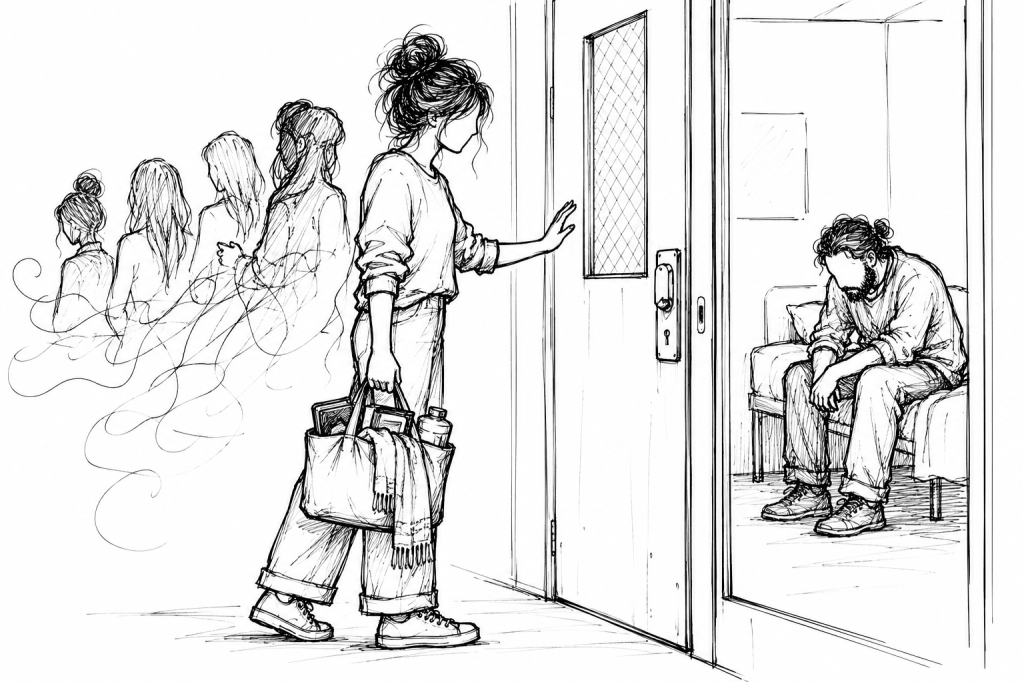
Beforehand, I went to his flat and collected some clothes for him and stuff he’d asked for. I went into town and bought him books and toiletries I thought he might enjoy or need.
I had never been inside a psychiatric ward before.
Everything about it felt strange and unfamiliar: the security, the locked doors, the awareness that I was entering a place most people only ever imagine.
It was a male ward, and there seemed to be almost as many staff as patients. The woman in charge was kind to me, and Stephen and I were allowed to sit together in a visitors’ room and talk.
There was something surreal about being there.
Stephen still seemed very out of touch.
The member of staff checked everything I had brought with me, presumably making sure there was nothing prohibited or potentially dangerous.
Then Stephen began criticising some of the things I had chosen to bring for him.
The member of staff reminded him that perhaps he should be more grateful for the trouble I had gone to.
The following day, Stephen and I were supposed to be going to The Traitors Live Experience together. It was a Christmas present from me to him.
Instead, he was in a psychiatric hospital.
I went with my youngest son’s girlfriend.
My life was carrying on outside those locked doors while Stephen’s had abruptly stopped.
We also had the Brixham Pirate Festival coming up in May. Stephen hoped he would be out within a couple of weeks and still be able to go with me.
We had both been buying numerous items which when put together would create stunning costumes for us to wear.
Before I left him, I told him I would stick by him through this.
But I needed one thing from him.
I was becoming increasingly uneasy about his developing relationship with K. After everything I had recently discovered, I knew I couldn’t support him through a psychiatric crisis while simultaneously wondering which woman might be waiting in the wings.
I told him I would stand beside him, but I didn’t want other women visiting him.
Stephen promised me they wouldn’t.
I returned to the hospital on Bank Holiday Monday to visit him again.
Only a few weeks earlier, I had been trying to understand how a man who claimed to love me could repeatedly risk losing me for other women.
Now I was walking through locked doors to visit that same man on a psychiatric ward.
I didn’t know what would happen to Stephen.
I didn’t know what would happen to us.
But seeing him reduced to that level of distress had awakened something in me that betrayal had never quite managed to extinguish.
Compassion.
And once again, compassion made leaving much harder than staying.
Reflection
I was beginning to understand why letting go of Stephen had become so difficult. Nothing ever seemed to reach a conclusion. Every betrayal brought another explanation, another conversation, another glimmer of hope that perhaps we were finally getting somewhere. I had become so invested in understanding what was happening inside his mind that I sometimes lost sight of what was happening to me. I kept believing that if we could find the reason for his behaviour, we might also find the solution. Understanding had become my way of keeping hope alive.
But the damage was reaching into parts of my life I had once taken for granted. I had become so accustomed to noticing the women Stephen noticed that I was doing it even when he wasn’t there. His infidelities had followed me into our most intimate moments, where I could no longer separate the man I loved from the women he had been with. I was still searching for the closeness we had once shared, but even when it was physically possible, emotionally it was slipping further away. I hadn’t simply lost trust in Stephen. I was losing the ability to feel safe in his love.
There was something particularly painful about hearing Stephen acknowledge so much of what had gone wrong. He seemed to understand the boundaries he had crossed, the damage he had caused and the reasons his behaviour needed to change. Those conversations mattered to me because they suggested that he was finally beginning to see what I had been trying to show him for years. But I was slowly recognising that understanding something and doing something about it were two very different things. I could help Stephen recognise a problem, but I couldn’t make him take responsibility for solving it.
And then I saw him in hospital. Nothing could have prepared me for the shock of seeing someone I had known so intimately reduced to such terrible distress. For a while, the betrayals seemed almost insignificant beside the frightening reality of his illness. They weren’t insignificant, of course. The damage was still there. But so was my love for him, and so was my compassion. I couldn’t look at Stephen in that state and see only the man who had hurt me. I saw the man I had shared five years of my life with, frightened and unwell, and every instinct I possessed wanted to comfort him.
Perhaps that was the greatest difficulty of all. I was beginning to understand that loving someone didn’t make me responsible for saving them. I had learned that I couldn’t be Stephen’s therapist or his crisis service, and I was trying to establish boundaries that protected us both. But knowing where my responsibility ended was very different from accepting it emotionally. I could recognise how much he had hurt me and still be devastated by his suffering. I could know that I needed to protect myself and still want to stand beside him. I was beginning to understand that compassion and self-preservation didn’t have to be opposites. I just hadn’t yet learned how to practise one without abandoning the other.


