
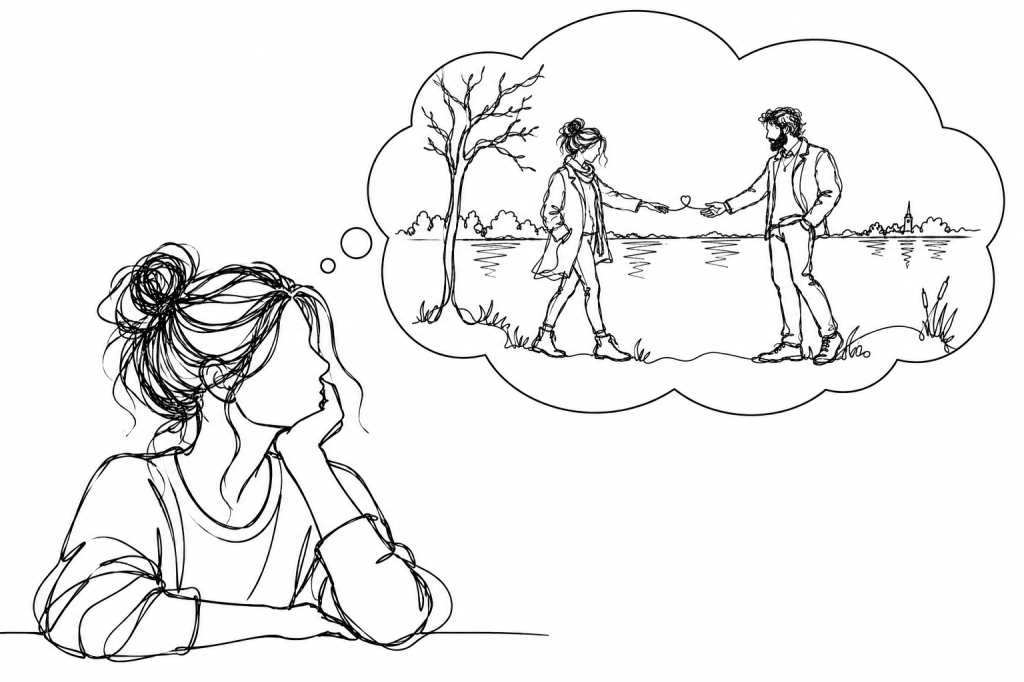
For several days, Stephen had existed partly in my imagination.
Now he was walking towards me through the trees.
And perhaps the most important thing about that first meeting was that reality didn’t disappoint me.
He was as attractive to me as his photographs had suggested. His voice belonged perfectly to the man approaching me. The humour translated. The conversation still flowed. The chemistry I’d been so careful not to take for granted was there almost immediately.
I had been right to be cautious.
But Stephen had also been right to be confident.
We liked each other.
There is something significant about having a fear disproved.
I’d spent the previous few days reminding both of us that we could meet and feel nothing. I had deliberately resisted allowing our messages to become evidence of a relationship that didn’t yet exist.
Then we met, and instead of puncturing the fantasy, reality seemed to confirm it.
That made it easier to trust everything else.
His reaction to seeing me certainly helped.
I can still remember that little growl.
It was an extraordinary response from a man meeting me for the first time, and I noticed its intensity immediately. But I didn’t experience it as threatening. I experienced it as spontaneous.
Stephen hadn’t carefully selected words designed to flatter me. His body appeared to react before his mind had time to intervene.
After wondering why this younger, handsome man was so interested in me, suddenly I had an answer standing directly in front of me.
He fancied me.
There was something wonderfully uncomplicated about that.
And I loved it.
I’d expressed insecurities about my age and my body before we’d met, and now the man who had reassured me through a screen was looking at me as though those concerns had been completely unnecessary.
There is reassurance in words.
There is considerably more reassurance in feeling somebody’s attraction.
Looking back, I think that first meeting strengthened something that had already begun happening between us. Stephen was making me feel extraordinarily desirable, while I seemed to be making him feel extraordinarily accepted.
Those are powerful things to exchange.
Perhaps we were simply fortunate enough to meet at a moment when each of us had something the other particularly needed.
I had come from the uncertainty of dating, from being left trying to decipher mixed messages and unexplained disappearances. Stephen offered the opposite. There was no ambiguity in his attraction. No wondering whether he liked me. No careful rationing of enthusiasm.
He seemed delighted by me.
What was I giving him?
I can only wonder.
Perhaps my enthusiasm matched his in a way he hadn’t experienced for some time. Perhaps he enjoyed being with someone who was curious about him rather than frightened by the complications he’d already revealed. Perhaps my acceptance made it easier for him to relax into the intensity he was already feeling.
Or perhaps he simply fancied me enormously and was having a wonderful first date.
Not everything needs a psychological explanation.
Still, there were little moments when I noticed that Stephen and I might experience intensity differently.
The presents were one of them.
The gifts themselves were thoughtful rather than extravagant. He had listened. He remembered the gin I liked. He wanted to share a film that meant something to him.
It was the labels that caught my attention.
The words belonged, in my mind, to a relationship further along than ours.
And I noticed.
That matters to me now.
I didn’t blindly absorb everything Stephen offered because I was intoxicated by the attention. Some part of me remained capable of standing outside the experience and measuring it.
This is lovely.
This is exciting.
This is also rather a lot.
What interests me even more is Stephen’s reaction when I drew attention to it.
He became embarrassed.
He wanted the label back.
That small moment makes me reluctant to retrospectively place a sinister interpretation on his early intensity. What is sometimes called love bombing involves overwhelming someone with affection, attention or promises, and the term is now used remarkably casually. Intensity alone doesn’t tell us someone’s motivation.
Perhaps Stephen wasn’t strategically trying to accelerate intimacy at all.
Perhaps he simply felt things intensely.
Maybe he’d written something romantic while caught up in the excitement of our conversations and, once he was sitting beside the actual woman who would read it, suddenly realised how exposed he’d made himself.
His embarrassment felt genuine to me.
And my response was revealing too.
I took the label.
I kept it.
Part of me had recognised that it was too much, too soon.
Another part of me was charmed by exactly the same thing.
Those two reactions could exist simultaneously.
That would become important.
My instincts rarely arrived as enormous alarms telling me to run. More often they were small observations.
That’s a little intense.
That’s not quite what I expected.
Didn’t he say he was only an occasional smoker?
Then another piece of information would arrive and give the observation context.
The romantic label was too much—but he seemed embarrassed by it.
The physical attention was intense—but I was attracted to him too.
The cigarettes were more frequent than I’d expected—but smoking wasn’t exactly a moral failing.
Nothing required a dramatic response.
And that’s something hindsight can easily flatten.
When we know that genuinely serious things happened later, there is a temptation to line up every early imperfection and call it evidence. But life isn’t lived backwards. A man smoking two cigarettes on a first date isn’t a warning of betrayal. An overly romantic gift label isn’t proof of manipulation. Intense attraction isn’t evidence of instability.
They were simply information.
I noticed them.
Then I continued gathering more.
And most of the information I gathered that afternoon was wonderful.
Stephen was funny. Interesting. affectionate. Thoughtful. Sexy. He listened. He remembered things I’d told him. We could talk easily. We could laugh. We were physically drawn to one another.
Most importantly, I felt remarkably comfortable with him.
The woman who had walked towards those woods wondering whether she was about to be disappointed was now finding excuses to extend the date.
First the lake.
Then the canal.
Then another bench.
Then the car.
Then the promise of seeing each other again that evening.
Neither of us wanted to stop.
There is a psychological concept called reward prediction error. Put simply, when something turns out better than we expected, the difference between expectation and reality can make the reward particularly powerful.
I had deliberately lowered my expectations.
Stephen exceeded them.
Perhaps that was part of the exhilaration.
But there was something else I want to preserve when I remember that afternoon.
I was happy.
Not deceived. Not foolish. Not a future victim walking unknowingly towards disaster.
Happy.
I had taken a chance on someone and, for those few hours at least, the chance appeared to have paid off spectacularly.
Whatever I understand about our relationship now doesn’t give me the right to take that afternoon away from the woman who lived it.
She noticed the things that didn’t quite fit.
She also noticed everything that did.
And on that first afternoon, there was far more of the latter.
So when I dropped Stephen home and agreed to return later, I wasn’t overriding some enormous internal warning telling me not to go back.
I was following something else my instincts were telling me.
I really like this man.
The difficult part would come much later, when those two kinds of instinct began telling me very different things.


