Stephen And An Ordinary Year (Part II)

The months rolled on.

June marked my first anniversary in the new job.

When I had started, I had told both myself and Stephen that I would give it a year.

By the time that year arrived, however, something unexpected had happened.

I had become good at it. I was enjoying it.

I had adjusted to the uncompromising demands and grown considerably more confident. I was also given a generous pay rise of almost £5,000 a year more.

Leaving suddenly seemed less sensible.

Stephen had stopped attending martial arts by then. But he had now sought legal advice about the inherited house with his brother because a year of correspondence with him had proved fruitless. He wasn’t spending much time in the spaces he had once asked me to create for him, and during the year he failed his driving test twice. He stopped trying after that.

But he was busy working with the stone specialist and travelling to Scotland.

And the conversations about other women, sex and alternative relationships seemed to have quietened down.

Life became predictable again.

For me, predictability felt reassuring.

In July we took another holiday.

This time we tried a shepherd’s hut.

Part of our thinking was that we could experiment with different kinds of small living and discover what might suit us best.

We learned very quickly that a shepherd’s hut probably wasn’t it.

It was tiny.

There was almost nowhere to spend time except the veranda or the bed. Fortunately, the weather was beautiful, so we could sit outside, but I missed the experience I’d loved at the cabin — pottering around, cooking, clearing up and pretending for a few days that this little place was our home.

On our first evening, we walked over to an event at the vineyard opposite the lake. There was a band playing, food to try and wine from the vineyard. Locals wandered around talking to one another.

We met an older couple and spent several hours chatting with them.

Stephen sat mostly with the woman while I talked to the man. There was some harmless flirting on all sides, but I felt completely comfortable.

This felt different.

It felt shared.

It reminded me much more of the kind of openness I had tried to describe to Stephen years earlier — being sociable, playful and interested in other people without anything threatening the relationship underneath it.

I liked us that way.

During the holiday we also took an extraordinarily long walk to the next coastal town, and towards the end of the trip we visited my son’s girlfriend’s parents, who lived nearby.

We spent a beautiful day with them. They showed Stephen around Mersea Island and the four of us got on easily as couples.

Again, I took comfort from it.

Stephen was increasingly woven into my family and my wider life.

Near the end of the holiday, however, we had another argument about sex.

I can no longer remember exactly what started it.

I remember only the frustration.

There seemed to be increasing confusion between us about what we each wanted and what we expected from the other.

That saddened me.

Affection and intimacy had already become less frequent in everyday life, largely because our lives were so busy. Holidays should have been the opportunity to rediscover that side of ourselves.

Instead, twice on holiday, we had ended up arguing about it.

Still, life carried on.

Another of Stephen’s birthdays arrived, and I surprised him with a dance performance telling the story of Ip Man and the growth in popularity of Wing Chun, the martial art Stephen loved.

He had introduced me to the Ip Man films and I had really enjoyed them, so I was enormously pleased with myself for finding another birthday surprise that genuinely impressed him.

These were the rhythms of that year.

Work.

Home.

Saving.

Stephen’s jobs.

Scotland.

Occasional holidays.

Plans.

Birthdays.

Arguments that came and went.

There was nothing that felt catastrophic.

Nothing that made me think our relationship was approaching some kind of crisis.

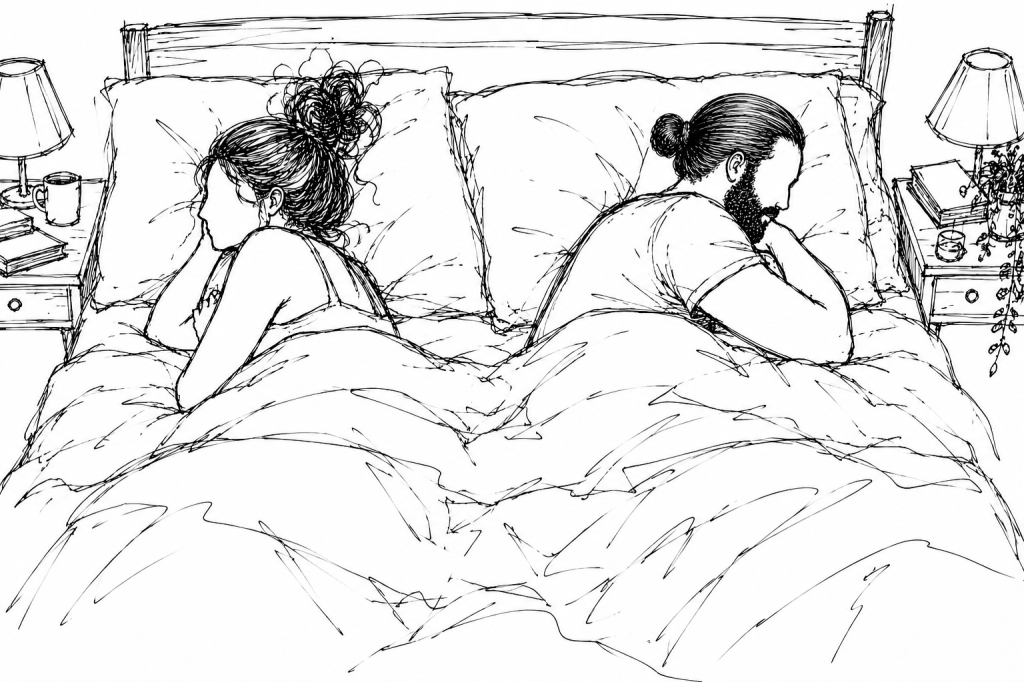
But as the year moved towards autumn, I did begin to recognise that something between us had become flatter.

Our chemistry wasn’t quite what it had been.

Neither was our intimacy.
I had gained weight and felt increasingly unhappy with my appearance. My confidence had suffered.

And I began wondering whether the job I had taken partly to improve our future was actually costing us too much in the present.

I had saved a respectable amount of money, but a surprising amount of my increased salary disappeared into petrol and maintaining a lifestyle made less healthy by the fact that I had so little time.

The job itself remained extremely difficult.

My employers were demanding and often unreasonable. I worked hard to meet their expectations, but increasingly felt I was fighting a losing battle. There was little willingness to work with me, and they could be dismissive and rude, showing scant regard for their staff or any real respect for the boundaries of our working hours.

I had tried incredibly hard to adapt.

After more than a year, I finally began accepting that perhaps I couldn’t.

Then one day in October, after an especially difficult day at work, an accident on the M25 turned my journey home into four miserable hours.

By the time I walked through the front door, I was angry, exhausted and completely depleted.

The following morning I woke up feeling really unwell and very tired so called in sick, which was rare. 

And somewhere during that day, something in me simply decided:

Enough.

I wrote an email to my manager explaining that I had tried my very best but could no longer make the job work. It was costing too much in my health and my relationships. I barely saw my friends or family anymore.

The moment I sent it, I felt lighter.

I still had two months of my contract to work, but there was now an end point.

I believed Stephen would be delighted.

Almost immediately, I contacted several agencies.

This time my priorities were different.

The managerial jobs all seemed to come with the same long hours and pressures, so I was prepared to accept less money for an ordinary housekeeping role if I could find a genuinely nice family.

I wanted my life back.

And, inevitably, part of wanting my life back meant wanting more of our life back too.

I didn’t want to return to the kind of relationship Stephen and I had once had, where I became too involved in managing his life. He had made considerable progress since attending the programme and I wanted that independence to continue.

But I missed us.

I missed having enough left at the end of the day to give to the person I lived with and whom I loved very much.

I thought that if our working lives became more compatible again, some of what had quietly disappeared between us might naturally return.

Around the same time, another change arrived.

To be continued…

Reflection

Looking back, there was still nothing about this period that felt like the beginning of an ending. If anything, the absence of drama reassured me. The conversations about other women and alternative relationships had quietened down. Stephen was working. I was succeeding in a job I had once thought I couldn’t survive. We took holidays, celebrated birthdays, spent time with family and continued talking about the future. Our relationship had become less intense, but after everything we had been through, perhaps less intensity was what a settled relationship was supposed to feel like.

There were things that had quietly slipped away. Some of Stephen’s early momentum had gone. The driving stopped. So did the martial arts. The rooms and projects that had once represented his new beginning weren’t being used in quite the way we had imagined. Our physical relationship had changed too. Sex had once been one of the easiest parts of us, and now even holidays could contain arguments about it. But none of these things seemed large enough on their own to frighten me. They looked like the ordinary compromises and disappointments of two people living a busy life together.

What I could see very clearly was what my job had done to me. I was exhausted. I had gained weight, lost confidence in my appearance and become disconnected from friends, family and much of the life I had previously enjoyed. Ironically, I had taken the job partly because I believed it would help us build a better future, yet increasingly I wondered whether I was sacrificing too much of the present to reach it. When I finally resigned, it felt less like giving something up than correcting the balance.

I also believed it might correct something between Stephen and me. I didn’t expect leaving the job to solve every problem, but there was an obvious logic to what had happened. I had become less available, less energetic, less interested in sex and less present in our everyday life. If I found work that left more of me intact, perhaps there would simply be more of me available for us again. That explanation was comforting because it located the problem somewhere tangible. Jobs could be changed. Hours could be reduced. Energy could return.

What I didn’t want was to go backwards. I wasn’t trying to become responsible for Stephen again or recreate the intensity of our earlier relationship. I still believed the programme had helped him become more independent, and I was proud of the progress he had made. I wanted something much simpler: two people with lives of their own who still had enough time and energy left to enjoy the life they shared.

So when I handed in my notice, I felt hopeful rather than defeated. I thought I had recognised something that wasn’t working and done something about it before it could damage us further. The distance between Stephen and me didn’t yet seem mysterious. I believed I knew what had caused it. And because I believed I knew the cause, I also believed I knew how to bring us closer again.
Stephen And An Ordinary Year (Part 1)

​The year of 2024 seemed, for the most part, to be a continuation of the one before it.

Stephen continued building his self-employment, taking work with the stone specialist and travelling periodically to Scotland, while I continued trying to find my feet in my demanding new job.

Life became very routine.

We worked. We came home. We ate. We slept. Then we got up and did it all again.

We still had his youngest son with us every other weekend and that continued to involve tennis practice. However, we had not heard from his eldest son since Christmas and he wasn’t responding to text messages. It was clearly starting to worry Stephen.

I was managing to save around £500 a month, which pleased me because saving had always been part of the reason I had taken the job. In my mind, every month I endured was putting us a little closer to whatever came next.

But earning more money also seemed to have created a more expensive life. Petrol swallowed a ridiculous amount of it. Vapes kept me sane through difficult working days. And far too often, when neither of us had the energy to cook, we resorted to fast food.

My diet deteriorated. I developed a dependance on fizzy cola that was readily available at work. I gained weight. My energy disappeared. 

The house wasn’t kept in the way I liked it anymore. On my days off, instead of catching up with everything, I increasingly wanted to stay in bed or do very little at the weekends.

I wasn’t particularly happy about any of that, but I saw it as temporary.

There was still a purpose underneath it.

We were working. We were saving. Stephen was gaining experience through self-employment. I was gaining experience working in another household. Scotland remained somewhere in the distance.

I never lost sight of where I thought we were going.

Earlier in the year, however, there was another difficult conversation between Stephen and me.

He was due to return to Scotland, and shortly before he left we had a huge argument.

It followed a conversation in which Stephen told me how much it bothered him that he had missed out on those younger years when many people date different people, experiment and have casual relationships.

He explained that because of what had happened during his childhood, by the time he was fifteen he had become angry and difficult. He smoked marijuana, struggled to make and maintain friendships and lacked confidence with women.

That continued at university, where he eventually met the woman who became his wife. Before her, I think he had only slept with one other person — the girl he had lost his virginity to.

Now, in middle age, he seemed to be wondering whether he had missed some important stage of growing up.

I didn’t dismiss that completely.

Perhaps he had.

But I tried to explain that the reality of sleeping around wasn’t necessarily as exciting or fulfilling as he imagined. Novelty could be exciting for a while, but for many people it quickly lost its appeal. There was also something much deeper to be found in knowing another person intimately, feeling secure with them and building a life together.

Coming so soon after our earlier conversations about polyamory, though, his curiosity unsettled me.

Why was he thinking about this now?

Once again, I found myself wondering whether I was enough for Stephen.

My attempts to reassure him didn’t appear to extinguish his curiosity, and when I became frightened I sometimes tried to protect myself by pushing the decision back towards him.

“If I’m not what you want, then tell me. Go and try that life.”

It wasn’t really what I wanted.

It was closer to saying: Please decide that you don’t want it.

But I didn’t react with fear to these conversations like I would have in the past. Since the programme, I was reassured that Stephen was simply being honest and authentic with me now. If he had realised something had changed in him, he would tell me before betraying me.

Stephen left for Scotland leaving a bad atmosphere between us.

I remember us arguing on the telephone while he was there too. Eventually, I think I told him to enjoy the rest of his trip, think about what he wanted while he was there and tell me what he had decided when he came home.

There was still some awkwardness between us when he returned.

It didn’t stop me leaving work at six o’clock and driving in the dark to Gatwick to collect him.

It was a long round trip at the end of an already long working day, but I loved him. I hated the thought that his entire trip had been tainted by the argument between us.

When our eyes met in the airport car park, we both had tears in them.

For a moment it reminded me of that morning beside the lake in Denmark, when our eyes had met after he had disappeared with my cousin.

Once we were home and talking properly again, Stephen told me how different the hostel had been with tourists staying there. It was hard to stay focused on the maintenance.

He had met lots of new people and had enjoyed some interesting conversations, particularly with a German woman. But he had also reached a conclusion about the transient lifestyle of hostels.

He didn’t like it.

He didn’t like meeting people, becoming interested in them and then watching them disappear from his life.

I took considerable comfort from that.

Perhaps he had discovered for himself something similar to what I had been trying to explain. Novelty and new people could be exciting, but perhaps what Stephen really wanted was permanence.

Something familiar.

Something that stayed.

So although he had gone to Scotland with doubts hanging between us, I felt he returned more certain.

Around the same time, Stephen went away for a couple of nights with the stone specialist for another job.

When he came home, he told me about an interesting woman I’ll call E. She had been travelling alone, and Stephen, his employer and E had eaten together in the hotel restaurant. Stephen said it had generated some good conversation and made dinner considerably more interesting than two male colleagues sitting together every evening.

I thought nothing of it.

In fact, I found it reassuring when Stephen told me about women he met when I wasn’t there.

It felt like openness.

After everything we had been through, openness mattered enormously to me.

In February, Stephen and I took what would become one of my favourite holidays of our entire relationship.

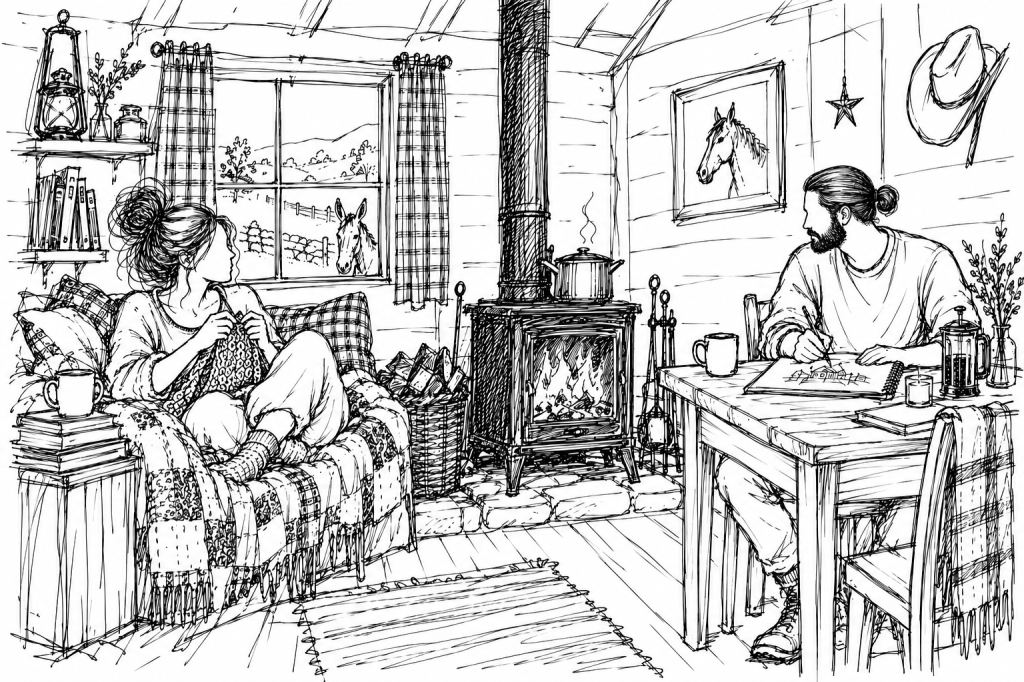
We rented a log cabin near the Black Mountains in Wales, close to the beautiful town of Hay-on-Wye.

From the outside, the cabin looked slightly like an oversized shed. Inside, though, it was gorgeous.

There was a double bedroom, a shower room and a small main living space with a dining area, a basic kitchen and a large stove for heating and cooking. Tucked away to one side was a cosy nook with a sofa, armchair and television.

It was decorated with gingham and patchwork fabrics, pictures of horses and bits of cowboy paraphernalia.

We were miles from almost everything.

The owners lived in the large house nearby and had donkeys, horses, chickens, geese and dogs wandering around the property.

There wasn’t actually very much to do.

And I loved it.

Some days I crocheted for hours. Other days I read.

Before we arrived, I had announced to Stephen that I was going to use the holiday time to reorganise my life. Since starting my new job, the housekeeping at home had deteriorated, my diet had become terrible and I spent far too much of my spare time lying in bed recovering.

I intended to make lists and plans and somehow return home as a completely reorganised woman.

I never really got around to it.

Stephen remained annoyed with me for a long time that I hadn’t fulfilled the promise. 

But I was enjoying myself too much. 

Instead, I crocheted, read and cooked.

I particularly loved making our meals. The nearest little shop was around twenty-five minutes away, so I took enormous pleasure in creating comforting dinners from whatever we could find, using only a handful of utensils and the stove.

There was something immensely satisfying about feeding the two of us in that tiny kitchen.

Every evening we settled down and watched a film on the DVD player.

It reinforced something I had suspected for years.

I didn’t need a huge house or an impressive lifestyle to be happy.

Give me somewhere cosy, some books, my crochet, a kitchen, a fire and someone I loved, and I could imagine being perfectly content.

It made the future Stephen and I had talked about feel almost tangible.

Stephen seemed to enjoy it too, although I noticed that when I disappeared into a book or my crochet, he sometimes seemed at a loose end.

He didn’t settle into inactivity in quite the same way I did.

For a moment, it concerned me.

If we really did create a quieter life somewhere one day, would Stephen actually be happy living it?

He reassured me that it would be different if the place belonged to us. There would always be jobs to do, things to repair, projects to build and land or a property to maintain.

That made sense.

My concern disappeared almost as quickly as it had arrived.

There was another moment during the holiday that was harder to dismiss.

During our recent conversations about sex and relationships, Stephen had told me that he wished I would sometimes simply take charge and initiate things.

I was surprised because I had always thought I did my fair share of initiating intimacy. Earlier in our relationship I had sometimes deliberately created occasions where I was completely in charge.

Perhaps I had done less of that since starting the new job.

That I could believe.

Most evenings I barely had enough physical or mental energy left for myself, let alone anything else.

So one evening at the cabin, I decided to make the effort.

I set everything up beside the fire and took the initiative.

Almost immediately, something felt different.

Stephen wasn’t responding with his usual enthusiasm and eventually he couldn’t perform.

What followed became our first major argument during — and about — sex.

That upset me almost as much as the problem itself.

Sex had always been one of the places where Stephen and I communicated beautifully. The conversations afterwards could sometimes feel almost as intimate and important as the sex itself.

Now we were abandoning the whole thing and arguing.

I felt rejected.

He had asked me to initiate more. I had taken what felt like a small emotional risk by doing exactly that, only to find myself wondering why he didn’t seem to want me when I did.

It left a black mark on an otherwise wonderful holiday, but it didn’t define it.

And there was something else that reassured me.

Stephen began making notes about the cabin. He drew little plans and thought about how he might design something similar for us one day.

Whatever difficulties existed between us, I looked at those drawings and saw evidence that he hadn’t lost sight of our future either.

To be continued…

Reflection

Looking back, I think this was one of the periods when it was easiest to believe that Stephen and I had finally become an ordinary couple. There were no enormous crises. We worked, worried about money, got tired, argued occasionally and looked forward to holidays. After everything we had already survived, there was something reassuring about the mundanity of it. I didn’t need our relationship to be extraordinary anymore. I wanted it to be dependable.

There were difficult conversations, but even those seemed to demonstrate progress. Stephen was telling me things I might once have feared he would keep to himself: his curiosity about other sexual experiences, the women he met while he was away, the thoughts that unsettled him. Because we had placed so much importance on honesty after the programme, I interpreted disclosure as safety. I believed that if Stephen could tell me something uncomfortable, I didn’t need to fear what he wasn’t telling me. His honesty became one of the reasons I trusted him.

What I didn’t fully appreciate was how much energy I was spending turning uncertainty into reassurance. Stephen wondered whether he had missed out sexually, but returned from Scotland talking about the emptiness of transient connections. He met interesting women, but told me about them. He seemed restless at the cabin, but explained that a home of our own would be different. We struggled sexually, but he was simultaneously drawing plans for our future. Whenever something unsettled me, there seemed to be something else nearby that allowed me to settle again.

The cabin probably revealed more about me than I realised at the time. Stripped of work, commuting, money and all the complications of ordinary life, what I wanted was remarkably simple. Somewhere warm. Something to cook. Books and crochet. A person I loved beside me. I had spent years imagining a future with Stephen, but sitting in that tiny cabin I could almost touch it. His drawings seemed to tell me he could see it too.

Perhaps that was why the argument about sex hurt so much. It wasn’t simply that Stephen couldn’t perform. I had responded to something he said he needed from me and made myself vulnerable, only to feel rejected when I did. After his questions about other women, other experiences and other ways of having relationships, it inevitably touched the insecurity that had already begun growing in me. For the first time, something that had always made me feel particularly connected to Stephen became another place where I could wonder whether I was enough.

And yet I came home remembering that holiday as one of our happiest. I think that’s important. The difficult moments weren’t hidden from me; they simply existed alongside genuine happiness. There was always enough love, companionship and evidence of a shared future to prevent any single concern from becoming the whole story. Our life didn’t feel as though it was falling apart. It felt ordinary. I hadn’t yet understood how much uncertainty can live inside an ordinary life without disturbing its surface.

Stephen Begins To Question Us

​By August, I had begun to settle into my new job, although it was still challenging and I was nowhere near the point where it felt easy.

There were other things to look forward to, though. We had a festival coming up, and my cousin R was travelling over to England and would be joining us.

While R was staying with us, I tried talking to him about what had happened in Denmark with his sister. I suppose part of me still hoped someone might be able to shed some light on something I had never really understood.

R couldn’t.

None of it had been his fault, and it certainly wasn’t the reason he had come to England, so I didn’t push it.

He and Stephen still got on extremely well. They spent a great day together in the town centre, with Stephen taking him around some of his favourite places. It was nice seeing them together and knowing that, despite everything that had happened in Denmark, Stephen’s relationship with the rest of my family hadn’t necessarily been damaged by it.

We had a brilliant day at the festival.

Getting home afterwards was considerably less enjoyable.

It took more than an hour just to make our way out with the crowds, and by the time we reached the taxi queue in the town centre, there was a long line of people waiting and virtually no taxis arriving. We stood there for what felt like forever before eventually reaching the front and climbing into one.

Even then, our journey wasn’t straightforward. The taxi broke down on the way home.

By the time we finally arrived back in the small hours of the morning, we were exhausted and enormously relieved to see the house.

Then we discovered that neither Stephen nor I had brought a key.

Our hearts sank.

It was the middle of the night, R was staying with us, and I had work in only a few hours. We went through every possible solution before I finally admitted defeat and called my eldest son, who fortunately still had a key.

Kindly, he got out of bed, made the twenty-minute drive over and let us in.

I was incredibly grateful.

We collapsed into bed, and what seemed like only moments later my alarm was waking me to face another day at work.

R returned to Denmark and overall it had been a successful and enjoyable visit.

Meanwhile, Stephen’s working life was beginning to gather some momentum.

One of the tradesmen we knew from my old job had started giving him occasional opportunities to work alongside him, mostly on jobs in London. He was a stone specialist, and I thought it was a fantastic skill for Stephen to have the opportunity to learn. Stephen enjoyed it and was good at it too.

At around the same time, Stephen’s work coach learned that he had become self-employed and encouraged him to become involved with an organisation offering free courses, support and advice to people trying to build their own businesses.

Stephen threw himself into it.

For a while, he even did some work for the organisation itself. He learned a great deal and, perhaps just as importantly, was introduced to lots of other people trying to establish businesses of their own.

It seemed exactly the kind of environment he needed.

Through the programme, he met a woman I will call P.

P offered him some work at her house — putting up pictures and shelves, assembling furniture and doing various other practical jobs.

I remember feeling slightly uneasy about it, although I wasn’t entirely sure why. At the same time, I didn’t want to interfere with an opportunity that had come through legitimate networking, nor did I want to become suspicious simply because the person offering him work happened to be a woman.

Stephen had completed the programme in London, and the problems involving women that had once seemed so prominent in our relationship had become much less of an issue.

I wanted to trust that.

On one occasion, Stephen went to stay with P for a weekend while doing work for her, sleeping overnight in her spare room.

I did have concerns about that.

Stephen reassured me. He was open about the fact that he found P attractive, but said she could also be quite strange and that there was nothing sexual between them. Their relationship, he told me, was entirely platonic.

I accepted that.

Stephen also started making trips to Scotland — to the hostel his friend owned. He would visit off season and help the permanent caretaker with the maintenance.

Stephen was also beginning to pick up customers closer to home. He had a couple of older women living in a village near our former workplace who employed him for all sorts of small jobs — putting up curtains, gardening and carrying out general maintenance around their homes.

It was genuinely wonderful to see.

His little self-employed business was beginning to take shape. He was earning money, meeting people, learning new skills and gradually building the experience we hoped might lead somewhere bigger.

Then, in October, we went on holiday.

We chose somewhere I had wanted to visit for years, and I couldn’t imagine anyone I would rather experience it with than Stephen.

Berlin.

We spent about five days there and had the most amazing time.

We were busy from morning until night — sightseeing, walking, exploring, visiting cultural attractions and finding interesting places as we went. One evening we saw one of my favourite bands in concert, a band Stephen had come to love too.

One of my favourite days was when we hired e-scooters and explored the city that way, covering far more ground than we ever could have managed on foot.

It felt adventurous and spontaneous and very us.

Berlin also reminded me of something else.

When we had the time, privacy and freedom to properly enjoy one another, the physical chemistry between us was still there.

Our sex life hadn’t disappeared. Life had simply become busy. I was working long hours in a demanding new job, Stephen was trying to establish his business, and ordinary responsibilities had a habit of swallowing time and energy.

In Berlin, away from all of that, we found each other again.

I came home reassured.

Not long afterwards, we took Stephen’s youngest son to Alton Towers, one of the UK’s best theme parks.

His eldest son had been supposed to join us too, but pulled out at the last minute without much explanation. I was irritated because I had already paid for his ticket and the money was wasted.

At the time, that was mostly what I thought about.

I couldn’t have known that his withdrawal would eventually come to mean something much more significant.

It was sometime between then and Christmas that Stephen began starting some strange conversations with me.

The first concerned my new job.

For the first time, I understood just how angry he was that I had taken it.

He told me that he had expressed concerns before I accepted the position and that I had gone ahead regardless. To him, that was evidence that I hadn’t been thinking about us. I had made a major decision about our lives without making it jointly with him.

I was confused.

I knew Stephen had raised concerns at the time, but I hadn’t understood the strength of his feelings or realised that he might see my decision as some kind of rejection of our partnership.

From my perspective, I had been thinking about us.

The job offered better money and new experience, both of which could help with the future we had been talking about building together. But I also believed I still had to think about myself.

Our relationship had not always been predictable or secure. I loved Stephen and wanted a future with him, but I couldn’t make important decisions on the assumption that nothing between us would ever go wrong again. If an opportunity came along that could improve our future together while also leaving me in a stronger position if I ever found myself alone again, I wasn’t prepared to turn it down.

Perhaps that was the difference between the way we were beginning to see things.

I thought I was protecting our future while retaining some security of my own.

Stephen seemed to experience that same decision as evidence that I wasn’t fully committed to our future at all.

There was another conversation that surprised me even more.

Stephen suggested that the onset of menopause might be affecting me.

It came completely out of the blue.

I hadn’t noticed any changes in myself that concerned me enough to seek medical advice, so although I appreciated that Stephen might be thinking about my health and wellbeing, I didn’t feel there was anything I needed to investigate.

Again, though, I had the sense that my response disappointed him. From his perspective, perhaps it was another example of him raising something he believed mattered and me not taking his concerns seriously enough.

Then came a conversation of a very different kind.

For the first time, Stephen began talking  about polyamory.

He wondered aloud whether this might simply be who he was — someone capable of loving more than one person, someone who could perhaps be happy having more than one intimate relationship at the same time.

My reaction surprised even me.

Part of what he was saying didn’t feel entirely surprising. In some ways, the idea seemed capable of explaining things about Stephen that I had struggled to understand almost from the beginning.

What I didn’t stop to ask myself was why he was raising it now.

Instead, I turned much of it inwards.

I had always believed in a monogamous relationship between two people. I thought that was what Stephen and I had been building. Hearing him wonder whether one relationship could ever be enough for him inevitably left me wondering whether I was enough for him.

It knocked my confidence.

Looking back, I think this was around the time I began comfort eating more. I became less confident about my body and more self-conscious in the bedroom. I stopped taking quite as much care of myself.

It wasn’t a dramatic transformation. There was no moment when I suddenly stopped recognising myself.

It was subtler than that.

I simply began feeling a little less desirable, a little less secure and a little less certain of where I stood.

I gave what Stephen had said a great deal of thought, but eventually I told him the truth.

I didn’t think polyamory was a life I could be happy living.

And then Christmas 2023 arrived.

Despite how difficult my new job had been, I was fortunate enough to have a decent break over Christmas, and we invited Stephen’s sons to spend it with us again.

We were disappointed when his eldest son came for only one day and one night.

We didn’t understand why he seemed to be pulling away.

And none of us knew that when he left our house that Christmas, it would be more than two years before we would see or hear from him again.

Reflection

Looking back, this period is difficult to reconcile because so much of it was genuinely good. Stephen was finally building the independent life I had hoped for him. He was working, meeting people, learning new skills and creating opportunities for himself. We travelled, went to festivals and spent time with his sons. Berlin reminded me how much fun we could still have together and how easily the intimacy between us could return when everyday pressures were removed. There was plenty of evidence that the life we had worked so hard to create was actually working.

I was also trying to live by the trust I had promised to give him. When Stephen worked for P and stayed at her house, I noticed my discomfort, but I didn’t want every woman to become a threat simply because of what had happened before. Stephen did exactly what I had once asked him to do: he acknowledged that he found her attractive and brought that information into the open. I took that as evidence of progress. We had talked about honesty being the protection against secrecy, and I believed this was what honesty looked like in practice.

What unsettled me more were the conversations that began later that year. Until then, I had believed Stephen and I were working from a shared understanding of the life we were building. Suddenly, I discovered that some of the things I had interpreted as commitment could be understood very differently by him. I saw my new job as an investment in our future while also protecting some independence of my own. Stephen saw my decision to take it despite his concerns as evidence that I wasn’t sufficiently thinking as part of an us. Neither interpretation felt unreasonable to me, but they couldn’t both describe quite the same relationship.

Polyamory disturbed me for a different reason. I had spent years trying to understand Stephen’s attraction to other women, and suddenly he was offering an explanation that seemed capable of making sense of some of it. Perhaps this wasn’t something he needed to overcome. Perhaps it was simply who he was. But if that were true, it raised a much more frightening question about who I would have to become in order for our relationship to survive. I knew I wanted monogamy, yet instead of stopping there, part of me began wondering whether my inability to offer something different represented some inadequacy in me.

That was a subtle shift, but an important one. My confidence didn’t collapse overnight. I simply began looking at myself through a slightly different lens. Was I attractive enough? Sexual enough? Open-minded enough? Was menopause changing me in ways I couldn’t see? Was my independence evidence that I wasn’t sufficiently committed? Questions about what Stephen wanted gradually became questions about what might be wrong with me.

I didn’t yet feel that our life was falling apart. Quite the opposite. There was still too much happiness around us for that conclusion to make sense. But for the first time since we had rebuilt the relationship, I was beginning to wonder whether the future Stephen wanted and the future I wanted were actually the same future. We had learned the same language and believed we were building the same life. What I hadn’t considered was that we might eventually use that language to describe very different things.

Stephen And The Changing Shape Of Our Lives

​The time eventually came for me to leave the job I had been in for sixteen years.

I was ready to go, but that didn’t make leaving easy.

I had first met my employers when I was working part-time as a cleaner for a friend’s cleaning company. They were among our regular clients and also among our favourites, largely because they allowed us enough time to actually do the job properly. There was none of the frantic rushing from one house to another that often came with cleaning work. Their house was somewhere I enjoyed going.

After a couple of years, though, I decided I’d had enough of cleaning and wanted to try something new.

On my final day, I happened to be working at their house. When I told them I was leaving, their eyes lit up. They immediately turned towards one another and began whispering.

Then they came back to me with an offer.

They were planning to build a large new house and, when it was finished, they would need a full-time housekeeper. Would I be interested? In the meantime, I could work for them part-time.

I said yes.

I was thrilled.

Sixteen years later, I was still there.

The role had grown enormously during that time. I wasn’t simply cleaning anymore. By the end, I was effectively managing the household, with five people working beneath me and responsibility for keeping everything running smoothly.

And I was good at it.

I had grown with the job.

Eventually, though, I began to feel I had grown beyond it too.

I wanted a new challenge. I was confident that the skills I had accumulated over sixteen years could transfer to another household, and I was ready to earn the kind of salary I now felt my experience deserved.

So when my final day arrived, there was sadness.

Sixteen years is a long time. I had spent a significant part of my adult life working for this family. I knew the house, the routines, the expectations and the people almost instinctively. Walking away from something so familiar felt strange.

But underneath the sadness was excitement.

I was ready.

That Friday evening, after finishing work for the last time, Stephen and I went out with his old friend from martial arts and his girlfriend. I really liked her and remember thinking that perhaps she and I could become friends.

Stephen and this man had become quite close since reconnecting. His friend did DIY work and had started giving Stephen occasional jobs with him, which meant a little extra money as well as some useful practical experience.

At some point, however, Stephen told me something about him that made me uneasy.

He said his friend could sometimes be inappropriate with some of the younger women at their martial arts classes.

I didn’t particularly like hearing that.

Given everything that had already happened with Stephen and women, I wasn’t thrilled by the idea of him becoming close to a man whose own boundaries with women apparently weren’t always great.

I didn’t make a huge issue of it.

But I noticed it.

The following day, Stephen and I travelled to Worthing for a music gig.

It was a small, intimate venue and the music was good. It should have been exactly the kind of evening we enjoyed together, but Stephen was drinking heavily. During the performance, he kept disappearing from my side and spending time hanging around the bar.

I remember wondering why.

There was nothing dramatic about it. He wasn’t doing anything obviously wrong. It just seemed strange that we had travelled there together to see the concert and yet he appeared increasingly interested in being somewhere other than beside me.

By the time we left, he was very drunk.

The walk back to our hotel should have taken about half an hour, but Stephen was moving slowly, becoming distracted by everything around him and repeatedly trying to strike up conversations with people we passed.

I found myself guiding him along and, at times, practically holding him up.

There was something funny about it too. He was drunk and sociable and easily distracted, and I couldn’t help laughing at some of his antics.

But as I watched him, another thought occurred to me.

So this is what he must have been like before he met me.

I had heard plenty of stories about Stephen’s old nights out, but this was one of the first times I felt I had actually caught a glimpse of that version of him.

Then it was time for my own new life to begin.

I had deliberately given myself a few days between jobs to relax and reset, but they disappeared quickly, and suddenly my first morning had arrived.

Almost immediately, there was a problem I hadn’t properly anticipated.

The commute.

I had estimated it would take about an hour, but rush-hour traffic made it considerably longer. Still, I arrived excited and determined to make a good impression.

The day began well.

I was issued with a laptop and phone, shown around and introduced to the workings of the household. Everything felt new and unfamiliar, but also exciting.

This was what I had wanted.

Something that would stretch me.

It was a full and varied day with an enormous amount to absorb. By six o’clock, I was tired. I gathered my things and prepared to leave.

The family’s executive assistant, who was also my manager, looked at me.

“Oh, the dinner service is about to start,” she said. “You can go if you want, though.”

I looked around.

Nobody else was leaving.

How could I possibly walk out?

It was my first day.

I messaged Stephen to tell him I was going to be late and stayed.

What followed was one of the most chaotic dinner services I had ever witnessed.

For much of it, I stood to one side of the kitchen trying to understand what everyone was doing. Everyone was present. Two housekeepers, a personal assistant, the executive assistant and the very stressed and flustered chef. People moved around one another, food appeared and disappeared, and there seemed to be far too many people tripping over each other without any obvious system.

At one point, I watched my manager spend what felt like an entire minute trying to balance a sprig of parsley on top of a plate of food.

By the end of the evening, the chef was sitting on the floor, rocking and crying.

I stood there taking it all in.

And somewhere amid the chaos, a thought occurred to me.

Is this why they’ve brought me here?

Was I expected to find a solution to this?

Eventually dinner was finished, but nobody simply went home. We stayed to clear the kitchen, wash everything, put things away and prepare for the following day.

By the time I finally reached home, it was around ten o’clock.

I had left the house fifteen hours earlier.

I walked through the front door, saw Stephen and fell into his arms.

Then I burst into tears.

“I’ve made a mistake,” I told him. “I can’t do this.”

All the confidence I had felt about leaving my old job had disappeared in the space of a single day.

Stephen held me and comforted me, although I don’t remember him saying very much.

Perhaps there wasn’t much he could say.

I was exhausted, overwhelmed and frightened that I had walked away from sixteen years of security for something I simply wasn’t capable of doing.

But I am also incredibly stubborn.

And conscientious.

So I slept on it.

The following morning, I got up, pulled myself together and went back.

This time, I approached it differently.

Instead of thinking, I can’t do this, I began thinking, I need to work out how to do this.

By the end of that first week, simply making it to Friday felt like an achievement.

So I was especially happy that we already had something planned for the weekend.

Stephen and I travelled to Bristol for an outdoor music festival. Four or five bands were playing, with one of my favourite bands, James, headlining.

The weather was lovely, the atmosphere relaxed and, after the intensity of my first week, it felt wonderful to be somewhere with nothing expected of me except to enjoy myself.

We watched the bands. We sang along.

Stephen stood behind me with his arms wrapped tightly around me.

It felt good.

His eldest son was studying in Bristol at the time, so we arranged to meet him while we were there. We ended up sitting together in a pub, talking and catching up.

During the conversation, his son tried to raise something with Stephen.

He was concerned about the way his dad sometimes spoke about his own father and his ex-wife — his son’s mother.

There was a sadness in what he was saying. He seemed to be trying to explain that he didn’t think Stephen was always fair to either of them, particularly considering how much they both continued to do for Stephen’s sons.

I listened as he tried to make his point.

His son wasn’t denying that Stephen had grievances with them. He seemed to accept that they both had their faults. What he wanted his dad to recognise was that, whatever had happened in the past, they were still there.

They were still helping.

They were still doing their best.

And that meant a great deal to his son.

It hurt him to hear Stephen be so critical of them.

I wasn’t sure Stephen was really hearing what his son was trying to tell him.

Then life moved on.

A month into my new job, things already looked very different from that first terrible evening.

The commute remained difficult and the days could be long, but I was beginning to find my feet. I was learning the rhythms of the household, understanding the personalities involved and, most importantly, beginning to see where I fitted.

There were problems to solve.

And I liked solving problems.

The chaos that had terrified me on my first day was gradually becoming something I could understand and organise. Every week I became a little more confident.

Perhaps I hadn’t made a terrible mistake after all.

Perhaps I could actually be good at this.

At almost exactly the same time, however, things were moving in the opposite direction for Stephen.

Not long after I left my old job, my previous employers emailed him to tell him they no longer required him as their groundskeeper.

The explanation they gave was that they were restructuring things and redistributing the work among the remaining team.

Perhaps that was all it was.

But I couldn’t help wondering whether my departure had played a part. I had been with them for sixteen years. Stephen had come into their lives through me. Perhaps once I had gone, they simply wanted a clean slate.

Whatever the reason, Stephen was angry and upset.

And somewhere beneath his anger, I couldn’t shake the uncomfortable feeling that some of it was directed towards me.

I wondered whether, in his mind, my decision to leave had somehow cost him his job.

That hadn’t been my intention at all.

In fact, in my mind, I had taken the new job partly because of us.

We had been talking about our future—working, saving, getting ourselves into a stronger financial position and eventually creating a life of our own. The increased salary mattered to me because I saw it as a way of moving us towards that.

The long commute, the responsibility, the exhausting days and even that first night when I had come home in tears were things I was prepared to endure because I believed they were taking us somewhere.

But while I was slowly establishing myself in a new working life, Stephen had suddenly lost part of his.

And there were other changes too.

Some of the projects he had begun at home lost momentum. The spaces he had been creating were left unfinished. He stopped going to his dad’s house to help tidy things there.

At home, though, he took on more.

He did a fantastic job of shopping and cooking for us, and most evenings there would be food waiting when I eventually made it through the door.

It must have been frustrating for him when I arrived home later than I had promised, sometimes after dinner had gone cold, or when I finally sat down only to open my laptop again or answer another work call.

The job followed me home in ways I hadn’t anticipated.

And so did the exhaustion.

There were evenings when Stephen wanted us simply to relax together and I was too preoccupied with work. There were nights when I was less interested in sex.

He rarely made a fuss about it at the time. He quietly got on with things, cooked our meals and adapted around my new hours.

But I knew it affected him.

We had imagined this new chapter as something that would move both of us forward. Instead, within weeks, our lives had begun moving at very different speeds.

I was becoming busier, more challenged and increasingly absorbed in proving myself.

Stephen had lost one of the few pieces of work he had, some of his projects had stalled, and more of his days were being spent at home.

Neither of us had planned it that way.

Still, autumn was approaching. Other work opportunities for Stephen were still in the pipeline, and we had some lovely things planned together.

I hoped they would give him something to look forward to.

More than anything, I hoped these were simply the uncomfortable first weeks of a transition we would eventually settle into.

We had wanted our lives to move forward together.

I hadn’t yet considered what might happen if, for a while, they didn’t.

Reflection

Looking back, I think this was the first time our carefully constructed plan encountered ordinary life. We had spent months imagining how things would work: Stephen would become more independent, I would earn more, we would save, and gradually we would move towards the future we had chosen together. On paper, my new job belonged completely to that plan. What I hadn’t anticipated was how differently change might affect each of us once we were actually living through it.

For me, the new job was initially terrifying, but it also gave me something I had been craving. I was being challenged. There were problems to solve, people to organise and an unfamiliar world to master. The harder it became, the more determined I was to prove that I could do it. Within weeks, something that had reduced me to tears on my first night was beginning to give me confidence. My world was expanding at precisely the moment Stephen’s seemed to be contracting.

That created a tension I didn’t immediately recognise. The more absorbed I became in work, the less available I was at home. I arrived late. I answered calls. I opened my laptop. I was tired and sometimes uninterested in sex. Stephen rarely complained, and in many ways he supported me beautifully. He shopped, cooked and made sure there was food waiting when I eventually came through the door. From where I stood, this was simply what partnership looked like during a demanding period: one person carried more at home while the other adjusted to something new, knowing that eventually the balance would shift again.

But I also knew enough about Stephen to understand why the change might be difficult for him. We had deliberately tried to build him a life that didn’t depend upon my constant availability. Now, almost by accident, we were testing whether that life was strong enough to sustain him when my attention really did have to go elsewhere. Losing his groundskeeping work mattered in that context. So did the projects that gradually stalled. I could see that something was changing, but I still believed it was temporary.

Perhaps the most revealing moments were the ordinary ones. Stephen wandering away from me at the bar in Worthing. His son trying to tell him something difficult about the way he saw other people. My own discomfort about the friend whose boundaries with women concerned me. None of those moments seemed especially significant by themselves. They were simply things I noticed and then carried on from. There was no reason yet to turn them into anything larger.

What mattered most to me was that we were still together and still moving towards the same destination. I believed my long hours were an investment in us, just as I believed Stephen’s quieter period would eventually give way to new opportunities of his own. I hadn’t yet understood that two people can agree completely about the life they want to build and still experience the journey towards it very differently. For the first time since Stephen moved back in, our lives were no longer moving at quite the same pace. I noticed the distance beginning to open, but I still believed it would close again.

Building A Life With Stephen

​Just before Stephen moved back in, he bought four more Billy Connolly paintings from the gallery.

I was beginning to feel uneasy about how much money he was willing to spend on art when there were so many other areas of his life — and now our life together — that could benefit from it.

Stephen understood my concern, although he explained that these particular pieces had been especially good value. The gallery had accidentally framed them, so he had been able to buy them for the original unframed price.

That may well have been true, but I told him I thought buying art should be something he did with genuinely disposable income. We were trying to build a future together now.

We had already talked about what we wanted the next year to look like. It was going to be about getting our lives in order, working, saving and putting ourselves in a position where we might eventually buy somewhere of our own. Moving to Scotland was still somewhere we talked about too. Whatever the destination turned out to be, there was a dream taking shape between us, and getting there would require us to think carefully about money.

Every penny mattered because, in my mind, every penny was taking us somewhere.

Once Stephen actually moved in, things began happening remarkably quickly.

He reorganised the garage to make room for a workshop and brought all his tools over. His desk went into the new craft room, and I bought a daybed for the space so it could be somewhere to sit, read and daydream, while also doubling as a spare bed when we had guests.

He started taking care of the garden.

One of the first things he made in his new workshop was a bookshelf for his collection of books. I loved seeing him in there designing and building something with his hands. There was a purposefulness about him that I hadn’t seen consistently before.

Everywhere I looked, there seemed to be evidence that our plan was working.

Then he bought another piece of art, a portrait of Keith Richards by Johnny Depp.

It was his most expensive purchase yet, although after our previous conversation he chose to buy it with interest-free credit rather than paying for it outright.

That concerned me. It wasn’t simply the amount of money anymore; I was beginning to wonder why he seemed unable to stop buying art. To my eye, much of what he was buying was quite commercial. It didn’t feel as though he was searching galleries and falling in love with individual works that spoke to him. He seemed to keep walking into the same little high-street gallery and coming home with something else.

But there was another side to it.

Stephen hung the paintings around my house, and for the first time it began to feel less like the home I had previously shared with my children and more like something we were creating together.

Our home.

That mattered to both of us.

After all the years of fitting our relationship around other people’s lives and living arrangements, we finally had a space that felt like ours.

And Stephen seemed to be flourishing in it.

His progress gave me the confidence to suggest something I had quietly been considering for a while.

I had wondered for some time whether I might like to offer Stephen to return to my place of work as a groundskeeper. I wasn’t prepared to put his name forward simply because he was my partner. I needed to see evidence that he could be productive, proactive and, importantly, conduct himself professionally.

The change I had witnessed in him since the beginning of the year — and particularly since moving in — made me believe he was ready.

So I approached my bosses.

They agreed to give him work a couple of days a week.

It felt like another piece falling into place.

At almost exactly the same time, however, I was becoming increasingly disillusioned with my own job after what had, for most of the previous sixteen years, been a good working relationship.

Renovations had begun in 2020 and were originally supposed to last around a year. We were now entering our third year of effectively working on a building site, with little evidence that it was ever going to end.

My female boss’ obsessive attention to detail was becoming increasingly difficult for me to manage. Although I was the house manager, I had been largely omitted from discussions about the renovation, yet somehow I was expected to know everything that was happening. I found myself being asked to manage builders and aspects of the project despite being kept in the dark about decisions and never having agreed to become a project manager.

Inevitably, it created friction.

So, even though Stephen had only just started working there again, I told him I was going to begin looking at what else might be available to me. There was no urgency. After sixteen years, I wasn’t going to leave for the sake of leaving. But for the first time in a long time, I was ready to consider something new.

Stephen appeared to understand.

What followed was a period of about two months that I would come to remember as one of the happiest stretches of our entire relationship.

More than that, it gave me a glimpse of what I thought our future could actually look like if we eventually found a place of our own, somewhere we could both thrive.

Our lives developed structure and routine.

I had always wanted that, and Stephen appeared to benefit from it too.

We worked.

We shopped.

We cooked.

We spent our evenings and weekends together.

There was an ordinary domestic rhythm to our life that I found deeply comforting.

We also began having Stephen’s youngest son stay with us rather than them always spending their weekends together at Stephen’s dad’s house. His son had tennis practice, so we would take him and then spend an hour together waiting for him to finish.

They were such simple things.

But my own sons had grown up and moved out, and suddenly the house had family life in it again.

The three of us felt like a little family.

I liked that enormously.

Stephen’s driving lessons were going well too. He was making steady progress and becoming increasingly confident behind the wheel. It might have seemed like another small thing, but to me it belonged to the much bigger picture of what we were trying to achieve. Being able to drive would give him greater independence, open up more opportunities for work and make the life we were imagining together that little bit easier, especially if all the driving didn’t just rest with me.

It was another sign that things were moving in the right direction.

Working at the house also began opening doors for Stephen. He met one of our tradespeople, who would offer him additional work. He got to know people in the local village who needed handyman jobs doing. For a short time, he even joined the building team working on the renovation.

Finally, Stephen was beginning to establish himself as self-employed.

After all the years of uncertainty around work, I could see something solid beginning to emerge.

And while Stephen was finding his feet, I was making plans of my own.

I registered with an agency to explore jobs that might pay significantly more. Part of my motivation was personal: I had become unhappy where I was and needed a new challenge. But our future was never far from my mind either.

If I could substantially increase my salary, we could save much more quickly.

Perhaps buying our own home wouldn’t have to remain a distant dream.

I expressed interest in several positions before my agent put me forward for a job she had been trying to fill for some time.

The recruitment process was long and demanding. I went through several interviews, completed a psychometric assessment and travelled to see the property because it was a considerable distance from home.

There were sacrifices to consider.

The commute would be much longer. The working days would be longer too. I would be giving up much of the comfort and flexibility I had built up over sixteen years.

But the salary was £25,000 a year more.

That was difficult to ignore.

When I laid everything out for Stephen, he seemed concerned about how much I would be giving up, and he wasn’t wrong. But I was ready for something different, and I kept thinking about what that additional money could do for us.

Even if I only stayed for a year, I reasoned, we could save hard during that time. If I hated it, I could find another job afterwards.

It didn’t have to be forever.

It only had to move us forward.

In May, I was offered the position.

I believed I could make it work.

Around this time, another conversation between Stephen and me seemed to belong to the same question of what it meant to build a life together.

Stephen encouraged me to open a joint bank account with him. It would give us somewhere to save together, but there was another reason too. He told me it would reassure him that I was taking our relationship seriously — that I saw us as a couple and a team, rather than simply two people whose lives happened to overlap.

This wasn’t the first time Stephen had expressed doubts about that.

Occasionally, something I said or did would leave him feeling that I wasn’t fully embracing him as part of my life. I knew this was particularly sensitive for him because of the way he had described his previous relationship. There had been times, particularly when his ex-girlfriend was angry with him, when he felt she kept him at arm’s length emotionally. To Stephen, it had seemed as though she could decide when he was part of the relationship and the family around them and when he wasn’t.

He had hated that feeling, and it was something he believed had contributed to him eventually leaving.

Now, sometimes, he suggested that I made him feel something similar.

I didn’t entirely understand it.

From where I stood, there seemed to be so much evidence of my commitment already. I had stood beside him through some incredibly difficult things. I had tried to understand him when I had been hurt, forgiven things I had struggled to make sense of, and continued believing in our relationship when walking away might have been easier.

To me, all of that said: I am here. I am choosing us.

But I also understood that the way we intend our love to be felt isn’t necessarily the way another person experiences it. If there were things I was doing that left Stephen feeling pushed out or less secure in our relationship, I wanted to know.

So I listened.

I put caution aside and we opened the joint account.

I also started paying more attention to the things I said and did — wondering whether something that felt perfectly ordinary or independent to me might make Stephen feel excluded, pushed away or not fully embraced.

It seemed like a reasonable thing to do when you loved someone. Relationships required compromise. They required you to consider another person rather than simply yourself.

And if Stephen needed to feel more strongly that there was an us behind the decisions I made, I wanted to give him that reassurance.

At the time, I thought I was learning to think more as we.

I was offered the job. I handed in my notice and gave my employers six weeks to replace me. I would finish in June, take a week off and then begin my new job. They found my replacement fairly quickly, and I spent my final weeks training her and preparing to hand over a role that had been part of my life for sixteen years.

It was an enormous change.

But so much seemed to be changing for the better.

Stephen had found his feet. I hoped my employers would continue giving him work after I left, while the contacts he had made were already beginning to give him opportunities elsewhere.

I was about to start a new job, take on a new challenge and earn considerably more money.

At home, we had begun creating a life that felt settled, productive and shared.

For once, it didn’t feel as though I was waiting for our future to begin.

It felt as though we were already building it.

And although I was nervous about leaving the security of a job I had known for sixteen years, underneath the fear was excitement.

There was a reason I was prepared to take the risk.

I could see where I thought we were going.

And almost every choice I was making was intended to help us get there.

Reflection

Looking back, this was probably the point when hope became investment. Until then, much of our future had existed in conversations: places we might live, things Stephen might do, the kind of relationship we hoped we could have. Now those ideas were becoming tangible. There was a workshop in the garage, a craft room upstairs, Stephen’s paintings on the walls and money beginning to accumulate for a future we both believed we were building. For perhaps the first time, our imagined life seemed to be becoming our actual one.

And for a while, it was genuinely lovely. That matters when I look back on it. I wasn’t clinging to a relationship that felt relentlessly unhappy. I was living through one of its happiest periods. Stephen was working, learning to drive and becoming more independent. We cooked and shopped together. His son stayed with us. There was family life in the house again. The ordinary domesticity I had wanted for so long had finally arrived, and its very ordinariness made it convincing. I wasn’t waiting for some dramatic transformation anymore. I thought I was watching lasting change settle quietly into everyday life.

Perhaps that was why my own decisions began to feel inseparable from our future. Leaving a job I had held for sixteen years was a huge step, and I was doing it partly for myself. I needed change and I wanted a new challenge. But the additional money also represented possibility. Every extra pound shortened the distance between the life we had and the one I imagined ahead of us. The joint account carried a similar meaning. It wasn’t simply somewhere to put money. It was another declaration that there really was an us now, with plans that extended beyond the present.

There was something subtler happening too. When Stephen told me that some of my independence made him feel as though he wasn’t fully part of my life, I took that seriously. I began examining myself more closely. Was I holding something back? Was I making decisions as an individual when I should be thinking as part of a couple? Compromise seemed like one of the ordinary responsibilities of loving someone, and I wanted Stephen to feel secure. At the time, adjusting myself in small ways didn’t feel like losing anything. It felt like learning how to build a partnership.

The art was perhaps the one place where something didn’t quite fit. I could see Stephen becoming more purposeful in almost every other area of his life, while simultaneously watching him spend increasingly large amounts of money on something I couldn’t quite understand. But even those paintings became part of our home. They were evidence of Stephen taking up space there, making the house his as well as mine. That made it easier to accommodate the discomfort alongside everything else that appeared to be going right.

I can see now how much of myself I was beginning to place into the future we had imagined: my home, my earnings, my financial security, my decisions and increasingly the way I thought about myself within the relationship. But it didn’t feel like sacrifice. It felt like momentum. We weren’t talking about building a life anymore. We appeared to be doing it. And because I could finally see that life taking shape around me, investing more of myself in it felt less like a risk than the natural next step.

Making Space For Stephen

​When October 2022 arrived, something huge was happening in my own life.

My two sons and my eldest son’s girlfriend were moving into an apartment together. For the first time in years, I was going to have the entire house to myself.

It should have felt like perfect timing.

Privacy and freedom at home were things Stephen had always said were important to his happiness. Sharing a house seemed to cause him a great deal of stress. I had assumed that, after the isolation of living with his dad, he would enjoy being surrounded by people again, but the opposite appeared to be true. He seemed to find communal living difficult.

And now, finally, the circumstances had changed.

The irony was that Stephen wasn’t there to share it with me.

Around the time of the move, I travelled with my son and his girlfriend to stay with her parents on the east coast of England. I really enjoyed the trip, but my mind was slightly elsewhere. Stephen and I were back in contact. He had completed the programme and, quietly and without my family knowing, we had begun moving towards each other again.

At night, once I had made my excuses and gone to bed, I looked forward to being able to talk to him.

When I returned home, Stephen and I met at a coffee house in my local precinct to discuss what will happen next.

He wanted me to tell my family that we were back together.

I agreed that eventually I would have to, but I also told him it needed to be handled carefully. My family had watched everything that had happened between us. I couldn’t simply announce that Stephen and I were together again and expect them not to have concerns.

I needed time to work out how to tell them.

Stephen became impatient with me.

In some ways, I understood why. One of the messages he had taken from the programme was a new sense of urgency: life was short; stop procrastinating; be honest; make decisions; take action.

Ironically, one of the things I had always said to Stephen was that if you were authentically honest with people, there was very little they could argue with. People might not like what you told them, but they were often more accepting when you simply stood behind your choices.

Now Stephen threw my own philosophy back at me.

If that was what I believed, why wasn’t I yet prepared to tell my children that we were planning a future together?

He had a point.

From his perspective, I probably did appear to be contradicting myself. But it wasn’t that I had no intention of telling them. I just needed time to ready myself, find the right moment and decide how I was going to explain it.

Stephen wanted action now.

I became upset.

There was something different about him. This wasn’t quite the Stephen I was accustomed to. He seemed more demanding, more confident and much more unwavering in what he wanted.

It caught me off guard.

And yet I hardly felt I could criticise him for it. This was one of the reasons I had encouraged him to do the programme in the first place. I wanted him to discover what he wanted from his life. I wanted him to stop feeling so helpless and victimised by his circumstances and start taking control of them.

Now he was doing exactly that.

I just hadn’t anticipated what it would feel like when some of that newfound certainty was directed at me.

I couldn’t cope with the conversation, so I did what I had always tended to do when I felt overwhelmed.

I ran away from him, but this time, literally.

He tried following me but I hid from his view.

He eventually found me but by then I had emotionally shut down and become silent, overwhelmed by the pressure.

Returning home on my own, I could calm down and try to think about what was actually troubling me.

Stephen had completed the programme and certainly sounded more positive, but not enough time had passed for me to know whether those changes would translate into his everyday life. Words were one thing. I needed to see what happened next.

At the same time, I understood why he didn’t want our relationship to remain a secret.

Neither did I.

The secrecy was eating me up. It felt as though I was living two separate lives.

Eventually, I worked out what I needed.

I told Stephen that before I could publicly declare that we were together again, I needed to see him begin taking control of his own life.

More importantly, he needed to build a life that existed independently of me.

I didn’t want to be in a co-dependent relationship anymore.

One of the biggest difficulties in our relationship had been Stephen’s tendency to seek attention elsewhere whenever I wasn’t physically or emotionally available to him. I believed that if he could shape his own daily existence and fill it with purpose, interests and other people, we would be standing on more equal ground. He would have a life of his own rather than relying so heavily on my presence and attention. 

I also asked him to tell me whenever he felt particularly attracted or drawn to another woman in a way he might feel tempted to act upon. I wasn’t asking him never to notice anyone else; attraction was human. What mattered to me was what happened next. I hoped that if he could bring those feelings into the open rather than acting on them privately, we could talk about them together before they had the chance to become something more.

I suggested he learn to drive so that more job opportunities would become available to him. He could exercise again, perhaps return to martial arts. He could reconnect with old friends or make new ones. He could continue helping his dad clear the enormous amount of clutter from the house.

And instead of repeatedly complaining about the situation with his brother and the inherited property, he could do something about it.

These were things I had wanted to say for a long time. I had tried before, but they rarely seemed to land.

Now, after the programme, it felt as though there might finally be an opportunity for him to hear them differently.

If Stephen could prove his love through consistent actions instead of merely telling me he loved me and describing the future he wanted, that would mean far more. Then I would tell my children that we were back together.

Stephen agreed.

And then something remarkable happened.

He started doing them.

In the new year of 2023, I celebrated my fiftieth birthday. Stephen took me out and treated me to a hotel stay. That evening, after a few drinks, we were talking when he said something unexpected.

He told me that, in another life, if he hadn’t been abused, perhaps he would have been bisexual.

I wasn’t entirely sure what he meant. Stephen had previously said that he could develop crushes on men in much the same way he could on women. I asked whether he ever thought about having sex with men.

He said no.

That left me unsure what to make of what he had told me. I could understand that he might experience attraction, admiration or emotional intensity towards men without necessarily wanting a sexual relationship with them. Still, I wondered why he was telling me this now, and the conversation stayed somewhere in the back of my mind.

Elsewhere, though, I was seeing exactly the kind of change I had hoped for.

Stephen signed up for driving lessons.

He bumped into an old friend from his carpentry course who also enjoyed martial arts, so they began attending classes together.

He helped his dad take loads of unwanted belongings to the tip.

He wrote a letter to his brother to discuss what could be done to settle the dispute over the inherited house.

This was the most dynamic I had ever seen him.

For years, I had watched Stephen talk about the things he wanted to change while somehow remaining stuck in the same circumstances. Now there was movement.

Finally, he seemed to have found some of the fearlessness I had hoped the programme would ignite in him.

And that gave me more evidence.

When I would tell my family that Stephen and I were back together, I didn’t have to tell them simply that things were going to be different this time.

I could tell them what he had actually done.

He had completed the programme. He was learning to drive. He had returned to martial arts. He was helping his dad. He had written to his brother.

He wasn’t just talking about changing his life.

He appeared to be changing it.

It was also here that I began to construct a narrative I would carry with me from this point onwards. Stephen was not a conniving, manipulative deceiver who chased women and knowingly betrayed me. He was confused and misguided, certainly, but inherently a good man — someone whose behaviour needed understanding rather than condemnation. Whatever mistakes he had made, I convinced myself they were not deliberate. He would never knowingly cheat on me.

It was an explanation that allowed me to keep believing in the man I loved, even when his behaviour would begin to tell a more complicated story.

So I told my family about us becoming reunited.

I don’t think anyone was particularly thrilled, but they accepted my decision.

It was a relief to be transparent again. I knew they would soon see what I was seeing, and their faith would be restored too.

It felt like further evidence that the programme had worked for us.

There was still one thing troubling Stephen, though.

We weren’t living together.

He continued to become sad and frustrated about it, and I began to feel that perhaps this was the final thing standing between us and the relationship we both wanted.

So I asked him a question.

What was missing in his life?

What did he actually need in order to feel happy?

Stephen’s answer was surprisingly specific.

He wanted somewhere he could be creative.

He wanted a garden.

He wanted a workshop.

And he wanted to be self-employed.

For the first time, those things were potentially within reach.

My sons had moved out. My eldest son’s bedroom was empty. I had a garden. I had a large garage.

Perhaps we didn’t have to return to the old arrangement at all.

Perhaps we could create something different.

I began thinking about how it might work.

Stephen could register as self-employed and start looking for work. If he moved in, he could divide his weekdays between his dad’s house and mine. He could spend a couple of days helping his dad tackle the hoarding and then spend several days at mine working on the new spaces.

My son’s old bedroom could become a creative room — somewhere Stephen could make things, think and be inspired.

There was the garden for him to work on.

And the garage could become his workshop.

While he was staying with me, he could sometimes do the shopping, cook meals and help with the housework.

I would still be the main breadwinner, but if Stephen was building his business, helping his dad and contributing to our home, perhaps it wouldn’t feel as though everything rested on me.

Most importantly, he would have structure.

He would have projects.

He would have things that belonged to him.

I believed that if his days were fuller and his life had a greater sense of purpose, some of the old problems might become less likely too. He wouldn’t be sitting around waiting for my attention whenever I was at work, tired or occupied with something else.

To me, it felt like a genuine compromise.

Stephen loved the idea.

He became enthusiastic about everything we could create.

And gradually, I became excited too.

By spring, I told him he could move back in.

For the first time, we would have the house to ourselves. Stephen would have the privacy he had always wanted, the creative space he said he needed, a garden to work in and a garage he could turn into a workshop. He would be building his own working life while contributing to ours.

After everything that had happened, it seemed as though we had finally found a way of putting the pieces back together differently.

It felt like something really amazing was about to happen.

Reflection

Looking back, I can see how carefully I tried to make this decision. Letting Stephen move back in wasn’t simply a surrender to love or loneliness. I had conditions. I wanted evidence. I wanted him to build a life that didn’t depend entirely on me, and for several months I watched him do many of the things I had asked of him. He learned to drive. He returned to martial arts. He confronted problems he had previously avoided. For the first time, I wasn’t just listening to Stephen tell me that things would be different. I could actually see him doing things differently.

That mattered because I had begun to understand our earlier relationship as a problem we might be able to solve. Stephen had struggled without enough purpose, independence or structure. He had found communal living difficult. He had relied too heavily on me for companionship and reassurance. If those things had contributed to what went wrong between us, then perhaps changing the circumstances could change the outcome. An empty bedroom, a garden and a garage weren’t simply spaces in my house. In my mind, they represented independence, creativity, work and purpose. I wasn’t trying to recreate our old life. I thought we were designing a better one.

I was also constructing an understanding of Stephen that made trying again possible. I didn’t believe I was dealing with a man who consciously set out to deceive or betray me. I believed I was dealing with someone damaged and confused, whose behaviour sometimes became destructive when he was overwhelmed. That distinction mattered enormously. If the problem was character, there was very little I could do with it. If the problem was behaviour arising from things Stephen could learn to recognise and manage, then change remained possible. The programme, and everything I saw him doing afterwards, appeared to support the version I desperately wanted to believe.

What I couldn’t see was how much responsibility I was still quietly carrying. I wanted Stephen to have a life of his own, but I was helping design it. I identified the driving, the exercise, the friendships, the work, the relationship with his father and the problem with his brother. Later I found the physical spaces in which his new life could happen. None of this felt controlling or sacrificial to me. It felt loving and practical. I was trying to create the conditions in which both of us might thrive.

And perhaps that is what making space for Stephen really meant. I wasn’t merely clearing a bedroom or sharing my home again. I was making space for the possibility that everything we had been through could become useful rather than simply painful. I thought we had understood what had gone wrong. I thought Stephen had begun changing the things that needed to change. And I thought I had learned enough not to lose myself in the process. By the time I invited him back, it didn’t feel like returning to the past. It felt like we were finally doing the future properly.

Stephen Chooses Me

The time finally came for Stephen to attend the programme in London.

It would take place over three long, intensive days, and having done it myself around twenty years earlier, I was able to give him some idea of what to expect.

I genuinely believed he would enjoy it.

There would be hundreds of new people to meet and talk to, opportunities to stand up and speak about his life, and encouragement to examine his relationships with the people closest to him. He would be challenged to look at where things had gone wrong, where he might have contributed to those breakdowns, and whether there were conversations he needed to have with people from his past.

But beneath my enthusiasm for him was something much bigger.

I was banking an enormous amount of hope on those three days.

I didn’t expect a personal-development course to magically change Stephen into somebody else. That wasn’t what it had done for me. But I knew how powerfully it had once challenged me to look at myself: my choices, my relationships, the stories I told myself and the responsibility I had for the direction of my own life.

And after everything that had happened between us, I desperately wanted Stephen to do the same.

I wanted him to look honestly at the events of the previous couple of years. The complaints at work. The problems with boundaries. Denmark. The hurt he had caused me. The uncertainty that had followed. I wanted him to examine those things without running away from them, minimising them or becoming overwhelmed by them.

Most of all, I wanted him to decide what he wanted.

Did he want this relationship?

Did he want the future we had spent so long imagining together?

And if he did, was he prepared to take responsibility for what would be required to protect it?

Stephen booked himself into a hotel in London for the duration of the programme. The days would run from nine in the morning until well into the evening, and I knew from experience how exhausting it could be. I wasn’t expecting to hear much from him while he was there.

So I waited.

When he called me after the first day, I could hear something immediately in his voice.

He was animated.

Enthusiastic.

He had enjoyed it.

He talked about the people he’d met, the conversations he’d had and the things he had been thinking about. And as I listened, I felt something inside me begin to loosen.

The same thing happened the following evening.

Stephen wasn’t merely enduring something I had persuaded him to do. He appeared to be embracing it.

The relief was enormous.

Better still, he was beginning to understand the language that had stayed with me since I had done the programme myself. Words and ideas that had meant something very particular to me—integrity, authenticity, responsibility—now meant something to him too.

For the first time, it felt as though we had a shared language for some of the things we had struggled so badly to communicate about.

Perhaps now, when I talked about accountability, he would understand what I meant.

Perhaps now, when I talked about integrity, he wouldn’t hear accusation or criticism.

Perhaps we could finally stop going around in circles and begin talking honestly about what had happened between us and what came next.

On the Sunday, on his third and final day, I travelled into London to meet him at the venue.

That evening, we joined hundreds of other people for the final session.

Friends and family had been invited to watch the participants complete the programme. Of course, I understood that there was a commercial element to it too. They relied heavily on participants introducing other people to the programme rather than traditional advertising.

But that wasn’t what mattered to me that night.

Towards the end of the session, participants were given the opportunity to stand and speak in front of the friends and family they had invited.

And Stephen stood up.

In front of that enormous room, after three days spent examining his life, his relationships, his choices and his future, he spoke about me.

Then he said that he chose me.

I cannot adequately describe the relief I felt hearing those words.

Because they weren’t being said in the middle of an argument.

They weren’t being said because I was crying or threatening to leave.

They weren’t whispered to me in bed or offered as reassurance when I was frightened.

As far as I could see, Stephen had just spent three days being encouraged to strip away excuses, look honestly at his life and ask himself what he wanted.

And after all of that, his answer was me.

Why wouldn’t I believe him?

Afterwards, Stephen introduced me to some of the people he had met during the programme. There were men and women, all of whom had shared this strange, intense three-day experience together.

One of them was a woman I’ll call B.

Stephen and B had apparently got on particularly well.

When I met her, I noticed something.

A flicker.

That familiar nervous energy in Stephen that I had noticed around certain women before.

For a moment, something inside me stirred.

Then I dismissed it.

Don’t be ridiculous.

Wasn’t this exactly the kind of thing I was supposed to stop doing? Searching every interaction for danger? Looking for evidence of old behaviour even when there might be none?

The programme was designed to help Stephen grow. It wasn’t supposed to erase his personality. He was still going to be sociable, enthusiastic and drawn to interesting people. That was part of who he was.

So I put the thought away.

The next morning, we spent some time wandering around London. Stephen took me to a gallery he had discovered nearby and showed me a photographic print of a musical artist he knew I liked.

Then he told me he’d bought it for me.

I was incredibly touched.

Later, we found a pub and had something to eat.

And we talked.

Really talked.

There was an openness between us that I couldn’t remember experiencing quite like that before. After so much confusion and pain, it felt as though we were finally meeting each other somewhere new—somewhere calmer and more honest.

We drove home later that day, and for perhaps the first time since Denmark, I felt genuinely hopeful about us.

More than hopeful.

Relieved.

I also felt that I finally had something tangible to support the decision that one day I could tell my family that Stephen and I were back together.

I had worried about how they would react. They knew what had happened. They knew how devastated I had been. Without anything having changed, I feared that taking him back might simply look like me walking straight back into the same relationship that had hurt me.

But something had changed.

Stephen had done the programme.

Both of my sons knew how profoundly my own experience of it had affected me. They understood why this mattered to me and why I believed it could matter for Stephen too.

And now I had watched him embrace it.

He had talked enthusiastically about what he was learning. We were speaking more openly. He seemed to understand ideas about responsibility and integrity that had previously been so difficult for us to navigate.

And, after being given three days to think about his life and what he wanted from it, he had stood in front of a room full of people and chosen me.

I wasn’t blindly hoping that things would be different.

At least, that wasn’t how it felt.

I believed I had evidence.

Evidence that Stephen was beginning to understand himself.

Evidence that he understood what had happened between us.

Evidence that he wanted our relationship.

And evidence that the man I loved was finally taking responsibility for becoming the man he told me he wanted to be.

Driving home beside him that night, I allowed myself to believe that perhaps the hardest part was finally behind us.

That we could put the past where it belonged.

And that, at last, we could begin building the future we had spent so long talking about.

Reflection

Looking back, I can understand why those three days felt so significant to me. I hadn’t been waiting for Stephen to become a different person. I had been waiting for something that might help us understand each other differently. For so long, our conversations had seemed to end in the same place. I would talk about responsibility and consequences; Stephen would talk about intention, emotion and what had been happening inside him. We could spend hours discussing the same event and somehow leave with completely different understandings of what had occurred.

The programme seemed to change that. Suddenly we had the same language. Integrity. Authenticity. Responsibility. Choice. These weren’t just words to me. They represented ideas that had shaped the way I tried to live my own life, and now Stephen appeared to understand them too. I thought we finally had a framework that could help us overcome the problems that love alone hadn’t been able to solve. If something went wrong, perhaps we would no longer have to disappear into endless arguments about what had been meant. We could ask what had happened, what part each of us had played and what needed to change.

That was why hearing Stephen say that he chose me carried so much weight. I had heard declarations of love from him before. I had heard promises, apologies and reassurances. But this felt different because of the circumstances in which he said it. I believed he had spent three days examining himself without me directing the conversation, and at the end of that process he had arrived at me. I wasn’t dragging him towards the future I wanted. I believed he had looked at his own life and independently chosen the same future.

Even my moment of unease around B became evidence, in my mind, that something had shifted in me too. I noticed the familiar feeling and deliberately questioned it. I didn’t want our new beginning to be built around suspicion. If Stephen was going to take responsibility for his behaviour, then perhaps I could stop taking responsibility for anticipating it. I wanted to trust what was in front of me rather than constantly searching for what might be hidden behind it.

Most importantly, the programme gave me a reason to believe that going back wouldn’t simply mean repeating what had already happened. That distinction mattered enormously. I wasn’t returning because Denmark no longer mattered or because I had forgotten how badly I had been hurt. I was returning because I believed something fundamental had changed. Stephen had chosen me, but I thought he had also chosen responsibility for himself. And because we finally seemed to have the same language for what that meant, I believed that whatever problems came next, we would know how to face them together.

Stephen And The Goodbye That Wouldn’t Hold

​In the weeks after Denmark, Stephen and I seemed to be constantly moving towards and away from each other.

One moment, I was certain it had to end.

The next, we were talking again.

Sometimes we were discussing practicalities: money, belongings, how we would begin separating the lives that had become so intertwined.

At other times, we were talking about love.

About loss.

About what had happened.

About whether there might ever be a way through it.

It was during one of those conversations that I told Stephen I didn’t want to lose him completely.

“I don’t want to lose you. By that I mean contact.”

And then I said something that probably described the weeks that followed better than I could have known at the time.

“I’ll always keep the door ajar.”

I wasn’t offering to resume our relationship.

I didn’t know whether I could ever trust him again.

But despite everything that had happened in Denmark, I couldn’t imagine simply removing Stephen from my life.

I still loved him.

And now I had another reason not to close the door completely.

I had suggested the personal-development programme I had attended many years earlier.

Stephen had been receptive almost immediately. He had looked into it, asked questions and seemed genuinely interested in what it might offer him.

That mattered to me.

I had spent so much time trying to understand Stephen myself. Perhaps this was something he needed to do without me.

But suggesting the programme didn’t suddenly make everything between us easier.

We were still raw.

Still grieving.

Still capable of hurting each other almost effortlessly.

I had begun trying to separate our lives.

There was enough of Stephen in my house to fill my car. Clothes. Possessions. The ordinary accumulation of a relationship that had gradually spread itself through drawers, cupboards and rooms.

Among it was his birthday present.

For the second year in a row, his birthday had become tangled up with betrayal.

I made arrangements to return everything to his dad’s.

I wanted the reminders gone.

At one point, I told Stephen I needed to eradicate the things that kept the wound open.

I deleted the photographs of us from my phone.

There had been hundreds.

Trips.

Christmases.

Walks.

Concerts.

Ordinary evenings.

Pictures of a relationship that, until Denmark, I had largely thought of as extraordinarily happy.

Deleting them felt brutal.

Stephen would remember that act for a very long time.

So would I.

There were other reminders that life was beginning to continue without him.

Only days after returning from Denmark, I attended a family celebration without Stephen.

I had been looking forward to going with him. Instead, I sat there alone, surrounded by people celebrating something wonderful, trying to participate while feeling as though part of me was somewhere else entirely.

Later, my sons and their girlfriends invited me out for drinks.

We went to a cocktail bar that Stephen frequented. The same one he stayed out late at, striking up conversations with strangers.

I knew what they were doing.

They were trying to look after me.

Trying to get me out of the house.

Trying, perhaps, to remind me that there was still a life around me that had nothing to do with Stephen.

I was grateful.

But I wasn’t free of him.

Part of me wondered whether he might walk through the door.

Even now, knowing everything that had happened, some part of my attention remained tuned to the possibility of Stephen appearing.

And Stephen and I were still talking.

That evening, another conversation began to unravel.

The exact argument is difficult to reconstruct because some of it happened by telephone, and Stephen and I subsequently disagreed about what had actually been said.

What I remember—and what my messages afterwards make very clear—is how I experienced it.

Stephen wanted to continue talking about something that felt urgent to him.

I was with my sons.

I felt that he was asking me to put his emotional needs above the people I was actually with and, once again, M became part of the conversation.

On the telephone, I understood Stephen to be telling me that the conversation couldn’t wait.

That if I wasn’t prepared to deal with it then, perhaps we needed to cut ties.

I was devastated.

I blocked him.

My sons, who had taken me out to try to cheer me up, ended up consoling me while I cried and panicked.

Hours later, Stephen and I were arguing about the argument.

He insisted I had misunderstood him.

He said he had known I needed to spend time with my boys. He had intended to continue writing down his thoughts while he waited for me to become available.

That wasn’t how I remembered the phone call.

“You said you couldn’t wait and hung up,” I told him.

Stephen said that wasn’t what he had meant.

I wished aloud that I had a recording of the conversation.

There was something painfully familiar in that.

Once again, Stephen and I weren’t only disagreeing about what should happen between us.

We were disagreeing about what had happened between us.

I told him I took him at his word.

If someone told me something, I believed that was what they meant.

Stephen believed there had been a misunderstanding.

Neither of us seemed capable of persuading the other.

And eventually I told him I didn’t want to speak to him.

That is where the surviving WhatsApp record from this period ends.

Perhaps that is appropriate.

Because there was no clean conclusion.

No final message in which we calmly accepted that the relationship was finished.

No dramatic declaration that we were going to try again.

Just another rupture.

Another attempt to close a door I had already admitted I wanted to leave ajar.

What happened between us over the following weeks is much less clearly preserved.

Without the messages, I don’t want to pretend I can reconstruct every conversation or place every moment precisely.

What I remember is the strange in-between state of it.

Stephen was no longer my partner.

But he wasn’t quite absent either.

I was trying to build a life that didn’t include him while still carrying the emotional weight of one that had.

And somewhere in the background was the programme.

The idea had been planted.

But Stephen wouldn’t actually attend until the end of September.

There were more than two months between me suggesting it and him finally walking through the doors.

During that time, life continued.

We weren’t speaking to each other much.

Then, in September, Queen Elizabeth II died.

Stephen told me he was going to London to see her lying in state.

There were queues stretching for miles, with people waiting through the night for the opportunity to walk through Westminster Hall and pay their respects.

It was such a Stephen thing to do.

The event was broadcast continuously, and as Stephen slowly made his way through the queue, I knew roughly when he was getting close.

I opened the live broadcast on my laptop at work.

And I waited.

For almost two hours, I watched the endless procession of strangers filing through Westminster Hall, searching for one familiar face.

Then suddenly, there he was.

Stephen.

His hair had grown long enough to pull into a tiny ponytail.

He looked solemn.

Almost painfully so.

I hadn’t felt particularly emotional about the Queen’s death myself, but there was something strange about seeing him there.

This man who had hurt me so profoundly only weeks earlier was walking quietly through Westminster Hall, looking humble, respectful and deeply moved.

Again, there were those two versions of him.

The man whose behaviour I sometimes found impossible to reconcile with love.

And the man I knew could be thoughtful, curious, sentimental and deeply affected by the world around him.

I captured several stills as he passed the coffin and lowered his head.

Within moments, he had disappeared from the screen.

I sent him what I had captured.

He was incredibly touched.

And once again, kindness found its way back between us.

That was the difficulty.

Love didn’t disappear simply because trust had been damaged.

Affection didn’t vanish because I was angry.

Stephen could hurt me profoundly and still be the person whose face I searched for amongst thousands of strangers.

I could decide that our relationship was over and still want to give him something I knew would matter to him.

The door moved constantly.

Sometimes I pushed it almost shut.

Sometimes Stephen did.

Then one of us would reach through the gap.

By late September, however, something was finally approaching that felt different.

Not another argument.

Not another explanation.

Not another promise between Stephen and me.

On 29 September, more than two months after I had first suggested it, Stephen was due to begin the programme.

I had no idea what would come from it.

I didn’t know whether it would change him.

I joked that once he found out who he really was, he might not actually want me. But at least I’d have my answer. 

I didn’t know whether it would change anything between us.

I didn’t even know whether change would bring us closer together or finally make it clear that we needed to let each other go.

Reflection

Looking back, I don’t think I was indecisive about what Denmark meant. I knew something fundamental had been broken. I was returning Stephen’s belongings, deleting photographs and beginning to imagine a life without him. Those were real attempts to separate. But ending a relationship practically and detaching from someone emotionally turned out to be very different things.

I had imagined that once something sufficiently terrible happened, love would somehow fall into line with reason. It didn’t. I could be furious with Stephen and still worry about him. I could believe we shouldn’t be together and still want to hear his voice. I could remove hundreds of photographs from my phone and then spend two hours staring at a screen filled with strangers because somewhere among them was a face I knew intimately. None of those things cancelled the others out.

The arguments made the separation even harder. Stephen and I were still trying to establish what had happened, what had been meant and whose understanding of a conversation was correct. I wanted certainty at precisely the point when everything felt uncertain. Perhaps that was part of why I kept engaging. It is difficult to put something down when you still feel you haven’t completely understood it.

Seeing Stephen in Westminster Hall captured the contradiction particularly clearly. There was no crisis for me to solve and no argument to untangle. I simply saw someone I loved doing something I knew mattered deeply to him, and my instinct was to give him something that would matter too. Capturing those photographs wasn’t a decision to take him back. It was an act of affection. I was beginning to learn that affection could survive even when a relationship perhaps shouldn’t.

That was what I meant when I said I would always keep the door ajar. At the time, I thought I was describing contact. With hindsight, I think I was also describing my emotional position. I was trying to leave without completely letting go. The programme gave that open door somewhere to lead. I didn’t know whether Stephen would change, whether we would find our way back to each other, or whether understanding himself might take him further away from me. I only knew that I wasn’t yet ready to close the door and stop wondering.

Trying To Understand Stephen

​For a few seconds after waking, there was nothing.

Then I remembered.

It hadn’t all been some awful dream. It was real.

And now Stephen and I had to make the long journey back to England with the unspoken knowledge that our relationship was over.

My aunt had already left for work. We had been asked to lock up behind us and meet her in the town centre to hand over the keys and say goodbye.

Stephen and I dragged our suitcases through the streets to the nearest bus stop. We stood there waiting, barely uttering a word to each other.

When the bus arrived, we found some seats and I stared out of the window.

The streets of Denmark passed by — a country that had always meant so much to me, filled with childhood memories and family and belonging. Just days earlier, I had been standing in these same streets believing I was here with the man I loved, surrounded by the people I loved.

Now I could barely comprehend what had happened.

Tears filled my eyes.

Stephen remained silent.

About half an hour later, the bus pulled into the terminal and there was my aunt waiting for us. She smiled when she saw me, but I could read the sympathy all over her face.

I hugged her and thanked her. I probably apologised too, although I can’t remember exactly what I said. Everything felt embarrassing somehow, even though I had done nothing wrong. I hated that something so private and devastating had unfolded in front of my family.

We went into the station and waited for the train to the airport. It was the same station I had been standing in twenty-four hours earlier, frantically trying to understand what Stephen and M might be doing.

Now there was nothing left to chase.

On the train, I stared numbly through the window as Denmark’s flat, beautiful landscape rushed past.

Stephen still said almost nothing.

At the airport we boarded our plane and took our seats beside one another. Those cramped airline seats suddenly felt unbearably intimate. I could feel Stephen’s shoulder and arm against mine, but I couldn’t bring myself to look at him.

I tried to imagine that the man sitting beside me was a stranger.

Ironically, that was almost exactly how he felt.

Somewhere during that flight, the numbness began to wear off.

The reality of what had happened started pushing its way through, and I began to cry. I tried desperately to hide it, turning my head away and keeping as quiet as I could, but eventually I was sobbing silently and couldn’t stop.

Stephen knew.

He did nothing that was helpful.

I don’t remember much about landing in England. We retrieved my car and began the journey home. We must have spoken at some point, but I can’t remember a single thing we said.

I probably told him I was taking him back to his dad’s.

He didn’t argue.

I can’t even remember leaving him there.

Nor can I clearly remember arriving back at my own house.

There are pieces of that journey that seem to have disappeared completely from my memory. I only remember the feeling of it: an enormous emptiness, as though something that had occupied so much space inside me had suddenly been ripped out.

That evening, I told my sons the whole nightmarish story.

I expected them to be horrified.

Instead, they reacted almost as though they had been expecting something like this all along.

They had never trusted Stephen.

They were angry on my behalf and far less charitable about him than I had ever been. To them, he was a low-life. Someone who didn’t know who he was. A parasite who attached himself to other people’s energy.

It was difficult to hear.

Partly because I understood where they were coming from.

But also because their version of Stephen didn’t contain the man I knew.

They hadn’t experienced all the other parts of him. The funny, curious, affectionate, enthusiastic man who could make ordinary things exciting. The man I could talk to for hours. The man who had become woven through almost every part of my life.

Both versions seemed to exist.

And I still didn’t know what to do with that.

But understanding Stephen did not mean that everything between us suddenly became calmer.

If anything, those first few days after Denmark were extraordinarily volatile.

The following day, Stephen suddenly became intensely worried about M.

My parents and other members of my family were still in Denmark, and M was due to be around some of them. Stephen wanted to know exactly what I had told them about what had happened.

He was frightened that somebody might confront her or say something that would destabilise her.

At first, I could understand the concern. M was vulnerable. Whatever responsibility she might or might not have had for what happened between them, I didn’t want her harmed either.

But then Stephen’s messages escalated.

He told me that if anyone said anything that caused M to have a meltdown, he would “set off a ‘bomb’ in that family they will never recover from.”

I was stunned.

Only days earlier, Stephen had left me alone in my aunt’s house to follow M through the streets of Denmark.

He had refused my pleas to come back.

He had stayed at her flat.

Our relationship had ended because of what had happened between them.

And now, while I was still trying to understand the wreckage of it all, he was threatening some kind of retaliation against my family in order to protect her.

Something in me snapped.

“You are not welcome at my house or my place of work,” I told him. That morning I had told him his job was still there for him if he wanted it.

I said I would return all his belongings the following weekend and block him at midnight.

“Your choices are horrendous. I don’t want it anymore in my life.”

When he told me he was panicking and didn’t want anyone else hurt, I answered:

“You’re damaging me and it stops now.”

Stephen quickly retreated from what he had said.

He told me he would never actually do anything. Becoming threatening, he said, had been a protective reaction. He had panicked.

But by then I had had enough.

“I’ve given everything I had to give,” I told him.

“The buck stops here.”

What strikes me now is how quickly I could move between compassion and absolute certainty.

I could believe Stephen was unwell.

I could believe he was overwhelmed.

I could desperately want to understand what was happening inside him.

And I could still reach a point where I thought: No. This is unacceptable.

That evening, I meant it.

I told him I couldn’t keep living inside ambiguity, never knowing which things he said were real and which things I was somehow expected to understand he hadn’t meant.

I told him that life was a sequence of choices and hoped his next one would be to get help.

Stephen acknowledged that something was seriously wrong. He described himself as going through a major relapse and, significantly, told me that it wasn’t mine to fix.

It sounded like an ending.

Except endings between Stephen and me were rarely clean.

By the following day, we were talking again.

Stephen told me he had been tempted to check whether M had replied to a goodbye message he had sent her, but instead he had gone outside for a cigarette.

I encouraged him not to reopen contact. M had family and friends around her. She had support. Whatever had happened between them, Stephen did not need to be the person who rescued her.

Then Stephen became overwhelmed.

He told me he wished he could hold me.

A little later he said he had finally broken down completely.

Sobbing.

Wailing.

For all my anger the previous evening, hearing his pain still affected me.

“I’m here,” I told him.

“I’ve got so much love for you.”

That contradiction is difficult to explain unless you understand what those days were actually like.

I wasn’t simply forgiving Stephen.

I wasn’t simply leaving him either.

I was moving between grief, anger, love, self-protection and a relentless need to understand what had happened.

By that evening, I told him something that probably captured my position better than anything else could have.

“I don’t want to lose you. By that I mean contact.”

The following morning I was still overwhelmed by sadness and disbelief. I admitted that I worried about how badly Stephen coped with being alone — whether loneliness or boredom would send him searching for connection again, perhaps even back towards M. According to Stephen, M had begged him to return to Denmark.

He told me he had been tempted to contact her, but hadn’t.

He was trying.

And perhaps that was what kept catching me.

Whenever I reached the point of believing I had to walk away completely, I would see some small indication that Stephen understood there was a problem and wanted to do something differently.

Later that morning, an idea occurred to me.

“Would you ever consider attending the the programme I did ?”

“I would consider anything that may help,” he replied.

Around twenty years earlier, I had attended the programme myself.

For me, it had been transformative.

It centred around ideas such as integrity, authenticity, forgiveness and personal responsibility. I had carried parts of what I learned there with me ever since.

Stephen became interested almost immediately.

He asked questions. He looked at the course. He investigated the cost and accommodation and wanted to understand how it worked.

“If it helps me to get better at Life…… price doesn’t matter!” he told me.

Then, having compared it with things he had previously learned in therapeutic community, he described it as potentially the perfect “top-up” for what he had learned and forgotten.

Something about that gave me hope.

Not because I suddenly believed Denmark was forgiven.

It wasn’t.

Not because we had decided to get back together.

We hadn’t.

And Stephen wouldn’t actually attend the programme until the end of September.

But for the first time since Denmark, there was something other than another conversation between the two of us.

Something he could do.

Something that didn’t depend upon me finding the right explanation, asking the right question or somehow teaching Stephen how to understand himself.

Perhaps someone else could help him see what I couldn’t make him see.

And perhaps, eventually, that might tell us whether there was anything left between us worth saving.

Reflection

Looking back, I think this was the point when understanding Stephen became almost inseparable from loving him. Denmark had given me every reason to walk away, and at moments I was absolutely certain that I would. I could recognise when his behaviour was unacceptable. I could draw boundaries, return his belongings and tell him that I had nothing left to give. But understanding why he behaved as he did still mattered enormously to me. If there was an explanation for what had happened, some part of me needed to find it.

That didn’t mean I was excusing him. In fact, I was becoming increasingly frustrated by explanations that seemed to make sense of Stephen’s emotional state without ever accounting for his choices. He could be overwhelmed, frightened, dysregulated or desperate to protect someone, and I could have compassion for all of those things. But I was beginning to understand that intention and consequence were different. Stephen didn’t have to intend to devastate me for me to be devastated. He didn’t have to mean a threat for me to experience it as threatening. His internal reasons could explain his behaviour without making the behaviour acceptable.

The difficulty was that compassion kept reopening doors that anger tried to close. I could tell Stephen, with complete conviction, that the buck stopped here and then hear him sobbing the following day and instinctively reach towards him. Neither response was false. I was furious with him, and I loved him. I wanted to protect myself, and I couldn’t bear the thought of abandoning someone I believed was struggling. I didn’t want the relationship we had just had, but I wasn’t ready for Stephen himself to disappear from my life.

Perhaps that was why the programme gave me so much hope. For years, talking had been the way Stephen and I tried to solve things. I listened, questioned, challenged, reassured and searched with him for explanations. After Denmark, I was beginning to reach the limits of what those conversations could achieve. Suggesting the programme was an attempt to place some of that responsibility somewhere other than with me. Maybe Stephen needed something I couldn’t provide. Maybe understanding himself had to become his work rather than ours.

I can see now how powerful that possibility was for me. As long as Stephen could recognise that something was wrong and seemed willing to seek help, it was difficult to believe that all hope was gone. I wasn’t yet offering him another chance at the relationship. I was offering him a chance to understand himself. But somewhere underneath that distinction was a question I wasn’t ready to let go of: if Stephen could finally understand why he kept making these choices, perhaps one day he might learn to make different ones.

Stephen And The Denmark Event (Part III)

​He was distressed. He told me he had left M’s flat and was now wandering around, lost and not really knowing where he was.

I told him I was at the station. I had changed my flight and was waiting for a train to the airport.

He started crying.

He said he didn’t know what he was doing. He tried to explain that he had felt overwhelmed at the party. It wasn’t only M, he said. Apparently, my sister’s children had also been asking him to help them talk to their dad about some family problems. He had felt pulled in different directions, responsible for everyone, unable to cope with it all.

I couldn’t understand what any of that had to do with what had happened.

How did feeling overwhelmed explain why my cousin was lying in his arms?

How did it explain leaving the house with her?

How did it explain ignoring me while I begged him to come back?

We argued through tears, each of us trying to explain a completely different version of the same night.

And then he said he was going to find the nearest bridge and throw himself off it.

Everything in me changed instantly.

Minutes earlier, I had been leaving him.

I had changed my flight. Packed my suitcase. Walked through the quiet suburban streets as a new day dawned. I had finally removed myself from a situation that had become unbearable.

Now none of that mattered.

Whatever he had done to me, I couldn’t leave him wandering around Denmark talking about killing himself.

I told him to send me his location.

Then, at 6:40, a message appeared.

“Can you see where I am?”

“Yes,” I replied. “Why don’t you answer my calls.”

A few minutes later, another message arrived.

“I know it won’t mean much now, if anything….”

“I Love You and I am sorry.”

And there it was again.

Even after everything that had happened during the night, I loved him.

“I love you too,” I replied, “but there will always be times you find something else more important that you forget about considering me.”

By then, I had made my decision.

I wasn’t going to the airport.

Not yet.

I withdrew some cash from the ATM, hailed a taxi and put my suitcase in the boot. Within fifteen minutes, I was being driven away from the station and back towards the man I had spent the entire night begging to come back to me.

I found him standing beside a lake in a quiet suburb, smoking.

I got out of the taxi and looked at him.

He looked terrible.

So must I.

We were both exhausted, our faces swollen and our eyes full of tears. Seeing him again hurt in a way I find difficult to describe. This was still Stephen. The man I loved. The man I had travelled here with. The man who, only hours earlier, had been part of my family celebration.

And yet something enormous now stood between us.

We looked at each other and I think, for a moment, we both understood that.

I paid the driver, took my suitcase from the boot and went to him.

Then the questions came pouring out of me.

Why did you leave with her?

He said M had become upset and run off. He had chased after her to find out what was wrong. When she insisted on walking home, he couldn’t bring himself to leave her alone.

“But what about me?”

He said he hadn’t been able to think about me. All he could think about was M being distressed and needing to make sure she was safe.

I stared at him.

There had been so many other choices.

He could have shouted for my help.

He could have woken my aunt.

He could have called me immediately and my aunt could have picked them up.

He could have called M a taxi.

He could have persuaded her to come back inside.

He could have walked part of the way and then returned.

He could have answered his phone and listened when I told him that I was falling apart.

He could have done almost anything other than what he had done.

He said none of those things had occurred to him.

All he had been able to think about was looking after her.

I felt something twist inside me.

“What about my distress?”

He told me that when I threatened to end the relationship if he didn’t come back, it had made him angry.

It was almost impossible to comprehend.

I had been pleading because I was terrified of losing him.

And somehow my terror had pushed him further away.

I still needed to know what had happened once they reached her flat.

“Where did you sleep?”

He said he had got into M’s bed because the flat was so small. Surely there was a sofa?

My stomach dropped.

“What happened then?”

He told me that M had undressed down to her underwear and got into bed beside him.

I could feel the anger rising through me, but I needed to keep asking.

I needed to know.

“What happened next?”

He hesitated.

Then he told me he had tried to kiss her.

For a moment, I could barely process the words.

I had spent the entire night listening to him tell me that he was only walking her home because she was vulnerable. That he couldn’t abandon her. That he was looking after her.

Now he was telling me that once he got her home, he climbed into her bed and tried to kiss her. How is that behaviour protecting her?

“Why?”

His answer stunned me.

He said he was in bed with an attractive, almost naked woman. Wanting to kiss her had felt natural.

Then he said something else.

“You told me we were finished.”

I stared at him.

Was he seriously using that as a justification?

I had told him our relationship would be over if he didn’t come back. I hadn’t ended our relationship and released him into the night to do whatever he wanted. I had been distraught, pleading with him to turn around. I had said those words because nothing else was working. I was trying desperately to make him understand what was at stake.

I had wanted the possibility of losing me to stop him.

Instead, he seemed to have taken it as permission to continue.

“But you knew why I said that,” I told him. “You knew I was begging you to come back.”

There was no answer that could make it make sense.

And I couldn’t believe I was hearing any of this from the same man who had once told me that sharing a bed with another woman meant nothing. The same man who had insisted he could lie beside a woman without anything sexual happening because he had self-control.

I had believed him.

Now that old argument came crashing back into the present.

Another reassurance that suddenly meant nothing.

Another thing I had trusted because I wanted to believe him.

Still I kept asking.

Perhaps some part of me was waiting for the piece of the story that would hurt less.

Perhaps I wanted him to tell me that, at the final moment, he had remembered me.

That he had looked at M and thought of us.

That he had stopped because he loved me.

“Why did you leave?”

His answer took even that away.

M hadn’t wanted things to go any further than the kiss.

So he decided he should leave.

I felt sick.

He hadn’t left because he remembered me.

He hadn’t left because he suddenly understood what he was doing.

He hadn’t stopped himself.

She had stopped it.

I couldn’t understand how we had got here.

How had we travelled from the year we had just shared to this lake in Denmark, standing beside my suitcase and smoking cigarettes while Stephen explained to me how he had tried to kiss my cousin?

There were more questions. Hundreds of them.

But we were both exhausted beyond reason.

I messaged my aunt and told her where we were. I asked whether she could come and collect us.

The drive back was silent, the three of us sitting with the hollow, exhausted feeling that something terrible had happened and none of us knew what could possibly be said to make it any less real.

When we arrived, my aunt was quiet but kind to us both. There was so much that needed to be said, but none of us had the energy left to say it.

I changed my flight back to the original booking.

I wasn’t leaving after all.

Then Stephen and I went to the guest room.

Only hours earlier, I had walked away from that house believing I might never return to it with him.

Now we were back in the same bed.

I lay with my back to him.

I was so desperately sad.

Not angry anymore. Not frantic. Just broken-hearted.

I cried quietly into the pillow.

I wanted him to reach for me.

After everything that had happened, after everything I had heard, some part of me still wanted the comfort of the person who had caused the pain.

But he didn’t touch me.

He didn’t put an arm around me.

He didn’t tell me he was sorry.

He didn’t comfort me at all.

Eventually, exhaustion took us both and we slept for a couple of hours.

When we woke, M was trying to contact him.

That was when I discovered they had exchanged numbers.

Another question.

When?

Why?

At what point during that night had exchanging numbers seemed necessary?

I was furious that he took her call. He could barely speak to me without becoming overwhelmed, yet he was willing to speak to her.

We eventually got up and went outside.

We sat in my aunt’s garden, eating and drinking almost nothing, chain-smoking in near silence. Our eyes were swollen from crying. Everything around us looked exactly as it had the day before, and yet nothing felt remotely the same.

I asked him again.

Calmer this time.

I wasn’t shouting. I wasn’t pleading.

I simply wanted to understand.

Why had he done this?

He told me about Scotland.

During his recent trip there, he said, he had stayed awake all night talking to a young man who was considering suicide. Stephen had spent hours trying to convince him not to take his own life. He said the experience had taken an enormous emotional toll on him and, because we had flown to Denmark almost immediately afterwards, he hadn’t had time to recover.

Then there had been the party.

My sister’s children had apparently been asking him to intervene with their father over family problems. I hadn’t considered how much it affected him at the time.

And then there was M.

Stephen believed she was a troubled young woman, possibly with the same diagnosis as him. He said people with similar difficulties could recognise something in each other and be drawn together.

I listened.

These were explanations.

They weren’t excuses.

And there was one question I couldn’t get past.

If he was emotionally and physically exhausted, why hadn’t he come to bed with me?

Why hadn’t he removed himself from everything that was overwhelming him and come to the person he had travelled to Denmark with?

Why hadn’t he come to me? The woman whom he loved. The woman who could support and comfort him.

He didn’t know.

That seemed to happen whenever I reached the question underneath all the other questions.

He could explain the circumstances.

He could explain M’s distress.

He could explain Scotland.

He could explain my sister’s children.

He could explain feeling overwhelmed.

But when I asked the question that mattered most to me—

Why did you choose to leave me and go with her?

—there was no answer.

M arrived that afternoon.

She wanted to speak to me alone, so the two of us walked out through the front of the house and sat on a bench opposite.

I remember surprisingly little of that conversation.

Perhaps by then I had simply reached the limit of what I could absorb.

I asked her what had happened at the flat. Her account seemed to corroborate Stephen’s. But, like him, whenever I asked questions that moved away from what happened and towards why, she became distressed and confused.

Before long, we were talking about her father’s suicide, her mental health and the way the family had never really spoken about what had happened.

I understood her pain.

And somehow, sitting on that bench opposite my aunt’s house less than a day after she had disappeared into the night with my partner, I found myself comforting her.

I was devastated.

I had barely slept.

My relationship felt as though it had been ripped open in front of my family.

And still, when someone else cried, something in me automatically moved towards their pain.

The rest of that day is hazy.

At some point Stephen spoke briefly to M alone, although they remained within my sight. I remember wondering what they were saying to each other.

Then she left.

As the day wore on, my sadness began turning back into anger.

I was angry with Stephen for allowing any of this to happen.

I was angry with both of them for behaving as though I had somehow disappeared from the equation.

My aunt naturally felt protective of M, but she was also angry with Stephen. Before long, the two of us were questioning him together.

He looked frightened.

Overwhelmed.

Confused.

Eventually I realised there was nowhere left for the conversation to go.

We had to stop.

My aunt prepared a beautiful dinner that evening, but none of us could really eat it.

We sat around the table with everything that had happened hanging silently between us.

The celebration was over.

The excitement of Denmark was gone.

The easy happiness Stephen and I had arrived with only days earlier felt impossibly far away.

Eventually we went to bed.

There were still so many questions I wanted answered.

There were still things about that night that didn’t make sense.

But there was nothing left in me with which to ask them.

We went to bed in silence.

The following morning, we would begin the journey back to England.

Together.

But something had happened in Denmark that neither of us could simply pack into a suitcase and leave behind.