
Reading those conversations again, I’m struck by how sensible it all seemed.
There is a version of this story that could easily be told differently.
Stephen was unemployed when I met him.
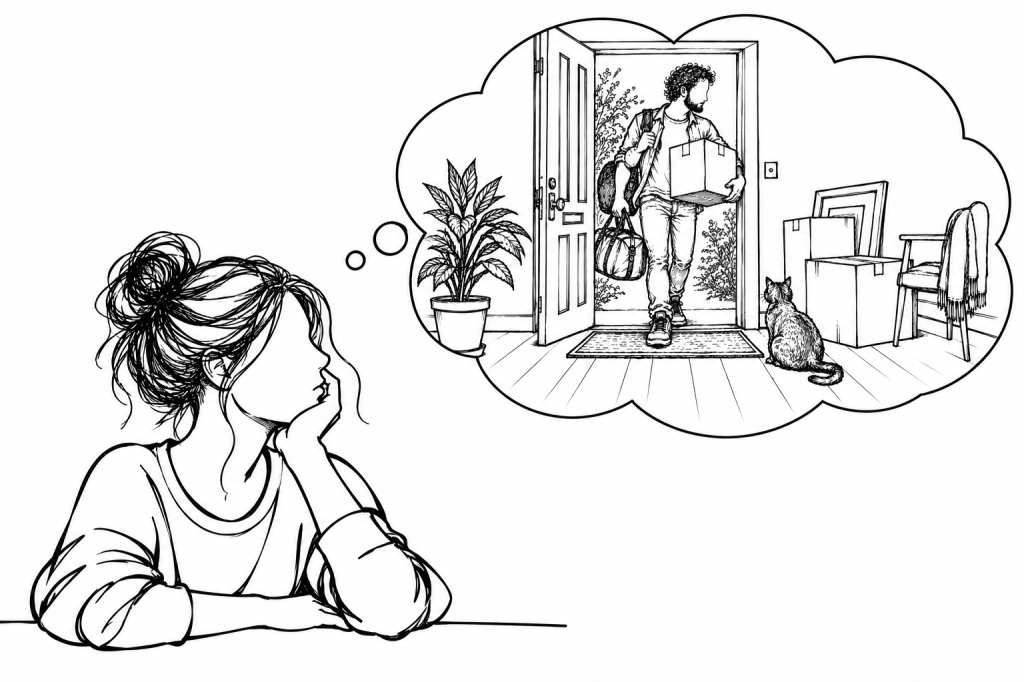
Within months, I let him move into my home.
Knowing everything that happened afterwards, those two sentences could be placed beside each other and made to look like evidence of terrible judgement.
But that isn’t what happened.
I had been clear from very early in our relationship that Stephen couldn’t live with me while he wasn’t working.
I loved him.
I wanted to be with him.
I hated the constant travelling backwards and forwards.
I knew he disliked the bedsit and struggled with being alone there.
But I still held the boundary.
Get a job first.
Then we can talk about living together.
And he did.
Not just any job, either.
It was a proper job with a good salary, doing something I genuinely believed suited him.
For the first time, I could see the possibility of us functioning as two working adults building a life together.
I had my income.
Stephen would have his.
I was already saving.
We could both contribute.
We could make plans.
There was nothing obviously reckless about that.
In fact, what surprises me most when I read the messages now is how much thought we gave to the transition.
We talked about money.
I talked to my sons about household contributions.
Stephen and I discussed what he would contribute.
We considered whether he might actually be better remaining at the bedsit while he established himself at work.
We thought about routines.
Sleep.
Shopping.
Cooking.
Showers.
Work.
Our children.
The ordinary logistics of combining two lives.
I even recognised that Stephen was facing several major changes simultaneously and told him that we needed to take the situation seriously.
“Really strategise to get this right.”
Those aren’t the words of a woman blindly sweeping a man into her home because she is in love with him.
I was trying to think ahead.
And perhaps that matters because hindsight has a habit of making bad outcomes look inevitable.
Once we know how something ended, every earlier decision can begin to look like an obvious mistake.
But decisions aren’t made with hindsight.
They are made with the information available at the time.
And at that time, the information looked encouraging.
Stephen had found employment.
He was excited about it.
I believed he would be good at it.
We were extraordinarily happy together.
We communicated constantly.
We were deeply attracted to one another.
We talked about marriage and a future.
And, importantly, Stephen seemed every bit as invested in protecting the relationship as I was.
When he worried about everything changing at once, the thing he was frightened of losing wasn’t the job.
It was us.
“I’d rather the job failed than us.”
“There will always be other jobs and other opportunities.”
“We are a one off.”
Those words meant something to me.
They told me that I wasn’t dragging Stephen towards domesticity while he reluctantly followed.
He wanted this too.
Perhaps even more urgently than I did.
And yet, reading the conversations now, there is another strand I notice.
It is subtle.
Nothing about it felt unhealthy at the time.
Stephen struggled when we were apart.
He found the bedsit lonely.
He didn’t sleep particularly well there.
Being with me, he said, made everything else feel easier and more achievable.
And I took that seriously.
When we considered whether he should establish his working routine from the bedsit before moving in, one of my concerns was whether he would cope.
Would he sleep?
Would he wake up alone and struggle to motivate himself?
Would he come home to an empty flat and become miserable?
Could that jeopardise the job?
I wanted him to succeed.
So my thinking naturally moved towards a question that would become increasingly familiar over the years ahead.
What does Stephen need in order to be okay?
At the time, there was nothing strange about asking it.
That is one of the things people do when they love each other.
We support.
We accommodate.
We think about what will help the other person thrive.
And Stephen was thinking about our relationship too.
This wasn’t yet a story of one person endlessly giving while the other endlessly took.
We were two people trying to work something out together.
But I can see the beginnings of something in myself.
When Stephen anticipated difficulty, I instinctively began looking for the solution.
If the bedsit made him lonely, perhaps he shouldn’t be there.
If starting work and moving house simultaneously might overwhelm him, perhaps we could structure the transition.
If routine was difficult, perhaps we could create one together.
If several competing demands might cause something to “slip”, perhaps we could strategise so nothing did.
There was love in that.
There was practicality in it.
There was also, perhaps, the earliest suggestion of how easily I could begin organising myself around somebody else’s ability to cope.
I don’t think I could or should have recognised that then.
There was nothing obviously alarming to recognise.
But knowing myself better now, I can see how naturally the role suited me.
I liked helping.
I liked solving problems.
I liked creating stability.
I liked making a home feel safe.
And Stephen seemed to need precisely those things.
In that sense, we fitted together beautifully.
At least at first.
There is another part of this period that feels important when I look back.
My bedroom.
Moving the bed.
Emptying the drawers.
Clearing the wardrobe rail.
Making room for his things amongst mine.
They were such ordinary acts.
But perhaps that is exactly why they mattered.
I wasn’t merely giving Stephen somewhere to stay.
I was making space for him inside a life that had previously been mine.
My home had been my security.
My bedroom was my sanctuary.
I liked order.
I liked knowing where things belonged.
And now I was willingly disturbing some of that order because having Stephen there mattered more to me than preserving everything exactly as it had been.
That is what commitment requires to some extent.
Two lives cannot become one shared life without each person giving up a little territory.
I wasn’t losing myself by clearing a wardrobe rail.
I was making room for someone I loved.
And I was excited to do it.
Perhaps the most poignant part of the messages is how ordinary our ambitions were.
“So, move in, then use six weeks to plan OUR routine?”
“Six weeks just to find our groove…”
“That sounds like Home.”
Home.
Not excitement.
Not drama.
Not grand declarations.
Home.
Bedtimes and showers.
Dinner and shopping.
Work and children.
Coming home at the end of the day and finding each other there.
That was what I wanted.
For all the intensity of our beginning, I wasn’t actually chasing intensity.
I was chasing ordinary.
I wanted the relationship to settle.
I wanted the uncertainty and travelling backwards and forwards to give way to something dependable.
I wanted us to become boring in the loveliest possible way.
And everything seemed to suggest that was exactly where we were heading.
There was work.
There was money.
There was planning.
There was extraordinary physical intimacy.
There was affection.
There was a future we both talked about as though it belonged to us.
Even the way Stephen desired me contributed to that sense of security.
I didn’t feel as though I had to compete with some impossible physical ideal.
I was carrying more weight than I wanted, and he seemed entirely unconcerned.
He made me feel desirable exactly as I was.
I loved that about him.
Perhaps because it seemed to confirm something I already believed about the relationship.
That what existed between us was deeper than surfaces.
That we had chosen each other as whole people.
I had no reason then to imagine how complicated that particular belief would eventually become.
At the time, I simply felt loved.
Wanted.
Chosen.
Secure.
That is important to remember.
Because when a relationship later becomes painful, there can be a temptation to rewrite its beginning so that the ending makes sense.
To search backwards for the moment when I should have known.
The obvious warning.
The foolish decision.
The door I should never have opened.
But I don’t think Stephen moving in was one of those moments.
I had set a boundary.
He had met it.
We had discussed the practicalities.
We had identified potential difficulties.
We had made a plan.
And then I opened my home to the man I loved.
What I couldn’t know was whether the life we had so carefully planned would reveal the people we believed ourselves to be.
Living together does something that dating cannot.
Eventually, the conversations about who we are give way to the ordinary evidence of how we actually live.
There would be plenty of time for that evidence to emerge.
But on the day Stephen moved in, I wasn’t standing at the edge of something that felt dangerous.
I was standing at the beginning of something that felt stable.
I had made room beside my bed.
I had emptied his drawers.
I had cleared a rail in my wardrobe.
We had six weeks to find our groove.
And, for the first time, the future we had spent months talking about was no longer somewhere ahead of us.
We were living in it.


