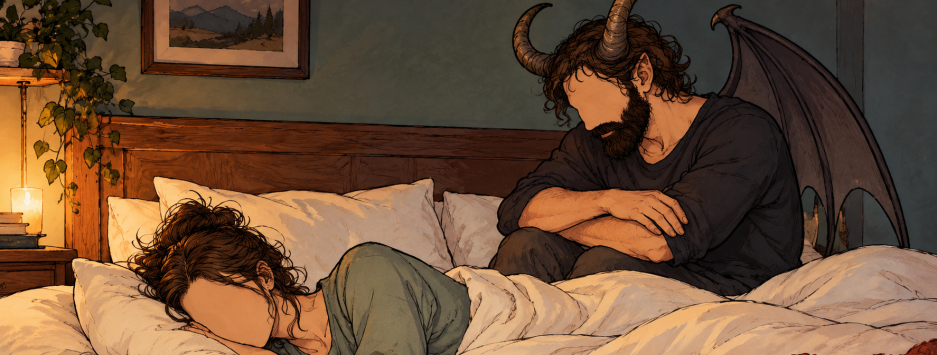
The night passed and, somehow, morning came.
I got up for work. I think I met Stephen in the hall on my way out of the door. We didn’t say much to each other. I just remember looking at him and feeling that same unspoken knowledge between us: things were never going to be the same.
We seemed to be falling further and further into something that was becoming increasingly difficult to climb back out of.
When I returned home that evening, Stephen was gone.
This period of my life has become quite hazy in my memory. I struggle to place some of the events in exactly the right order now. I think I was simply so emotionally exhausted and confused by everything that was happening that I was no longer properly absorbing it.
I believe my son’s girlfriend told me that Stephen had called a taxi, filled it with as many of his belongings as he could fit inside and left.
He didn’t come back that night.
Or any night after.
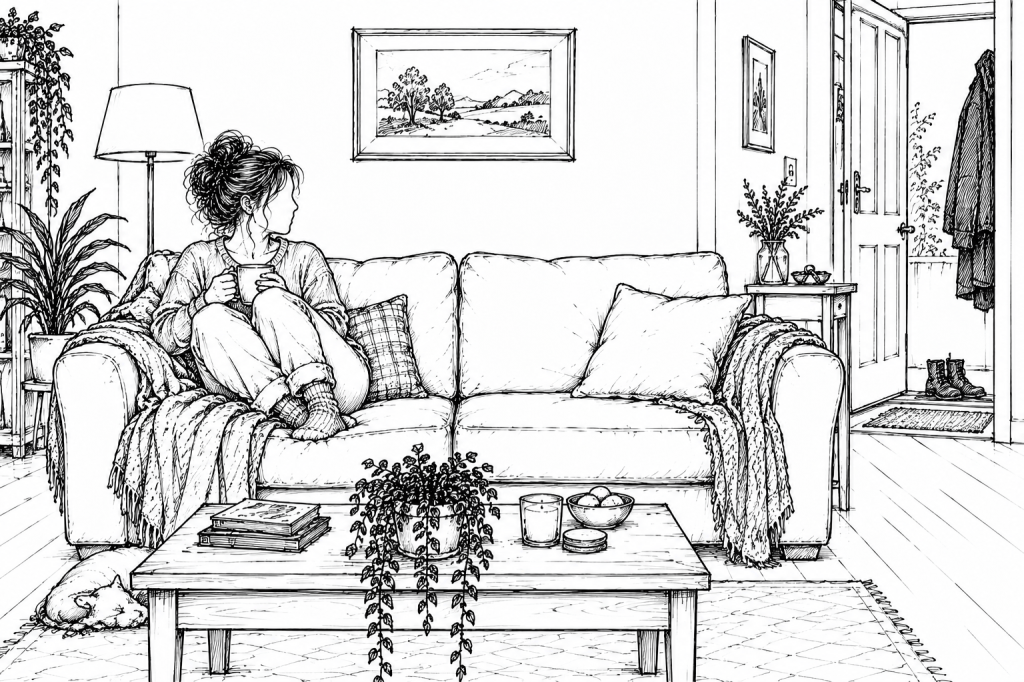
Within the next few days, a van arrived to collect the rest of his things. His keys were left behind.
And that was it.
He had moved out.
It made me incredibly upset.
I had given him three weeks because I thought it would allow us both some breathing space and give him time to move his belongings gradually. I had hoped we might still part on good terms, without ruling out the possibility of a future together. Instead, he had left almost immediately.
I think I sent him a message telling him that, from then on, he should contact me only if it concerned the practicalities of the separation. If he needed access to the house again, he should arrange it through my son.
I do remember agreeing that his many paintings could remain where they were for the time being. There wouldn’t be room for them in the flat, and they were safer staying on my walls.
What I remember most clearly is that we went for around ten days without speaking.
I missed him terribly.
I was desperately sad that this was where we had arrived after everything we had shared and everything I had believed we were building together.
But something else began happening during those days apart.
There was a tiny shift in me.
On the first weekend after Stephen left, I asked my parents if I could stay with them.
It was then that I told them the whole sorry story.
They looked after me. They were kind to me. My father said he hoped Stephen’s departure meant that the awful art would now go too.
As an artist himself, my dad wasn’t particularly kind about the commercial art Stephen had been prolifically acquiring and hanging on my walls. He especially disliked the Johnny Depp print of Keith Richards. “One spoilt celebrity painting a picture of another spoilt celebrity.” For months afterwards, he would continue asking whether I had finally taken it down.
During that visit, Dad lent me a book by his friend Natalie d’Arbeloff, a writer and artist.
He told me that Natalie had left what appeared to be a happy marriage when she was young and had chosen to live a single life. Now ninety-six, she had kept that promise to herself.
Her book, The Joy of Letting Women Down, was a satirical self-help book centred on the idea of the worshipped male: the man who juggles multiple relationships while women continue to worship the ground he walks on.
It was funny, and I enjoyed it.
As far as I knew, Stephen had never actually cheated on me. Even so, I recognised behaviours and conversations that corresponded with some of the characters in the book.
With Stephen physically removed from my everyday life, a little clarity began to return.
It almost felt as though I had been under some kind of spell.
Not literally, of course. But I had been so deeply immersed in the relationship, so accustomed to trying to understand each new development from inside it, that I had lost the ability to see clearly what was happening to me.
Distance was beginning to give some of that perspective back.
But distance also softened my anger.
As the days passed, I began wondering how Stephen was doing. I wondered how he was settling into the flat. I wondered whether he was coping.
Eventually, I summoned the courage to call him.
Maybe I shouldn’t have.
But he had left now. Our relationship was much further along the road towards being over. I told myself that I was simply checking on someone I had loved for nearly five years.
So I called.
Stephen answered and seemed pleased to hear my voice.
He told me that he hadn’t contacted me because I had asked him not to. Mostly, though, he seemed interested in one thing.
Why was I calling him now?
Before I could properly explain, he told me where he was.
He was in France, waiting for a connecting flight.
To South Africa.
I was flabbergasted.
It had been roughly ten days since he had left my house and since we had properly spoken. I had called expecting to hear how he was adjusting to life in his flat.
Instead, he was already on his way to South Africa to spend ten days with the two women he had recently met online.
My mind went into overdrive.
He must have arranged the trip very quickly. It felt as though he had left my house and almost immediately booked himself onto a plane.
Suddenly, I was questioning everything.
The rational part of my brain knew that he had met these women after our relationship had begun falling apart. But another part of me became deeply suspicious.
Was he in love with one of them?
Had there been more going on than I knew?
Had this entire confusing ending—the flat, needing space, needing to work out who he was, not knowing whether he wanted a future with me—actually been a way of leaving without having to admit that there was somebody else?
I had no evidence of that.
But after years in which my instincts had so often told me that something wasn’t quite right, only for me to talk myself out of listening to them, my mind was no longer very good at distinguishing between reasonable suspicion and fear.
What I did know was that this didn’t look anything like the period of quiet reflection I had imagined when Stephen talked about needing to find himself.
It looked like escape.
Or distraction.
And if it wasn’t either of those things, then my frightened mind was left contemplating something worse: perhaps I had been deceived about why he was leaving me in the first place.
Soon afterwards, I spent a weekend with an old friend who had been through something similar. She had been planning to marry a man without knowing that he was still married. She had her dress, the date and a venue booked.
We spent an evening mourning our failed relationships.
Then and there, quite spontaneously, we booked tickets to the Isle of Wight Festival for the following June.
It was a small act of defiance against the misery we were both feeling.
A few days later, I travelled to stay with my sister and her family.
But even there, my mind kept returning to South Africa.
What was Stephen doing?
Would I ever speak to him again?
And, if I did, what was I going to discover when he came home?
The morning after arriving at my sister’s, I woke up feeling extremely unwell. It felt like Covid or some kind of flu.
It could have been a miserable few days—illness layered on top of longing, sadness and confusion—but strangely, it wasn’t.
There was something comforting about being tucked away in the guest room of my sister’s lovely farmhouse in the middle of nowhere.
She put no pressure on me.
She let me sleep.
She brought me cups of tea and bottles of water.
Her miniature dachshund made regular visits, burrowing beneath the blankets and curling up beside me while we snoozed together.
For a little while, there was nothing I needed to do.
After a couple of days, I began to recover.
I had brought a book about domestic abuse with me.
At times, I had wondered whether I could be considered a victim of it. Yet I found it very difficult to identify with much of what I was reading.
Stephen had never been overtly controlling or coercive. He hadn’t deliberately separated me from my family or told me whom I could see.
And yet, in a more roundabout way, our relationship had produced some of the same outcomes.
I felt manipulated and emotionally abused. The intensity of the relationship and Stephen’s needs had gradually led to me seeing less of my family and friends. Even that sense of being under a spell didn’t feel entirely removed from the emotional dynamic that could keep women returning to someone who repeatedly hurt them.
I didn’t know whether the language of domestic abuse truly fitted what had happened between us.
But I knew that something had happened to me.
I knew that I had become increasingly isolated inside the relationship, and that leaving it felt far more difficult than I could rationally explain.
Then, out of the blue, Stephen called.
His ten days in South Africa were over, and he was back in the UK.
Almost immediately, he wanted to know why I had called him that day at the airport.
I didn’t answer straight away, and he kept repeating the question.
I sometimes wonder whether he wanted me to say that I regretted asking him to leave. Perhaps he hoped I had called because I wanted him back in my life.
But that wasn’t why.
I had simply wanted to know how he was.
Instead of answering his question, I asked the one that had been sitting in my stomach ever since he told me where he was going.
Had he slept with either of the women?
I suspected that he had, and I wanted to be put out of my misery.
There was a pause.
Then Stephen said, “I can’t lie to you. I did.”
I was reeling.
I had barely begun grieving the end of our relationship, and he had already slept with somebody else.
More than anything, I remember feeling angry.
Perhaps because some part of me had known that this was going to happen.
Despite everything, I still hadn’t completely abandoned the possibility that somehow, eventually, we might find our way back to each other. Now that possibility seemed immeasurably more complicated.
There was something painfully final about knowing that the person I loved had already been intimate with somebody else.
I challenged him.
I thought these women had boyfriends?
Stephen told me that one of them had recently separated from hers.
“What about me?” I asked.
He said that he believed we were finished.
And technically, I couldn’t argue with him.
We were.
But emotionally, it still felt like a betrayal.
The man I loved had told me that he didn’t know whether he wanted a future with me. He had talked about needing space, needing independence and needing to work out who he was and what he wanted from his life.
He had said he wouldn’t be looking for another relationship.
Yet within days of leaving our home, he had flown thousands of miles and slept with another woman.
Stephen began telling me that almost as soon as he arrived in South Africa, he had felt as though both women were interested in him.
I could imagine how intoxicating that must have felt.
I asked how quickly something had developed.
A day or two, he said.
To his credit, he appeared to be answering my questions honestly.
Then the conversation took another turn.
Stephen began wondering aloud whether there might have been some ulterior motive for inviting him there in the first place.
Perhaps, I suggested, they were looking for a husband so that one of them could eventually move to England.
He didn’t challenge the suggestion. He seemed content to allow me to think that he had been a pawn in some kind of devious subterfuge.
By that point, alarm bells were ringing everywhere in my head.
I didn’t know what to think anymore.
In one sense, I couldn’t believe what I was hearing.
In another, I could completely believe it.
Eventually, we hung up.
I spent another day with my sister and her family before making my way home.
Stephen had left my house less than three weeks earlier.
I had thought he was moving into his flat to begin working out what he wanted from his life.
Instead, in the space of ten days, he had travelled to another continent and slept with another woman.
I went home under yet another cloud of confusion, trying to understand what any of it meant.
Reflection
Stephen leaving hurt enormously, but his absence also did something unexpected. For the first time in years, I was experiencing my life without his emotions, explanations and needs constantly beside me. I went to my parents. I talked openly about what had happened. I laughed at my father’s comments about the paintings and read a book that allowed me to look at certain behaviours from a completely different angle. Nothing was resolved, and I certainly wasn’t healed, but distance was beginning to return a little perspective. I could feel myself starting, very tentatively, to emerge from the relationship and look back at it from the outside.
That was why discovering Stephen was already travelling to South Africa was so destabilising. I had imagined him alone in his flat, renovating it and trying to understand himself. That was the story I had been given about why he needed to leave. Instead, within days, he was flying across the world to stay with two women he had recently met online. Immediately I was back inside the familiar maze of questions. Had I misunderstood everything? Had there been somebody else all along? Was this really about independence and self-discovery, or had those explanations simply made leaving easier?
There were moments during those weeks when I began searching for language to explain what had happened to me as well. I wasn’t sure that domestic abuse fitted my experience, and much of what I read didn’t resemble Stephen or our relationship. But I recognised some of the outcomes: the isolation, the gradual loss of perspective and the extraordinary difficulty of walking away from something that was repeatedly hurting me. I didn’t yet have a neat explanation for why I had stayed or why separation felt so frightening. I simply knew that the person I had been before Stephen seemed easier to recognise when he wasn’t physically beside me.
Then he told me he had slept with one of the women. Technically, Stephen was right: we were no longer together. I had asked him to leave. I couldn’t reasonably claim that he had cheated on me. But emotions don’t reorganise themselves according to technicalities. Less than three weeks earlier we had been sharing a home, and not long before that a bed. I was still trying to comprehend the loss of nearly five years together while Stephen had already been intimate with somebody else. It felt horribly fast, and painfully at odds with everything I had understood about his need to be alone and work out what he wanted.
Perhaps the most revealing thing was that even then my mind immediately returned to understanding him. Why had the women invited him? What had happened when he arrived? What had he been feeling? Had he been manipulated, flattered or swept along by the attention? I was angry and deeply hurt, yet I was still searching for an explanation that might make what he had done easier to absorb. Distance had briefly allowed me to begin asking what the relationship had done to me. One phone call was enough to pull me back towards asking why Stephen had done what he did. I was beginning to see the pattern. I just wasn’t yet free of it.


