
When I returned home from work the following day, I told Stephen that the friends-with-benefits arrangement wasn’t working for me.
I had tried to convince myself that perhaps it could. We still loved each other. We were still living together. We were still sharing a bed. Perhaps keeping that physical connection alive would somehow preserve something between us while Stephen worked out what he wanted.
But it was doing the opposite.
It was horrible being in love with someone, falling asleep beside him and waking up beside him, while knowing that he was simultaneously making plans for a life that might not include me. Every moment of closeness gave me hope, and then reality would return and take it away again.
I couldn’t keep doing that to myself.
I told him I thought we needed to start sleeping separately.
It wasn’t what I wanted.
What I wanted was for Stephen to tell me that none of this was necessary. I wanted him to tell me he’d made a terrible mistake, that he loved me, that he wanted our life and our future after all. I still wanted to be chosen.
But wanting that was becoming unbearable.
Stephen accepted my decision. He didn’t seem terribly reluctant, although I remember seeing something emotional in his eyes. Perhaps there was sadness there. Perhaps some part of him understood what this represented.
That night, Stephen went to sleep in my youngest son’s old bedroom, while I went upstairs alone to mine.
I lay in the bed that had been ours.
Part of me kept listening.
I think I was waiting for footsteps on the stairs. For the bedroom door to open. For Stephen to appear and tell me he couldn’t do it either.
That he’d made a mistake.
That he wanted to come home.
He never came.
When I woke the following morning, the space beside me was empty and the reality of what I had asked for hit me all over again.
I wanted to cry.
I went to Stephen’s room, knocked and went inside. I climbed onto the bed beside him and tried to curl myself into his arms while I cried.
But something was different.
His arm around me felt limp and lifeless. He said very little. There was none of the warmth I was desperately searching for. It felt as though he was tolerating my presence rather than wanting me there, almost waiting for me to pull myself together and leave.
I told him how sad I was that we had come to this.
Perhaps even then I was hoping he would undo it.
Instead, he said something along the lines of, “If this is what you want, you shouldn’t be coming in here trying to cuddle me. It’s confusing.”
He was right.
I knew he was right.
But it wasn’t the response I had gone into that room hoping for.
So I left.
And that was the beginning of a different kind of heartbreak.
Until then, there had still been enough of our old relationship around me to pretend that perhaps it wasn’t really ending. We still slept together. We still touched. We could still occasionally disappear into the familiarity of being us.
Separate bedrooms began stripping those illusions away.
I went to work.
I came home.
Sometimes Stephen and I ate together and sometimes we didn’t. Sometimes we sat beside each other on the sofa and watched television, almost like we always had, except everything that had once made those ordinary evenings intimate had disappeared.
He didn’t rub my feet anymore.
We hardly discussed what we were watching.
There were no absent-minded touches, no leaning into each other, no easy physical affection.
And even if either of us felt the urge to reach across the space between us, we both knew that doing so would blur the boundaries again.
I felt as though I was permanently living on the edge of something.
Then, most nights, Stephen began saying goodnight to me at around half past nine.
He would get up from the sofa and disappear into his bedroom.
It was far too early for me to go to bed, so I would stay watching television alone, knowing that he was in the room directly behind me.
I couldn’t understand it.
Stephen wasn’t someone who ordinarily went to bed at half past nine. And despite everything that was happening between us, we didn’t hate each other. We still liked each other. We could still talk and laugh sometimes.
So why didn’t he want to stay with me until he was actually tired?
What was he doing in there?
I tried not to think about it.
But uncertainty had become the background noise of my life.
By the time September 2025 arrived, I was crying most days.
Not the kind of crying that came after an argument and eventually passed. I could be doing something completely ordinary and suddenly feel the grief rising inside me. Sometimes it happened in the morning. Sometimes at work. Sometimes in the evening. Sometimes while I was trying to fall asleep.
Two or three times a day I would simply start weeping.
I was watching the man I loved go about his ordinary life inside my home while slowly constructing another life outside it.
There was nowhere for me to escape from it.
The person I was grieving was sleeping only a few metres away.
Eventually, after a month or so of this, something had to change.
One evening, while we were eating together, I asked Stephen when he thought he would be moving into the flat.
I think what I really needed was an end date.
If I knew when he was leaving, perhaps I could count down the days. I could tell myself I only had to survive another week, another fortnight, another month.
Stephen said he didn’t know.
Maybe January. Or maybe later.
January?
I stared at him.
That was another four months.
Four more months of separate bedrooms. Four more months of watching him withdraw from me. Christmas would come and go. What would have been our fifth anniversary would come and go.
I couldn’t imagine enduring it.
Stephen saw my reaction and seemed disappointed.
He reminded me that I had promised to support him. I had told him he could take as long as he needed.
And that was true.
I had said those things.
But when I had made that promise, I had still believed the story differently. I had believed that perhaps the flat was something Stephen needed to become independent, to work out who he was and what he wanted, perhaps even to become a better version of himself. There had still been enough hope for me to believe that the distance might ultimately help us.
Now it didn’t feel like that anymore.
Since moving into separate bedrooms, whatever connection remained between us seemed to be fading rather than strengthening.
And I found myself caught between two completely opposing instincts.
I wanted to keep my word to Stephen.
And I desperately needed to protect myself.
I went upstairs to my bedroom and cried on the bed.
Stephen followed me.
It was probably the first time he had entered my bedroom in a month.
He sat on the edge of the bed, and for a moment I think I hoped he had come because he could see how much pain I was in.
But he seemed strangely detached.
It wasn’t the first time I had experienced that disconnection. There had been other occasions when I was crying because of something happening between us and, when we tried to discuss it, Stephen seemed almost removed from the emotional reality of what I was experiencing.
I can’t remember everything I said that evening.
I know I talked about how confused I was.
His reasons for leaving seemed to keep changing. At different times I had understood the flat and our separation differently, and I no longer knew what I was supposed to believe.
All I really knew was that living alongside him like this was breaking me.
Then, on my bed, Stephen told me something else.
Through his new gaming alliance, he had made a couple of new friends from South Africa. They lived together and had invited him to visit them.
I was already defensive of my own feelings by then, determined not to appear controlling or unreasonable.
So I said something like, “Maybe travelling would be good for you.”
In my head I imagined this happening months into the future, perhaps once his flat was habitable and his life was more settled.
I asked where he would stay.
He said one of them would give up their bedroom for him.
That seemed generous.
“Do the guys mind sharing a room together?” I asked.
Stephen looked at me.
They weren’t guys.
They were women.
I couldn’t believe what I was hearing.
But of course they were women.
Suddenly all those early nights took on a different meaning in my mind. Was that what he was doing in the bedroom behind me? Playing the game and talking to these new women while I sat alone on the other side of the wall wondering why he didn’t want to spend the evening with me?
I didn’t know.
But by then my mind was desperately trying to make sense of everything.
Who was this man?
Only weeks earlier we had still been sharing a bed. Now he was talking about flying to another continent to stay with two women I had never heard of and he had never actually met.
I could feel him moving away from me.
And for the first time, I began to wonder whether there was anything left for me to hope for.
Through tears and anger, I said, “You’re probably going to fuck these girls.”
“Noooo,” he replied. “They’re just friends. They’ve got boyfriends. And I’ve always had a fascination with South Africa”
It didn’t comfort me.
I didn’t believe Stephen had decided to leave me because of these women. As far as I knew, he had only met them recently. But that almost wasn’t the point.
He had bought a flat that needed considerable work. He had talked about needing independence, saving money, renovating it and working out who he was and what he wanted.
Yet now, while I was barely holding myself together in the house we had shared, he was forming new friendships with women online and talking about travelling halfway across the world to see them.
None of it seemed to fit together anymore.
I went to bed and cried myself to sleep.
The following morning, I made myself go to work.
I was in no fit state to be there.
I couldn’t make sense of everything that had happened since the conversation in which Stephen had told me about the £10,000 art purchase.
It felt as though my life had accelerated into something I couldn’t recognise.
We had once been so passionate about each other. We had talked about Scotland, saving money, building a future. Growing old together. I had opened my home to him and eventually allowed myself to think of us almost as a marriage.
And now I was going to work each morning while the relationship disappeared a little more in my absence.
There seemed to be nothing I could do to stop it.
For perhaps the first time, I was beginning to face the possibility that Stephen, us, and the future I had spent years believing in might genuinely be lost for good.
When I came home that evening, I talked to my son and his girlfriend about what Stephen had told me.
Then I learned something else.
His girlfriend already knew about South Africa.
Stephen had mentioned the invitation to her before he had told me.
She had told him that she didn’t think it sounded like a good idea.
She had also heard him talking to the women on the phone.
So that was what had been happening while I was at work.
Something inside me seemed to give way.
We sat down to eat, but the food tasted like wet cardboard.
I couldn’t eat.
I started sobbing over my dinner.
My son watched me falling apart and finally stepped in.
“Come on, man,” he said to Stephen. “Look what you’re doing to her.”
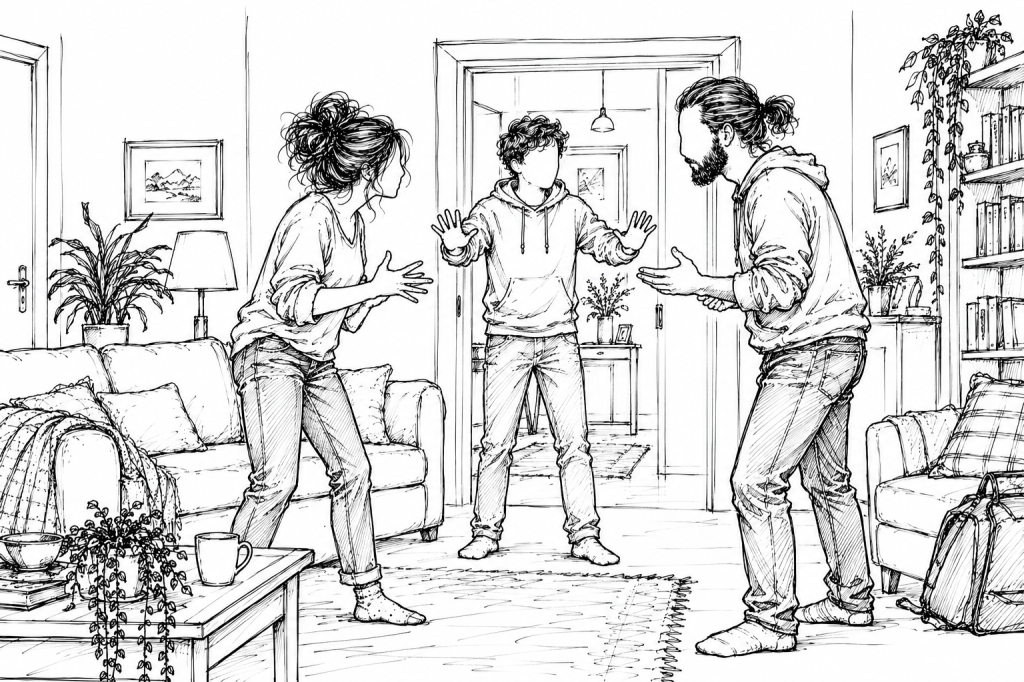
Stephen just looked confused.
I went upstairs crying.
A little while later my son came to find me.
He spoke firmly to me.
This was my house.
This was my life.
I didn’t have to remain trapped inside a situation simply because I had once promised Stephen that he could stay.
I could make a decision.
Right now.
One that was in my own best interests.
“What do you want?” he asked.
He told me that if I wanted Stephen out, he would go downstairs and tell him to leave immediately.
“No. No, that’s not necessary.”
Even then, I didn’t want to be cruel.
Even then, some part of me was thinking about what was fair to Stephen.
But I knew what I wanted.
“I want him to leave.”
I thought about it.
“I’ll give him three weeks.”
Three weeks seemed fair.
My son told me to go downstairs and tell him. If I needed him, he was right there.
I remember being grateful for that.
He had grounded me at a moment when I felt as though I was losing my grip on everything.
So I went downstairs and tearfully told Stephen.
He had three weeks to leave.
Immediately, he protested.
He thought we would spend Christmas together.
I had promised him he could take as long as he needed.
I had said I would support him.
And again, technically, he was right.
But standing there in front of him, I wondered whether he could hear anything beyond the broken promise.
Could he hear the desperation underneath my words?
Could he see what keeping that promise was doing to me?
I had spent years trying to understand Stephen’s pain, his history, his fears, his mistakes and the things he said he needed.
But I was drowning now.
And for once, I needed to respond to my own pain.
I went upstairs with my son’s girlfriend and cried with her. We discussed emotional abuse and how Stephen’s treatment of me was becoming something close to that.
My son remained downstairs with Stephen.
They talked for more than an hour.
I had no idea what they said to each other.
I wouldn’t find that out until much later.
All I knew was that I had finally put an end date on the unbearable limbo I had been living in for three months.
Three weeks.
I thought I was giving Stephen three weeks to leave.
I didn’t yet know that he would be gone the following day.
Reflection
Moving into separate bedrooms was the first boundary I created that Stephen hadn’t asked for. I didn’t want the separation it represented; I wanted him to make it unnecessary. Some part of me genuinely expected him to come upstairs that first night and tell me he couldn’t bear it either. When he didn’t, and then seemed so emotionally distant when I went to him the following morning, I began to understand that removing the physical closeness between us wasn’t going to make Stephen miss what we had. It was simply going to reveal more clearly what was already disappearing.
The weeks that followed were some of the loneliest I had experienced. Stephen was still physically present, which meant there was no clean absence to adjust to. Instead, I watched our relationship disappear in increments: the foot rubs, the touching, the conversations on the sofa, the shared bedtime, the tiny gestures that had made ordinary life feel intimate. I was grieving someone who was sitting only a few metres away. When he suggested he might remain until January, I realised I couldn’t continue living indefinitely inside his timetable for deciding what happened to his life.
South Africa made everything feel even more incomprehensible. It wasn’t simply that the new friends were women. Stephen had told me he needed independence, time and space to work out who he was and what he wanted. Yet while I was struggling to survive the loss of our relationship, his world seemed to be expanding again — new friendships, private conversations and the possibility of travelling halfway across the world. Mine had become increasingly narrow. I went to work, came home, cried and tried to understand what was happening. The imbalance between those two realities was becoming impossible for me to ignore.
Even then, I struggled to give myself permission to act. I had promised Stephen that he could stay. I had promised to support him. Those promises still mattered to me, even though keeping them was causing me enormous pain. It took my son asking the simplest question — What do you want? — for me to momentarily stop considering Stephen’s needs and recognise that I was allowed to have an answer of my own. I didn’t want him thrown out that night. I still wanted to be fair. Three weeks felt compassionate to him and survivable to me.
Telling Stephen he had to leave wasn’t me finally deciding that I no longer loved him, or even accepting completely that our relationship was over. It was something smaller and, for me, perhaps more significant. For years I had responded to difficult situations by asking what Stephen needed, why he behaved as he did and what I could do to help us through it. That evening, with my son standing behind me if I needed him, I made a decision based on what I needed. I was still heartbroken, still confused and still capable of changing my mind about almost everything. But for the first time in months, I had stopped waiting for Stephen to decide what happened next.


