
With Christmas only days away, Stephen and I met our new therapist for the first time over Zoom.
Stephen joined from his flat and I was at home. It was a free introductory session, really just an opportunity for us to meet her, explain why we were there and talk about what we hoped to get from therapy. We had already completed detailed forms covering our individual mental health histories, so she had some background before we began.
Together, we went over the events that had led to our separation.
We wanted to understand how we had ended up here. We wanted help deciding whether we should try to rebuild our relationship or accept that it was over and go our separate ways. And if we did decide to reconcile, there was another question waiting for us: how could we possibly make that work after everything that had happened, particularly with our families knowing so much?
We also talked about the possibility that our relationship had become co-dependent.
I noticed that I seemed to be doing most of the talking. Several times I deliberately left pauses, expecting Stephen to fill them or add his own perspective, but he didn’t always take them.
It made me wonder how invested he was.
Our therapist explained that her approach could be quite tough. She wasn’t afraid to challenge people, she said, and there might be times when she confronted us with things we found difficult to hear.
We both said we were fine with that.
In fact, I thought it was probably exactly what we needed.
The session ended positively and we arranged to begin properly once Christmas and New Year were out of the way, early in January.
Christmas arrived and my boys were busy with their father’s side of the family, so I went to my sister’s with Mum and Dad for a couple of days.
When I returned, I had the house to myself.
For the first time since Stephen had left, I invited him back.
He hadn’t been inside my home for around three months and I remember him finding it strange and quite emotional to be there again. Seeing that affected me. This had been his home too, after all. Whatever had happened between us, there were years of our life contained within those walls.
We had also booked an Airbnb for New Year’s Eve and New Year’s Day.
I remember that sometime before we were due to go, Stephen and I had another argument and very nearly cancelled the whole thing. I can’t even remember what the argument was about now.
Perhaps that in itself says something about that period.
After Stephen left my home, and throughout the year that followed, we were on and off more times than I can remember. There were repeated changes of heart, repeated conclusions that separation was probably for the best, repeated threats of betrayal, followed by repeated reconciliations. There were tears, hurtful comments, nights out without me, moments of hope and then another collapse.
But we did go away for New Year.
And we had a super time.
We cooked together. We went for walks. We watched television. We shared a bath. We were intimate.
All our favourite things.
For those couple of days, we could have looked like two people with absolutely nothing wrong between them.
During our stay, Stephen received a message from U.
Immediately, my hairs went up.
I had thought they had severed contact, but Stephen reassured me that there was nothing to worry about. Apparently she had only messaged him about a documentary he had previously recommended to her.
I let it go.
After the holiday period, ordinary life resumed.
During the first working week of January, we had our first proper therapy session. This time Stephen and I were together, sitting side by side on his bed at the flat, with the therapist on the screen in front of us.
In my opinion, it went well.
I felt awkward telling her about what Stephen and I had come to call his “acting out” — the betrayals, the nights out, the flirting and his pursuit of attention from other women.
I explained something I had begun to believe about the pattern between us. It seemed to me that Stephen was particularly likely to seek attention from other women when I was not physically or emotionally available to him.
This needed to stop if we were to have a relationship built around trust. The co-dependency had to end. I needed to feel safe and secure and relaxed in our relationship.
Naturally, a lot of the conversation focused on Stephen’s behaviour because it had become such a significant feature of our arguments and difficulties.
The ninety minutes disappeared quickly. We had barely scratched the surface, but I came away feeling positive. At least we had finally started unpacking some of it with somebody who might be able to help us make sense of it.
We arranged our next session for two weeks later.
The night before that appointment, Stephen and I spoke on the phone.
It was a perfectly pleasant conversation. Stephen was tired and knew he needed to be awake for our 8 a.m. session, so eventually he made his excuses and we said goodnight.
The following morning, I woke early, showered and made myself a cup of tea. I positioned myself in front of my laptop feeling, if anything, a little excited.
Bang on eight, my therapist and I appeared on each other’s screens.
There was no Stephen.
We waited five minutes.
Still no Stephen.
I sent him a message, but it remained unread.
The therapist and I chatted for a while, both of us becoming increasingly aware that he probably wasn’t going to appear. I joked that perhaps he had forgotten to set his alarm.
But he knew about the appointment.
We had talked about it the night before.
He had got an early night.
Eventually, we carried on without him and began discussing the relationship.
About forty-five minutes later, the therapist suddenly said, “Ah. I think Stephen is here.”
I felt relieved.
And slightly annoyed.
Then his image appeared on the screen.
I was horrified by how he looked.
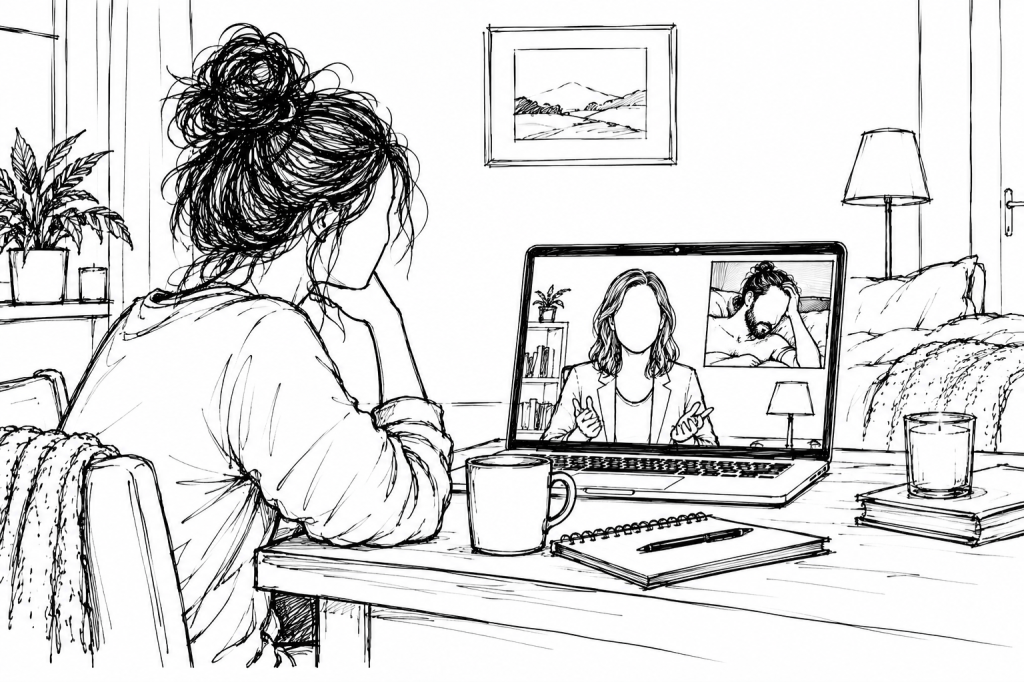
He was topless, still in bed and without his glasses. Under his eyes were some of the biggest bags I had ever seen on him. There seemed to be eyebags beneath his eyebags.
I knew that look. It was how Stephen often looked when he had been awake for much of the night.
My immediate suspicion was that this was what had happened, although I couldn’t know that for certain. Stephen sometimes struggled to sleep too.
We asked what had happened. As I remember it, he had either forgotten to set his alarm or slept through it. He seemed confused and exhausted and couldn’t really explain himself.
Before I had much opportunity to say anything, the therapist challenged him.
His commitment mattered, she told him. If he genuinely wanted to take part in this process, then he needed to make sure he was there for it.
Stephen insisted that he did want to be there, but kept returning to how tired he was and how he couldn’t explain what had happened.
I had the impression that she was seeing something in his response that concerned her — not simply that he was late, but the lack of accountability around it.
Eventually, she suggested that Stephen leave the call and that she finish the session with me alone.
Once he disappeared from the screen, she gave me her assessment.
From her perspective, Stephen was not demonstrating commitment to the process. His arrival forty-five minutes late told her something.
I couldn’t really argue with her.
I just didn’t like admitting that I thought she might be right.
We decided that, for the time being, I would continue the sessions alone. There seemed little point in trying to conduct couples therapy with somebody she wasn’t convinced was committed to being there.
I was deeply discouraged.
I had genuinely thought Stephen wanted this.
I hadn’t forced him into therapy. I hadn’t bullied, pressured or blackmailed him. I had simply suggested that perhaps we needed help, and he had welcomed the idea. He had even offered to pay for half of it.
I couldn’t conceal my disappointment in the messages I sent him later that day.
When I told him that the therapist and I had decided I would continue without him, Stephen said that, in some ways, he was relieved.
I didn’t know what to make of that.
Was he relieved because he wouldn’t have to explain himself? Because he would no longer be under the spotlight? Or was he relieved because, despite everything we had been saying about trying again, he didn’t really want to reconcile at all?
I didn’t know.
Meanwhile, Stephen was settling into his new job.
He was beginning to find his place among the trustees, management and volunteers. He was making friends and occasionally going out with people from work for drinks or something to eat.
One person in particular started appearing increasingly often in his stories.
I’ll call her K.
Stephen liked K and had begun mentioning her quite a lot. Inevitably, I noticed.
After one evening when he had been out with a small group that included her, I asked him about it. He told me that he had walked K home and given her what he described as a friendly kiss.
Immediately, I was on high alert.
Stephen reassured me that they were only friends. There was no interest in anything more.
I told him that, from what he had said about her, it sounded to me as though K might like him as more than a friend.
Again, he reassured me that this wasn’t the case. Her life was complicated at the moment, he explained, and she wasn’t looking for anything beyond friendship with him. I wondered what kind of conversations they had been having for her to even tell him this.
At the same time, Stephen was beginning to struggle with certain aspects of the job itself.
The politics of the organisation were doing his head in, and he was finding it extremely difficult to stick to his official working hours. There was simply too much to do in the ten hours he was being paid for.
He was one of only two paid employees. Almost everybody else was a volunteer, which made it difficult for him to walk away when something needed doing or to simply say no.
It sounded like a genuinely challenging situation.
So I supported him.
I encouraged him to listen to himself, to recognise when too much was being asked of him and to start putting some boundaries around the job.
Needless to say, apart from some disassembly of the kitchen units and lifting up of the floorboards in the flat, very little had changed in four months.
Whatever uncertainty existed between us, whatever had happened in the past and whatever questions therapy had begun to raise, I was still doing what came naturally to me.
Trying to help him make his new life work.
Reflection
By Christmas, I had begun to believe that Stephen and I might genuinely be finding our way back to each other. Inviting him into my home again felt significant, and New Year reminded me how easy we could still be together when everything complicated was temporarily stripped away. We cooked, walked, talked and were intimate. Those moments mattered because they reassured me that whatever had gone wrong between us hadn’t destroyed the connection itself. Even U’s message could be explained away. I wanted to believe we were moving forwards.
Therapy represented something more serious. For once, I wasn’t simply trying to understand Stephen by myself. There was another person in the room who could listen to both of us, challenge our interpretations and perhaps help us identify the patterns we seemed incapable of resolving alone. I was ready to examine my own part in them too. If our relationship had become co-dependent, I wanted that to change. I didn’t want to spend another five years watching, anticipating and trying to manage what Stephen might do whenever he felt unhappy or disconnected from me. I wanted to feel safe enough to stop doing that.
That was why his failure to turn up properly for the second session affected me so much. Being forty-five minutes late was one thing. Seeing him appear exhausted and confused, and then watching the therapist challenge his commitment, was another. I had spent years wondering whether I expected too much, misunderstood Stephen or failed to appreciate the ways in which he was trying. Now somebody with no history with either of us had noticed an imbalance almost immediately. I didn’t particularly want her to be right. I wanted Stephen to prove her wrong.
Instead, I continued therapy alone, while another familiar pattern quietly appeared beside it. K entered Stephen’s stories. There was a walk home, a friendly kiss and reassurance that there was nothing for me to worry about. I noticed my anxiety immediately, but by then I was caught in an impossible position. If I questioned every friendship, I risked becoming the suspicious, controlling partner I never wanted to be. If I trusted his explanation, I had to silence instincts that experience had repeatedly taught me not to dismiss. I still hadn’t found a way to feel secure that didn’t depend upon Stephen behaving in ways that allowed me to be.
And yet, when Stephen began struggling with his new job, I knew exactly how to respond. I listened, encouraged him, helped him think about boundaries and worried about whether he was taking too much on. It was almost automatic. We had gone to therapy partly because I wanted to stop carrying so much responsibility for what happened inside our relationship, but I was still deeply invested in helping Stephen make his life work outside it. I was beginning to understand that co-dependency wasn’t only about how much I needed Stephen. It was also about how difficult I found it to stop being needed by him.


