
Through to the end of January 2026 and into the beginning of February, I continued seeing the therapist on my own.
Much of our work focused on the origins of my codependency and my tendency to abandon myself in relationships in order to keep someone else happy.
Stephen wasn’t the first partner I had done this with. It had simply never been as extreme as it had become with him.
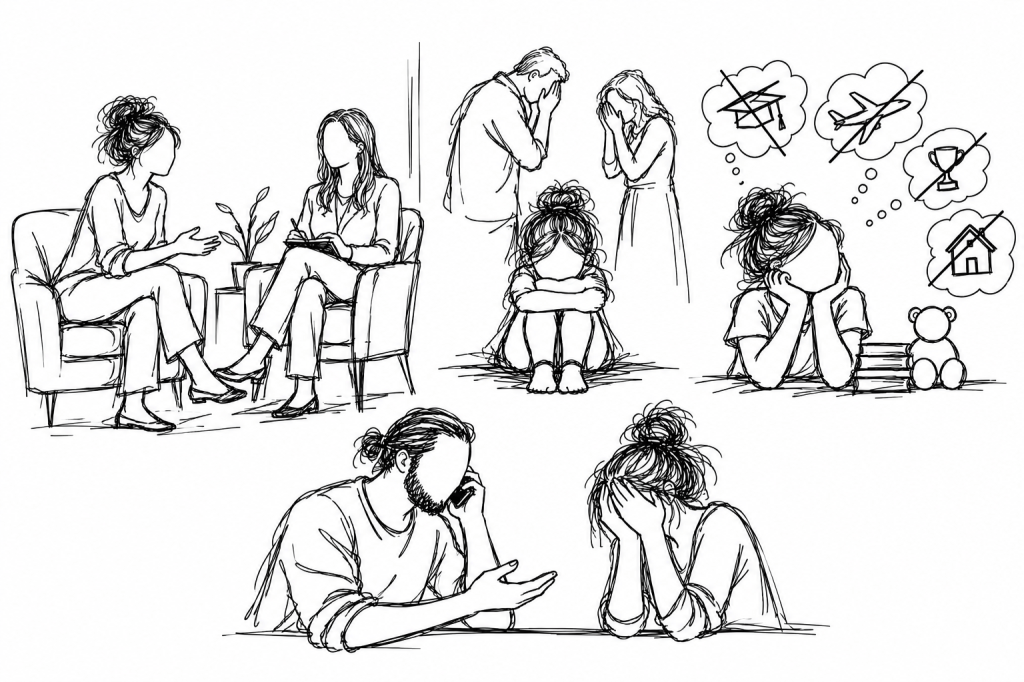
Exploring where that pattern came from took me back to my childhood.
There had been poverty and hardship, and conflict between my parents and other people that I had not always been shielded from. I had seen both of my parents cry because of the actions of others, and that frightened the little girl I had been.
Somewhere along the way, I think I learned that my job was to keep the peace. To maintain the status quo. Not to ask for too much. Not to demand. Not to create additional problems for people who already seemed to have enough of them.
I had been very loved. Up until around the age of eight, I remember feeling special, cherished and unique. But as I grew older, something gradually changed.
Whenever I showed desire, ambition or confidence, there were often practical reasons why it couldn’t be encouraged. We couldn’t afford it. It was too risky. It might upset the apple cart. Sometimes there simply didn’t seem to be enough belief that I could succeed to justify taking the chance.
Over time, I think some of that eroded my confidence and ambition. I learned to make myself smaller. Wanting less felt safer than wanting something and discovering that it wasn’t possible, sensible or deserved.
Sometimes I cried during those therapy sessions.
But gradually my therapist helped me understand where these patterns might have begun without needing to blame my parents for them. They had been doing the best they could with their own circumstances, fears and limitations.
At the same time, she was trying to help me see something much more immediate.
Stephen and I were not on the same page.
Whatever he said about wanting the same things I wanted, his behaviour repeatedly showed something different. She was sympathetic towards him and his traumatic past, but she wanted me to understand that it was not my job to fix him. There was too much damage for me to repair on his behalf, and he might never become the partner I needed or had spent so long hoping he could become.
It was painful to hear, but by then I could recognise some truth in it.
It didn’t stop me seeing Stephen.
It didn’t stop me hoping.
But the possibility that she might be right had begun to sit quietly somewhere in the back of my mind.
Meanwhile, Stephen’s relationship with K was developing.
She had begun asking him to visit her home to help with small jobs. From what Stephen shared with me, and from the things he suggested himself, it appeared she might want more than friendship. He acknowledged that it was beginning to look that way too.
I told him to be careful.
We had already identified that he wasn’t particularly good at halting the chemistry once it began to develop. I saw this as an opportunity for him to recognise the pattern early and do something differently.
Then one day Stephen was extremely low.
He told me he didn’t think he could progress or get well on his own. He needed someone beside him. A companion. He had made a mistake in believing he could do all of this alone.
I had warned him about this. I knew moving into a flat alone would only exacerbate his problems.
And despite everything I was beginning to learn in therapy, hearing him say that activated something very familiar in me.
I wanted to rescue him.
I thought about it and then, with far more confidence than consideration for the possible consequences, I said:
“Let’s do it.”
Let’s tell my family that this had all been a huge mistake. Come back and live with me. We would commit ourselves properly to getting him well and rebuilding our relationship.
Stephen cried and thanked me.
He said he needed time to think about it.
A little while later, he called me while I was at work, out walking my employers’ dogs.
He told me that he wanted what I had suggested.
But before we could do it, he said there was something he needed to tell me.
If we were genuinely going to try again, I needed to know the whole truth. We couldn’t move forward without honesty. Trust would have to be the foundation of whatever we attempted to rebuild.
And then Stephen said:
“I have cheated on you in the past.”
And then:
“I have cheated on you many times.”
I started crying immediately.
It is difficult to convey how shocked I was.
I had always believed I had good instincts about Stephen. So many things I had worried about over the years had eventually proved to have some foundation.
But I had never, ever truly believed that Stephen had actually cheated on me.
I didn’t think he could do it.
I didn’t think he had it in him.
I believed he loved me more deeply than he had loved anyone before. He had his supposed “rule” about not cheating. For years, I had told people that whatever Stephen’s faults were, he wasn’t a player.
The news hit me like a ton of bricks. I couldn’t hold back the tears or the desperation in my voice.
My first questions were obvious.
Who?
When?
He told me about the German woman he had met while working in Scotland. He slept with her more than once. I had picked him up at Gatwick. I remember that moment not feeling unlike Denmark. Was his infidelity the reason why?
And E, whom he had met while away working with the stone specialist. The specialist had left the two of them alone at dinner and Stephen went back with her to her hotel room.
He couldn’t remember which had happened first.
I struggled to place them within the timeline of our relationship.
Eventually I narrowed the period down to somewhere around the beginning of 2024 — roughly six months after I had started my difficult new job and shortly before our wonderful trip to the frontier cabin.
That made the revelation even harder to comprehend.
This had happened during what I had always considered one of the least troubled periods of our relationship.
In my own telling of our story, this was the stretch in which there had been no betrayals to speak of.
Now I discovered that there had been betrayals.
I simply hadn’t known about them.
It was also sometime after our conversations about polyamory and Stephen’s regret about having missed out on the youthful experience of sleeping around. Were they the clue that he was weakening?
And suddenly other memories began rearranging themselves.
At the cabin, Stephen had struggled sexually and we had argued about sex for the fist time.
Was this connected?
Had sleeping with other women changed something about the way he experienced sex with me?
He had even mentioned these women to me at the time, but in the context of our conversations about openness. I had been allowed to believe they were harmless encounters.
That was when something else began to dawn on me.
Stephen repeatedly assured me that he was at his core, a ‘good guy’ and a terrible liar.
But Stephen had been far more capable of deception than I had ever imagined.
I couldn’t even understand how he had managed it.
When Stephen worked away, we spoke almost every night before going to sleep. There were very few exceptions.
Had those exceptions been the nights he spent with other women?
Or had he simply said goodnight to me and then gone to their bedrooms?
Perhaps that was part of the reason I had found it so difficult to believe he could ever have cheated. Even when he was away from me, there never seemed to be enough opportunity. Our communication was too regular.
But perhaps opportunity wasn’t as difficult to create as I had imagined.
All it would have taken was, “I’m tired, I’m going to bed,” and I would have happily put down the phone believing my partner was settling down for the night.
Whatever the exact circumstances, he must have lied to me in some form to prevent me from knowing what was happening.
I asked him why he had done it.
He said the two encounters had happened relatively close together.
He couldn’t really explain why.
Only that we hadn’t been in a good place, an opportunity had arisen and, once the chemistry began, he hadn’t stopped it.
He described moments when his thinking had simply become:
“Just go with it.”
Consequences disappeared.
I wanted to know where I had been in his mind.
What about me?
What about our relationship?
What about the future we were supposedly building together?
In typical Stephen fashion, he said he simply hadn’t thought about any of it.
Throughout the conversation, his delivery was strikingly matter-of-fact.
It barely felt like a confession. I had imagined that confessing something of this magnitude would involve visible remorse, emotion, perhaps even some kind of plea for forgiveness.
Instead, it felt more as though he was unloading information.
I began to wonder whether Stephen believed that telling me everything would somehow wipe the slate clean. That once the truth was out, we could proceed with my offer for him to come home and begin again.
But hadn’t he considered what knowing the truth might do to me?
Wasn’t I allowed to reconsider my offer now that I finally had the information that should have accompanied it?
I asked him what the encounters had felt like.
He told me they had been fun.
He had enjoyed them.
It was almost the worst thing he could have said.
Stephen had a tendency for brutal honesty. It often left me in a difficult place. He had been honest but cruelly indelicate in its delivery.
He also told me that he regretted the affairs and believed they had changed something. They had affected our relationship.
But I hadn’t even known they had happened.
Now I found myself trying to understand how something I knew nothing about could have been influencing the relationship I was living inside.
Was that why we had argued about sex?
Was it connected to the times he struggled to perform?
Had crossing that boundary once made crossing it again easier?
Had the experience changed how he saw me, himself, sex, or commitment?
I would never really know.
But suddenly there was another version of our relationship running alongside the one I remembered — a hidden reality that had existed without my knowledge.
And I had no idea how much that hidden reality had contributed to our eventual collapse.
I asked him if there was anything else.
There was.
Stephen told me that when he had gone to Manchester, he hadn’t simply met B for coffee.
They had gone back to his hotel and become intimate.
I immediately remembered the energy I had sensed between them when he introduced me to her after the programme.
And I remembered the story Stephen had later told me about another woman in Manchester who had wanted to take things further with him.
According to the version I had been given at the time, he had thought of me and declined.
I had been touched by that story.
I had felt chosen.
I had felt honoured.
Meanwhile, during that same trip, he had been intimate with B.
Again, I was forced to confront something I had never believed about Stephen.
He knew how to conceal things.
He knew what to tell me to make me feel safe while withholding the information he knew would make me feel anything but safe.
This wasn’t simply impulsivity in the moment. Afterwards, he had been capable of constructing a version of events that preserved my faith in him.
The strange thing was that we were technically separated by then.
He could have told me what had happened and justified it on those grounds.
Instead, he came home with a story in which another woman had wanted him and he had chosen me.
By this point, I wasn’t even sure I felt heartbroken.
Perhaps my heart was already broken.
What I felt more than anything was shock.
Disbelief.
I found myself mentally travelling backwards through nearly five years, reevaluating events I thought I understood and questioning my entire perception of Stephen, our love and our relationship.
I even wondered whether he genuinely expected to tell me all of this and for me to say, “Thank you for being honest. Now let’s carry on.”
For a moment, I became so destabilised that I considered another possibility.
Maybe he was telling me because he wanted me to leave.
Perhaps he thought that if he told me something sufficiently terrible, I would finally be horrified enough to walk away and never come back.
I began asking about every other incident that had troubled me over the years.
Had he slept with his ex the night he shared her bed?
Had anything more happened with M in Denmark?
What about P, whose house he had stayed at when he was supposedly putting up shelves?
He said no.
According to Stephen, the encounters he had just disclosed were the extent of it.
But I had reached an obvious problem.
How could I know?
The man who had so often portrayed himself as honest, loyal, clumsy, a terrible liar, useless with women and utterly devoted to me, had successfully concealed multiple sexual encounters for as long as two years.
Valentine’s Day was only a couple of days away.
I had imagined that perhaps we might spend it together.
Instead, Stephen had delivered a Valentine’s gift I could never have imagined receiving: the knowledge that parts of the relationship I had been grieving and analysing had never existed quite as I remembered them.
For more than two years I had been allowed to believe that those years contained no major infidelities. I had examined my own behaviour, my job, our sex life, Stephen’s unhappiness and countless other possible explanations for why our relationship had deteriorated.
Now I knew that something enormous had been missing from the evidence.
Stephen had crossed boundaries capable of damaging a relationship long before I even knew there was damage to account for.
But I thanked him for finally telling me the truth. I said it was very brave. He could have continued the lies and I would have been oblivious.
And I told him I needed time and space now.
I had no idea what I wanted to do next.
Even then, my immediate instinct wasn’t anger. I didn’t scream at him or tell him to fuck off.
I was simply stunned.
There was too much to absorb. Too much history to revisit. Too much of what I thought I knew suddenly thrown into question.
To begin with, I told nobody.
Partly because I was humiliated.
But there was another reason too.
Somewhere inside all that shock and disbelief, I was still considering taking Stephen back.
And if I did, I couldn’t bear the thought of anyone knowing that I had done so after discovering all of this.
Reflection
Therapy had begun taking me somewhere uncomfortable before Stephen told me the truth. For years, I had concentrated on understanding him; now I was being asked to understand myself. I was beginning to see how easily I could put another person’s needs, pain and happiness ahead of my own, and how far back that instinct might reach. None of this meant that loving Stephen had been a mistake, or that everything I had done for him had been unhealthy. But I was starting to recognise how often compassion had required me to make myself smaller. Then, almost perfectly timed, Stephen told me he needed someone beside him, and I responded exactly as I was beginning to understand I always had: I offered to rescue him.
His confession changed far more than my understanding of a handful of sexual encounters. It changed the history I thought I knew. I had spent years believing that, however complicated Stephen could be, there were certain lines he simply wouldn’t cross. Even when I had been suspicious, even when my instincts had unsettled me, actual infidelity had remained outside my understanding of who he was. Now I discovered that some of the periods I had regarded as evidence of our growing stability had contained a completely different reality. There had not been an absence of betrayal. There had been an absence of knowledge.
That distinction was devastating. I began travelling backwards through our relationship, revisiting conversations, phone calls, work trips, sexual difficulties and moments of reassurance. Even some of the things that had once made me feel safest became uncertain. Stephen had mentioned women to me and allowed me to believe those encounters were harmless. In Manchester, he had actually given me a story in which another woman wanted him and he had chosen me, while withholding what had happened with B. Until then, I had often understood Stephen’s betrayals as impulsive moments in which emotion or opportunity overwhelmed judgement. For the first time, I had to confront something more difficult: whatever happened in the moment, afterwards he had been capable of maintaining a version of reality that kept me trusting him.
Perhaps most painfully, the revelation changed the way I looked at myself. I had spent so much time examining what I might have done differently. I had questioned my demanding job, my exhaustion, my weight, my menopause, our sex life, my independence, the amount of attention I gave Stephen and whether I had somehow allowed our connection to deteriorate. I had been trying to solve an equation without being given all the numbers. There were things happening inside my relationship that affected its course while I remained completely unaware of them. I had accepted responsibility for understanding and repairing problems whose true shape had been hidden from me.
And still I didn’t walk away. That is perhaps the hardest part to explain, but also one of the most important. The truth didn’t instantly extinguish nearly five years of love, attachment, hope and habit. I was shocked enough to question almost everything I believed about Stephen, yet some part of me was still protecting the possibility of us. I even kept the confession from my family because I knew that telling them might close a door I wasn’t ready to close myself. Therapy was teaching me how often I had abandoned myself to preserve a relationship. Stephen’s confession gave me perhaps the clearest evidence yet of what that relationship had cost me. I could finally see both things at once. I just wasn’t yet ready to act on what I could see.


