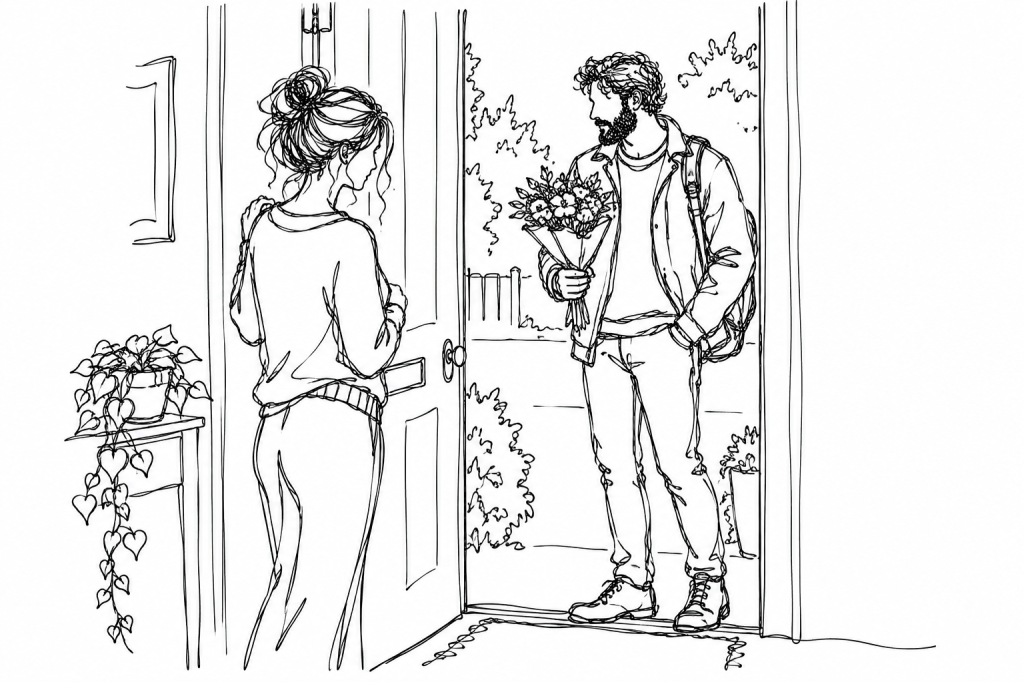
Stephen And The Bedsit

As Stephen’s unhappiness with living with his father continued, he began hinting more frequently about living with me.

I reminded him that he had told me about moving in with his former girlfriend very quickly. His story was surprisingly similar to what was now happening between us. He had been in a very difficult place mentally, and she had driven to collect him and brought him back to her home. Before long, he had effectively moved in.

I could see the temptation for Stephen to repeat that pattern with me.

So I set a boundary.

I told him that he couldn’t move into my home until he had found a job.

He accepted that, but he was becoming increasingly desperate to get away from his father’s house. Instead, he arranged to rent a bedsit.

I didn’t think it was necessarily a bad idea. In fact, I thought it might be good for him. It would give him some independence, some privacy and a place of his own while he worked out what he wanted to do next.

He put some effort into making it feel like home. He bought things he needed to cook and some nicer touches to make the little room more comfortable.
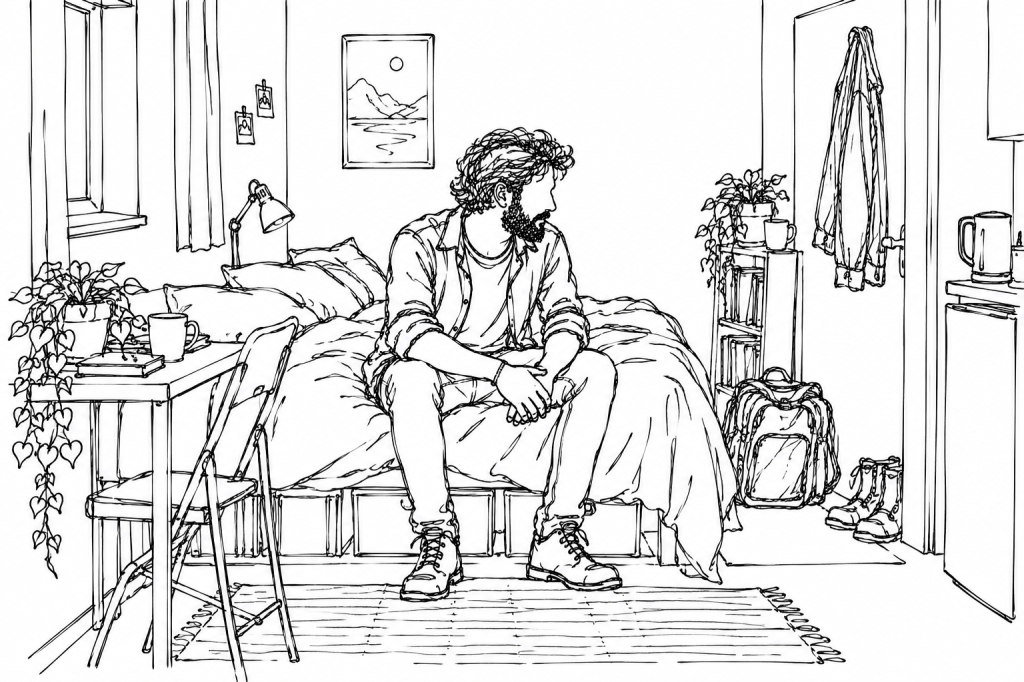
I was pleased for him.

The first time I visited, we were both excited about having somewhere of our own to spend time together. We joked that we needed to christen the new place.

What followed was an unexpectedly intense and intimate experience, and I remember leaving with a real glow of happiness.

I felt incredibly close to Stephen.

But there was something else I was carrying home with me.

I had pretended to have reached a level of sexual pleasure that I hadn’t quite reached.

It was a tiny lie, but it bothered me enormously.

The following day, I was still thinking about it at work. I felt guilty. I was falling deeply in love with this man, and the last thing I wanted was to start our relationship by hiding things from him. I didn’t want to create a pattern where I pretended everything was fine when it wasn’t.

So I decided to tell him.

I imagined we’d laugh about it.

Perhaps he’d tease me.

Perhaps we’d simply talk about it and move on.

Instead, his reaction was completely disproportionate to what I had expected.

He became extremely upset.

He compared me to his ex-wife and spoke at length about how much her lying had hurt him. He seemed to experience my admission as though I had deliberately deceived him, rather than what it was: something I had admitted to less than twenty-four hours later because I didn’t want to be dishonest with him.

I tried to explain.

I tried to reassure him.

Nothing seemed to help.

I was shocked by the intensity of his response and frightened that something so small might somehow cost me the relationship.

I went home from work that evening feeling ashamed and deeply upset.

Then things became much more serious.

Later that night, Stephen had returned to his father’s house and called me.

He was in an awful state.

He was crying, distressed and increasingly paranoid, and he had been drinking. I was so worried about him that I got in the car and went to collect him.

I brought him back to mine.

I remember him sitting on the edge of my bed, confused and barely coherent. He seemed completely overwhelmed by whatever was happening inside his head.

I didn’t know what to do.

Until then, I had known that Stephen had mental health difficulties. I knew about his EUPD and I knew about his traumatic childhood.

But this felt different.

This was the first time I began to understand that his difficulties could be much more serious than I had appreciated.

There wasn’t much I could do except stay with him, apologise for upsetting him and try to comfort him until eventually he slept.

Thankfully, the episode passed.

We got through it.

And from that point onwards, I never deliberately lied to Stephen again throughout the rest of our relationship.

The bedsit itself, however, soon became another source of difficulty.

Stephen moved in just as the UK entered its third national lockdown in January 2021. Restrictions meant that there was very little for him to do, and he quickly found the isolation difficult.

He struggled with the empty days and lonely nights.

He would try to cook, but often ended up bringing takeaway food back instead. He didn’t seem to know how to fill his time or settle into living alone.

I tried to help.

Sometimes I stayed over, even when I had work the next day, because I knew how difficult he was finding the loneliness. We still spent some weekends together when he didn’t have his sons, and I suggested different things he might do to occupy himself.

But nothing seemed to make much difference.

Within only a couple of weeks, I noticed that he was spending more and more time back at his father’s house.

When he had his sons, his father would often collect him on a Thursday, and Stephen wouldn’t return to the bedsit until the following Tuesday.

By the end of this period, my impression was that he was spending only two or three nights a week there, although I know Stephen may remember this differently.

I could see that the independence I had hoped the bedsit would give him wasn’t working out quite as I had imagined.

Then, sometime in March, Stephen told me he wanted to visit his ex-girlfriend to collect belongings he had left behind.

He planned to stay for two nights.

I wasn’t entirely comfortable with the idea.

Why did he need to stay for two nights?

Why couldn’t he collect his things and come home?

And why was he relying on her rather than asking me?

But I didn’t want to become the jealous or difficult girlfriend. I’d started this relationship wanting to be trusting and easy-going, and I wanted to maintain that part of myself.

So I didn’t make too much of it.

When the day came for his ex-girlfriend to collect him from the bedsit, I asked him for just one thing.

One promise.

“Just please don’t share the bed with her.”

He reassured me immediately.

“No way. I’ll be sleeping on the sofa.”

I believed him.
Letting Stephen In (REFLECTION)

There was something Stephen gave me during those first weeks that went deeper than attraction.

He made me feel accepted.

I had worried about my age and my body before we’d even met. Then, when I finally allowed myself to be completely exposed in front of him, he seemed to find beauty in the very things I had learned to regard as imperfections.

I still remember what he said about my stretch marks.

Scarification.

It was such an unusual comparison, but perhaps that’s why it stayed with me. He had taken something I felt self-conscious about and looked at it through an entirely different lens. Instead of damage, he saw decoration.

Whether he understood its significance or not, Stephen was beginning to change the way I experienced myself in his presence.

I felt desirable.

But increasingly, I also felt seen.

That evening with the music game mattered to me for exactly that reason. Stephen wasn’t merely interested in my body or in the excitement of a new sexual relationship. He seemed interested in my mind, my photographs, my journals, my memories, my creativity and all the strange little things that made up my world.

He wanted to look.

He wanted to know.

And I wanted to show him.

There is enormous intimacy in being curious about another person’s inner world. Perhaps that was part of why the relationship accelerated so quickly. We weren’t simply spending time together. We were exchanging ourselves.

Stephen was showing me his world too.

And his was becoming increasingly painful.

As he told me more about his childhood, I began to understand that the diagnosis he’d mentioned so matter-of-factly on Christmas Eve had a history behind it.

A child had been hurt.

That knowledge inevitably changed the way I saw the adult.

I don’t think that was wrong.

Understanding someone’s history can help us respond to them with compassion. Experiences of childhood trauma can affect attachment, trust, emotional regulation, self-worth and the ways people experience closeness in adulthood. But trauma doesn’t produce one predictable kind of person, and it certainly doesn’t explain every choice someone later makes.

I couldn’t know what Stephen’s childhood meant for Stephen.

I could only listen to what he told me.

And what I felt was enormous tenderness.

Perhaps something equally powerful was happening for him.

He had met a woman who wasn’t frightened away by his diagnosis. I didn’t recoil from his history. I listened when he spoke about his childhood. I welcomed him into my home. I wanted him physically. I was interested in his ideas.

And increasingly, when he was distressed, I came to get him.

I wonder what that felt like.

Perhaps my home became more than somewhere pleasant to spend the night.

Maybe it represented relief.

Stephen would describe the frustration and unhappiness of living with his father, and then sometimes, quite literally, I would arrive.

My car would pull up.

He would get in. 

And I would take him somewhere warm, comfortable and calm.

To my home.

To me.

There was nothing calculated about it from my side.

Someone I was falling in love with was unhappy.

I had the means to make him less unhappy.

So I did.

That equation felt remarkably simple.

It also felt like an expression of one of the qualities I valued most in myself.

Love meant showing up.

If somebody I loved was struggling, I didn’t want to stand at a safe distance explaining that their struggle belonged to them. I wanted to help.

There is nothing inherently unhealthy about that either.

Relationships require care.

The difficulty comes when care quietly begins changing into responsibility.

I didn’t notice that boundary moving.

Perhaps because nobody moved it deliberately.

Stephen was distressed.

I responded.

His distress reduced.

I felt useful.

He felt better.

Then, when distress returned, we repeated the process.

Psychologically, patterns don’t need to be consciously designed in order to become powerful. When one person’s distress repeatedly draws a soothing response from another, both people can begin learning their respective roles.

Stephen could turn towards me for regulation.

I could turn towards helping him as a way of expressing love.

Neither of us had to decide that this was how our relationship would work.

We simply had to repeat it.

And there was another ingredient that made helping Stephen particularly compelling.

I could see his vulnerability now.

The confident man I’d initially imagined was still there, but alongside him was someone much less certain and much more wounded.

The more of that person I saw, the harder it became to evaluate Stephen only in terms of whether he could meet my needs.

I began thinking about his.

That shift was subtle.

I had entered dating wanting companionship, comfort, security and somebody with whom I could thrive.

Now I was increasingly asking myself what Stephen needed in order to thrive.

Perhaps love could help.

Perhaps stability could help.

Perhaps patience could help.

Perhaps being with somebody who genuinely accepted him could give him the secure foundation from which the rest of his life could begin falling into place.

There was something deeply hopeful in that idea.

And then Stephen told me something that should have sat awkwardly beside all that hope.

He probably wasn’t ready for a relationship.

When I look back now, I think this was one of those moments when reality spoke remarkably plainly.

Stephen wasn’t necessarily warning me that he would hurt me.

He may simply have understood something about himself.

His life was unstable. He was unhappy. He had unresolved practical problems, fractured relationships and emotional difficulties. Perhaps some part of him genuinely recognised that beginning an intense new relationship in the middle of all that wasn’t sensible.

But then came the second half.

Meeting me was an opportunity he couldn’t pass up.

And that transformed the meaning completely.

I’m not ready for a relationship might have created distance.

I’m not ready, but you’re too special to lose created intimacy.

It made me the exception.

There is something extraordinarily seductive about being someone’s exception.

It suggests that ordinary rules don’t quite apply because what you’ve found is unusual.

Perhaps Stephen genuinely felt that way.

I suspect he did.

I don’t imagine him sitting there constructing a sentence designed to override my judgement. I think it is entirely possible that two contradictory things were true inside him at once.

He wasn’t ready.

And he desperately wanted me anyway.

Human beings live inside contradictions like that all the time.

The more interesting question is what I did with the information.

I heard both parts.

But emotionally, I gave more weight to the second.

Once again, my instincts hadn’t failed me.

I knew we were moving quickly.

I knew his life was complicated.

I knew his diagnosis might present challenges.

I knew I was beginning to accommodate him.

And now Stephen himself had told me that perhaps he wasn’t ready.

But I had another growing collection of evidence too.

He made me happy.

He made me laugh.

He made me feel beautiful.

He was interested in my world.

The chemistry was extraordinary.

I was beginning to love him.

And he appeared to be falling in love with me.

When he accidentally let those three words escape at the end of a phone call, I stopped him because I knew it was too soon.

That was another instinct.

Slow down.

But beneath it was another truth.

I wanted to say them too.

This is what makes the story difficult to reduce to warnings ignored.

There wasn’t one voice inside me saying danger while another foolish voice silenced it.

There were competing truths.

This is moving too quickly.

This feels extraordinary.

His life is unstable.

He wants to change it.

He may not be ready.

Neither of us wants to lose this.

And perhaps the most powerful:

Maybe with enough love, patience and security, we’ll be all right.

I didn’t yet understand how easily that belief could alter the balance of a relationship.

Because if love became something that could help Stephen become more stable, then difficulties between us could acquire a new meaning.

They wouldn’t necessarily mean the relationship was wrong.

They might simply mean he needed more understanding.

More patience.

More security.

More time.

And I had enormous reserves of all four.

The woman who had begun dating looking for somebody with whom she could build a secure life was starting, almost imperceptibly, to offer her own security as somewhere for Stephen to shelter.

At the time, that didn’t feel like losing anything.

It felt like love.

And perhaps that was why the boundary between loving Stephen and looking after Stephen became so difficult for me to see.

Letting Stephen In

The weeks that follow our first meeting are a mixture of immense joy and the first hints of things that make me uneasy.

About a week after we met, I’m becoming tired of our unconventional dates.

Meeting in my car, staying out until four in the morning and then going home to face a full day of work isn’t sustainable. I’m exhausted, and eventually I summon the courage to ask Stephen if he’d like to come back to mine.

I’m nervous.

I’m also slightly embarrassed because my house isn’t as tidy as I’d normally like it to be. Work, late-night meetings with Stephen and long conversations on the phone have left very little time for housekeeping.

But I want him to see my home.

More importantly, I want to invite him into my life.

So Stephen comes back with me.

For the first time, we have the privacy and comfort of my own bedroom. We can finally stop making out in a car and lie down together properly.

We make love for the first time.

Getting completely naked in front of him makes me a little self-conscious. I’m very aware of my middle-aged body — the stretch marks and loose skin left by two pregnancies and years of losing and gaining weight.

But Stephen makes me feel completely at ease.

He tells me that my skin is the softest he’s ever touched. When he sees my stretch marks, he compares them to scarification — something deliberately created on the skin as a form of decoration.

I remember thinking:

What a beautiful thing to say.

This man is saying things that make me feel comfortable, accepted and, somehow, beautiful.

Later, Stephen shows me a headless naked photograph of a former girlfriend who was a much larger woman than me.

I think it’s a little inappropriate to show me a photograph like that, but I understand the point he’s trying to make.

He’s telling me that bodies don’t have to conform to some particular ideal for him to find a woman attractive.

And I believe him.

His apparent lack of judgement towards women’s bodies makes me feel safe with him. It becomes something I admire about him, something I associate with his openness and acceptance.

I don’t yet understand the other side of that openness.

For now, I simply feel grateful to be with a man who seems to see beauty so differently from the way I have sometimes seen myself.

My home quickly becomes our new favourite place to spend time together.

We listen to music, talk, laugh, make love and sit smoking at my bedroom window.

Smoking isn’t something I particularly want to do, but it’s becoming increasingly obvious that Stephen is a much heavier smoker than I had initially understood.

I don’t want him having to go outside in his underwear, so I let him smoke at the window.

Before long, I’m joining him.

It’s a small thing, but I’m already beginning to accommodate his habits into my own life.

When we can’t be together, our relationship continues through our phones.

We text constantly and find ways to amuse ourselves.

One evening, we take turns photographing ourselves wearing every hat we own.

It’s silly.

It’s fun.

And it feels intimate in the way that only the early stages of falling for someone can.

I remember one particular evening when something else happens that feels significant.

For once, our time together doesn’t revolve around sex.

We play a music board game I received for Christmas, taking turns answering the questions. Each question seems to lead somewhere else — a favourite song, a memory, an artist, a story from our past.

We talk for hours.

Later, I show Stephen some of the things that make up my world: my photographs, journals and various projects I’ve worked on.

He is genuinely interested.

He asks questions. He listens. He’s enthusiastic about what I show him and complimentary about my home and my sense of style.

I feel seen.

Not simply looked at, but genuinely seen.

I can’t remember feeling that way with anyone before.

Then, at the end of one of our phone calls, Stephen quietly mumbles:

“I love you.”

I immediately pick him up on it.

It’s far too soon.

He pretends he didn’t say it.

We both know he did.

We laugh about it, but I don’t let him off quite that easily.

The truth is, I’m falling in love with him too.

I’m just not ready to say it yet.

Around this time, Stephen begins telling me more about his childhood.

He gives me more detail about the abuse he experienced and how extensive it had been. Hearing about what happened to him makes my heart ache for the child he once was.

I already know that he has EUPD, and now I’m beginning to understand that there is much more behind the diagnosis than I had previously appreciated.

I do wonder whether his past and his emotional instability might eventually become a problem.

But Stephen seems remarkably matter-of-fact about what happened to him. He doesn’t present himself as broken or helpless. He seems certain about what he wants and, more importantly, certain that he wants me.

I convince myself that love, patience and a secure relationship could help us overcome whatever difficulties might arise.

Then Stephen tells me something that, looking back, should perhaps have made me pause.

He says he probably isn’t ready for a relationship.

But meeting me is an opportunity he can’t pass up.

The way he says it makes me feel as though I’m different.

As though I’m the exception.

As though I’ve appeared at exactly the right moment and he simply can’t let me go.

I love hearing that.

I’m already smitten, and I don’t stop to consider what it might mean that the man I’m falling for is telling me he isn’t actually ready for the relationship I’m hoping to build with him.

If I’d been more detached, or more focused on what I needed rather than what I was feeling, perhaps I would have told him to take the time he needed.

Perhaps I would have said, Get yourself into a better place, and when you’re ready for a relationship, come and find me.

But I don’t.

I’m falling in love.

And I believe we can overcome whatever difficulties stand between us.

I don’t yet understand how much Stephen’s life is still unravelling.

I only know the man I’m getting to know now.

There are many evenings when we simply talk on the phone.

Increasingly, he tells me how unhappy he is living with his father. He talks about the situation with his brother, the house and the money he believes he’s owed. His frustration is growing, and some of our conversations become deeply emotional.

Sometimes, I worry about him.

Sometimes, I can’t bear the thought of him sitting there feeling miserable and alone.

So when the conversations become particularly difficult, I get in my car and drive to collect him.

Sometimes it’s late.

Sometimes it’s the small hours of the morning.

I bring him back to my house.

I give him somewhere comfortable to be, somewhere he can escape the chaos of his father’s home, and someone willing to listen.

At the time, it feels like love.

I’m simply being there for someone I care about.

I don’t realise that something is beginning to form between us — a pattern in which his distress becomes my responsibility and helping him becomes one of the ways I express my love.

I only know that he needs me.

And I want to be the person he can turn to.

Getting To Know Stephen (REFLECTION)

There is an uncomfortable irony in the fact that one of the first significant things Stephen ever told me was that something he had already told me wasn’t true.

He wasn’t a property developer.

He was unemployed.

On paper, perhaps that should have mattered more than it did. Stability was one of the things I was actively looking for, and financial and employment insecurity were things I specifically hoped not to carry into another relationship.

Yet I didn’t experience Stephen’s confession primarily as dishonesty.

I experienced it as honesty.

That distinction interests me now.

He hadn’t been caught. I hadn’t challenged him. He volunteered the truth almost immediately and gave me an explanation I could understand. Dating profiles are advertisements of sorts, and unemployment isn’t something many people would enthusiastically offer as their opening line. Property development was something he aspired to do. He had simply presented the man he hoped to become as though he already existed.

I could understand the insecurity behind that.

Perhaps because I could understand it, the confession actually reassured me. Someone determined to deceive me, I reasoned, would surely have maintained the lie.

Stephen hadn’t.

So instead of thinking, This man has lied to me, I found myself thinking, This man is willing to tell me uncomfortable truths.

And throughout that day, he appeared to keep proving it.

He told me about his previous relationship without turning his ex-partner into someone I needed to dislike. He told me he had EUPD. He hinted at childhood trauma without using it to demand sympathy or revealing details I hadn’t earned the right to hear.

None of those things felt manipulative to me.

They felt vulnerable.

I wonder sometimes what that conversation felt like from Stephen’s side.

Perhaps telling me about his diagnosis so quickly was simply openness. Perhaps he had learned that it was better to disclose it early rather than risk somebody discovering it later and feeling misled. Perhaps there was also an element of testing involved: Here are the less straightforward parts of me. Are you still interested?

I can’t know.

What I do know is that I stayed.

More than that, I remained fascinated.

And perhaps Stephen learned something about me that day too.

He learned that difficult information didn’t automatically frighten me away.

At the time, I would have considered that a good thing.

I still do, in many ways.

I don’t believe a mental health diagnosis should disqualify somebody from being loved, nor do I think childhood trauma makes someone inherently dangerous or incapable of a healthy relationship. If anything, Stephen’s willingness to name his difficulties suggested to me that he had some understanding of himself.

What I didn’t yet appreciate was the enormous distance that can exist between knowing something about yourself and being able to manage it.

A diagnosis is a description, not an explanation for every behaviour that follows. And self-awareness, however valuable, doesn’t automatically create self-regulation, accountability or change.

But those were distinctions I had no reason to be making on Christmas Eve.

I was simply listening to a man tell me about himself.

And I liked what his openness seemed to say about him.

There was something else happening between us that was much less intellectual.

I was becoming intensely attracted to him.

His voice changed things.

Until then I had been responding to photographs and words, but suddenly there was tone, rhythm, laughter and personality. The giggle particularly disarmed me. There was something unexpectedly boyish about it, something that seemed at odds with the handsome, confident man in the photographs.

I found that contrast incredibly appealing.

Perhaps it also awakened something very familiar in me: tenderness.

I had always been drawn to complexity in people. Strength didn’t interest me nearly as much when it stood alone. Stephen seemed to possess confidence and vulnerability simultaneously. There appeared to be a capable adult and something softer underneath him.

I wanted to know both.

And already we were talking about dreams.

His woodland. My home.

Neither of us was proposing that we build those things together. We had known each other for barely a day. But when two people are strongly attracted to each other, similarities can begin to feel disproportionately meaningful.

There is a psychological phenomenon called confirmation bias: once we begin hoping something might be true, we naturally notice information that supports that possibility.

I wasn’t planning a future with Stephen.

But I was beginning to notice how easily he might fit into one.

The differences hadn’t disappeared. I was still conscious of his unemployment. I knew EUPD could potentially make a relationship more complicated. And somewhere in the conversation sat that first small lie.

But beside those things were intelligence, humour, attraction, vulnerability, apparent self-awareness and dreams that didn’t seem incompatible with mine.

The balance felt overwhelmingly positive.

And perhaps that is one of the things hindsight can distort most cruelly.

Once we know that something eventually hurt us, we can become obsessed with identifying the point at which we should have recognised the danger. We turn ordinary decisions into evidence against our former selves.

I don’t think that’s fair.

I noticed the lie.

I noticed the diagnosis.

I considered them.

Then I made a judgement based on the person Stephen appeared to be and the information available to me.

What I couldn’t know was which pieces of information would eventually matter.

Nor could I know that one of the qualities I was beginning to admire most in Stephen — his apparent willingness to tell me uncomfortable truths — would become far more complicated for me to understand.

For now, honesty seemed simple.

You told someone the truth.

They listened.

And if the truth was difficult, perhaps accepting it was one of the ways you showed someone that they were safe with you.

I had no idea how often, in the years ahead, I would find myself trying to work out where understanding another person should end and protecting myself should begin.

Getting To Know Stephen

Christmas Eve 2020 was the busiest day of my working year. Normally, it would have been impossible to give anything else much attention, with important tasks to complete and an impossible long list of things that needed doing before Christmas could properly begin. 

But somehow, Stephen and I managed to keep talking all day.

Messages flew back and forth between us whenever I had a spare moment. Each one seemed to open another door into the other’s life, and beneath the practicalities of my busy day, we were quietly assessing the chemistry between us.

There was definitely a spark.

Our communication seemed to work effortlessly. We shared a similar sense of humour and enjoyed playing with ideas, and the more we talked, the more common ground we discovered. We were beginning to recognise similarities in our pasts, but perhaps more excitingly, we were discovering that some of our hopes for the future weren’t so different either.

It was during those conversations that I learned my first surprising fact about Stephen.

He wasn’t actually a property developer.

He confessed that he had listed it on his dating profile because, although property development was something he aspired to, it sounded considerably better than putting ‘unemployed’ on his profile.

It was, technically, a lie.

It raised an eyebrow.

But I also appreciated that he had told me himself, rather than allowing me to continue believing something that wasn’t true. He was remarkably open about other aspects of his life, and I could understand the embarrassment behind wanting to present yourself in a better light when entering the dating world. I decided not to make too much of it.

There were more important things I was discovering about him.

Stephen spoke warmly about his previous girlfriend, describing her as a lovely and kind woman but explaining that, despite those qualities, he couldn’t see a future with her.

I remember finding that refreshing.

There was something reassuring about hearing a man speak kindly about an ex-partner rather than dismissing her or turning her into the villain of his story. It suggested a degree of maturity and compassion that I found attractive.

Then Stephen told me something else.

He had EUPD — Emotionally Unstable Personality Disorder.

He suggested that it had developed as a consequence of something traumatic during his childhood, although he didn’t tell me what had happened. I didn’t push him. We’d only known each other for a day, and there were some things that I felt belonged to a later conversation, if and when we got to know each other properly.

I listened carefully, though.

I was aware enough to understand that entering a relationship with someone who had a significant mental health diagnosis could bring its own complexities. I wondered what it might mean for him, and potentially for me, if our relationship developed.

But at that point, what stood out more strongly than the diagnosis was his apparent openness about it.

He seemed self-aware. He wasn’t hiding it or pretending that everything in his life had always been straightforward. There was something quite compelling about that honesty.

I suspected that whatever had happened in his childhood had been serious, possibly involving abuse, but I didn’t need to know everything immediately.

There was plenty about Stephen that I found fascinating already.

My curiosity about him was stronger than my reservations.

We talked about the sort of lives we imagined having one day. Stephen dreamed of owning some woodland and creating a self-sufficient life for himself. I had rather more modest ambitions.

I simply wanted a lovely home to come back to after a day’s work.

Somewhere I could feel safe. Somewhere I could feel secure. Somewhere I could build a happy life.

When we talked about it, neither dream seemed incompatible with the other.

In fact, they seemed as though they might fit surprisingly well.

It was far too soon to be imagining a future with a man I’d met on a dating app only the day before, and I was perfectly aware of that.

But it was difficult not to entertain the possibility.

Something exciting and, perhaps, surprisingly realistic seemed to be taking shape.

That evening, I think we had our first telephone conversation.

Until then, Stephen had existed as words on a screen and a handful of photographs. Suddenly, there was a voice attached to him.

I loved it instantly.

It was quite low and textured, with a slightly silky quality that I found incredibly attractive. There was something almost contradictory about the way he spoke — occasionally quite polished and almost posh, then suddenly dropping into much more ordinary, familiar pronunciations.

And when I made him laugh, he would giggle.

Not a restrained, self-conscious laugh, but something much more childlike and spontaneous.

I found it adorable.

Hearing his voice made the attraction I’d already felt through our messages grow stronger. There was something about Stephen that seemed to combine confidence with an almost boyish naivety, and I found the combination irresistible.

It was Christmas Eve.

The timing somehow made everything feel even more exciting. There was something wonderfully surreal about being on the threshold of Christmas, surrounded by all the usual preparations, while at the same time beginning something completely unexpected with a man I’d only just met.

I was already pretty hooked.

I wanted to know more about him. I wanted to hear his voice again. I wanted to see where this extraordinary conversation might lead.

But I also knew that the next couple of days would probably put everything temporarily on hold.

Christmas was here.

For the moment, I had to put my phone down, finish my work and get on with the festivities.

I had no idea then that the conversation I’d started just a few days earlier would become the beginning of a relationship that would change my life.

For now, it was simply Christmas Eve, and I was excited about a man I had only just met.