
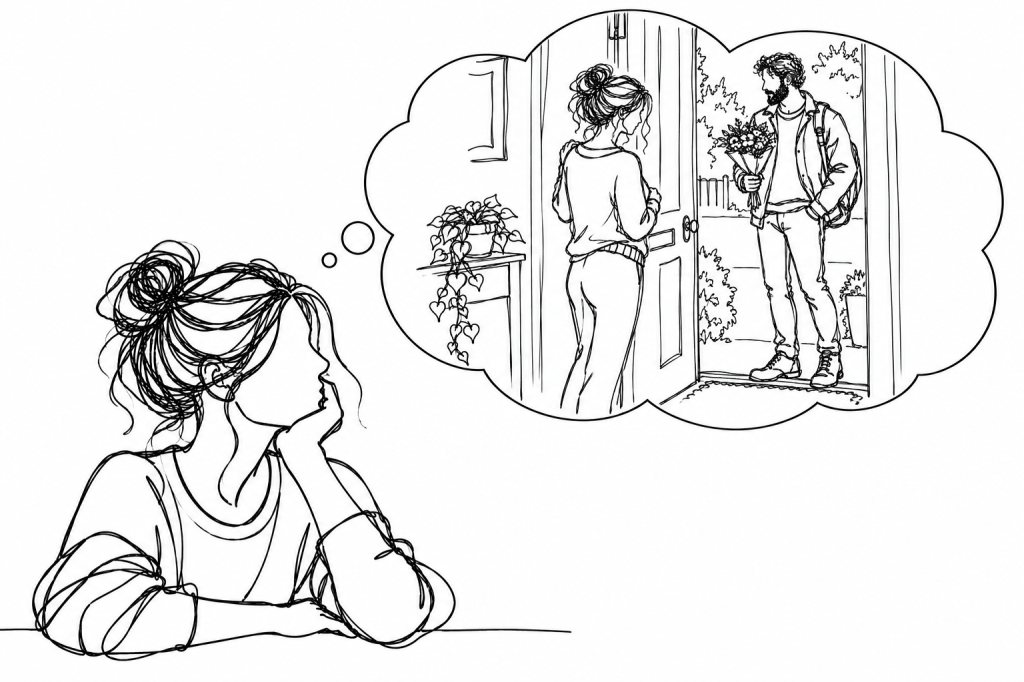
There was something Stephen gave me during those first weeks that went deeper than attraction.
He made me feel accepted.
I had worried about my age and my body before we’d even met. Then, when I finally allowed myself to be completely exposed in front of him, he seemed to find beauty in the very things I had learned to regard as imperfections.
I still remember what he said about my stretch marks.
Scarification.
It was such an unusual comparison, but perhaps that’s why it stayed with me. He had taken something I felt self-conscious about and looked at it through an entirely different lens. Instead of damage, he saw decoration.
Whether he understood its significance or not, Stephen was beginning to change the way I experienced myself in his presence.
I felt desirable.
But increasingly, I also felt seen.
That evening with the music game mattered to me for exactly that reason. Stephen wasn’t merely interested in my body or in the excitement of a new sexual relationship. He seemed interested in my mind, my photographs, my journals, my memories, my creativity and all the strange little things that made up my world.
He wanted to look.
He wanted to know.
And I wanted to show him.
There is enormous intimacy in being curious about another person’s inner world. Perhaps that was part of why the relationship accelerated so quickly. We weren’t simply spending time together. We were exchanging ourselves.
Stephen was showing me his world too.
And his was becoming increasingly painful.
As he told me more about his childhood, I began to understand that the diagnosis he’d mentioned so matter-of-factly on Christmas Eve had a history behind it.
A child had been hurt.
That knowledge inevitably changed the way I saw the adult.
I don’t think that was wrong.
Understanding someone’s history can help us respond to them with compassion. Experiences of childhood trauma can affect attachment, trust, emotional regulation, self-worth and the ways people experience closeness in adulthood. But trauma doesn’t produce one predictable kind of person, and it certainly doesn’t explain every choice someone later makes.
I couldn’t know what Stephen’s childhood meant for Stephen.
I could only listen to what he told me.
And what I felt was enormous tenderness.
Perhaps something equally powerful was happening for him.
He had met a woman who wasn’t frightened away by his diagnosis. I didn’t recoil from his history. I listened when he spoke about his childhood. I welcomed him into my home. I wanted him physically. I was interested in his ideas.
And increasingly, when he was distressed, I came to get him.
I wonder what that felt like.
Perhaps my home became more than somewhere pleasant to spend the night.
Maybe it represented relief.
Stephen would describe the frustration and unhappiness of living with his father, and then sometimes, quite literally, I would arrive.
My car would pull up.
He would get in.
And I would take him somewhere warm, comfortable and calm.
To my home.
To me.
There was nothing calculated about it from my side.
Someone I was falling in love with was unhappy.
I had the means to make him less unhappy.
So I did.
That equation felt remarkably simple.
It also felt like an expression of one of the qualities I valued most in myself.
Love meant showing up.
If somebody I loved was struggling, I didn’t want to stand at a safe distance explaining that their struggle belonged to them. I wanted to help.
There is nothing inherently unhealthy about that either.
Relationships require care.
The difficulty comes when care quietly begins changing into responsibility.
I didn’t notice that boundary moving.
Perhaps because nobody moved it deliberately.
Stephen was distressed.
I responded.
His distress reduced.
I felt useful.
He felt better.
Then, when distress returned, we repeated the process.
Psychologically, patterns don’t need to be consciously designed in order to become powerful. When one person’s distress repeatedly draws a soothing response from another, both people can begin learning their respective roles.
Stephen could turn towards me for regulation.
I could turn towards helping him as a way of expressing love.
Neither of us had to decide that this was how our relationship would work.
We simply had to repeat it.
And there was another ingredient that made helping Stephen particularly compelling.
I could see his vulnerability now.
The confident man I’d initially imagined was still there, but alongside him was someone much less certain and much more wounded.
The more of that person I saw, the harder it became to evaluate Stephen only in terms of whether he could meet my needs.
I began thinking about his.
That shift was subtle.
I had entered dating wanting companionship, comfort, security and somebody with whom I could thrive.
Now I was increasingly asking myself what Stephen needed in order to thrive.
Perhaps love could help.
Perhaps stability could help.
Perhaps patience could help.
Perhaps being with somebody who genuinely accepted him could give him the secure foundation from which the rest of his life could begin falling into place.
There was something deeply hopeful in that idea.
And then Stephen told me something that should have sat awkwardly beside all that hope.
He probably wasn’t ready for a relationship.
When I look back now, I think this was one of those moments when reality spoke remarkably plainly.
Stephen wasn’t necessarily warning me that he would hurt me.
He may simply have understood something about himself.
His life was unstable. He was unhappy. He had unresolved practical problems, fractured relationships and emotional difficulties. Perhaps some part of him genuinely recognised that beginning an intense new relationship in the middle of all that wasn’t sensible.
But then came the second half.
Meeting me was an opportunity he couldn’t pass up.
And that transformed the meaning completely.
I’m not ready for a relationship might have created distance.
I’m not ready, but you’re too special to lose created intimacy.
It made me the exception.
There is something extraordinarily seductive about being someone’s exception.
It suggests that ordinary rules don’t quite apply because what you’ve found is unusual.
Perhaps Stephen genuinely felt that way.
I suspect he did.
I don’t imagine him sitting there constructing a sentence designed to override my judgement. I think it is entirely possible that two contradictory things were true inside him at once.
He wasn’t ready.
And he desperately wanted me anyway.
Human beings live inside contradictions like that all the time.
The more interesting question is what I did with the information.
I heard both parts.
But emotionally, I gave more weight to the second.
Once again, my instincts hadn’t failed me.
I knew we were moving quickly.
I knew his life was complicated.
I knew his diagnosis might present challenges.
I knew I was beginning to accommodate him.
And now Stephen himself had told me that perhaps he wasn’t ready.
But I had another growing collection of evidence too.
He made me happy.
He made me laugh.
He made me feel beautiful.
He was interested in my world.
The chemistry was extraordinary.
I was beginning to love him.
And he appeared to be falling in love with me.
When he accidentally let those three words escape at the end of a phone call, I stopped him because I knew it was too soon.
That was another instinct.
Slow down.
But beneath it was another truth.
I wanted to say them too.
This is what makes the story difficult to reduce to warnings ignored.
There wasn’t one voice inside me saying danger while another foolish voice silenced it.
There were competing truths.
This is moving too quickly.
This feels extraordinary.
His life is unstable.
He wants to change it.
He may not be ready.
Neither of us wants to lose this.
And perhaps the most powerful:
Maybe with enough love, patience and security, we’ll be all right.
I didn’t yet understand how easily that belief could alter the balance of a relationship.
Because if love became something that could help Stephen become more stable, then difficulties between us could acquire a new meaning.
They wouldn’t necessarily mean the relationship was wrong.
They might simply mean he needed more understanding.
More patience.
More security.
More time.
And I had enormous reserves of all four.
The woman who had begun dating looking for somebody with whom she could build a secure life was starting, almost imperceptibly, to offer her own security as somewhere for Stephen to shelter.
At the time, that didn’t feel like losing anything.
It felt like love.
And perhaps that was why the boundary between loving Stephen and looking after Stephen became so difficult for me to see.


