Stephen And The Life We Couldn’t Hold Together

​Several new plans we had made, started with a trip to an IMAX cinema to watch a Led Zeppelin documentary. It was incredible. The recordings of the band live during they heyday were so cinematic, it felt like we were there at the time. Stephen was a big fan of 60s and 70s rock and since meeting him, I became appreciative of it too.

In April, we took Stephen’s youngest son to Blackpool Pleasure Beach.

We had loved our trip to Alton Towers the year before, and I felt as though Blackpool was another theme park they both needed to experience.

The April showers were at their absolute worst and the B&B we had booked was filthy, but somehow neither managed to spoil the trip. We had a fantastic time.

Then, in May, Stephen and I went away again.

This time we were staying in a stargazing pod in Devon. It was a great little building and came close to matching the frontier cabin we had loved so much, although it didn’t quite beat it. The large glazed entrance looked straight out towards the sky, though, and when the clouds cleared at night we could sit there and look at the stars.

We spent time wandering around the picturesque town of Totnes, and Stephen treated us to a clay-pigeon shooting experience. I enjoyed it as much as I did at the gun show.

We were having a wonderful time.

One day, on a whim, we decided to visit the coastal town of Brixham.

Almost as soon as we left the car park, we began noticing pirates.

Lots of pirates.

Men, women and children were walking around dressed in surprisingly authentic-looking costumes. These weren’t the cheap fancy-dress outfits you might buy for a party. There were elaborate coats, boots, hats, swords and replica pistols.

We looked at each other, wondering what on earth was going on.

Then it became apparent that, completely by accident, we had arrived in the middle of the annual Brixham Pirate Festival.

It was everything Stephen loved in one place.

Costumes. Replica weapons. Boats. Cannons. Beer.

It looked like so much fun that after a while we actually felt slightly embarrassed walking around in our ordinary civilian clothes.

There and then, we made a deal.

We would come back the following year — and next time, we would come as pirates.

There was one day during the holiday when my phone game suddenly became particularly busy. By now I was part of an alliance, and something significant was happening within the game. I told Stephen I was going to play for a little while.

A little while turned into several hours.

It was exciting and involving, and I became completely absorbed in it. I knew we were on holiday together, but I also thought: it was my holiday too. If this was what I happened to want to spend an unplanned afternoon doing, why shouldn’t I?

Stephen seemed okay about it at the time. I thought he could see how much enjoyment I was getting from it.

But later on, the amount of time I was spending on the game was beginning to irritate him.

He felt I was spending too much time on my phone and not enough time with him.

I tried to explain why the game had become important to me. Since leaving my previous managerial role, there were parts of myself I no longer had an outlet for. Now that I was involved in the management of the alliance, I had responsibilities again. People relied on me. I was organising things, solving problems and making decisions.

In a funny little way, it had filled a gap I hadn’t realised had been left behind.

So I suggested what seemed like the perfect solution.

Why didn’t Stephen download the game and join my alliance too?

He had enjoyed similar games before. If he joined me, I could carry on doing something I genuinely loved without it feeling as though it was taking me away from him. Perhaps it could become another part of our life that we shared.

At the time, it seemed like such a small solution to such a small problem.

I had no idea how significant that little game would eventually become in both our lives.

When we returned from Devon, there was disappointing news waiting for Stephen.

He had missed the opportunity to buy the bunker land in Scotland.

He was devastated.

I was, if I was completely truthful, a little relieved.

I suggested again that perhaps he should look for something closer to home. Somewhere he could still create the kind of space he wanted, but somewhere we could easily drive to and from rather than having it hundreds of miles away in Scotland. It was woodland  he had always dreamed of owning and the bunker never quite matched that description.

Eventually he found somewhere with potential, and we went to see it.

To me, it seemed ideal.

It was a good-sized plot of a few acres and only around thirty minutes from where he was working. Once we were standing there, walking around it together, I think Stephen began to see the possibilities too. I imagined he could spend time there in an environment that he enjoyed and inspired him, and I could have more precious time to myself, respite from the stress that Stephen’s every day anxieties imposed on me.

Then, one otherwise completely ordinary morning, everything changed.

We woke up and Stephen checked his phone.

A six-figure sum of money was sitting in his bank account.

There had been no warning.

After all the years of dispute over the property he owned with his brother, half of its value had simply appeared in his account.

We were ecstatic.

This was something Stephen had been talking about, fighting over and waiting for since the day I met him. Suddenly, there it was.

The money was his.

And with very little hesitation, he put in an offer on the woodland.

It was accepted.

Once again, it felt as though everything was beginning to come together.

As though, after all the false starts and setbacks, life was finally moving in our direction.

It almost felt as though the universe was rooting for us.

But around the same time, something else happened.

Stephen had been asked to unload and store dozens of hay bales for the horses on the estate. That evening, he told me he thought he might have pulled something in his shoulder.

By the following morning, he was in excruciating pain.

There were tears in his eyes and ordinary painkillers weren’t touching it. He took the day off work, but we were due to travel to my parents’ later because we had a music festival near them on the Friday.

I booked him a last minute physiotherapy appointment before we left, hoping there might be something they could do to ease the pain.

The session was useful, but there was only so much that could be achieved in one appointment. He would need a course of treatment.

The day became chaotic and, when we eventually departed for my parents’, we left the flat in a mess.

The washing-up hadn’t been done. The rubbish hadn’t been taken out. Things had simply been left where they were.

I knew it wasn’t how I would normally leave somewhere, but getting Stephen comfortable and getting ourselves out of the door had seemed more important.

Once we reached Mum and Dad’s, we went to a pharmacy to see if we could get stronger pain relief and a sling.

We came very close to abandoning the festival altogether. Stephen was in so much pain that I couldn’t imagine how he would manage an entire day there.

But he wanted to try.

If the painkillers and sling helped enough, he thought he could get through it.

The following morning was a beautiful spring day and we headed to the festival.

As long as the co-codamol was working, Stephen said he could almost forget about the pain for a while. But whenever it began to wear off, the pain returned with a vengeance.

Despite that, we had a great day.

We had VIP tickets, which meant decent toilets and a quieter chill-out area filled with enormous beanbags where Stephen could rest. We saw several bands we liked and finally got to see one Stephen particularly loved.

I enjoyed myself.

But I also noticed something in myself.

I wasn’t quite my usual self.

The depression had made me quieter. Less engaged. Less interested in the people around me.

Stephen, meanwhile, was Stephen.

He struck up conversations everywhere he went. When he spotted members of the band he loved standing in the crowd watching another act, he simply went over and introduced himself.

I watched him doing it and became aware, perhaps for the first time quite so clearly, of how different we were in that respect.

He wanted to engage with everybody.

I didn’t feel like talking to anybody.

And for some reason, that made me sad.

I had this outgoing, sociable boyfriend who seemed able to find people and conversation wherever he went, while I increasingly wanted to retreat into myself.

When we returned from the festival, and left my parents home the following day, Stephen was in so much pain again, I drove him straight to A&E. He wanted the injury investigated, stronger pain medication and perhaps a note from the doctor to say he couldn’t work.

However, as soon as we returned to the estate, Stephen was called in to speak to his employers.

They fired him then and there.

They told him they didn’t feel the working relationship was working out.

They were both very physically active, former athletes and seemed sceptical about the extent of Stephen’s injury. They didn’t believe his pain could be as bad as he was describing it or that he needed more time off from work, especially when he could still go to a music festival. There was so much judgement within their criticism.

Then we discovered something else.

While we had been away, they had entered the flat.

And they were horrified by the state we had left it in.

I was mortified.

I already knew we hadn’t left it as I would normally leave a home. There were dirty dishes and rubbish that should have been taken out. But it was superficial mess. We hadn’t damaged anything. We hadn’t wrecked the place. And it had been handed to us in a much filthier state which I had since cleaned.

Still, knowing they had walked around it and judged what they saw left me feeling deeply embarrassed.

I was also angry.

I didn’t feel they should have entered the flat without warning us. It felt intrusive — almost as though they had been snooping.

They said water marks had appeared on the ceiling, which is likely correct, and their justification for going inside. Stephen said he had reported the problem several times and nothing had been done about it.

His boss dismissed that.

Stephen began to cry.

Rather than responding sympathetically, his boss effectively told him to stop crying and man up.

Stephen came back to me broken and confused.

I felt desperately sorry for him because I had watched him genuinely try to make the job work. I believed then, and still believe, that with different employers he might have thrived in that role.

And yet another part of me wasn’t entirely surprised.

I had sensed something wasn’t right almost from the first week. I had never quite had the feeling that his employers were happy with him, and somewhere in the background I had been waiting for something to happen.

I didn’t judge Stephen for losing the job.

But I couldn’t hide my disappointment either.

And because I was already depressed, my disappointment probably looked colder from the outside than it felt inside me.

There was embarrassment mixed into it too.

Although it hadn’t been my job, somehow I felt judged alongside him.

He was my boyfriend. His employers knew my former employers. They had now seen the state we had left their flat in. As someone who had spent most of her working life looking after other people’s homes to an extremely high standard, that stung more deeply than I wanted to admit.

By then, though, I simply wanted to leave.

I wanted to go home.

The whole thing had looked so promising, but it hadn’t worked out.

That wasn’t the end of the world.

Perhaps going home would give us a chance to stop, regroup and work out what came next.

Perhaps Stephen and I might find each other again.

Perhaps my depression would lift.

On his last day, I dropped Stephen off in the nearest town to collect his new prescription authorised from the hospital.

That evening, we packed everything into the car, and I insisted that we clean the flat from top to bottom before we left.

I think I needed to make amends.

More than that, perhaps I needed to prove something.

I didn’t want them remembering us as the filthy people who had left their flat in that state. I wouldn’t allow us to leave until every room and every corner had been cleaned to the standards I had spent my working life holding myself to.

Then we packed the last of our things into the car.
We waited until it was dark before driving away, hoping to leave without attracting any attention.

There was a heaviness between us as we pulled away.

Stephen was still in physical pain and emotionally crushed. I was depressed, disappointed and desperate to get home.

Only a short time earlier, we had been standing together in a piece of woodland, imagining what it might become.

Now we were driving away from another future that hadn’t quite worked out.

And for once, there wasn’t very much either of us could say.

Reflection

It is strange to remember how much happiness still existed during this period. We went to concerts and festivals, laughed our way through a rain-soaked Blackpool and accidentally discovered a pirate festival we immediately planned to return to. Devon was another genuinely lovely holiday. Even while something between us was becoming increasingly difficult, Stephen and I could still step outside ordinary life and find the version of ourselves that had always travelled well together. Those moments weren’t pretence. I was still capable of looking at him beside me and feeling enormously lucky.

At the same time, I was beginning to need more space from Stephen than I had before. The game gave me somewhere to disappear, but it also returned something I hadn’t realised I missed: responsibility, purpose and a sense of competence that belonged entirely to me. The woodland seemed capable of providing something similar in the real world. Stephen could have the space and project he had always wanted, while I could have periods of solitude without either of us having to explain why we needed them. I didn’t see that as us growing apart. I saw it as finding a healthier way of being together.

When the money arrived and Stephen bought the woodland, it felt almost ridiculously fortunate. After years of waiting, suddenly he had financial security and something tangible that belonged entirely to him. We had spent so long imagining the circumstances that might finally allow our lives to settle that each new development seemed to suggest we were getting closer. Even while I was depressed and our relationship was struggling, I could still look ahead and see possibilities. There was always another version of our life just beyond the difficult one we were currently living.

Losing the job punctured some of that optimism. I had watched Stephen try, and I genuinely believed the wrong combination of personalities had contributed to his failure there. But I had also sensed almost from the beginning that something wasn’t working, so the dismissal was both shocking and strangely unsurprising. My reaction was complicated by my own state of mind. I felt compassion for Stephen, disappointment for both of us and a humiliation that wasn’t entirely rational but felt intensely personal. Cleaning that flat before we left became my way of reclaiming something. Whatever his employers thought of us, I needed to leave knowing that I had restored the standards by which I recognised myself.

Driving away should perhaps have felt frightening, but mostly I wanted to go home. Another future had failed to materialise, but I still didn’t think that meant we had failed. Home represented somewhere to recover, regroup and decide what came next. That had always been our pattern: when one version of the future collapsed, we created another. I still believed Stephen and I would do that again. What I hadn’t yet understood was how tired I had become of continually needing to.
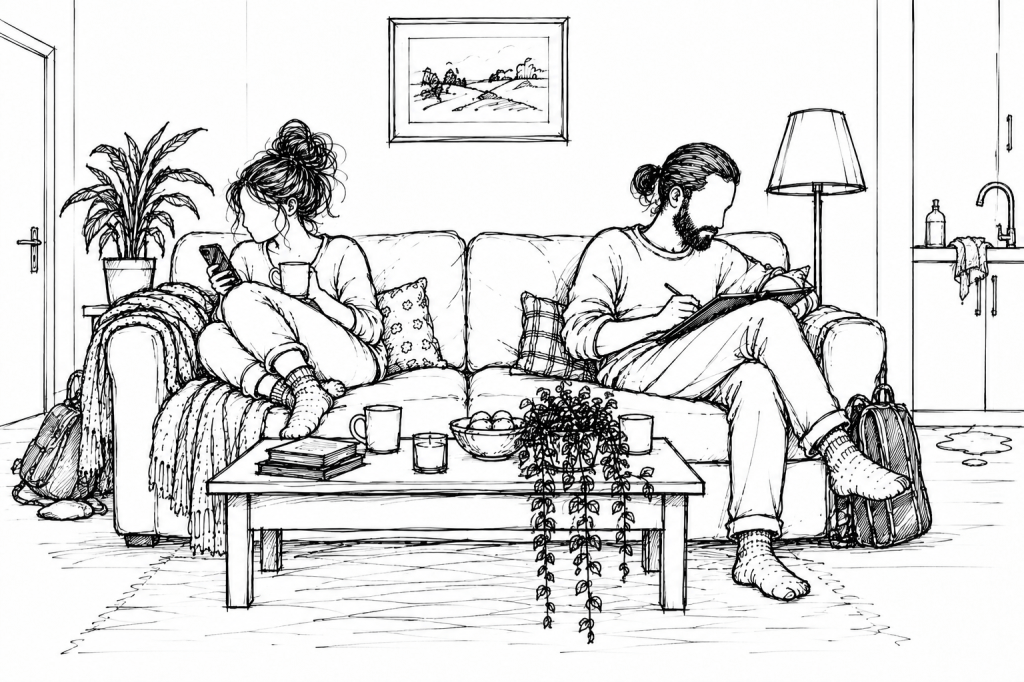

Stephen And The Life That Was Closing In

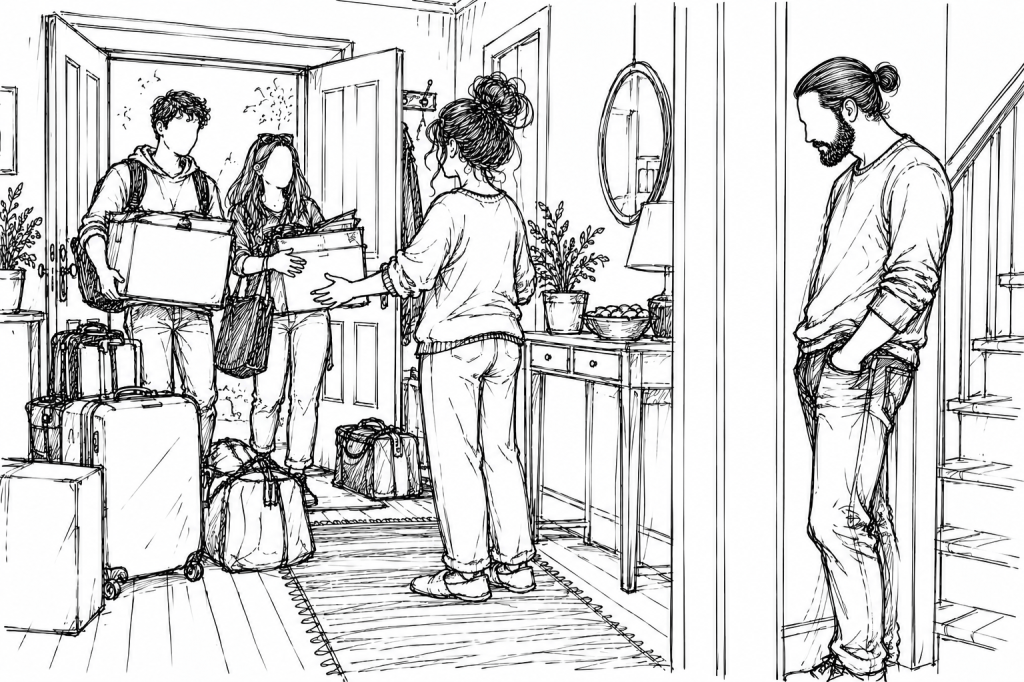
​In the new year, once Stephen’s new employers had returned from their holiday, we officially moved into the flat.

It was a one-bedroom apartment attached to the main house, with a large bathroom and an open-plan kitchen and living area. We arrived with only a couple of bags each — enough clothes for the working week, toiletries, towels and the other bits and pieces we thought we would need.

It was supposed to be the beginning of our new life.

Almost immediately, though, I was surprised by the state the flat had been left in.

The kitchen and bathroom appeared to have been cleaned only superficially and the bedding was stained. Considering how immaculate the main house was, I couldn’t understand why the same standards hadn’t extended to the place they were giving us to live.

Stephen mentioned it to his employers and they seemed surprised. Their cleaner had apparently cleaned it.

Perhaps she had, but not particularly well.

Still, it wasn’t a major problem. We could sort it out.

We began making lists of everything we needed. There were some kitchen utensils and equipment, but nowhere near enough to cook properly five nights a week, so we found the nearest supermarket and gradually started stocking the cupboards. We bought some nice decorative things to give the flat a personal touch.

That part I enjoyed.

Cooking and eating together had always been one of the simple pleasures of our relationship, and this felt like an opportunity to establish some healthier routines. We planned meals, shopped for them and cooked together.

Our working hours were much more aligned now too. I could get up and make us a decent breakfast before Stephen left for work, usually about an hour before I needed to leave for mine.

His first few days seemed to go well.

He learned how to service the swimming pool, familiarised himself with the extensive grounds and outbuildings and began walking the family’s three dogs. He would come back at the end of the day enthusiastic, pleased with what he had accomplished and full of stories about what he had been doing.

For a while, it really did seem as though everything might be falling into place.

The village itself was beautiful. Quiet and picturesque, with a couple of pubs but no shops, it felt a world away from the life we had been living before.

My own commute was only around twenty minutes, mostly through lovely country lanes.

Stephen’s solicitor had also been corresponding with his brother for several months about the house they jointly owned, and it was beginning to look increasingly likely that his brother would buy Stephen out. If that happened, Stephen would receive his half of the property’s value.

Suddenly there were possibilities.

If the job worked out and we continued enjoying the area, perhaps we could even buy somewhere nearby.

At weekends, we returned to my house. Stephen’s youngest son still stayed with us on his weekends and we continued taking him to tennis.

On paper, there was a great deal to feel hopeful about.

But as the first few weeks passed, something began to change.

Stephen became increasingly up and down.

Some evenings I would come home to the Stephen who had been there at the beginning — proud of what he’d achieved, enthusiastic about the estate and pleased with himself.

Other evenings I came home to someone completely different.

He would be despondent, pessimistic and anxious.

Part of it was his eldest son. It had now been around a year since they had properly spoken, with no clear explanation beyond his son apparently not wanting contact with his dad. The longer it continued, the more it seemed to weigh on Stephen.

But I was also becoming concerned about his relationship with his employer.

I watched the two of them together and listened carefully to the things Stephen told me about his working day, and my intuition was telling me they weren’t particularly well matched.

His boss was cut from a very different cloth. A farmer’s son, former athlete and very much a man’s man, he was physically and mentally robust, always moving quickly and frequently firing instructions at Stephen from several directions at once.

Stephen was strong too, but in a different way. He was sensitive and more easy-going. He liked to take his time over things and do them properly. He worked best when he understood clearly what was expected of him.

Here, the instructions sometimes changed. Stephen felt micromanaged. If something wasn’t completed quickly enough, or wasn’t done in exactly the way his boss expected, the frustration was obvious.

I felt sorry for him.

Having known Stephen for years, I could see how hard he was trying. In many ways, I thought he was performing better than I had ever seen him perform before.

But somewhere underneath my encouragement was a growing worry.

I wasn’t sure it was going to be enough for these people.

And increasingly, at the end of my own working day, I didn’t know which Stephen I would be coming home to.

The flat wasn’t helping.

I discovered that I couldn’t use the washing machine without dirty water backing up into the kitchen sink. Twice the water overflowed onto the floor. Sometimes the opposite happened: clean washing sitting in the machine would become wet and dirty again when water from the kitchen drained back into it.

There were days when I didn’t have clean clothes or even a dry towel.

Stephen reported the problem and his employers replaced the washing machine, but within days exactly the same thing happened. Clearly the problem wasn’t the machine at all but a blockage somewhere further down the plumbing.

Stephen told them.

Nothing happened.

He told them again.

Still nothing happened.

Eventually I started taking our washing back to my house at weekends.

By then, the flat itself was beginning to feel less like an exciting new home and more like somewhere I was trapped.

We could hear the family and their adult children talking and sometimes shouting late into the evening. At the bottom of our stairs was a locked door connecting our accommodation to the main house. Although there was supposed to be separation between the two spaces, occasionally we could hear somebody from the family entering that part of the property.

I began to feel observed.

I didn’t feel entirely at home there.

Strangely, I didn’t feel entirely at home in my own house anymore either.

Every weekend we returned, my son and his girlfriend had been living there without us all week. They were doing nothing wrong — quite the opposite. They were looking after the house and feeding the cat, and I was grateful.

But gradually it began to feel as though Stephen and I were the visitors.

I had somehow ended up belonging properly to neither place.

The days became repetitive.

There wasn’t much to do in the village and very little opportunity for a spontaneous change of scene. In the evenings, after dinner, I began spending more and more time playing the game on my phone.

Initially it had just filled some empty time.

Increasingly, it became somewhere to disappear.

Stephen, meanwhile, was becoming more openly unhappy about work. He loved the grounds, the animals and the practical nature of the job, but he was beginning to say that he was frightened of his boss. His employer could be highly critical and made little effort to disguise his frustration when Stephen hadn’t completed something or had misunderstood what he wanted.

I could understand why Stephen was struggling with him.

At the same time, things with his family were getting worse.

Some days he seemed able to talk about little else but his eldest son. He couldn’t understand why he wouldn’t speak to him and became increasingly emotional and confused about the estrangement.

Then problems developed with his youngest son at school. Eventually his mother reached the point where she felt unable to deal with it alone and asked Stephen to step in.

Stephen asked his employers whether his son could stay with us at the flat for a couple of days.

They agreed.

But by then I had developed an ominous feeling that they were quietly assessing far more than Stephen’s ability to do the work.

I began to wonder whether they were deciding that he wasn’t the right person to employ and have living on their property.

I didn’t know what to do with any of these concerns.

I could feel myself sinking too.

I still loved my own job, but some of my enthusiasm had disappeared. My body was beginning to hurt in ways it hadn’t before. My joints ached. My muscles felt tired. On the worst days, climbing a flight of stairs felt disproportionately difficult.

I was gaining weight.

I was spending more and more time escaping into my phone.

I didn’t feel at home in the flat, yet increasingly I didn’t feel at home in my own house either.

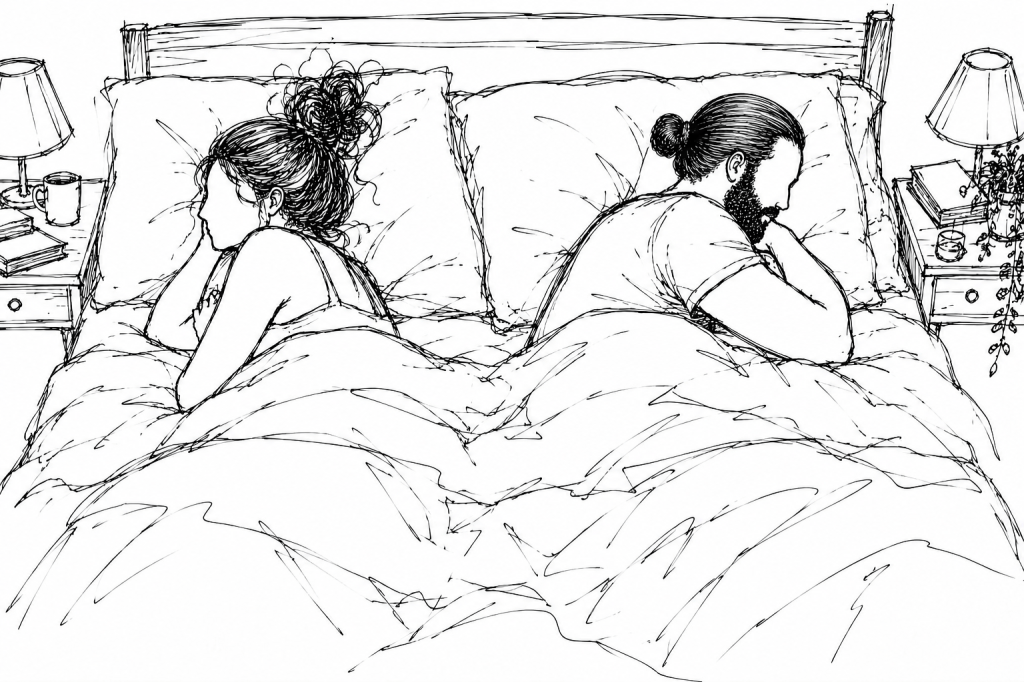
Our physical relationship was suffering too. Intimacy had almost disappeared and sex was becoming uncomfortable and sometimes painful for me.

Then I noticed something that frightened me more than any of the practical problems.

For the first time in our relationship, I sometimes left work and didn’t look forward to seeing Stephen.

There were evenings when I fantasised about driving back to my own house instead. Or going into town alone, wandering around the shops and perhaps having something to eat by myself.

I never actually did it.

But I thought about it.

There had always been something about seeing Stephen again at the end of the day that lifted me, even during difficult periods. Now, sometimes, there wasn’t.

Something between us was changing.

The irony was that I had been on the other side of this before.

When I had taken my new job, Stephen hadn’t been happy with what it did to our life together. He had struggled to communicate that to me, and I hadn’t fully understood how deeply unhappy he had become.

Now I was the one struggling to say it.

This was Stephen’s dream job. He had wanted an opportunity like this for so long. I could see how desperately he wanted it to work, and I didn’t want to be the person who told him that the life surrounding it was making me miserable.

So instead of saying, I don’t want this, I kept hoping it would get better.

There were still other futures being imagined too.

With the money from the house likely to arrive soon, Stephen began looking at woodland for sale. He found a small plot in Scotland with a disused building on it and became excited by the idea of turning it into some kind of bunker-style dwelling.

He travelled up alone to see it.

It was extraordinarily difficult to reach. After arriving at the nearest station, he had to walk for miles just to get there. He took videos for me, spent some time exploring the land and eventually began the long walk back.

By then he was exhausted and his body was hurting so badly that he ended up hitching a lift back towards his hotel.

And yet he wanted to buy it.

I couldn’t understand why.

It was in Scotland, inaccessible by car and would require an enormous amount of work. I couldn’t see how we could realistically keep travelling there, let alone undertake the project Stephen imagined.

I suggested he look for something closer to home.

Perhaps that was another small indication of what was happening between us.

We were still talking about the future, but we weren’t always imagining the same one.

Stephen began saying that he had nothing to look forward to. His eldest son wouldn’t speak to him. His youngest was struggling. The job that had initially excited him was becoming a source of anxiety.

So we booked things.

Trips. Events. Things to put on the calendar.

Things to look forward to.

Perhaps I needed them just as much as he did.

Because despite everything that was happening, I still wasn’t thinking about leaving Stephen.

I wasn’t looking at our relationship and concluding that it should end. I was looking at our life and thinking that something had gone badly wrong with it.

I wanted us to find our way out of this strange, constricted period. I wanted Stephen’s job to either improve or lead to something better. I wanted us to find somewhere that felt like home. I wanted my body to feel like mine again. I wanted Stephen to be happier. I wanted to feel happier.

Most of all, I wanted us to get back to being us.

The opportunity that had seemed as though it might open up the world for us had somehow done the opposite. Our lives had become smaller. We were more isolated, more restricted and increasingly retreating into ourselves.

I could feel something between us beginning to come apart.

I just never imagined that the answer would be for us to come apart too.

Reflection

The flat was supposed to give us something we had never really had before: a little life that belonged only to the two of us. For a brief period, it seemed to do exactly that. We cooked together, our working hours aligned and Stephen came home excited by everything he was learning. There were possibilities everywhere I looked — his job, the money from the house, somewhere we might eventually buy, perhaps even the couple’s position we had talked about for years. It felt as though several separate threads of our lives might finally be coming together.

What I hadn’t anticipated was how quickly that sense of possibility could become one of confinement. The flat never really felt like ours. My own house gradually stopped feeling entirely like mine. Stephen became increasingly anxious about his job and his sons, while I became tired, physically uncomfortable and strangely detached from myself. Even the game on my phone, which had begun as a silly way of filling spare time, became somewhere I could retreat when I didn’t particularly want to be present in the life around me.

The most unsettling change was much simpler. Sometimes I didn’t look forward to seeing Stephen. That was new. Whatever had happened between us before, seeing him had almost always brought some kind of emotional lift. Now I occasionally imagined driving somewhere else after work simply to have a few hours alone. I noticed that change in myself, but I didn’t interpret it as wanting to leave him. I thought I wanted to escape the circumstances we had somehow created around us.

Perhaps that was why I found it so difficult to tell Stephen how unhappy I was. I knew what this job represented to him. I had watched him work towards independence for years, and this was the closest he had come to the kind of opportunity we had always hoped he would find. Telling him that I hated living there felt dangerously close to asking him to give it up. So I did what I had done many times before: I waited, adjusted, made plans and looked for ways to improve the situation. We booked things to look forward to. Stephen imagined woodland in Scotland. I imagined somewhere closer to home. We were still talking about a future, although increasingly we weren’t always describing the same one.

I could feel something changing between us, but I still believed the relationship itself was underneath it somewhere, waiting to be recovered. I didn’t think I wanted a life without Stephen. I wanted a different life with him — somewhere we felt at home, where he wasn’t frightened of his employer, where his children were okay, where my body felt better and where we had enough happiness and energy left to find each other again. The life that was supposed to open everything up had somehow made our world smaller. I could see that clearly. What I couldn’t yet imagine was that making it bigger again might eventually mean living it apart.

Stephen And The Dream Job

I started my new job at the beginning of December 2024.

One of the things I had looked forward to most about leaving my previous job was simply having more of my life back.

For the past eighteen months, work had consumed an enormous amount of my time and energy. The relationship had inevitably been neglected, but so had our home. My son and his girlfriend were always very good at cleaning up after themselves, so the house was never a disaster, but I hadn’t done any proper deep cleaning for well over a year. There were cupboards I wanted to sort, rooms I wanted to reorganise and all those little jobs I had been mentally adding to a list while telling myself I would get around to them when life finally became less demanding.

Now, theoretically, I could.

Except that for the first few weeks, I didn’t.

I was actually rather lazy.

Looking back, I think I was recalibrating after eighteen months of constantly pushing myself. I had become so accustomed to being busy, tired and under pressure that when the pressure suddenly disappeared, I didn’t immediately fill the space with productivity. I seemed to need some time simply to exist in it.

There was another reason too.

My son and his girlfriend were still living with us, and now that we were all sharing the house again, there seemed slightly less incentive to start making radical changes to it. I still had ideas about what I wanted to do eventually, but for the moment there was no urgency.

For once, things could wait.

The most important thing was that my new job was wonderful almost from the moment I started.

My new employers were completely different from the ones I had just left. The atmosphere was different. The expectations were different. I didn’t feel as though I was constantly bracing myself or trying to anticipate the next problem.

Very quickly, I had the feeling that I could be happy there.

It was quite strange suddenly having mental space again.

I even found myself with little pockets of idle time after a working day, something I hadn’t experienced for what felt like forever. On a whim, I downloaded a silly little game onto my phone. It wasn’t anything significant. Whenever I was bored or had fifteen minutes, I would open it and play for a while.

At the time, it was simply a way of filling time.

Meanwhile, something interesting was beginning to happen with my son.

He and a plasterer friend were building a business together, although what they were doing was rather more specialised than ordinary plastering. They were working with high-end microcement and decorative finishes.

I had actually started noticing these finishes through my own work in private households. In some of the more expensive homes, traditional painted or wallpapered walls were increasingly being replaced by highly polished surfaces that looked almost like stone, or softer textured finishes reminiscent of the walls you might see in Morocco.

My son and his friend were becoming very good at it.

They were also beginning to attract some extremely wealthy and prestigious clients.

Then, shortly before Christmas, my son did something that meant far more to me than he probably realised.

He asked Stephen whether he would like to go with them on one of their jobs.

It was significant because my son’s opinion of Stephen had not always been particularly high. There had been times when he had seen me supporting Stephen while Stephen seemed to be making very little progress himself. But recently that had begun to change. Stephen had been working, becoming more productive and appearing to get his life back on track.

My son had noticed.

His willingness to take Stephen onto one of his own jobs felt like tangible evidence that some of his faith in him had been restored.

I knew my son well enough to know that he wouldn’t have made the offer casually. He was building a business and developing a reputation. Taking somebody onto a job meant trusting them to work hard, behave appropriately and represent that business well.

I was delighted.

Immediately, my mind began running ahead.

If Stephen impressed them, perhaps there was a possibility that my son and his friend might start using him more regularly. Maybe, eventually, he could become part of what they were building.

It seemed like another door opening.

So Stephen left with them that first morning.

When he came home that evening, however, the story he had to tell me was even better than anything I had imagined.

While working at the property, Stephen had got talking to the male principal of the household. During their conversation, Stephen mentioned that he had previously worked as a groundskeeper for my former employers.

By coincidence, the man knew them.

That immediately gave Stephen some credibility, but the conversation then took an unexpected turn.

The household was looking for a gardener and groundskeeper.

Would Stephen be interested?

He absolutely would.

Suddenly, what had begun as a single day’s work with my son had turned into the possibility of a completely new job.

And the more we heard about it, the better it sounded.

The salary would be around £30,000 a year. The work would involve gardening and groundskeeping, some general maintenance around the property and walking the dogs — all things Stephen was perfectly capable of doing and, more importantly, things he could actually enjoy.

There was also accommodation.

A small flat on the estate came with the job.

To us, it sounded incredible.

Financially, it changed the picture almost immediately. One of the uncertainties surrounding my decision to leave my previous job had been giving up the salary that had allowed me to save so much money. But if Stephen was earning £30,000 a year alongside my new income, that concern almost disappeared.

Together, we could still earn well.

Together, we could still save.

And the job seemed useful in another way too.

For some time, we had talked about the possibility of eventually applying for a couple’s position in a private household, perhaps in Scotland. I now had years of experience running homes and managing staff. Stephen had been gradually building a collection of practical skills of his own — gardening, groundskeeping, maintenance and working with his hands.

This job would add another substantial piece to that picture.

It made the idea of us one day applying together seem less like something we merely talked about and more like something we might genuinely be able to do.

We were both enormously excited.

Then there was the flat.

Initially, I wasn’t certain that I would live there with him.

There were still things I wanted to do at home, and my son and his girlfriend were still living there. Stephen, on the other hand, hadn’t particularly enjoyed sharing the house with them.

More importantly, things between Stephen and me had felt a little unstable over the previous six months.

We hadn’t separated, and I wasn’t thinking about ending the relationship, but something had shifted. I had spent much of that period believing the strain came from the enormous pressure of my job and the effect it had had on us. Now that I had changed jobs, I wanted to see what happened when life became easier again.

Perhaps a little space wouldn’t be such a bad thing.

Stephen could live in the flat during the week while I remained at home. We could spend time together without immediately throwing ourselves into another major change.

It seemed sensible.

At some point just before or just after Christmas — I can’t remember exactly when — we went to the property together and met the female principal to discuss the arrangements properly.

We were shown the flat.

And that changed something.

It was much nicer than I had imagined.

As I walked around it, I began to picture us there.

There would be no children living with us. No girlfriend. No navigating somebody else’s routines or trying to find privacy inside a shared family home.

Just Stephen and me.

In all the years we had been together, we had never actually moved into a new home as a couple. Stephen had moved into my house, into a life and household that already existed. This would be different.

This could be somewhere that belonged, at least temporarily, to the two of us.

Suddenly, staying there with him didn’t seem like such a bad idea after all.

We didn’t have to abandon my house. We could come home at weekends. I could still gradually do the things I wanted to do there.

But during the week, perhaps we could have this other little life.

Our own space.

The job wasn’t due to begin until sometime in January, which gave us a few weeks to think about everything and look forward to it.

And I was incredibly proud of Stephen.

When he told me how the opportunity had arisen, what impressed me most was that he hadn’t sat quietly waiting for somebody else to notice him. He had talked to the man. He had told him what he could do. He had put himself forward.

There was something fearless about it.

Stephen could sometimes doubt himself enormously, but at other times he had an ability to seize an opportunity that I admired. On this occasion, he had simply been brave enough to enter into a conversation and see where it led.

And look where it had led.

Only a few weeks earlier, I had left the job that had dominated our lives for eighteen months. Now I had found somewhere I already knew I could be happy, Stephen appeared to have stumbled into what sounded like the perfect job, my son’s faith in him was returning, our finances suddenly looked secure again and the possibility of a little home of our own had appeared almost from nowhere.

For the first time in quite a while, it felt as though life wasn’t something we were struggling to hold together.

It felt as though it might finally be opening up in front of us.

Reflection

Looking back, I can understand why this opportunity felt almost like confirmation that we were still heading in the right direction. I had changed the part of my life I believed was damaging us, and almost immediately other pieces seemed to fall into place. I was happier at work. Stephen had found an opportunity that suited him. Our combined finances looked healthier again. Even my son’s willingness to work with Stephen felt significant. After everything that had happened between them, I saw it as evidence that other people were beginning to recognise the progress I believed I had been seeing for some time.

The flat represented something more emotional. Stephen and I had lived together before, but always in my home, surrounded by the remains and routines of a life that existed before him. This would be the first time we could step into a space together and make it ours from the beginning. After months of feeling that something between us had become flat, the idea of having somewhere that belonged only to us felt strangely romantic. Perhaps what we needed wasn’t to recover the relationship we had once had, but to meet each other again somewhere new.

I was still cautious. I knew things between us hadn’t felt completely right, which was why my first instinct was not to move into the flat at all. I wanted to see whether changing jobs and having more time would naturally restore some of what we had lost. But when I saw the flat, caution began giving way to possibility. We didn’t have to make one enormous decision. We could keep my house, spend weekends there and try this different life during the week. It seemed to offer independence and togetherness at the same time.

Most of all, I was proud of Stephen. Years earlier, I had wanted him to stop waiting for life to happen to him and begin creating opportunities for himself. Now I had watched him do exactly that. A conversation on somebody else’s job had turned into the possibility of stable work, his own income and a home. It seemed like another example of the man I had always believed Stephen could become when he trusted himself enough to step forward.

Everything appeared to be aligning at precisely the moment I thought we needed a fresh start. I had more of myself to give again, and Stephen seemed about to begin the most promising working chapter I had ever seen him enter. Even the distance that had developed between us no longer frightened me quite so much. We were being offered time, privacy and a new space in which to find each other again. It was difficult not to look at everything opening up in front of us and believe that perhaps this was exactly what we had been waiting for.

Stephen And An Ordinary Year (Part III)

Also in October, my eldest son’s tenancy with his girlfriend was ending, and he asked whether I would consider allowing them to move back home for a year so they could save properly towards buying a house.

There wasn’t really anything for me to consider.

He was my son.

I immediately said yes, although of course I discussed it with Stephen.

Stephen wasn’t delighted.

The house had become ours, and we had grown accustomed to the privacy.

But it was only going to be for a year. My son and his girlfriend would pay rent, which would also help compensate for the reduction in salary I expected when I changed jobs.

Stephen reluctantly agreed.

I think he understood that he would probably have made the same decision had it been his son.

He had now gone ten months without being able to reach his son, and with every month that passed without contact, his anxiety about the situation seemed to deepen. Maybe that was partly what affected his reaction.

I couldn’t hand my son a large sum of money towards a house deposit.

What I could give him was somewhere inexpensive to live while he created one himself.

So they moved home.

And they moved home with considerably more enthusiasm than Stephen had anticipated.

Things began shifting around almost immediately.

Stephen hadn’t used his garage workshop much for some time, but he disliked seeing his stuff pushed aside to accommodate my son’s gym equipment and car things.

The craft room had remained largely unfinished since Stephen moved his desk in there and built a bookcase, so that became their bedroom again.

The study was rearranged so my son’s girlfriend could work from home.

Kitchen cupboards were redistributed.

Somehow, our storage space seemed to shrink overnight.

I didn’t mind particularly.

It was temporary, and I was happy that they felt comfortable enough to treat the house as home again.

Stephen experienced it differently.

I could see that he was irritated, but I don’t think I appreciated quite how much.

Perhaps I should have established clearer boundaries before they moved in. They were returning as paying tenants, whereas emotionally I still saw it simply as my son coming home.

By the time I recognised the tension, everything had already happened, and rather cowardly, I allowed it to continue rather than confronting everyone and reorganising the house again.

I saw it as another temporary inconvenience.

Another thing we would accommodate.

Another year.

Because in my mind the larger plan remained unchanged.

While all this was happening, I was interviewing for new jobs.

One agency introduced me to a family who lived much closer to us.

The position was somewhere between housekeeping and a mother’s help. I would clean, walk the dogs, drive the children around, visit the employer’s mother and cook a couple of times a week.

It was varied.

It was only eight hours a day.

And it paid considerably less money.

I wasn’t entirely confident about the cooking, but I knew I could produce a respectable lasagne or macaroni cheese, so I bluffed my way through that part.

My prospective employer was lovely during our Teams interview.

When I visited the family and saw their house, I fell in love with the job almost immediately.

I could imagine myself being happy there.

The house would be a pleasure to look after.

Even one of their nervous little dogs seemed to take a shine to me, which they told me was unusual.

Internally, I was thinking, Thank you, little doggy. Excellent endorsement.

They were prepared to wait more than a month for me while they sorted things out with their existing housekeeper.

I would start at the beginning of December.

The timing felt perfect.

By the time I finally left my current job, I had around £10,000 in savings, considerably more confidence and another eighteen months of valuable experience behind me.

Whatever the job had cost me, it hadn’t been a waste.

And, importantly, Stephen and I were still okay.

Not perfect.

Not quite as connected as we once had been.

But okay.

I believed I understood why.

We had simply spent eighteen months living under difficult circumstances.

I had been exhausted. Our routines had become mundane. We had stopped giving enough attention to ourselves and, inevitably, to each other.

Those things could be changed.

And I was more secure than ever because Stephen and I had experienced our longest stretch without a betrayal.

When I started my new job in December, the relief was enormous.

The commute was shorter. The working day was shorter. I could come home without carrying additional work and stress through the front door with me.

Looking back over 2024, it seemed a strangely unremarkable year.

There had been lovely holidays and occasional arguments, some changes at home and some worries about intimacy, but mostly there had simply been life.

Work and dinner.

Petrol and shopping.

Saving money.

Coming home tired.

Talking about the future.

Going to bed and beginning again the next morning.

And perhaps that very ordinariness was why I wasn’t particularly worried.

I didn’t believe anything fundamental had changed between Stephen and me.

I thought life had simply got in the way of us for a while.

Now I had changed jobs, I believed we had an opportunity to correct that.

I had savings behind me. Stephen’s working life had progressed. Stephen’s solicitor was also making slow but steady progress towards resolving the dispute with his brother over the house and untangling the question of what Stephen was legally entitled to.

My children were beginning to build futures of their own. We still talked about the life we might eventually create.

Whatever affection, intimacy or excitement had been neglected during those eighteen difficult months, I believed it was still there underneath.

We simply needed enough time and space to find it again.

And as 2024 drew to a close, I genuinely believed that was what 2025 would give us.

Reflection

Looking back, what strikes me most about the end of 2024 is how secure I had begun to feel. Stephen and I weren’t at our happiest or most passionate, but we had been together for longer than ever before without another betrayal. After everything that had happened earlier in our relationship, that mattered enormously. Time itself had become evidence. The longer nothing happened, the easier it became to believe that something really had changed.

That confidence affected the way I interpreted everything else. I could see that Stephen wasn’t happy about my son moving home, and I knew the house no longer felt as much like ours. But I saw a practical problem rather than a threat to our relationship. Families required accommodation and compromise. My son needed something I was able to give him, just as there had been many occasions when Stephen or his sons had needed something from me. It was a year. We would adjust.

I approached the distance between Stephen and me in much the same way. I didn’t deny it. We were less affectionate, less sexually connected and perhaps less excited by one another than we had once been. But eighteen months of exhaustion provided such an obvious explanation that I didn’t feel compelled to search for another one. I had changed. I was tired, heavier, less confident and preoccupied with work. Our home life had become repetitive. It seemed entirely reasonable that our relationship had become flatter alongside it.

Changing jobs therefore felt like removing the obstacle rather than abandoning the plan. I had done what I originally set out to do. I had challenged myself, increased my experience and saved a meaningful amount of money. Now I could choose something that gave me more of my life back. I wasn’t retreating. I thought I was moving us into the next stage with greater security than I had possessed before.

There was something reassuring about all the other pieces apparently moving forward too. Stephen was working. The situation with his brother was finally being addressed legally. My children were building lives of their own. I had savings. We still talked about our future. None of it was happening as quickly or neatly as we had once imagined, but adulthood rarely does. I had stopped expecting transformation and become comfortable with progress being slow.

Perhaps that is why I entered 2025 with so little sense of danger. I thought the difficult period was behind us. I believed the problems I could see had explanations, and most importantly, I believed Stephen had demonstrated over time that the problems I had once feared most were no longer part of our relationship. I wasn’t waiting nervously for the next crisis. I was waiting for ordinary life to become a little easier.

After years of trying to understand Stephen, understand us and create the right conditions for our relationship to work, I thought we had finally achieved something remarkably simple: stability. I didn’t think we needed to rebuild our relationship again. I thought it was already intact. We just needed enough time, energy and space to remember how much we enjoyed living inside it.

Stephen And An Ordinary Year (Part II)

The months rolled on.

June marked my first anniversary in the new job.

When I had started, I had told both myself and Stephen that I would give it a year.

By the time that year arrived, however, something unexpected had happened.

I had become good at it. I was enjoying it.

I had adjusted to the uncompromising demands and grown considerably more confident. I was also given a generous pay rise of almost £5,000 a year more.

Leaving suddenly seemed less sensible.

Stephen had stopped attending martial arts by then. But he had now sought legal advice about the inherited house with his brother because a year of correspondence with him had proved fruitless. He wasn’t spending much time in the spaces he had once asked me to create for him, and during the year he failed his driving test twice. He stopped trying after that.

But he was busy working with the stone specialist and travelling to Scotland.

And the conversations about other women, sex and alternative relationships seemed to have quietened down.

Life became predictable again.

For me, predictability felt reassuring.

In July we took another holiday.

This time we tried a shepherd’s hut.

Part of our thinking was that we could experiment with different kinds of small living and discover what might suit us best.

We learned very quickly that a shepherd’s hut probably wasn’t it.

It was tiny.

There was almost nowhere to spend time except the veranda or the bed. Fortunately, the weather was beautiful, so we could sit outside, but I missed the experience I’d loved at the cabin — pottering around, cooking, clearing up and pretending for a few days that this little place was our home.

On our first evening, we walked over to an event at the vineyard opposite the lake. There was a band playing, food to try and wine from the vineyard. Locals wandered around talking to one another.

We met an older couple and spent several hours chatting with them.

Stephen sat mostly with the woman while I talked to the man. There was some harmless flirting on all sides, but I felt completely comfortable.

This felt different.

It felt shared.

It reminded me much more of the kind of openness I had tried to describe to Stephen years earlier — being sociable, playful and interested in other people without anything threatening the relationship underneath it.

I liked us that way.

During the holiday we also took an extraordinarily long walk to the next coastal town, and towards the end of the trip we visited my son’s girlfriend’s parents, who lived nearby.

We spent a beautiful day with them. They showed Stephen around Mersea Island and the four of us got on easily as couples.

Again, I took comfort from it.

Stephen was increasingly woven into my family and my wider life.

Near the end of the holiday, however, we had another argument about sex.

I can no longer remember exactly what started it.

I remember only the frustration.

There seemed to be increasing confusion between us about what we each wanted and what we expected from the other.

That saddened me.

Affection and intimacy had already become less frequent in everyday life, largely because our lives were so busy. Holidays should have been the opportunity to rediscover that side of ourselves.

Instead, twice on holiday, we had ended up arguing about it.

Still, life carried on.

Another of Stephen’s birthdays arrived, and I surprised him with a dance performance telling the story of Ip Man and the growth in popularity of Wing Chun, the martial art Stephen loved.

He had introduced me to the Ip Man films and I had really enjoyed them, so I was enormously pleased with myself for finding another birthday surprise that genuinely impressed him.

These were the rhythms of that year.

Work.

Home.

Saving.

Stephen’s jobs.

Scotland.

Occasional holidays.

Plans.

Birthdays.

Arguments that came and went.

There was nothing that felt catastrophic.

Nothing that made me think our relationship was approaching some kind of crisis.

But as the year moved towards autumn, I did begin to recognise that something between us had become flatter.

Our chemistry wasn’t quite what it had been.

Neither was our intimacy.

I had gained weight and felt increasingly unhappy with my appearance. My confidence had suffered.

And I began wondering whether the job I had taken partly to improve our future was actually costing us too much in the present.

I had saved a respectable amount of money, but a surprising amount of my increased salary disappeared into petrol and maintaining a lifestyle made less healthy by the fact that I had so little time.

The job itself remained extremely difficult.

My employers were demanding and often unreasonable. I worked hard to meet their expectations, but increasingly felt I was fighting a losing battle. There was little willingness to work with me, and they could be dismissive and rude, showing scant regard for their staff or any real respect for the boundaries of our working hours.

I had tried incredibly hard to adapt.

After more than a year, I finally began accepting that perhaps I couldn’t.

Then one day in October, after an especially difficult day at work, an accident on the M25 turned my journey home into four miserable hours.

By the time I walked through the front door, I was angry, exhausted and completely depleted.

The following morning I woke up feeling really unwell and very tired so called in sick, which was rare. 

And somewhere during that day, something in me simply decided:

Enough.

I wrote an email to my manager explaining that I had tried my very best but could no longer make the job work. It was costing too much in my health and my relationships. I barely saw my friends or family anymore.

The moment I sent it, I felt lighter.

I still had two months of my contract to work, but there was now an end point.

I believed Stephen would be delighted.

Almost immediately, I contacted several agencies.

This time my priorities were different.

The managerial jobs all seemed to come with the same long hours and pressures, so I was prepared to accept less money for an ordinary housekeeping role if I could find a genuinely nice family.

I wanted my life back.

And, inevitably, part of wanting my life back meant wanting more of our life back too.

I didn’t want to return to the kind of relationship Stephen and I had once had, where I became too involved in managing his life. He had made considerable progress since attending the programme and I wanted that independence to continue.

But I missed us.

I missed having enough left at the end of the day to give to the person I lived with and whom I loved very much.

I thought that if our working lives became more compatible again, some of what had quietly disappeared between us might naturally return.

Around the same time, another change arrived.

To be continued…

Reflection

Looking back, there was still nothing about this period that felt like the beginning of an ending. If anything, the absence of drama reassured me. The conversations about other women and alternative relationships had quietened down. Stephen was working. I was succeeding in a job I had once thought I couldn’t survive. We took holidays, celebrated birthdays, spent time with family and continued talking about the future. Our relationship had become less intense, but after everything we had been through, perhaps less intensity was what a settled relationship was supposed to feel like.

There were things that had quietly slipped away. Some of Stephen’s early momentum had gone. The driving stopped. So did the martial arts. The rooms and projects that had once represented his new beginning weren’t being used in quite the way we had imagined. Our physical relationship had changed too. Sex had once been one of the easiest parts of us, and now even holidays could contain arguments about it. But none of these things seemed large enough on their own to frighten me. They looked like the ordinary compromises and disappointments of two people living a busy life together.

What I could see very clearly was what my job had done to me. I was exhausted. I had gained weight, lost confidence in my appearance and become disconnected from friends, family and much of the life I had previously enjoyed. Ironically, I had taken the job partly because I believed it would help us build a better future, yet increasingly I wondered whether I was sacrificing too much of the present to reach it. When I finally resigned, it felt less like giving something up than correcting the balance.

I also believed it might correct something between Stephen and me. I didn’t expect leaving the job to solve every problem, but there was an obvious logic to what had happened. I had become less available, less energetic, less interested in sex and less present in our everyday life. If I found work that left more of me intact, perhaps there would simply be more of me available for us again. That explanation was comforting because it located the problem somewhere tangible. Jobs could be changed. Hours could be reduced. Energy could return.

What I didn’t want was to go backwards. I wasn’t trying to become responsible for Stephen again or recreate the intensity of our earlier relationship. I still believed the programme had helped him become more independent, and I was proud of the progress he had made. I wanted something much simpler: two people with lives of their own who still had enough time and energy left to enjoy the life they shared.

So when I handed in my notice, I felt hopeful rather than defeated. I thought I had recognised something that wasn’t working and done something about it before it could damage us further. The distance between Stephen and me didn’t yet seem mysterious. I believed I knew what had caused it. And because I believed I knew the cause, I also believed I knew how to bring us closer again.

Stephen And An Ordinary Year (Part 1)

​The year of 2024 seemed, for the most part, to be a continuation of the one before it.

Stephen continued building his self-employment, taking work with the stone specialist and travelling periodically to Scotland, while I continued trying to find my feet in my demanding new job.

Life became very routine.

We worked. We came home. We ate. We slept. Then we got up and did it all again.

We still had his youngest son with us every other weekend and that continued to involve tennis practice. However, we had not heard from his eldest son since Christmas and he wasn’t responding to text messages. It was clearly starting to worry Stephen.

I was managing to save around £500 a month, which pleased me because saving had always been part of the reason I had taken the job. In my mind, every month I endured was putting us a little closer to whatever came next.

But earning more money also seemed to have created a more expensive life. Petrol swallowed a ridiculous amount of it. Vapes kept me sane through difficult working days. And far too often, when neither of us had the energy to cook, we resorted to fast food.

My diet deteriorated. I developed a dependance on fizzy cola that was readily available at work. I gained weight. My energy disappeared. 

The house wasn’t kept in the way I liked it anymore. On my days off, instead of catching up with everything, I increasingly wanted to stay in bed or do very little at the weekends.

I wasn’t particularly happy about any of that, but I saw it as temporary.

There was still a purpose underneath it.

We were working. We were saving. Stephen was gaining experience through self-employment. I was gaining experience working in another household. Scotland remained somewhere in the distance.

I never lost sight of where I thought we were going.

Earlier in the year, however, there was another difficult conversation between Stephen and me.

He was due to return to Scotland, and shortly before he left we had a huge argument.

It followed a conversation in which Stephen told me how much it bothered him that he had missed out on those younger years when many people date different people, experiment and have casual relationships.

He explained that because of what had happened during his childhood, by the time he was fifteen he had become angry and difficult. He smoked marijuana, struggled to make and maintain friendships and lacked confidence with women.

That continued at university, where he eventually met the woman who became his wife. Before her, I think he had only slept with one other person — the girl he had lost his virginity to.

Now, in middle age, he seemed to be wondering whether he had missed some important stage of growing up.

I didn’t dismiss that completely.

Perhaps he had.

But I tried to explain that the reality of sleeping around wasn’t necessarily as exciting or fulfilling as he imagined. Novelty could be exciting for a while, but for many people it quickly lost its appeal. There was also something much deeper to be found in knowing another person intimately, feeling secure with them and building a life together.

Coming so soon after our earlier conversations about polyamory, though, his curiosity unsettled me.

Why was he thinking about this now?

Once again, I found myself wondering whether I was enough for Stephen.

My attempts to reassure him didn’t appear to extinguish his curiosity, and when I became frightened I sometimes tried to protect myself by pushing the decision back towards him.

“If I’m not what you want, then tell me. Go and try that life.”

It wasn’t really what I wanted.

It was closer to saying: Please decide that you don’t want it.

But I didn’t react with fear to these conversations like I would have in the past. Since the programme, I was reassured that Stephen was simply being honest and authentic with me now. If he had realised something had changed in him, he would tell me before betraying me.

Stephen left for Scotland leaving a bad atmosphere between us.

I remember us arguing on the telephone while he was there too. Eventually, I think I told him to enjoy the rest of his trip, think about what he wanted while he was there and tell me what he had decided when he came home.

There was still some awkwardness between us when he returned.

It didn’t stop me leaving work at six o’clock and driving in the dark to Gatwick to collect him.

It was a long round trip at the end of an already long working day, but I loved him. I hated the thought that his entire trip had been tainted by the argument between us.

When our eyes met in the airport car park, we both had tears in them.

For a moment it reminded me of that morning beside the lake in Denmark, when our eyes had met after he had disappeared with my cousin.

Once we were home and talking properly again, Stephen told me how different the hostel had been with tourists staying there. It was hard to stay focused on the maintenance.

He had met lots of new people and had enjoyed some interesting conversations, particularly with a German woman. But he had also reached a conclusion about the transient lifestyle of hostels.

He didn’t like it.

He didn’t like meeting people, becoming interested in them and then watching them disappear from his life.

I took considerable comfort from that.

Perhaps he had discovered for himself something similar to what I had been trying to explain. Novelty and new people could be exciting, but perhaps what Stephen really wanted was permanence.

Something familiar.

Something that stayed.

So although he had gone to Scotland with doubts hanging between us, I felt he returned more certain.

Around the same time, Stephen went away for a couple of nights with the stone specialist for another job.

When he came home, he told me about an interesting woman I’ll call E. She had been travelling alone, and Stephen, his employer and E had eaten together in the hotel restaurant. Stephen said it had generated some good conversation and made dinner considerably more interesting than two male colleagues sitting together every evening.

I thought nothing of it.

In fact, I found it reassuring when Stephen told me about women he met when I wasn’t there.

It felt like openness.

After everything we had been through, openness mattered enormously to me.

In February, Stephen and I took what would become one of my favourite holidays of our entire relationship.

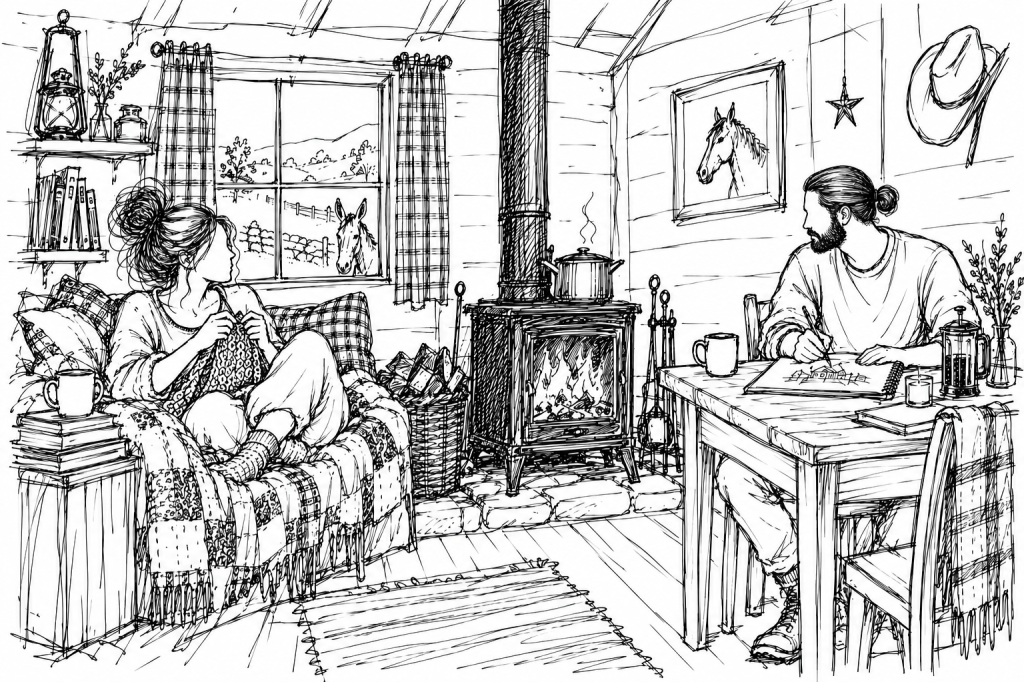
We rented a log cabin near the Black Mountains in Wales, close to the beautiful town of Hay-on-Wye.

From the outside, the cabin looked slightly like an oversized shed. Inside, though, it was gorgeous.

There was a double bedroom, a shower room and a small main living space with a dining area, a basic kitchen and a large stove for heating and cooking. Tucked away to one side was a cosy nook with a sofa, armchair and television.

It was decorated with gingham and patchwork fabrics, pictures of horses and bits of cowboy paraphernalia.

We were miles from almost everything.

The owners lived in the large house nearby and had donkeys, horses, chickens, geese and dogs wandering around the property.

There wasn’t actually very much to do.

And I loved it.

Some days I crocheted for hours. Other days I read.

Before we arrived, I had announced to Stephen that I was going to use the holiday time to reorganise my life. Since starting my new job, the housekeeping at home had deteriorated, my diet had become terrible and I spent far too much of my spare time lying in bed recovering.

I intended to make lists and plans and somehow return home as a completely reorganised woman.

I never really got around to it.

Stephen remained annoyed with me for a long time that I hadn’t fulfilled the promise. 

But I was enjoying myself too much. 

Instead, I crocheted, read and cooked.

I particularly loved making our meals. The nearest little shop was around twenty-five minutes away, so I took enormous pleasure in creating comforting dinners from whatever we could find, using only a handful of utensils and the stove.

There was something immensely satisfying about feeding the two of us in that tiny kitchen.

Every evening we settled down and watched a film on the DVD player.

It reinforced something I had suspected for years.

I didn’t need a huge house or an impressive lifestyle to be happy.

Give me somewhere cosy, some books, my crochet, a kitchen, a fire and someone I loved, and I could imagine being perfectly content.

It made the future Stephen and I had talked about feel almost tangible.

Stephen seemed to enjoy it too, although I noticed that when I disappeared into a book or my crochet, he sometimes seemed at a loose end.

He didn’t settle into inactivity in quite the same way I did.

For a moment, it concerned me.

If we really did create a quieter life somewhere one day, would Stephen actually be happy living it?

He reassured me that it would be different if the place belonged to us. There would always be jobs to do, things to repair, projects to build and land or a property to maintain.

That made sense.

My concern disappeared almost as quickly as it had arrived.

There was another moment during the holiday that was harder to dismiss.

During our recent conversations about sex and relationships, Stephen had told me that he wished I would sometimes simply take charge and initiate things.

I was surprised because I had always thought I did my fair share of initiating intimacy. Earlier in our relationship I had sometimes deliberately created occasions where I was completely in charge.

Perhaps I had done less of that since starting the new job.

That I could believe.

Most evenings I barely had enough physical or mental energy left for myself, let alone anything else.

So one evening at the cabin, I decided to make the effort.

I set everything up beside the fire and took the initiative.

Almost immediately, something felt different.

Stephen wasn’t responding with his usual enthusiasm and eventually he couldn’t perform.

What followed became our first major argument during — and about — sex.

That upset me almost as much as the problem itself.

Sex had always been one of the places where Stephen and I communicated beautifully. The conversations afterwards could sometimes feel almost as intimate and important as the sex itself.

Now we were abandoning the whole thing and arguing.

I felt rejected.

He had asked me to initiate more. I had taken what felt like a small emotional risk by doing exactly that, only to find myself wondering why he didn’t seem to want me when I did.

It left a black mark on an otherwise wonderful holiday, but it didn’t define it.

And there was something else that reassured me.

Stephen began making notes about the cabin. He drew little plans and thought about how he might design something similar for us one day.

Whatever difficulties existed between us, I looked at those drawings and saw evidence that he hadn’t lost sight of our future either.

To be continued…

Reflection

Looking back, I think this was one of the periods when it was easiest to believe that Stephen and I had finally become an ordinary couple. There were no enormous crises. We worked, worried about money, got tired, argued occasionally and looked forward to holidays. After everything we had already survived, there was something reassuring about the mundanity of it. I didn’t need our relationship to be extraordinary anymore. I wanted it to be dependable.

There were difficult conversations, but even those seemed to demonstrate progress. Stephen was telling me things I might once have feared he would keep to himself: his curiosity about other sexual experiences, the women he met while he was away, the thoughts that unsettled him. Because we had placed so much importance on honesty after the programme, I interpreted disclosure as safety. I believed that if Stephen could tell me something uncomfortable, I didn’t need to fear what he wasn’t telling me. His honesty became one of the reasons I trusted him.

What I didn’t fully appreciate was how much energy I was spending turning uncertainty into reassurance. Stephen wondered whether he had missed out sexually, but returned from Scotland talking about the emptiness of transient connections. He met interesting women, but told me about them. He seemed restless at the cabin, but explained that a home of our own would be different. We struggled sexually, but he was simultaneously drawing plans for our future. Whenever something unsettled me, there seemed to be something else nearby that allowed me to settle again.

The cabin probably revealed more about me than I realised at the time. Stripped of work, commuting, money and all the complications of ordinary life, what I wanted was remarkably simple. Somewhere warm. Something to cook. Books and crochet. A person I loved beside me. I had spent years imagining a future with Stephen, but sitting in that tiny cabin I could almost touch it. His drawings seemed to tell me he could see it too.

Perhaps that was why the argument about sex hurt so much. It wasn’t simply that Stephen couldn’t perform. I had responded to something he said he needed from me and made myself vulnerable, only to feel rejected when I did. After his questions about other women, other experiences and other ways of having relationships, it inevitably touched the insecurity that had already begun growing in me. For the first time, something that had always made me feel particularly connected to Stephen became another place where I could wonder whether I was enough.

And yet I came home remembering that holiday as one of our happiest. I think that’s important. The difficult moments weren’t hidden from me; they simply existed alongside genuine happiness. There was always enough love, companionship and evidence of a shared future to prevent any single concern from becoming the whole story. Our life didn’t feel as though it was falling apart. It felt ordinary. I hadn’t yet understood how much uncertainty can live inside an ordinary life without disturbing its surface.

Trying To Understand Stephen

​For a few seconds after waking, there was nothing.

Then I remembered.

It hadn’t all been some awful dream. It was real.

And now Stephen and I had to make the long journey back to England with the unspoken knowledge that our relationship was over.

My aunt had already left for work. We had been asked to lock up behind us and meet her in the town centre to hand over the keys and say goodbye.

Stephen and I dragged our suitcases through the streets to the nearest bus stop. We stood there waiting, barely uttering a word to each other.

When the bus arrived, we found some seats and I stared out of the window.

The streets of Denmark passed by — a country that had always meant so much to me, filled with childhood memories and family and belonging. Just days earlier, I had been standing in these same streets believing I was here with the man I loved, surrounded by the people I loved.

Now I could barely comprehend what had happened.

Tears filled my eyes.

Stephen remained silent.

About half an hour later, the bus pulled into the terminal and there was my aunt waiting for us. She smiled when she saw me, but I could read the sympathy all over her face.

I hugged her and thanked her. I probably apologised too, although I can’t remember exactly what I said. Everything felt embarrassing somehow, even though I had done nothing wrong. I hated that something so private and devastating had unfolded in front of my family.

We went into the station and waited for the train to the airport. It was the same station I had been standing in twenty-four hours earlier, frantically trying to understand what Stephen and M might be doing.

Now there was nothing left to chase.

On the train, I stared numbly through the window as Denmark’s flat, beautiful landscape rushed past.

Stephen still said almost nothing.

At the airport we boarded our plane and took our seats beside one another. Those cramped airline seats suddenly felt unbearably intimate. I could feel Stephen’s shoulder and arm against mine, but I couldn’t bring myself to look at him.

I tried to imagine that the man sitting beside me was a stranger.

Ironically, that was almost exactly how he felt.

Somewhere during that flight, the numbness began to wear off.

The reality of what had happened started pushing its way through, and I began to cry. I tried desperately to hide it, turning my head away and keeping as quiet as I could, but eventually I was sobbing silently and couldn’t stop.

Stephen knew.

He did nothing that was helpful.

I don’t remember much about landing in England. We retrieved my car and began the journey home. We must have spoken at some point, but I can’t remember a single thing we said.

I probably told him I was taking him back to his dad’s.

He didn’t argue.

I can’t even remember leaving him there.

Nor can I clearly remember arriving back at my own house.

There are pieces of that journey that seem to have disappeared completely from my memory. I only remember the feeling of it: an enormous emptiness, as though something that had occupied so much space inside me had suddenly been ripped out.

That evening, I told my sons the whole nightmarish story.

I expected them to be horrified.

Instead, they reacted almost as though they had been expecting something like this all along.

They had never trusted Stephen.

They were angry on my behalf and far less charitable about him than I had ever been. To them, he was a low-life. Someone who didn’t know who he was. A parasite who attached himself to other people’s energy.

It was difficult to hear.

Partly because I understood where they were coming from.

But also because their version of Stephen didn’t contain the man I knew.

They hadn’t experienced all the other parts of him. The funny, curious, affectionate, enthusiastic man who could make ordinary things exciting. The man I could talk to for hours. The man who had become woven through almost every part of my life.

Both versions seemed to exist.

And I still didn’t know what to do with that.

But understanding Stephen did not mean that everything between us suddenly became calmer.

If anything, those first few days after Denmark were extraordinarily volatile.

The following day, Stephen suddenly became intensely worried about M.

My parents and other members of my family were still in Denmark, and M was due to be around some of them. Stephen wanted to know exactly what I had told them about what had happened.

He was frightened that somebody might confront her or say something that would destabilise her.

At first, I could understand the concern. M was vulnerable. Whatever responsibility she might or might not have had for what happened between them, I didn’t want her harmed either.

But then Stephen’s messages escalated.

He told me that if anyone said anything that caused M to have a meltdown, he would “set off a ‘bomb’ in that family they will never recover from.”

I was stunned.

Only days earlier, Stephen had left me alone in my aunt’s house to follow M through the streets of Denmark.

He had refused my pleas to come back.

He had stayed at her flat.

Our relationship had ended because of what had happened between them.

And now, while I was still trying to understand the wreckage of it all, he was threatening some kind of retaliation against my family in order to protect her.

Something in me snapped.

“You are not welcome at my house or my place of work,” I told him. That morning I had told him his job was still there for him if he wanted it.

I said I would return all his belongings the following weekend and block him at midnight.

“Your choices are horrendous. I don’t want it anymore in my life.”

When he told me he was panicking and didn’t want anyone else hurt, I answered:

“You’re damaging me and it stops now.”

Stephen quickly retreated from what he had said.

He told me he would never actually do anything. Becoming threatening, he said, had been a protective reaction. He had panicked.

But by then I had had enough.

“I’ve given everything I had to give,” I told him.

“The buck stops here.”

What strikes me now is how quickly I could move between compassion and absolute certainty.

I could believe Stephen was unwell.

I could believe he was overwhelmed.

I could desperately want to understand what was happening inside him.

And I could still reach a point where I thought: No. This is unacceptable.

That evening, I meant it.

I told him I couldn’t keep living inside ambiguity, never knowing which things he said were real and which things I was somehow expected to understand he hadn’t meant.

I told him that life was a sequence of choices and hoped his next one would be to get help.

Stephen acknowledged that something was seriously wrong. He described himself as going through a major relapse and, significantly, told me that it wasn’t mine to fix.

It sounded like an ending.

Except endings between Stephen and me were rarely clean.

By the following day, we were talking again.

Stephen told me he had been tempted to check whether M had replied to a goodbye message he had sent her, but instead he had gone outside for a cigarette.

I encouraged him not to reopen contact. M had family and friends around her. She had support. Whatever had happened between them, Stephen did not need to be the person who rescued her.

Then Stephen became overwhelmed.

He told me he wished he could hold me.

A little later he said he had finally broken down completely.

Sobbing.

Wailing.

For all my anger the previous evening, hearing his pain still affected me.

“I’m here,” I told him.

“I’ve got so much love for you.”

That contradiction is difficult to explain unless you understand what those days were actually like.

I wasn’t simply forgiving Stephen.

I wasn’t simply leaving him either.

I was moving between grief, anger, love, self-protection and a relentless need to understand what had happened.

By that evening, I told him something that probably captured my position better than anything else could have.

“I don’t want to lose you. By that I mean contact.”

The following morning I was still overwhelmed by sadness and disbelief. I admitted that I worried about how badly Stephen coped with being alone — whether loneliness or boredom would send him searching for connection again, perhaps even back towards M. According to Stephen, M had begged him to return to Denmark.

He told me he had been tempted to contact her, but hadn’t.

He was trying.

And perhaps that was what kept catching me.

Whenever I reached the point of believing I had to walk away completely, I would see some small indication that Stephen understood there was a problem and wanted to do something differently.

Later that morning, an idea occurred to me.

“Would you ever consider attending the the programme I did ?”

“I would consider anything that may help,” he replied.

Around twenty years earlier, I had attended the programme myself.

For me, it had been transformative.

It centred around ideas such as integrity, authenticity, forgiveness and personal responsibility. I had carried parts of what I learned there with me ever since.

Stephen became interested almost immediately.

He asked questions. He looked at the course. He investigated the cost and accommodation and wanted to understand how it worked.

“If it helps me to get better at Life…… price doesn’t matter!” he told me.

Then, having compared it with things he had previously learned in therapeutic community, he described it as potentially the perfect “top-up” for what he had learned and forgotten.

Something about that gave me hope.

Not because I suddenly believed Denmark was forgiven.

It wasn’t.

Not because we had decided to get back together.

We hadn’t.

And Stephen wouldn’t actually attend the programme until the end of September.

But for the first time since Denmark, there was something other than another conversation between the two of us.

Something he could do.

Something that didn’t depend upon me finding the right explanation, asking the right question or somehow teaching Stephen how to understand himself.

Perhaps someone else could help him see what I couldn’t make him see.

And perhaps, eventually, that might tell us whether there was anything left between us worth saving.

Reflection

Looking back, I think this was the point when understanding Stephen became almost inseparable from loving him. Denmark had given me every reason to walk away, and at moments I was absolutely certain that I would. I could recognise when his behaviour was unacceptable. I could draw boundaries, return his belongings and tell him that I had nothing left to give. But understanding why he behaved as he did still mattered enormously to me. If there was an explanation for what had happened, some part of me needed to find it.

That didn’t mean I was excusing him. In fact, I was becoming increasingly frustrated by explanations that seemed to make sense of Stephen’s emotional state without ever accounting for his choices. He could be overwhelmed, frightened, dysregulated or desperate to protect someone, and I could have compassion for all of those things. But I was beginning to understand that intention and consequence were different. Stephen didn’t have to intend to devastate me for me to be devastated. He didn’t have to mean a threat for me to experience it as threatening. His internal reasons could explain his behaviour without making the behaviour acceptable.

The difficulty was that compassion kept reopening doors that anger tried to close. I could tell Stephen, with complete conviction, that the buck stopped here and then hear him sobbing the following day and instinctively reach towards him. Neither response was false. I was furious with him, and I loved him. I wanted to protect myself, and I couldn’t bear the thought of abandoning someone I believed was struggling. I didn’t want the relationship we had just had, but I wasn’t ready for Stephen himself to disappear from my life.

Perhaps that was why the programme gave me so much hope. For years, talking had been the way Stephen and I tried to solve things. I listened, questioned, challenged, reassured and searched with him for explanations. After Denmark, I was beginning to reach the limits of what those conversations could achieve. Suggesting the programme was an attempt to place some of that responsibility somewhere other than with me. Maybe Stephen needed something I couldn’t provide. Maybe understanding himself had to become his work rather than ours.

I can see now how powerful that possibility was for me. As long as Stephen could recognise that something was wrong and seemed willing to seek help, it was difficult to believe that all hope was gone. I wasn’t yet offering him another chance at the relationship. I was offering him a chance to understand himself. But somewhere underneath that distinction was a question I wasn’t ready to let go of: if Stephen could finally understand why he kept making these choices, perhaps one day he might learn to make different ones.

Stephen And The Red Flag (REFLECTION)

Until that night, my doubts about Stephen had mostly existed in the space between instinct and explanation.

Something would feel slightly wrong.

I would notice it.

I would question it.

Then more information would arrive and the feeling would settle.

This time, it didn’t.

What I remember most clearly about that night is the argument taking place inside my own head.

Stephen had disappeared.

That was a fact.

For almost three months, we’d been in constant contact, and on the one evening when I had specifically told him I felt uncomfortable, the pattern abruptly changed.

My instincts responded immediately.

Something isn’t right.

But I didn’t simply surrender to suspicion.

I challenged it.

His battery has probably died.

He’s busy.

You’re catastrophising.

Wait until you know what actually happened.

I was doing exactly what I believed a reasonable, emotionally mature person should do. I was separating feelings from facts. I was resisting the temptation to turn anxiety into accusation.

And then the following day, I discovered that the thing I’d been frightened of had actually happened.

Stephen had shared her bed.

That moment changed something in me.

Not because sharing a bed automatically meant something sexual had happened. I still didn’t know whether it had.

The deeper injury was that I had identified one particular situation that would make me feel unsafe, communicated it clearly, received an explicit promise — and then spent the night trying to persuade myself not to trust the very instinct that turned out to be correct.

I had told myself I was catastrophising.

I wasn’t.

At least not about the bed.

That distinction matters enormously to me now.

Because anxiety and intuition can feel remarkably similar from inside the body. Both can produce that tightening sensation, the racing thoughts, the feeling that something isn’t right.

The difficulty is knowing which one you’re experiencing.

And once you’ve mistakenly labelled an accurate perception as anxiety, something unsettling can happen to your relationship with yourself.

You become less certain which internal voice deserves your trust.

But there was another contradiction waiting for me.

Stephen told me the truth.

He could have said he’d slept on the sofa.

As far as I knew, there was nobody who could have contradicted him. Instead, when I asked him directly, he admitted he’d shared the bed.

That mattered to me.

It complicated everything.

If Stephen were simply a liar trying to deceive me, why tell me the one thing he knew would hurt me?

Perhaps his willingness to admit it meant the rest of his explanation was true.

Perhaps nothing sexual had happened.

Perhaps he really had been exhausted and overwhelmed.

Perhaps this was exactly what it looked like to love someone whose mind sometimes worked differently from mine.

I wanted to understand.

But understanding became remarkably difficult during our argument.

I wasn’t expecting perfection from Stephen. I wasn’t even demanding an explanation that made everything disappear.

I wanted accountability.

I promised you something. I broke that promise. I understand why that hurt you.

Had he been able to remain there with me, perhaps the rupture would have been easier to repair.

Instead, he seemed compelled to explain why his responsibility was smaller than I believed it was.

He’d been exhausted.

His head had gone.

His ex had taken him upstairs.

He hadn’t properly registered what was happening.

He couldn’t remember much.

He hadn’t consciously decided to betray me.

Perhaps all of that was genuinely how Stephen experienced the night.

I can’t know.

People under extreme emotional stress can experience impaired judgement, fragmented memory and states of overwhelm. Stephen also had a history and diagnosis that made me take the possibility seriously.

But even if his explanation was entirely accurate, another question remained.

What did that mean for being in a relationship with him?

If Stephen could become so overwhelmed that a promise made only hours earlier effectively disappeared, how was I supposed to know which promises I could rely upon?

That frightened me almost as much as the possibility that he was lying.

There seemed to be only two broad explanations.

Either Stephen had knowingly broken his promise and wasn’t being completely honest with me about why.

Or he genuinely could become so dysregulated that promises, boundaries and awareness of my feelings became temporarily inaccessible to him.

Neither possibility made me feel particularly safe.

And then I saw another Stephen.

He became angry.

Defensive.

Dismissive.

He told me I was blowing things out of proportion.

That was new.

Until then, I had known a man who seemed unusually attentive to my feelings. Now I was telling him I was hurt and somehow finding myself having to defend my right to be hurt.

Psychologically, defensiveness often appears when accepting responsibility threatens something we need to believe about ourselves. Shame can make accountability particularly difficult: if I did something hurtful is experienced internally as I am a terrible person, explaining, minimising or shifting responsibility can become a way of escaping an intolerable feeling.

I sometimes wonder whether something like that was happening for Stephen.

Perhaps admitting that he’d simply chosen the bed would have required him to see himself as someone who had knowingly betrayed a woman he believed he loved.

Perhaps the explanation protected him from that.

Or perhaps he was simply telling me exactly what happened.

I still don’t know.

What I do know is what happened to me while we argued.

I became increasingly certain that my boundary was reasonable.

So certain, in fact, that I ended the relationship.

That is important.

I didn’t discover that Stephen had broken his promise and immediately explain it away because I couldn’t bear to lose him.

My first response was to protect myself.

This isn’t acceptable.

I’m leaving.

Then something changed.

Stephen changed.

The anger disappeared and the vulnerable man returned.

He became tearful, overwhelmed and confused.

And almost immediately, something changed inside me too.

Anger had made separation possible.

His vulnerability made compassion return.

Suddenly I wasn’t only thinking about what Stephen had done to me.

I was thinking about what might be happening to Stephen.

His childhood.

His diagnosis.

His emotional instability.

His exhaustion.

His distress.

His history.

Perhaps I was expecting him to respond like somebody whose mind worked very differently from his.

Perhaps loving him meant learning that difference.

That thought opened the door I had just tried to close.

This is where compassion became complicated for me.

Empathy is the ability to step outside our own experience and imagine somebody else’s. It is one of the qualities I value most deeply.

But empathy has a vulnerability of its own.

If every hurtful behaviour can be understood through the pain of the person who caused it, the question can quietly shift from:

Was this acceptable to me?

to:

Did he have an understandable reason for doing it?

Those aren’t the same question.

I didn’t understand that yet.

So instead of deciding whether sharing the bed, disappearing and then dismissing my reaction were things I was willing to accept in a relationship, I became absorbed in understanding why Stephen might have behaved that way.

And because there were possible explanations, leaving became harder.

Then came four words I would remember for years.

Out of sight, out of mind.

I didn’t have a psychological framework for them.

I simply knew I didn’t like them.

They suggested something about Stephen’s experience of connection that felt profoundly different from mine.

When someone I loved wasn’t physically beside me, they didn’t disappear from my emotional world.

I carried them with me.

I thought about how my choices might affect them even when they weren’t there to witness those choices.

Was Stephen telling me that he experienced this differently?

Perhaps he only meant he’d become distracted.

Perhaps it was a throwaway remark.

Perhaps it revealed something more important about the way he held other people in mind when they weren’t immediately present.

At that stage, I had no way of knowing.

So I stored the words somewhere inside me.

Along with everything else I couldn’t yet explain.

And then the crisis ended.

This may be the most important part.

Stephen became loving again.

We laughed again.

We talked.

He was gentle and affectionate.

The relationship I thought I’d lost returned.

And the relief was enormous.

Psychologically, relief can be a remarkably powerful reinforcer. When distress is followed by warmth and reconnection, the return of safety can feel even more intense because of what immediately preceded it.

I wasn’t thinking about reinforcement.

I was thinking:

We’ve survived our first big argument.

Perhaps this was what relationships required.

People hurt one another.

They argued.

They learned.

They forgave.

And carried on.

That fitted perfectly with everything I already believed about love.

Except something had changed.

Before that night, trust had mostly been an assumption.

Afterwards, it became something I was watching.

I wanted to believe Stephen had understood.

I wanted to believe the boundary was now unmistakable.

I wanted to believe that because he had seen how deeply he’d hurt me, he would never put me in that position again.

But another part of me had learned something too.

Stephen was capable of reassuring me and then doing the thing he’d reassured me he wouldn’t do.

That knowledge couldn’t simply be argued away.

And perhaps that is where the quieter story of my instincts began to change.

Before this, when something felt wrong, I could usually reassure myself that there was probably an innocent explanation.

Now I had evidence that sometimes there wasn’t.

So I became more alert.

More watchful.

Not because I wanted to police Stephen.

Because something I had trusted had failed.

And yet, almost immediately, I was being encouraged to question whether my reaction to that failure was itself the problem.

When Stephen later suggested that perhaps I didn’t know how to truly love someone, the accusation reached somewhere particularly vulnerable in me.

Love was something I believed I was good at.

Patience.

Forgiveness.

Understanding.

Staying through difficulty.

These were qualities I was proud of.

So the suggestion that my inability to accept what had happened might represent a failure of love was deeply destabilising.

Perhaps loving Stephen really did require something different from me.

More understanding.

Less judgement.

Greater tolerance of his difficulties.

I didn’t yet realise how dangerous that question could become for someone like me.

Because if endurance could be interpreted as evidence of love, then leaving could begin to feel like evidence that I hadn’t loved enough.

I stayed.

Not because the broken promise stopped mattering.

Not because I suddenly believed every part of Stephen’s explanation.

And not because my instincts told me everything was fine.

I stayed because I loved him, because most of what we had was still wonderful, because I could see possible explanations for what had happened, and because I believed people should have the opportunity to learn from their mistakes.

That decision didn’t feel weak.

It felt compassionate.

Reasonable.

Hopeful.

Perhaps it was all three.

But something had entered the relationship that hadn’t been there before.

I had learned that Stephen could make me feel extraordinarily safe.

And I had learned that he could suddenly make me feel profoundly unsafe.

I didn’t yet understand what living between those two versions of the relationship might eventually do to me.

For now, I simply wanted the loving one back.

And when it returned, I was enormously relieved.

Stephen And The Bedsit (REFLECTION)

Looking back, I am struck by how clearly I could see one particular danger.

Stephen wanted to live with me.

I knew he’d moved quickly into a previous girlfriend’s home when his life had become difficult, and I could see that something remarkably similar might be developing between us.

So I stopped it.

That matters.

Once again, my instincts weren’t failing me.

I loved Stephen. I was increasingly concerned about him. I hated knowing how unhappy he was at his father’s house. But I also knew we’d barely begun our relationship and that allowing an unemployed man I’d known for such a short time to move into my home would be unwise.

So I created a condition.

Find a job first.

It was a boundary designed to protect both my independence and the pace of our relationship.

And Stephen accepted it.

The bedsit seemed like an encouraging alternative. He would have somewhere safe and private while also proving to himself, and perhaps to me, that he could establish some independence.

For a moment, it looked as though that was exactly what was happening.

Then came something I could never have anticipated.

A tiny lie.

I don’t excuse it because it was small. In fact, the reason I confessed almost immediately was that honesty mattered enormously to me. I didn’t want even something as inconsequential as pretending to have experienced something sexually that I hadn’t to become part of the way Stephen and I communicated.

So I told him the truth.

What happened next taught me something.

Not consciously.

Not all at once.

But powerfully.

Stephen experienced my admission very differently from the way I expected him to.

To me, the important part was that I’d corrected the dishonesty almost immediately because I wanted our relationship to be truthful.

To Stephen, the important part seemed to be that I had lied at all.

The distinction almost disappeared.

His reaction was so intense that I found myself trying desperately to make things right.

I apologised.

I explained.

I reassured.

And when his distress escalated later that night, I went to get him.

Once again, Stephen became overwhelmed and I responded by moving closer.

I still wonder what happened inside him that night.

Perhaps my admission touched something much older and more painful than the event itself. He explicitly connected it to experiences with his ex-wife, so perhaps dishonesty carried an emotional meaning for him that I couldn’t yet understand.

Given what I knew of his history and diagnosis, it’s also possible that something relatively small triggered feelings that became extraordinarily difficult for him to regulate.

But explanation and responsibility are different things.

That’s a distinction I hadn’t yet learned to make.

I could understand that Stephen’s reaction might have roots extending far beyond me.

What I couldn’t yet see was that this didn’t make me responsible for calming it.

At the time, however, his distress was happening directly in front of me.

And it was frightening.

The man I was falling in love with was crying, drinking, paranoid, confused and barely coherent.

Suddenly EUPD wasn’t a collection of letters Stephen had disclosed during an intimate conversation.

It was something I was experiencing beside him.

I didn’t know what was happening.

I didn’t know how serious it might become.

And I didn’t know what I was supposed to do.

So I did what came naturally.

I looked after him.

The episode eventually passed.

But something remained.

I never deliberately lied to Stephen again.

For years, I regarded that simply as evidence of how seriously I took honesty in our relationship.

Now I think there may have been something else happening too.

I had learned how costly dishonesty could be.

Psychologically, we learn remarkably quickly from intense emotional experiences. When one action is followed by an unexpectedly distressing consequence, we become motivated to avoid repeating the action.

I didn’t sit down the following morning and decide, I must manage Stephen’s emotions by never upsetting him.

Nothing so deliberate happened.

I simply knew that I never wanted to see him like that again.

Perhaps this was one of the first invisible rules I learned in our relationship.

Be completely honest with Stephen.

On its own, that sounds like an excellent rule.

But there was another lesson hiding underneath it.

Be careful what you do, because Stephen may experience it far more intensely than you expect.

That was more complicated.

Meanwhile, the bedsit was showing me something else.

My boundary had worked.

Stephen hadn’t moved into my home.

Yet somehow I was still increasingly involved in helping him cope with the consequences of living somewhere else.

He was lonely, so I stayed over.

He struggled to fill his days, so I suggested things he might do.

He was unhappy, so I worried.

He returned repeatedly to his father’s house, and I watched the independence I’d hoped he would build fail to take hold.

Again, none of those individual acts of care was unreasonable.

The pattern was what mattered.

Stephen’s discomfort increasingly generated activity in me.

If he was unhappy, I thought about how to make him happier.

If he was lonely, I considered how much time I could give him.

If something wasn’t working in his life, my mind naturally moved towards solutions.

Perhaps that felt reassuring to Stephen.

I imagine there was something comforting about having somebody who responded to his difficulties by moving towards him rather than away.

And perhaps, without either of us understanding it, we were strengthening the roles that had begun forming between us.

Stephen struggled.

I helped.

Stephen became overwhelmed.

I soothed.

The crisis passed.

We felt close again.

There is a concept in psychology called co-regulation. In healthy relationships, we naturally help one another settle when we’re distressed. A voice, a touch, someone’s presence or reassurance can help our nervous system return to calm.

There is nothing unhealthy about needing another person sometimes.

The difficulty comes when one person’s emotional regulation begins depending too heavily on the other, or when the other person begins feeling responsible for maintaining that stability.

We weren’t there yet.

But I can see the beginnings.

And then Stephen told me he was going to stay with his ex-girlfriend.

Immediately, something in me tightened.

Why two nights?

Why stay at all?

Why was she collecting him?

Why couldn’t he simply retrieve his belongings and come home?

Once again, my instincts produced questions.

And once again, I didn’t ignore them.

But another part of my identity entered the conversation.

I didn’t want to be controlling.

I didn’t want to be jealous.

I wanted to be the kind of partner who trusted.

That mattered enormously to me.

Perhaps because I believed secure love shouldn’t require policing another adult, I tried to distinguish between what I was feeling and what I could reasonably ask of him.

I couldn’t tell Stephen he wasn’t allowed to see his ex.

I didn’t want that kind of relationship.

So I reduced everything I was feeling to one boundary.

Don’t share her bed.

It was simple.

Specific.

And, to me, entirely reasonable.

Stephen didn’t hesitate.

He would sleep on the sofa.

That reassurance mattered because something important was about to be tested for the first time.

Until then, most of my doubts about Stephen had been answered with words.

He had told me he wanted me.

He had told me appearance wasn’t important.

He had told me about his diagnosis and his past.

He had explained his strange behaviour outside his father’s house.

And whenever there had been uncertainty, there had usually been an explanation I could understand.

But trust can’t ultimately be built from explanations.

At some point, words have to meet behaviour.

I didn’t need Stephen to avoid every situation that made me uncomfortable.

I didn’t need access to his phone or proof of where he was sleeping.

I didn’t want to supervise him.

I wanted something much simpler.

I wanted to be able to tell the man I loved what made me feel unsafe, hear him reassure me, and then discover that his actions matched what he’d promised.

Perhaps that was why the boundary about the bed mattered more than the bed itself.

I wasn’t really asking:

Where will you sleep?

I was asking:

When I tell you something matters to me, can I trust you to treat it as though it matters to you too?

Stephen said yes.

And I believed him.

Not because my instincts had gone quiet.

Because I was about to give him the opportunity to prove them wrong.

Stephen And The Bedsit

As Stephen’s unhappiness with living with his father continued, he began hinting more frequently about living with me.

I reminded him that he had told me about moving in with his former girlfriend very quickly. His story was surprisingly similar to what was now happening between us. He had been in a very difficult place mentally, and she had driven to collect him and brought him back to her home. Before long, he had effectively moved in.

I could see the temptation for Stephen to repeat that pattern with me.

So I set a boundary.

I told him that he couldn’t move into my home until he had found a job.

He accepted that, but he was becoming increasingly desperate to get away from his father’s house. Instead, he arranged to rent a bedsit.

I didn’t think it was necessarily a bad idea. In fact, I thought it might be good for him. It would give him some independence, some privacy and a place of his own while he worked out what he wanted to do next.

He put some effort into making it feel like home. He bought things he needed to cook and some nicer touches to make the little room more comfortable.

I was pleased for him.

The first time I visited, we were both excited about having somewhere of our own to spend time together. We joked that we needed to christen the new place.

What followed was an unexpectedly intense and intimate experience, and I remember leaving with a real glow of happiness.

I felt incredibly close to Stephen.

But there was something else I was carrying home with me.

I had pretended to have reached a level of sexual pleasure that I hadn’t quite reached.

It was a tiny lie, but it bothered me enormously.

The following day, I was still thinking about it at work. I felt guilty. I was falling deeply in love with this man, and the last thing I wanted was to start our relationship by hiding things from him. I didn’t want to create a pattern where I pretended everything was fine when it wasn’t.

So I decided to tell him.

I imagined we’d laugh about it.

Perhaps he’d tease me.

Perhaps we’d simply talk about it and move on.

Instead, his reaction was completely disproportionate to what I had expected.

He became extremely upset.

He compared me to his ex-wife and spoke at length about how much her lying had hurt him. He seemed to experience my admission as though I had deliberately deceived him, rather than what it was: something I had admitted to less than twenty-four hours later because I didn’t want to be dishonest with him.

I tried to explain.

I tried to reassure him.

Nothing seemed to help.

I was shocked by the intensity of his response and frightened that something so small might somehow cost me the relationship.

I went home from work that evening feeling ashamed and deeply upset.

Then things became much more serious.

Later that night, Stephen had returned to his father’s house and called me.

He was in an awful state.

He was crying, distressed and increasingly paranoid, and he had been drinking. I was so worried about him that I got in the car and went to collect him.

I brought him back to mine.

I remember him sitting on the edge of my bed, confused and barely coherent. He seemed completely overwhelmed by whatever was happening inside his head.

I didn’t know what to do.

Until then, I had known that Stephen had mental health difficulties. I knew about his EUPD and I knew about his traumatic childhood.

But this felt different.

This was the first time I began to understand that his difficulties could be much more serious than I had appreciated.

There wasn’t much I could do except stay with him, apologise for upsetting him and try to comfort him until eventually he slept.

Thankfully, the episode passed.

We got through it.

And from that point onwards, I never deliberately lied to Stephen again throughout the rest of our relationship.

The bedsit itself, however, soon became another source of difficulty.

Stephen moved in just as the UK entered its third national lockdown in January 2021. Restrictions meant that there was very little for him to do, and he quickly found the isolation difficult.

He struggled with the empty days and lonely nights.

He would try to cook, but often ended up bringing takeaway food back instead. He didn’t seem to know how to fill his time or settle into living alone.

I tried to help.

Sometimes I stayed over, even when I had work the next day, because I knew how difficult he was finding the loneliness. We still spent some weekends together when he didn’t have his sons, and I suggested different things he might do to occupy himself.

But nothing seemed to make much difference.

Within only a couple of weeks, I noticed that he was spending more and more time back at his father’s house.

When he had his sons, his father would often collect him on a Thursday, and Stephen wouldn’t return to the bedsit until the following Tuesday.

By the end of this period, my impression was that he was spending only two or three nights a week there, although I know Stephen may remember this differently.

I could see that the independence I had hoped the bedsit would give him wasn’t working out quite as I had imagined.

Then, sometime in March, Stephen told me he wanted to visit his ex-girlfriend to collect belongings he had left behind.

He planned to stay for two nights.

I wasn’t entirely comfortable with the idea.

Why did he need to stay for two nights?

Why couldn’t he collect his things and come home?

And why was he relying on her rather than asking me?

But I didn’t want to become the jealous or difficult girlfriend. I’d started this relationship wanting to be trusting and easy-going, and I wanted to maintain that part of myself.

So I didn’t make too much of it.

When the day came for his ex-girlfriend to collect him from the bedsit, I asked him for just one thing.

One promise.

“Just please don’t share the bed with her.”

He reassured me immediately.

“No way. I’ll be sleeping on the sofa.”

I believed him.