
The weeks that follow our first meeting are a mixture of immense joy and the first hints of things that make me uneasy.
About a week after we met, I’m becoming tired of our unconventional dates.
Meeting in my car, staying out until four in the morning and then going home to face a full day of work isn’t sustainable. I’m exhausted, and eventually I summon the courage to ask Stephen if he’d like to come back to mine.
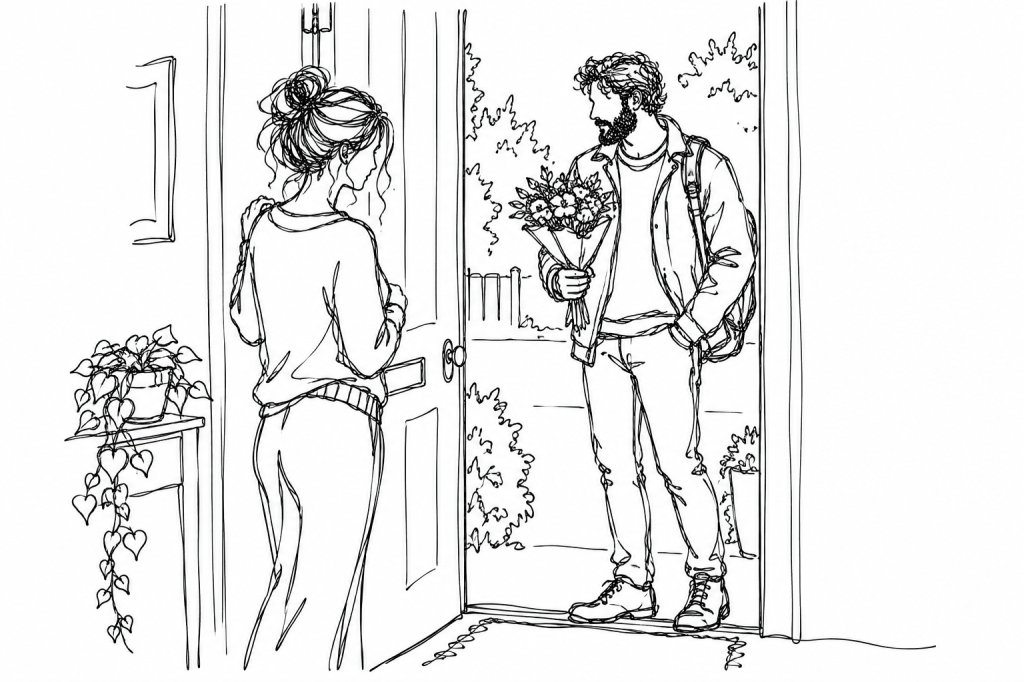
I’m nervous.
I’m also slightly embarrassed because my house isn’t as tidy as I’d normally like it to be. Work, late-night meetings with Stephen and long conversations on the phone have left very little time for housekeeping.
But I want him to see my home.
More importantly, I want to invite him into my life.
So Stephen comes back with me.
For the first time, we have the privacy and comfort of my own bedroom. We can finally stop making out in a car and lie down together properly.
We make love for the first time.
Getting completely naked in front of him makes me a little self-conscious. I’m very aware of my middle-aged body — the stretch marks and loose skin left by two pregnancies and years of losing and gaining weight.
But Stephen makes me feel completely at ease.
He tells me that my skin is the softest he’s ever touched. When he sees my stretch marks, he compares them to scarification — something deliberately created on the skin as a form of decoration.
I remember thinking:
What a beautiful thing to say.
This man is saying things that make me feel comfortable, accepted and, somehow, beautiful.
Later, Stephen shows me a headless naked photograph of a former girlfriend who was a much larger woman than me.
I think it’s a little inappropriate to show me a photograph like that, but I understand the point he’s trying to make.
He’s telling me that bodies don’t have to conform to some particular ideal for him to find a woman attractive.
And I believe him.
His apparent lack of judgement towards women’s bodies makes me feel safe with him. It becomes something I admire about him, something I associate with his openness and acceptance.
I don’t yet understand the other side of that openness.
For now, I simply feel grateful to be with a man who seems to see beauty so differently from the way I have sometimes seen myself.
My home quickly becomes our new favourite place to spend time together.
We listen to music, talk, laugh, make love and sit smoking at my bedroom window.
Smoking isn’t something I particularly want to do, but it’s becoming increasingly obvious that Stephen is a much heavier smoker than I had initially understood.
I don’t want him having to go outside in his underwear, so I let him smoke at the window.
Before long, I’m joining him.
It’s a small thing, but I’m already beginning to accommodate his habits into my own life.
When we can’t be together, our relationship continues through our phones.
We text constantly and find ways to amuse ourselves.
One evening, we take turns photographing ourselves wearing every hat we own.
It’s silly.
It’s fun.
And it feels intimate in the way that only the early stages of falling for someone can.
I remember one particular evening when something else happens that feels significant.
For once, our time together doesn’t revolve around sex.
We play a music board game I received for Christmas, taking turns answering the questions. Each question seems to lead somewhere else — a favourite song, a memory, an artist, a story from our past.
We talk for hours.
Later, I show Stephen some of the things that make up my world: my photographs, journals and various projects I’ve worked on.
He is genuinely interested.
He asks questions. He listens. He’s enthusiastic about what I show him and complimentary about my home and my sense of style.
I feel seen.
Not simply looked at, but genuinely seen.
I can’t remember feeling that way with anyone before.
Then, at the end of one of our phone calls, Stephen quietly mumbles:
“I love you.”
I immediately pick him up on it.
It’s far too soon.
He pretends he didn’t say it.
We both know he did.
We laugh about it, but I don’t let him off quite that easily.
The truth is, I’m falling in love with him too.
I’m just not ready to say it yet.
Around this time, Stephen begins telling me more about his childhood.
He gives me more detail about the abuse he experienced and how extensive it had been. Hearing about what happened to him makes my heart ache for the child he once was.
I already know that he has EUPD, and now I’m beginning to understand that there is much more behind the diagnosis than I had previously appreciated.
I do wonder whether his past and his emotional instability might eventually become a problem.
But Stephen seems remarkably matter-of-fact about what happened to him. He doesn’t present himself as broken or helpless. He seems certain about what he wants and, more importantly, certain that he wants me.
I convince myself that love, patience and a secure relationship could help us overcome whatever difficulties might arise.
Then Stephen tells me something that, looking back, should perhaps have made me pause.
He says he probably isn’t ready for a relationship.
But meeting me is an opportunity he can’t pass up.
The way he says it makes me feel as though I’m different.
As though I’m the exception.
As though I’ve appeared at exactly the right moment and he simply can’t let me go.
I love hearing that.
I’m already smitten, and I don’t stop to consider what it might mean that the man I’m falling for is telling me he isn’t actually ready for the relationship I’m hoping to build with him.
If I’d been more detached, or more focused on what I needed rather than what I was feeling, perhaps I would have told him to take the time he needed.
Perhaps I would have said, Get yourself into a better place, and when you’re ready for a relationship, come and find me.
But I don’t.
I’m falling in love.
And I believe we can overcome whatever difficulties stand between us.
I don’t yet understand how much Stephen’s life is still unravelling.
I only know the man I’m getting to know now.
There are many evenings when we simply talk on the phone.
Increasingly, he tells me how unhappy he is living with his father. He talks about the situation with his brother, the house and the money he believes he’s owed. His frustration is growing, and some of our conversations become deeply emotional.
Sometimes, I worry about him.
Sometimes, I can’t bear the thought of him sitting there feeling miserable and alone.
So when the conversations become particularly difficult, I get in my car and drive to collect him.
Sometimes it’s late.
Sometimes it’s the small hours of the morning.
I bring him back to my house.
I give him somewhere comfortable to be, somewhere he can escape the chaos of his father’s home, and someone willing to listen.
At the time, it feels like love.
I’m simply being there for someone I care about.
I don’t realise that something is beginning to form between us — a pattern in which his distress becomes my responsibility and helping him becomes one of the ways I express my love.
I only know that he needs me.
And I want to be the person he can turn to.


