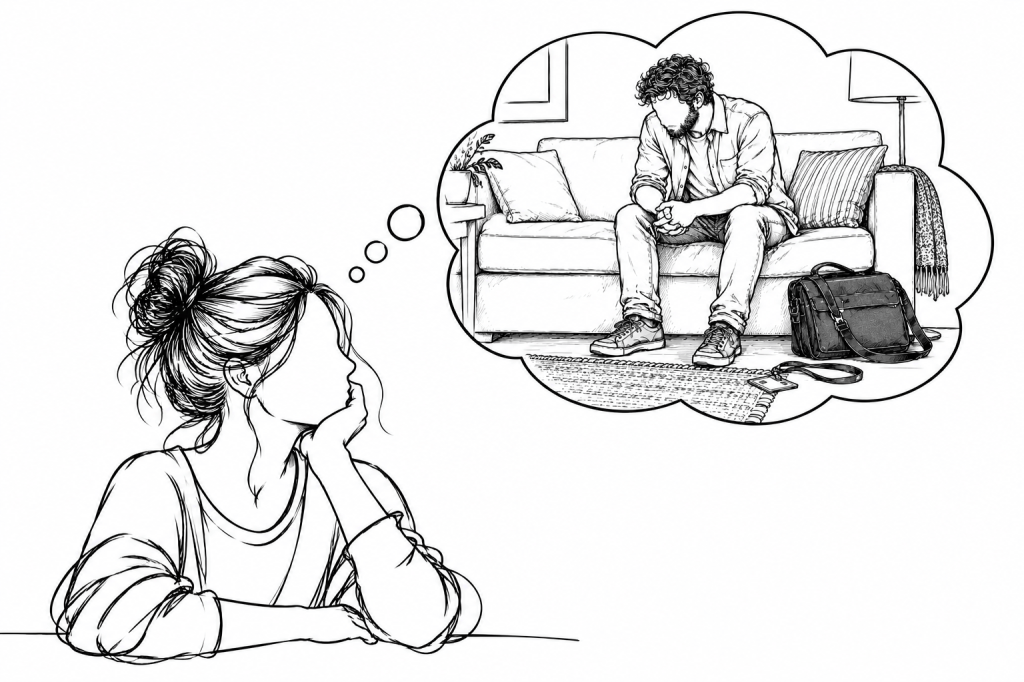
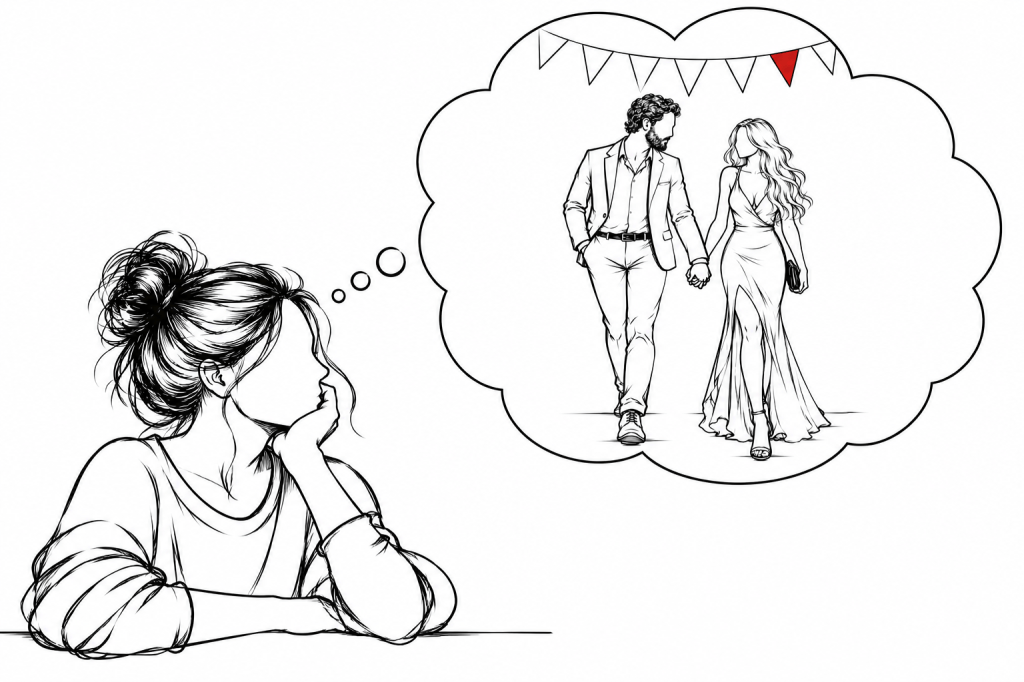
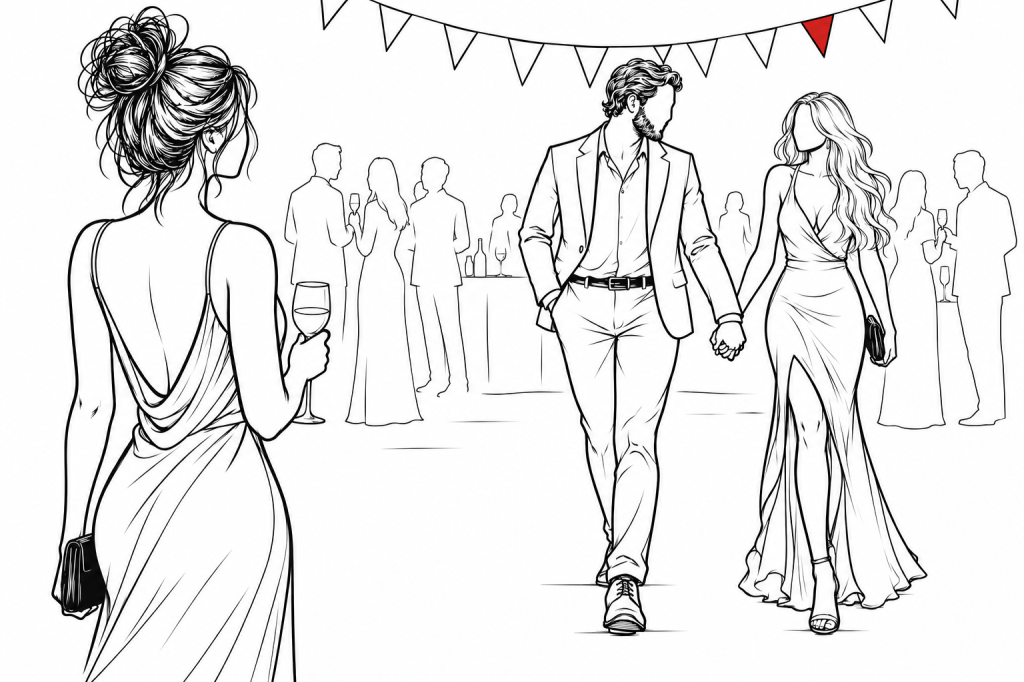
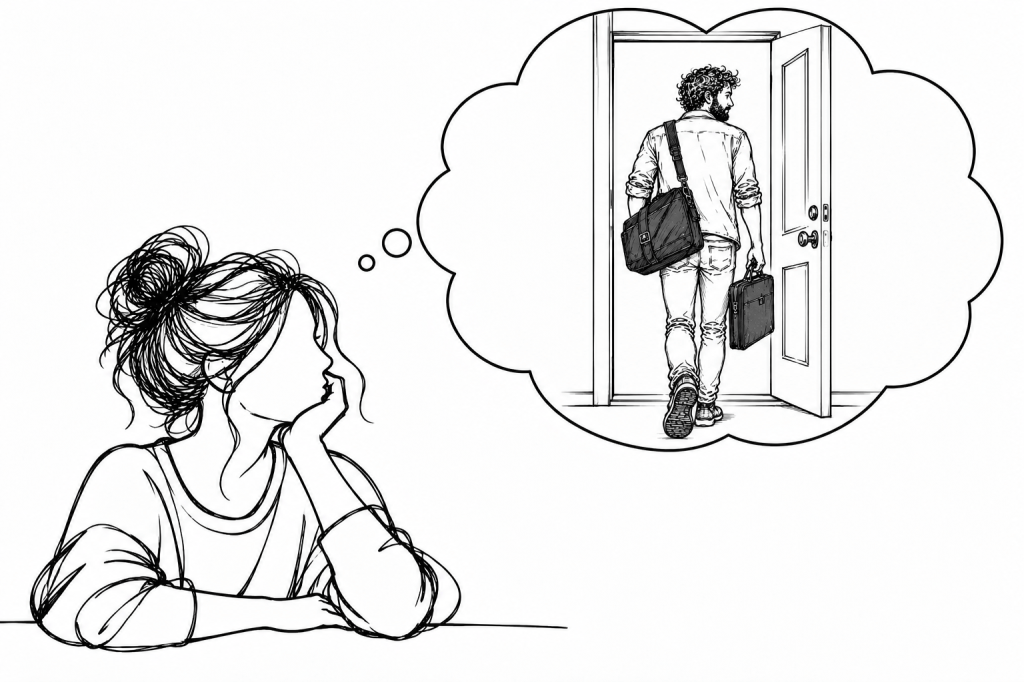
Panic hit me in the chest, hard and immediate, as though my body already knew what my mind was still refusing to understand.
I ran back inside for my phone.
“Where are you?”
For seven minutes, there was no answer.
Then Stephen replied.
“I’m walking her home.”
I stared at the message.
He had left my aunt’s house with M without even telling me.
“You didn’t think to say anything to me?”
“Stephen. I need to talk to you.”
“It’s important.”
I tried to call him several times.
Finally, I got through.
He told me M had become upset and run off. He had followed her and caught up with her. He had tried to persuade her to stay at her mum’s, but she was determined to walk home.
So he was walking her.
I told him this was ridiculous.
Come back.
Come back now.
He said he couldn’t leave her walking alone at night.
I couldn’t understand what I was hearing.
I was his partner.
I was alone in a foreign country, in my aunt’s house, devastated by something I had just witnessed between him and another woman.
And he was explaining to me why she needed him.
I needed him.
I told him that if he cared about me, he needed to turn around and come back.
He refused.
I became more upset, more frightened and more desperate to somehow reverse what was happening before whatever line was being crossed became impossible to uncross.
I was bargaining with him.
Pleading with him.
Trying to make him understand the enormity of what he was doing.
Just come back.
Please.
Come back now.
Eventually, I became desperate enough to give him an ultimatum.
“If you don’t come back now, our relationship is over.”
I didn’t say it because I wanted our relationship to end.
I said it because I needed those words to stop him.
I needed the possibility of losing me to be enough.
It wasn’t.
The call ended.
“You’ve made your priorities loud and clear,” I wrote.
“I mean so little to you.”
“I guess it’s over.”
“You are so cruel.”
“It will be hours until you’re back and leave me here suffering.”
“Leaving me guessing. Wondering.”
“I just can’t believe this.”
“Who the hell are you?”
For thirteen minutes, there was nothing.
Then Stephen finally replied.
“I thought you had already made up your mind.”
“You’re breaking my heart,” I wrote.
“So now you won’t tell me where you’re going or talk to me.”
“Was trying to persuade her to stay at her moms.”
“She wanted to walk home.”
“I am walking her home.”
“Please answer the phone,” I wrote.
“Why don’t you care about how I feel?”
“This is killing me.”
His response came back.
“You trashed tonight.”
I didn’t even know what that meant anymore.
“So you don’t want to talk to me anymore?”
Then I asked the question that frightened me most.
“Are you staying over there and not coming back?”
No answer.
Everything was suddenly beyond my control.
That’s when I unravelled.
I couldn’t reach him. I couldn’t reason with him. I couldn’t persuade him to come back. I didn’t know exactly where he was, what he was doing or whether I would see him again that night.
Only hours earlier I had been at my grandmother’s party with the man I loved, surrounded by my family.
Now he had disappeared into the night with my cousin.
I felt more alone than I can remember ever feeling.
I called my eldest son.
I told him what was happening.
He listened and then told me he wasn’t surprised.
He had never trusted Stephen.
I checked on my aunt, perhaps hoping absurdly that someone older and wiser might wake up and somehow take control of this nightmare.
She was fast asleep, snoring loudly.
And I was alone again.
I didn’t know what to do with myself.
I was furious.
Terrified.
Humiliated.
Heartbroken.
But more than anything, I was in disbelief.
This couldn’t actually be happening.
Not after the year we’d just had.
Not after everything we had survived.
Not after I had forgiven him.
Not after I had given him another chance.
Not here.
Not with my cousin.
Eventually, the only thing I could think to do was leave.
I asked Stephen whether he wanted me to change my flight and go home that day.
There was no answer.
“Yes or no?”
Still nothing.
Eventually, I made the decision myself.
“I’m a broken woman and I can’t be here any longer than I have to,” I wrote to him.
A minute later:
“I’m leaving for Copenhagen first thing. This is the worse day of my life.”
Our flight home was supposed to be the following day, but I couldn’t imagine remaining there waiting for Stephen to return. I changed my flight, packed my suitcase and sent my aunt a message explaining what had happened.
Then, while it was still dark, I left her house.
I began walking towards town, pulling my suitcase behind me.
There is something very strange about walking alone through an unfamiliar place in the hours before dawn while your entire life seems to be collapsing somewhere behind you.
At 4:20 in the morning, my phone lit up.
Stephen.
“Tess, are you awake?”
I looked at the message.
I was already gone.
“I’m walking to town.”
Then we spoke.
He told me he was at M’s.
I told him to get in a taxi and come back.
He said he couldn’t. He was too tired. He was going to stay at M’s for the rest of the night.
I couldn’t understand what I was hearing.
He could have called a taxi and come back. I hadn’t slept either. I wasn’t asking him for anything complicated.
I just wanted him to come back.
“Where are you going to sleep?” I asked. “What’s M doing?”
He said he didn’t know. The flat was very small. M was in the toilet.
By then, I was pleading.
“Please, Stephen. Just get a taxi and come back. Please come back now.”
For the last time, I asked him to choose to come back to me.
His answer was firm.
“No.”
I was walking through Denmark in the early hours of the morning with nothing but my own thoughts for company.
I replayed everything.
The party.
The way Stephen had looked at M.
His attention towards her.
Her lying in his arms.
His face when I caught them.
My walking away.
His not following.
The empty conservatory.
The garden gate.
The unanswered calls.
Again and again I asked myself what I could have done differently.
Why hadn’t I stayed in the conservatory?
Why hadn’t I insisted he come to bed?
Why had I left them alone?
Why hadn’t I stopped him?
There was a terrible desperation in trying to find the precise moment when I might have changed the outcome.
And beneath all those questions was another one I simply couldn’t make sense of.
Why was Stephen willing to throw us away for a woman he had barely met?
Not just any woman.
My cousin.
After everything I had done to understand him, forgive him and believe in him, how could I possibly matter so little in that moment?
As the sun began to rise, I called my mum and dad.
I told them what had happened.
They were devastated for me and understood immediately why I needed to leave.
By the time I reached the station, daylight had arrived.
I stood there with my suitcase waiting for the train that would take me to the airport, utterly exhausted but far too distressed to feel tired.
The enormity of the night was beginning to sink in.
A year earlier, I had asked Stephen to leave my home because I believed that loving him did not mean protecting him from the consequences of his behaviour. I had given him another chance because I genuinely believed people could learn, grow and change.
And for almost a year, everything I saw seemed to tell me I had been right.
The alarm bells had become quieter.
And when they did sound, I had learned to question them.
Was I seeing something real, or was I allowing what had happened before to contaminate what was happening now?
I thought that was what learning to trust looked like.
Now I was standing alone on a railway platform in Denmark while the man I loved was somewhere else with my cousin.
It had been almost a year since Stephen’s dismissal and his moving out of my house, and against all my fears at the time, that year had been amazing.
There had been almost no alarm bells.
Stephen seemed to have grown. We were enjoying each other more than ever, our relationship felt calmer and more secure, and I had begun to believe that asking him to leave had achieved exactly what I had hoped it would. He still didn’t have a job, but if that year had been spent working on himself, I could live with that. I wasn’t interested in measuring his progress by a salary. What mattered to me was whether he was becoming happier, healthier and more self-aware.
And from where I was standing, it seemed that he was.
Stephen’s son had been working for me one day a week at the house I managed. When he left for his summer break after leaving college, Stephen had stepped in to fill the role.
Shortly before Denmark, Stephen had made his first trip to his friend’s hostel in Scotland, taking his eldest son with him. His son had been feeling stressed about what he would do after college, and Stephen thought a few days away together might do him good.
When he returned, we had only a few days before we flew to Denmark.
This time we had been invited to stay with my aunt, my mum’s younger sister, because the guest rooms at my grandmother’s house would be occupied by my parents and other family members coming for the party.
I had always been very fond of my aunt. She is considerably younger than my mum, so when I visited Denmark as a little girl, she was still a teenager. I looked up to her. She would style my hair, paint my fingernails and do all those little things that made an older girl seem impossibly glamorous to a child.
About twenty years earlier, she had experienced an unimaginable tragedy. Her English husband, whom she had met through my dad while staying in England as a young woman, took his own life, leaving her with four children.
It was a devastating time for the whole family, but my aunt was incredibly resilient. Forever the optimist, she somehow found a way to continue living and to create joy again. Inevitably, though, the circumstances surrounding their father’s death affected each of her four children differently—some in ways that were obvious, and others that were perhaps much harder to see.
On our second evening, my aunt took Stephen and me to an outdoor live music event. The weather was kind to us, we had drinks, listened to music and had a genuinely lovely evening. It felt like the beginning of another wonderful trip.
The following day, my aunt’s eldest daughter—I’ll call her N—came to visit with her son. Of all my cousins, N had always seemed to me to be the one most visibly affected by what had happened to their father. Over the years I had heard stories about arguments and difficult encounters between her and other members of the family, including my mum.
We talked about some of those family tensions and asked whether she was planning to come to my grandmother’s party. N wasn’t sure she would be welcome.
Rather naively, we encouraged her to come.
Put the past behind you. Come with an open heart. Start again.
It sounded reasonable at the time.
Later that evening, my aunt’s eldest and only son—I’ll call him R—dropped by and stayed for dinner. Afterwards we sat in the garden well into the night, smoking, talking, listening to music and discussing films.
I had always been very fond of R, and Stephen seemed to connect with him easily too. I wondered whether Stephen’s own history of trauma and mental-health difficulties gave him a particular empathy for some of what my cousins had experienced following their father’s death.
Everything felt easy.
Then came the party.
My sister and her family had arrived in Denmark and were staying in a rented house nearby. We all went to my grandmother’s early to help my mum set everything up, and throughout the afternoon friends and extended family began arriving.
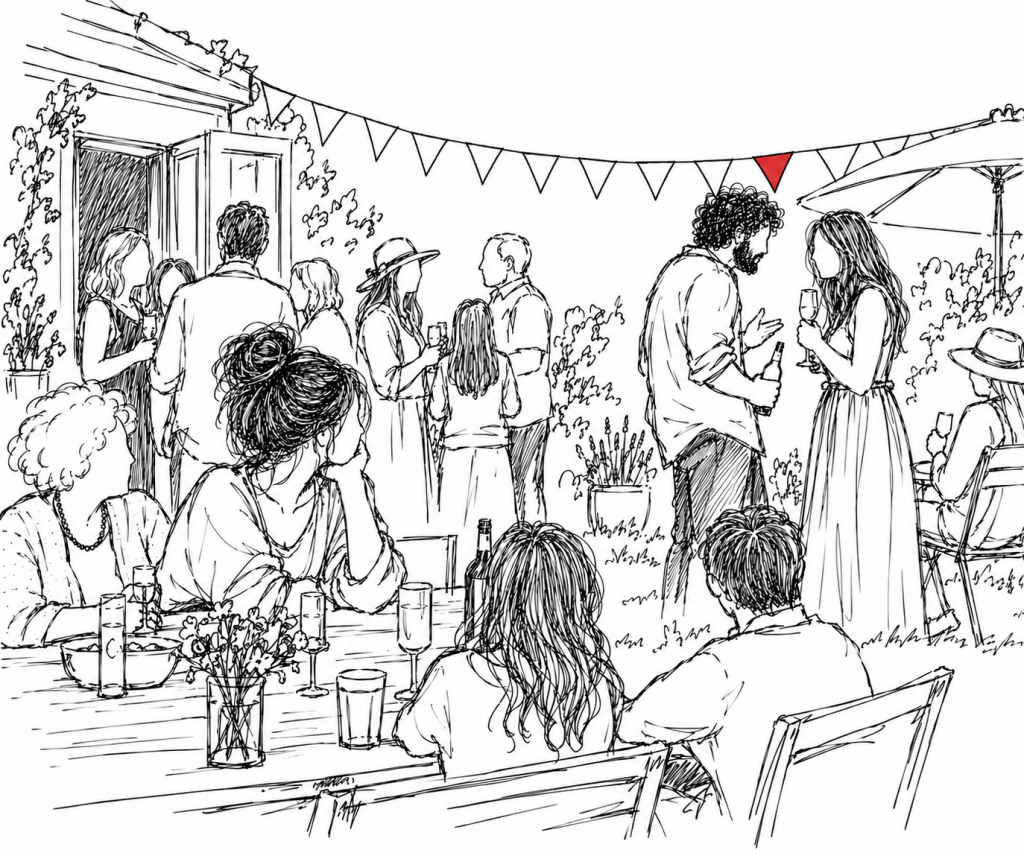
There was a lovely atmosphere. Everyone was outside in the garden—different generations milling around, joining conversations, drifting away and joining others.
My aunt’s middle daughter—I’ll call her M—arrived. Stephen looked up.
Almost immediately, I noticed something in him.
It reminded me of the young woman at the Claridge’s party the previous year. Nothing overt happened. It was simply a slight change in him: a little more nervousness, a fixed quality to his gaze, an attentiveness that felt different.
It occurred to me that M might be his type.
She was dark-haired, tall, around thirty, fit from going to the gym and had a couple of tattoos. She had a particular look I had noticed Stephen respond to before, both in women we passed in the street and women he saw on television.
If he found her attractive, that was fine. People don’t stop finding other people attractive because they’re in a relationship.
But I noticed.
And after the relative peace of the previous year, I had also become accustomed to questioning myself when I noticed things like this.
Perhaps this was simply what trusting someone required.
My aunt’s youngest daughter and her boyfriend arrived and Stephen and I had some lovely conversations with them. R arrived too.
Then N appeared with her son.
The reaction was immediate.
I could almost feel the atmosphere change.
People who had been relaxed suddenly seemed watchful. There was surprise on faces and an apprehension I hadn’t expected. For the first time, I wondered whether we had badly underestimated the fractures within this family and whether encouraging N to come had been a mistake.
Initially everything remained civilised, but as the afternoon went on and more alcohol was consumed, tension began building between N and M.
Then it escalated frighteningly quickly.
Before we really understood what was happening, N had become aggressive and M was in tears. N and her son were encouraged to leave before things became worse, while M stormed out of the garden crying.
Stephen and I followed her.
It was then that M told us what had happened the previous Christmas. What I had understood to have been an argument and a fight between the sisters had apparently been far more serious. She showed us a photograph of her face afterwards. It was black and blue all over.
We had had no idea.
Once N had gone, M began to settle down and Stephen spent a great deal of time talking to her, calming her and listening to her talk about her relationship with her sister.
At first I understood completely.
She was distressed. Stephen could be extraordinarily compassionate when someone was struggling, and this was exactly the sensitive, caring side of him that I loved.
But gradually I became aware of just how invested he was becoming.
He wasn’t simply offering some comfort and then returning to the party. His attention remained with her. Conversation after conversation revolved around M, her feelings and what had happened.
And once again, I began to experience that familiar sensation of somehow disappearing from Stephen’s awareness when another woman captured his attention.
I didn’t want to make something out of nothing.
So I said nothing.
Despite the drama, the party had otherwise been a success, and when it was finally time to leave I felt relieved. I was tired and ready to return to my aunt’s house, climb into bed with Stephen and put the events of the day behind us.
Then M asked her mother if she could come back with us and stay the night.
My heart sank slightly.
I didn’t particularly want her to come. I had already noticed what I thought might be chemistry between her and Stephen, and I had watched him devote much of the evening to her.
But what could I reasonably say?
She was my cousin. She had just been through an upsetting confrontation with her sister. This was her mother’s house.
So M came back with us.
My aunt soon went to bed, leaving the three of us sitting in the conservatory with another drink.
The table was small.
Stephen sat between M and me.
We chatted for perhaps half an hour, but it was late and I was exhausted. Eventually I said I was going to bed and asked Stephen to come with me.
He said he would stay up for just a little longer.
Something in me didn’t like it.
But I also knew that if I suddenly insisted he come to bed, I would look worried. Jealous. Controlling.
And after everything we had been through, I didn’t want to be that woman anymore.
So I said goodnight.
“See you shortly,” I told him.
I climbed into bed.
And lay there awake.
Of course I couldn’t sleep.
I knew they were outside alone together, and no matter how much I tried to reason with myself, my body would not settle.
I waited.
And waited.
And waited.
Every minute seemed to make the silence outside louder.
Nearly an hour passed.
Eventually I couldn’t stand it anymore.
I quietly got out of bed and crept back towards the conservatory.
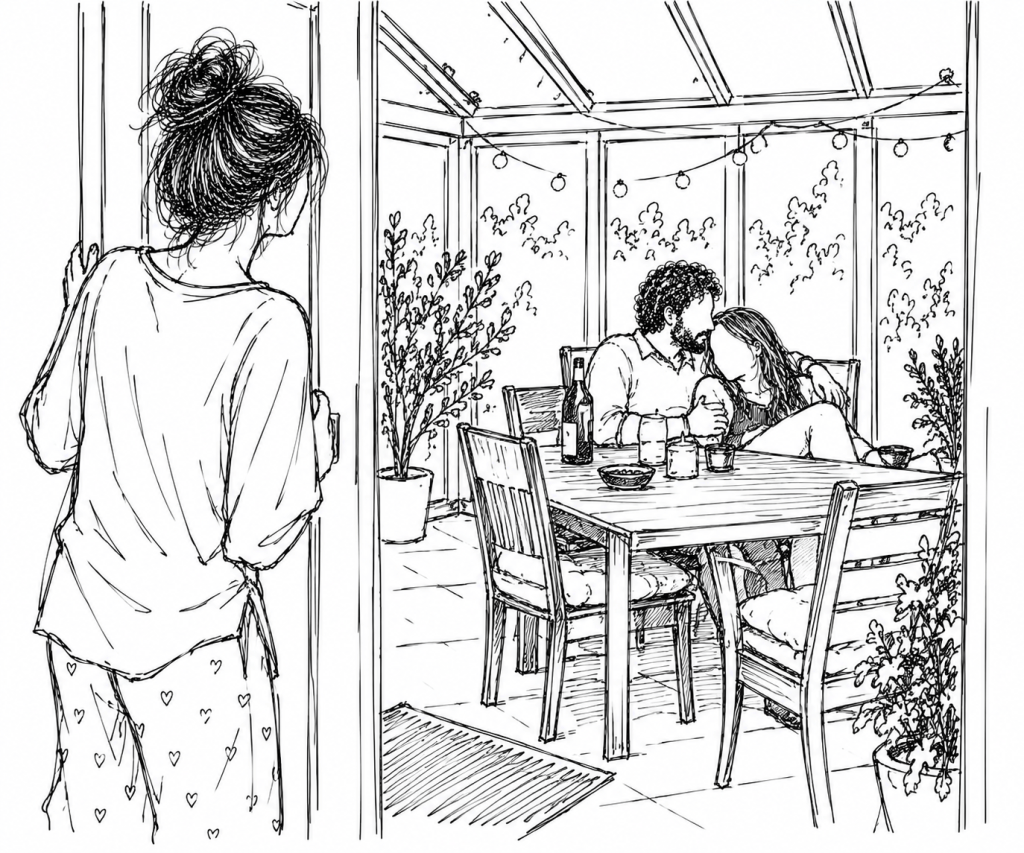
What I saw stopped me.
They weren’t talking.
M was reclined in Stephen’s arms.
For a moment I couldn’t quite process the image in front of me.
Then something exploded inside me.
“What the hell is going on here?”
M jumped away from him and immediately pulled herself upright.
Stephen looked at me. His eyes bulging like a deer in the headlights.
I don’t remember exactly what I said next. I only remember the anger. The shock. The feeling that something I had feared without really allowing myself to fear it was suddenly happening right in front of me.
I could have stayed there.
I could have separated them.
I could have demanded Stephen to come to bed with me.
But I didn’t want to have to drag my partner away from another woman.
I wanted him to choose me.
Surely catching them like that and seeing how upset I was would be enough.
So I stormed back to the bedroom.
I expected to hear him behind me.
I waited for footsteps.
Nothing.
The house became completely quiet.
I gave it perhaps five minutes.
Still nothing.
Finally I got up again.
The conservatory was empty.
I checked the other rooms.
Nothing.
And then a horrible thought entered my head.
Don’t tell me they’ve left.
I hurried down the garden path and reached the gate. I looked one way and then the other.
Stephen moving back to his father’s house felt like the end of something.
Not the relationship.
I wasn’t ready for that.
But certainly the end of the version of it I had believed we were building.
Only a few months earlier, I’d cleared drawers and wardrobe space for him. I’d imagined breakfasts before work, evenings together and the quiet accumulation of an ordinary shared life.
Now I was helping him move backwards.
Back to his father’s house.
Back to the bedroom he’d been so desperate to escape.
Back to unemployment.
Back to complaints about his father and his estranged brother not paying rent.
It felt terribly sad.
And yet, underneath the sadness, there was also a strange sense of clarity.
For eight months, I had been trying to understand a feeling.
Something about Stephen and women hadn’t felt safe to me.
At first, there had been isolated moments.
The night with his ex.
My aunt.
Comments about women.
J.
The young woman at Claridge’s.
Stories from his marriage.
None of them had been enough on their own to tell me exactly what I was looking at.
And I had been extremely reluctant to join them together.
I didn’t want suspicion to become evidence simply because I was frightened.
Then Stephen lost his job following complaints from two women.
Suddenly, my unease had somewhere to land.
I hadn’t predicted this.
Nothing in my imagination had prepared me for sexual complaints at work.
But something inside me had been saying for months:
There is something here you don’t understand yet.
That distinction matters to me.
Instinct isn’t prophecy.
Mine hadn’t told me what Stephen was going to do.
It had simply kept responding to inconsistencies, broken agreements, unusual interactions and moments when his behaviour around women didn’t quite fit the man he described himself as being.
Perhaps my instincts weren’t trying to give me an answer.
Perhaps they were asking me not to stop looking.
Now I had an answer of sorts.
But it created another question.
What was I supposed to do with it?
The obvious answer might seem to be that I should have ended the relationship.
I considered it.
But from where I stood then, the situation didn’t feel that simple.
I loved Stephen.
Deeply.
And the eight months we’d spent together weren’t eight months of misery punctuated by occasional happiness.
Quite the opposite.
Most of our relationship had been joyful.
We had laughed constantly.
We had extraordinary chemistry.
We could talk for hours.
He was affectionate, interesting and exciting.
He embraced my friends and family.
He made ordinary experiences feel bigger.
I could imagine a future with him because there was so much in our present that genuinely worked.
The problem was that something else existed alongside all of that.
Something neither of us seemed properly able to explain.
Stephen appeared genuinely distressed by what had happened at work.
I don’t think his confusion was necessarily an act.
I suspect there may have been parts of the complaints he genuinely experienced very differently from the women involved.
That didn’t mean the women were wrong.
Nor did it absolve him.
But it made me wonder how much insight Stephen actually had into his own behaviour.
That seemed important.
Because you cannot reliably change a pattern you cannot recognise.
Perhaps shame made recognition harder.
There is a difference between guilt and shame that I understand better now.
Guilt says:
I did something bad.
Shame says:
I am bad.
Guilt can encourage repair.
Shame often encourages escape, defensiveness or explanation because fully accepting what happened feels like accepting something unbearable about yourself.
I sometimes wonder whether that was part of what I saw in Stephen.
When consequences arrived, he could appear remorseful.
But if we stayed with the behaviour too long, explanations would begin appearing around it.
Stress.
Safeguarding.
His mental health.
J exaggerating.
Pressure.
Circumstances.
Perhaps those things genuinely contributed.
But I was beginning to understand that explanations and accountability aren’t the same thing.
I didn’t need Stephen to declare himself a terrible person.
I needed him to be able to say:
Whatever was happening inside me, I behaved in ways that affected other people, and I need to understand why.
That was what I hoped his dismissal might finally force him to do.
So I asked him to leave my home.
Looking back, I think that decision tells me something important about the woman I was then.
I did have boundaries.
I wasn’t prepared to pretend nothing had happened simply because I loved him.
The condition for Stephen moving in had been employment, and that condition no longer existed.
But the deeper condition was trust.
That had been damaged too.
So I created distance.
What I didn’t create was an ending.
Instead, I created another opportunity.
A second chance.
At the time, that felt like a distinction worth making.
I wasn’t saying that what Stephen had done was acceptable.
I was saying I didn’t believe a person’s worst behaviour necessarily had to define everything they would ever become.
People can learn.
People can grow.
People can recognise patterns and change them.
I believed that then.
I still believe it now.
The question I didn’t yet understand was that change requires more than consequences.
It requires ownership.
Curiosity about oneself.
A willingness to tolerate uncomfortable truths.
And, eventually, behaviour that remains different even when nobody is watching.
I couldn’t do those things for Stephen.
But I could give him the opportunity to do them himself.
So Stephen returned to his father’s house.
And something surprisingly literal happened there.
He began clearing his room.
When I’d first seen it, the room had seemed almost overwhelmed by his life.
Bags.
Cases.
Furniture.
Possessions.
Clutter everywhere.
Barely enough visible floor to move around comfortably.
Now he started throwing things away.
He rearranged the furniture.
He created space for a desk.
He moved his bed beneath the windowed alcove.
The room became calmer.
More ordered.
More inviting.
I loved the transformation.
Perhaps I invested it with more meaning than it deserved.
But it looked like progress.
Stephen was sorting something out.
Even if, initially, it was only a bedroom.
I began staying there.
And slowly, the place he’d once described as intolerable became somewhere we could actually enjoy being together.
That encouraged me.
So did the letter.
Stephen pinned the letter I’d written to his notice board.
I found that deeply meaningful.
He wasn’t hiding it.
He wasn’t throwing it away.
There it was, visible in his room: my disappointment, my boundaries, my hopes for him.
I interpreted that as evidence that he’d heard me.
Perhaps he genuinely wanted the reminder.
Perhaps looking at it made him think about what he’d nearly lost.
Perhaps it represented his own determination to become the man he wanted to be.
I can’t know exactly what it meant to Stephen.
I know what it meant to me.
He’s taking this seriously.
That mattered enormously.
Because I wasn’t asking Stephen to become somebody else.
I was asking for consistency between the man he so often appeared to be and the behaviours that occasionally seemed completely at odds with him.
I wanted the loving Stephen.
The thoughtful Stephen.
The man who talked about integrity.
The man who wanted a future with me.
I wanted that man to become dependable.
And I believed he could.
There was one theory I had begun to develop that troubled me.
I wondered whether female attention did something for Stephen at particular moments.
Not simply sexual attraction.
Something more regulatory.
Perhaps when he was lonely, stressed, bored, emotionally disconnected or feeling badly about himself, attention from a woman gave him something immediate.
Validation.
Excitement.
Escape.
A sense of desirability.
A temporary shift in how he felt.
I didn’t have enough evidence to know whether that was true.
It was simply a hunch.
But it helped connect things I otherwise struggled to understand.
His marriage.
The teenage colleague he’d remembered so intensely.
His ex.
My aunt.
J.
The messages at work.
Maybe these weren’t expressions of a man constantly searching for another relationship.
Perhaps sometimes they were expressions of a man searching for a feeling.
If so, that distinction mattered.
Because Stephen could genuinely love me and still be vulnerable to seeking something from somebody else.
At that stage, though, I still believed love should provide considerable protection against that.
If our connection remained strong, perhaps he wouldn’t need whatever those interactions gave him.
And that belief placed me in a difficult position without me noticing.
Because if Stephen was most vulnerable to seeking attention when he felt disconnected, then keeping us connected began to feel important not only because connection was lovely.
It began to feel protective.
I didn’t consciously think:
I must keep Stephen happy or he might betray me.
Nothing so stark.
But the seed of that idea may already have been there.
Perhaps if he felt loved enough.
Desired enough.
Understood enough.
Secure enough.
Then whatever had happened before wouldn’t happen again.
The clean slate grew from that hope.
I didn’t want Stephen permanently living under suspicion.
If I had chosen to continue the relationship while repeatedly using his past against him, neither of us would have been happy.
So if I was going to give him another chance, I wanted it to be real.
I would watch what he did now.
Not endlessly prosecute what he’d already done.
That felt fair.
It also meant I was deliberately placing some of my fear to one side.
The next chapter would provide new evidence.
Stephen had told me himself that perhaps he hadn’t been ready for a relationship when we’d met.
Maybe he was right.
Our beginning had been extraordinary but chaotic.
Covid.
His father’s house.
The bedsit.
Unemployment.
His mental health.
Moving in.
The job.
The dismissal.
Perhaps we’d simply tried to build too much too quickly on foundations that weren’t ready.
Now we had an opportunity to do something different.
Date.
Go places.
Have experiences.
Spend time together without immediately trying to construct a shared household.
Get to know each other again.
There was something romantic about that idea.
Almost as though the first eight months had been the turbulent prologue and the real relationship could begin now.
I think Stephen wanted that too.
I think he wanted to prove something to me.
Perhaps also to himself.
He had lost his job.
He had moved out.
He had seen the consequences of his behaviour.
Maybe he genuinely believed that this was the shock he needed.
I certainly did.
And then something happened that would make that belief increasingly easy to maintain.
Life became calmer.
The alarm bells became quieter.
Stephen and I began doing the things Covid had prevented us from doing at the beginning.
We went places.
We shared experiences.
We built memories.
And gradually, the version of Stephen I had been waiting for seemed to become more consistent.
That mattered because trust isn’t restored only by apologies.
It is restored by experience.
Each ordinary day without a crisis becomes evidence.
Each situation handled differently becomes evidence.
Each month without another betrayal becomes evidence.
Slowly, the nervous system begins to relax.
Perhaps I hadn’t been foolish to stay.
Perhaps the boundary had worked.
Perhaps Stephen really had reflected.
Perhaps people really could change.
That was the second chance I believed I was giving him.
But looking back, I can see something I couldn’t see then.
I had created a test without knowing exactly what would constitute passing it.
How long did Stephen need to behave differently before I could believe the change was permanent?
Three months?
Six?
A year?
And how could I distinguish genuine internal change from a period in which the circumstances that activated the old behaviour simply hadn’t occurred?
I had no answer.
None of us really does.
We discover whether someone has changed only by trusting them enough to give life the opportunity to test that change.
So that is what I did.
I trusted Stephen again.
Not completely.
Not immediately.
But deliberately.
I loosened my grip on what had happened and allowed the relationship to move forward.
And for a long time, what happened next would seem to prove that I had made the right decision.
That is what makes this part of the story so important to me now.
I wasn’t giving Stephen a second chance because I knew he had changed.
I gave him one because I believed change was possible.
Then, slowly, life began giving me reasons to believe it had happened.
And the more reasons I found, the safer I allowed myself to feel.
When 2022 arrived, the year began quietly, although I celebrated my birthday in January.
Around Christmas or my birthday, Stephen gave me a beautiful silver eternity ring, half-set with what I think were lab-grown diamonds. He told me that while buying it, he’d joked with the sales assistant, “How can you have half an eternity? Isn’t that a paradox?” The full eternity ring would hurt his wallet so he settled for the half. I found it funny at the time.
Years later, the joke would acquire a meaning neither of us could possibly have understood then. Perhaps half an eternity wasn’t such a paradox after all.
In March I had arranged to meet my sister and her eldest daughter in London to visit the Van Gogh immersive experience, but about a week beforehand I contracted Covid for the second time. It meant that Stephen and I didn’t see each other while I recovered, which, given how intensely we had been spending time together, felt like quite a separation.
So when I was finally better and we arranged to meet at the station before heading into London, I found myself standing outside eagerly watching for him to arrive.
Then suddenly, this handsome man appeared, walking towards me in baggy jeans, a faded white Union Jack T-shirt and a dark blazer. For a few seconds, I genuinely didn’t realise it was Stephen. Perhaps it was the time apart, or simply seeing him approaching from a distance rather than already being beside me, but I suddenly saw him with fresh eyes.
He looked so effortlessly cool and incredibly sexy.
And I remember having that wonderful little rush of disbelief all over again.
That’s my boyfriend.
I still couldn’t quite believe that this gorgeous man walking towards me was mine.
While we were in London, we wandered into a cool vintage shop where Stephen spotted a ring he liked. I offered to buy it for him so that he would have a ring too. We both liked the idea of wearing something that represented our love for each other — a small, physical reminder of our connection that we could carry with us wherever we went.
For Stephen, perhaps it could serve another purpose too. He had once described me as being somewhat “out of sight, out of mind,” and I hoped that feeling the ring on his finger might remind him of me in those moments when I wasn’t there.
March brought another experience that, a year earlier, I would never have imagined sharing with Stephen.
My bosses invited all their staff to the Cheltenham races to watch their horse run. It wasn’t something I would ordinarily have chosen to do, but I knew Stephen would absolutely love it, so we went together. We placed a few bets, enjoyed the atmosphere and, rather surprisingly, came home with more money than we had arrived with.
It was one of those simple days that I remember fondly because there was no drama attached to it. We were simply enjoying being together.
And that was becoming the story of our relationship.
By the spring, things were going incredibly well. The intensity of those first few months after Stephen’s dismissal had settled into something that felt much more comfortable. We were spending time together, trying new things and making memories. There was a growing sense that we were building a life rather than simply experiencing a romance.
So when my mum told me she was planning a trip to Denmark to visit my elderly grandmother and wanted someone to accompany her, I immediately thought of Stephen.
Denmark wasn’t simply another holiday destination for me. It was somewhere deeply connected to my childhood and my family, a place filled with memories and meaning. Inviting Stephen into that part of my life felt significant.
I wanted him to see the places that had helped shape me.
And, as it turned out, Stephen was an absolute pleasure to travel with.
From the moment we got up to catch the plane until the moment we landed back in England, he was a dream travel companion. He was enthusiastic about everything. Every new place, every unfamiliar experience, every little detail seemed to interest him.
Knowing how excited he could become about something new, you can imagine how much he enjoyed travelling around a new country and meeting members of my extended family.
I loved showing him Denmark.
I took him to places that were important to me, but I also wanted to find things that I thought he would enjoy. One of my favourites was Den Fynske Landsby in Odense, on the Danish island of Funen.
It is an open-air museum recreating a 19th-century rural community from the time of Hans Christian Andersen, with thatched timber-framed buildings, historic gardens, animals wandering around and staff dressed in period costume.
It was exactly the sort of place where I wanted to stop and look at everything.
And one of the things I loved about travelling with Stephen was that he let me.
He didn’t hurry me through places or make me feel that I was taking too long. He would happily wander alongside me while I read the information, looked at the buildings and took everything in.
That might sound like a small thing, but it wasn’t to me.
I remembered when my ex-husband and I visited an exhibition once. Within fifteen minutes, he had made his way to the exit and was waiting for me. I never felt that I could take my time, read the cards beside the displays or properly lose myself in what I was looking at.
Stephen was a completely different experience.
With him, I didn’t feel rushed.
I felt free to be curious.
We also took a two-day trip to Copenhagen, including a visit to Tivoli Gardens.
Tivoli held some of my happiest childhood memories, so returning there after so many years was incredibly nostalgic. But this time, I wasn’t simply revisiting somewhere from my past.
I was sharing it with someone I loved.
There was something particularly special about watching Stephen experience somewhere that had been part of my childhood. I could show him the things I remembered, tell him the stories and see it all again through his eyes.
Those were the moments when our relationship felt bigger than just the two of us.
I was beginning to weave him into my life.
And he seemed to fit.
By May, our adventures continued.
We attended the annual UK gun show. If someone had told me before meeting Stephen that I would one day happily spend a day shooting rifles, firing clay pigeons, doing archery and throwing axes, I would probably have laughed at them.
But because of Stephen, I went.
And I loved it.
I was surprisingly good at the shooting, which was probably as much of a surprise to me as it was to anyone else.
The axe throwing was a different matter.
I became frightened that I might hurt myself or someone else and eventually started crying because I couldn’t bring myself to throw the axe.
It was one of those moments where Stephen saw a side of me that wasn’t particularly brave or adventurous.
But I was beginning to discover that our relationship gave me permission to try things I would never have tried on my own.
Then, in June, we went on a five-day bushcraft course.
This was a little more intense than our previous adventure with bushcraft. We learned practical skills and spent much of the time outside, getting our hands dirty and learning how to survive with very little.
I skinned a rabbit.
I carved a spoon.
I learned how to start a fire.
I slept in a hammock.
We even learned how to make cordage from nettle stems.
At one point, our guide demonstrated how to strip the leaves from a nettle stem in one quick movement without getting stung. He explained that the trick was to do it quickly and fearlessly.
Naturally, I said I wanted to try.
I did exactly as he instructed.
Unfortunately, my hand came up in a spectacular collection of blisters.
It was painful, but also hilarious, and it became another story we could laugh about afterwards.
The sex between us had been incredible that year too. We had become completely relaxed and comfortable with one another. We knew each other’s bodies, understood what we both enjoyed and felt free to be experimental and adventurous. There was playfulness to it, but also an easy familiarity. It was regular, affectionate and deeply satisfying, and it felt like another part of our relationship that simply worked.
I stopped believing that good sex could guarantee fidelity. But I would be lying if I said it didn’t give me a quiet sense of security. Of all the things I worried might go wrong between us, our sex life wasn’t one of them. There was no obvious lack, frustration or incompatibility for me to be concerned about. I certainly never imagined that Stephen might go looking elsewhere because something was missing between us.
In a relationship where I had once worried so much about his boundaries with other women, that became one more reason for me to believe I could finally stop worrying.
I also always reminded him how sexy I found him to be. Not only was it true but I hoped that would mean he was less likely to look for the validation somewhere else.
Looking back at those months, what stands out to me is how happy we were.
Not just occasionally happy.
Properly happy.
We were curious about the world and about each other. We were constantly doing things, discovering places, meeting people and creating experiences that were becoming part of our shared history.
There was a sense of adventure about us.
And there was something else beginning to happen too.
I was trusting him.
Not blindly, and not without the occasional wobble, but enough to let him further into the parts of my life that mattered to me. Denmark was my childhood. My family. My memories. Taking Stephen there felt like opening another door and inviting him further inside.
And he seemed to embrace it all.
So when, in July, we were invited back to Denmark for my grandmother’s 90th birthday, I couldn’t wait to go.
The first trip had been so wonderful that the idea of returning with Stephen filled me with excitement. This time there would be even more family, more memories and another opportunity to share something precious with him.
I had no reason to think it would be anything other than another happy chapter in our story.
I had no idea that, within that trip, something would happen that would change the way I saw Stephen, our relationship and myself.
Something that would rock my world in a way nothing before it had.
At the time, though, I knew none of that.
I was simply a woman deeply in love, looking forward to taking the man she loved back to a place that meant so much to her.
And I couldn’t have felt happier about the future we were building together.
By October 2021, the complaints and the investigation that followed had brought our brief period of living together to an end.
It marked the end of the first chapter of our romance.
By then, those first ten months had accumulated an uncomfortable number of things I couldn’t explain away.
A broken promise.
A night when his phone was switched off.
My aunt.
The things Stephen had told me about his marriage and previous affairs.
J and H.
Other women.
Moments when something had felt wrong, even when I couldn’t quite identify what it was.
My instinct that there was something untrustworthy about Stephen, particularly when it came to women, had not appeared from nowhere. It had grown from a succession of events, observations, comments and disappearances.
With each one, I had become increasingly anxious that Stephen was going to betray me, although I had no idea what shape that betrayal might eventually take.
When I was finally told that two women had made complaints about his behaviour at work, it came as a complete shock.
It wasn’t something I could have imagined in my wildest dreams.
And yet, once I knew, it seemed connected to the same unease those earlier incidents had created in me: that Stephen’s boundaries with women were not always where I believed they should be.
Stephen was devastated by what had happened.
When it came to the complaints themselves, however, I didn’t always feel that he was taking full responsibility for the part he had played. He believed the pressure of the training and safeguarding responsibilities had affected him, and argued that J in particular had exaggerated events in a way that portrayed him unfairly.
I struggled with that.
Whatever else had contributed to what happened, two women had independently complained about his behaviour.
I needed Stephen to look at his own part in that rather than concentrate entirely on why other people might have interpreted him unfairly.
But in our private conversations, there were also signs that he was beginning to do exactly that.
When we talked about H and his behaviour around women more generally, Stephen acknowledged that he sometimes looked for interesting conversation and stimulation from other people. He accepted that the way he had done that had been inappropriate and disrespectful to me and to our relationship.
He began trying to understand why he did it.
Stephen told me that when he became flirtatious or sought attention, it tended to happen when he was bored or unhappy, or when he felt that other parts of his life were beyond his control.
He was adamant that he wasn’t bored or unhappy with me.
And he told me that none of this was an excuse.
That distinction mattered to me.
I could understand dysregulation, stress, pressure and boredom contributing to somebody behaving badly without believing those things absolved them of responsibility.
In fact, I told Stephen exactly where I thought the problem with his explanation lay.
He was going to be bored and unhappy again.
Life would frustrate him again.
There would be difficult jobs, difficult people and periods when he felt trapped, unstimulated or out of control.
If his response to those feelings was to seek excitement, attention or validation through other women, then changing jobs wasn’t going to solve anything.
He needed to learn another way of dealing with those feelings.
And now something enormous had happened.
Stephen hadn’t simply upset me or had an uncomfortable conversation with a colleague.
Two women had complained.
There had been an investigation.
A disciplinary process.
And he had lost his job.
However painful that was, I found it difficult to imagine that somebody could experience consequences on that scale and not seriously reflect on the behaviour that had led them there.
Surely this would stay with him.
Surely the next time a conversation with another woman began drifting towards a boundary, he would remember what had happened.
Surely losing his job would make him question his own behaviour in a way that my anxiety, questions and warnings never could.
If Stephen had succeeded in keeping his job, I couldn’t reasonably see how he would have moved forward positively. As painful as his dismissal was, I thought it was probably best for everyone concerned that his employment ended.
And that was an important part of why I didn’t walk away.
I wasn’t relying solely on Stephen promising me that he would change.
I believed something had happened that might actually make him change.
It was strange to think that we had only managed to live together for less than three months.
And so much was going to happen before we would share a home again.
Stephen and I discussed how we should move forward.
He still wanted a future with me.
I wasn’t sure I wanted the same now that this version of Stephen had been revealed to me in such a devastating way.
But I wasn’t ready to end the relationship either.
Instead, I told him that while he was living with his dad, he needed to sort himself out.
That meant something quite literal to begin with.
His bedroom.
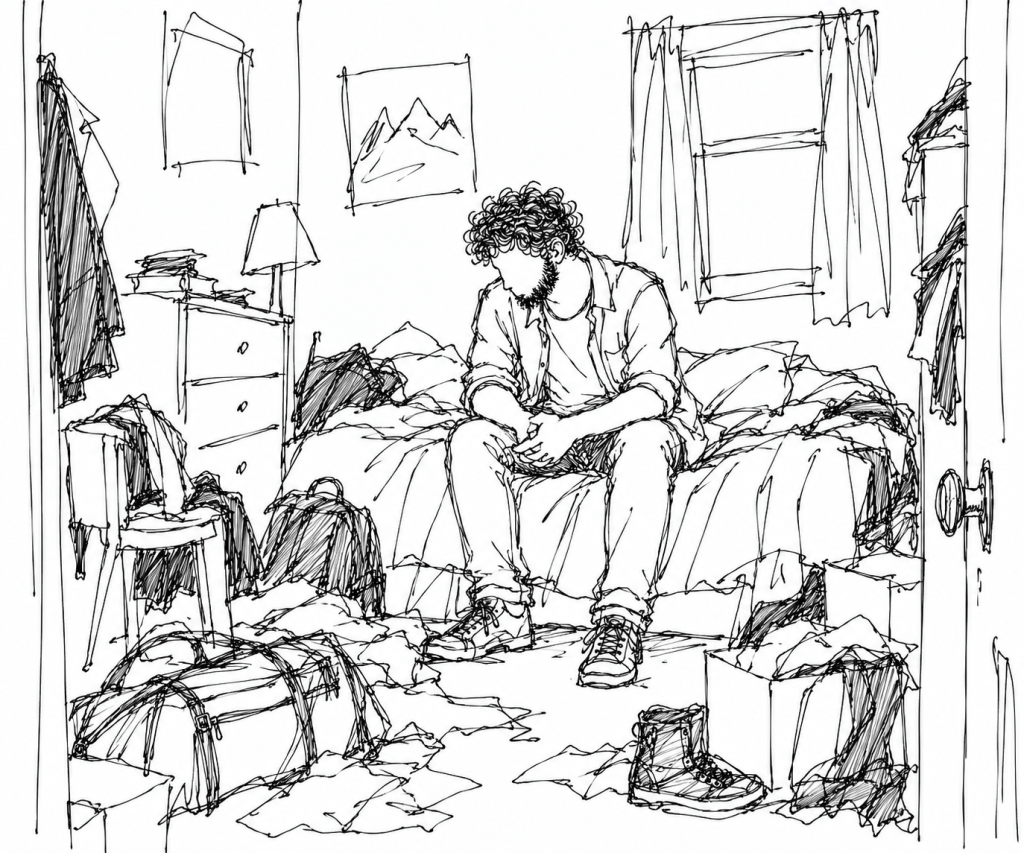
When I had first seen it at the beginning of our relationship, it had been in a terrible state. He was sleeping in his bed surrounded by piles of belongings. There was furniture, clutter, filled cases and bags bursting with possessions. The carpet was barely visible, with little more than enough room to stand beside the bed.
So Stephen began clearing it.
He threw things away and rearranged the furniture until there was enough room for a desk. His bed was moved beneath a windowed alcove, and somehow the room that had once seemed so chaotic began to feel cosy.
Eventually, I started staying there for the first time.
In some ways, that little room reflected what I hoped Stephen might be able to do with the rest of his life.
Clear some things out.
Create some order.
Make room for something different.
We revisited the red flags that had troubled me during those first months. Stephen couldn’t really explain all of them, but he seemed remorseful.
I reminded him that stability and security had been part of our conversations from the very beginning.
They were among the things I had been looking for when I met him.
Ten months later, I felt he had provided me with neither.
If we were going to have any future together, that had to change.
I needed Stephen to create some stability of his own, and I needed him to stop giving me reasons to feel insecure.
This mattered particularly because Stephen had presented himself to me from the beginning as somebody capable of self-reflection and change.
When we first met, he had spoken about difficulties in his past and told me that it had taken him a long time and a lot of work to get through them.
I had admired that about him.
I had even told him that working on yourself was something to be proud of.
So when I asked Stephen to use what had happened as an opportunity to look at himself, I wasn’t asking him to become somebody completely different.
I believed I was asking him to be the person he had already told me he was capable of being.
I hated telling my friends and family how Stephen had lost his job and why he had moved out.
I think it inevitably changed their opinion of him a little, but they supported me in my choices and continued to welcome him into their homes.
I wrote Stephen a letter.
He pinned it to his notice board.
It was there as a reminder of what had happened, but also of what I needed from him if we were going to have a future.
One of the things I expressed was a suspicion I had begun to develop about Stephen and women.
I wondered whether he had a need to seek female attention whenever I wasn’t physically or emotionally available to him.
I had no proof of that.
It was an educated hunch based on the pattern I thought I could see emerging, and I had no idea whether I was right.
Years later, I would understand why that instinct had been so persistent.
But at the time, it was simply another question.
By then, though, I was becoming increasingly conscious of the difference between what Stephen said and what he actually did.
Words had always come easily between us.
From the beginning, we had talked endlessly about honesty, trust, communication, commitment and the kind of relationship we wanted to build. Stephen had reassured me many times.
But after everything that had happened, reassurance alone no longer carried the weight it once had.
I told him so.
“I can’t stress enough how little the words mean to me when the actions haven’t matched.”
It wasn’t that I believed everything Stephen had ever said to me had been meaningless. I still believed that much of what he told me reflected how he genuinely felt in the moment.
But feelings and intentions were no longer enough.
“We’ve exhausted the words.”
What I needed now was evidence.
Stephen told me that he understood.
“I am making my actions match how I feel. I will continue to do that.”
For the first time in a long while, I stopped listening quite so carefully to what Stephen was promising and started watching what he actually did.
Despite everything, there were still reasons for me to believe that Stephen might be capable of doing things differently.
Only shortly before everything unravelled, we had still been talking about the future we wanted to create together.
Stephen had told me that he wanted security for both of us.
He wanted a comfortable future with me.
Those weren’t merely things I wanted and was trying to persuade him to want too.
They were things we had talked about wanting together.
And that mattered.
Because I loved him.
Because much of our relationship was extraordinarily happy.
And because the Stephen I had fallen in love with had told me from the beginning that people could work on themselves, reflect, grow and change.
So I offered him a second chance.
But it wasn’t quite the clean slate I once remembered it as.
I didn’t tell him that what had happened didn’t matter.
I didn’t invite him straight back into my home and carry on as though nothing had changed.
Quite the opposite.
Stephen went back to his dad’s house.
I remained in mine.
He needed to sort himself out.
He needed to create some stability.
And I needed to see whether the man I loved could become someone I could feel safe trusting again.
We were also about to embark on a year of plans and experiences we had already been looking forward to.
In some ways, it would be like dating for the first time.
Even living separately seemed to bring back some of the small rituals we had developed earlier in our relationship.
One evening, Stephen and I decided to watch Parasite together from our separate homes. We couldn’t get the watch-together function to work through the television, so we resorted to synchronising the film ourselves.
Stephen found a frame near the beginning where a pair of socks were hanging in the background.
“I’ve paused at the socks,” I told him when I found the same place.
Then he counted us in.
“3…”
“2….”
“1…..”
“Go, go, go!”
And we pressed play together.
It was such a small thing, but that was part of what our relationship was like too. Alongside all the difficult conversations and uncertainty, there was companionship. We could make something as ordinary as watching a film from two different houses feel like something we were doing together.
Covid had meant we hadn’t really been able to date normally at the beginning of our relationship. So much of those first months had taken place inside houses, during restrictions, while the ordinary world of restaurants, concerts, travel and spontaneous days out remained largely closed to us.
Stephen had said himself that he probably hadn’t been ready for a relationship when he met me.
Perhaps, I thought, this was our opportunity to begin again differently.
For Stephen to sort himself out.
For both of us to enjoy the things we had missed the first time around.
And for me to get to know him again without immediately rebuilding the domestic life that had just fallen apart.
At the time, I believed perhaps this was exactly what we needed.
I thought the worst might finally have been exposed.
I thought losing his job might be the consequence serious enough to make him understand where his behaviour could lead.
I thought consequences might lead to reflection.
I thought reflection might lead to change.
And I thought that, if it did, perhaps we could begin again.
I didn’t know whether Stephen had changed.
There was no way I could know that yet.
That was what the second chance was for.
It wasn’t a declaration that I trusted him again.
It was an opportunity for him to show me that one day I might.
And, for a while at least, what happened next would give me reason to believe that hope had not been misplaced.
And because I loved Stephen, because so much of our relationship was extraordinarily happy, and because there was usually another possible explanation, I had continued living in the space between suspicion and proof.
Then Stephen told me he had been suspended from work following complaints involving two women.
Something changed.
Until then, almost everything troubling me had existed inside our relationship.
I was the person noticing.
I was the person questioning.
And increasingly, I was also the person wondering whether the problem might be me.
Had the broken promise involving his ex damaged my trust?
Was I becoming hypervigilant?
Was I connecting incidents that had nothing to do with one another?
Was I becoming jealous?
Was I interpreting ordinary friendliness as flirtation because I was frightened of being hurt again?
Then two women I barely knew stepped into the story.
They had experienced something too.
That was both validating and devastating.
There is a peculiar kind of relief in discovering that something you feared wasn’t entirely in your imagination.
But it isn’t a comforting relief.
It is the relief of discovering you may have been right about something you desperately wanted to be wrong about.
And then Stephen handed me his phone.
That changed things again.
Because I no longer had to choose between his interpretation and mine.
The messages existed.
I could read them.
What I found was more complicated than a man who had simply failed to understand that he was flirting.
Stephen knew there were boundaries.
He and H actually discussed them.
He referred to “casual flirting” himself.
He acknowledged that she was a young, attractive woman.
He knew she was twenty-two and that he was almost twice her age.
He told her that he couldn’t get her out of his mind.
He told her that if he were single and available, from his side there would not be a line.
And eventually, when H challenged the direction their conversation had taken, Stephen acknowledged it himself.
“I need to check my own emotions and behaviour.”
“I should have been more aware of boundaries.”
“I got a bit carried away.”
Those words mattered.
They made it much harder to understand what had happened simply as social clumsiness or an innocent misunderstanding.
I still couldn’t know exactly what Stephen had wanted from H.
Perhaps he hadn’t known himself.
Attraction, curiosity, excitement, validation and emotional stimulation may all have become tangled together.
I cannot retrospectively climb inside his mind and separate them.
But I no longer needed to know his precise intention in order to judge the behaviour.
That distinction was becoming important.
For so long, I had been trying to understand why Stephen did things.
Perhaps if I understood the mechanism, I thought, I could determine how seriously to take the behaviour.
But intention and effect are not the same thing.
Nor does understanding why somebody does something make the consequences disappear.
I could have compassion for whatever was happening inside Stephen and still decide that what he had done was unacceptable to me.
Perhaps the most extraordinary discovery, though, wasn’t any particular flirtatious message.
It was a date.
9 July.
I had lived that evening once already.
I remembered Stephen seeming troubled.
I remembered trying to understand what was wrong.
He had suggested that perhaps it was work.
I had told him I didn’t think it was situational.
“It seems every time we remove what troubles you, you remain troubled by a new thing.”
“I fear this may chase you the rest of your life.”
Then he told me:
“I am so confused.”
And when he stopped responding to me while remaining online, something inside me had reacted.
“Are you talking to someone else?”
“You’re staying online but not responding.”
I had no evidence.
I didn’t know about H.
I didn’t know what was happening in another WhatsApp conversation.
I just knew that something felt wrong.
Now, weeks later, I could finally see the part of that evening that had been invisible to me.
He had been talking to someone else.
He had been talking to H.
And while I was trying to understand Stephen’s strange mood, H was confronting him about comments that had made her uncomfortable.
Stephen was acknowledging to her that he needed to examine his behaviour and that he had become carried away.
The answer to the question I had asked had existed all along.
I simply hadn’t been allowed to see it.
That feels important to me now because for years afterwards I would struggle with the distinction between intuition and anxiety.
Both can feel remarkably similar in the body.
Both can make your heart race.
Both can make you search for meaning in tiny changes of behaviour.
Both can whisper that something is wrong.
And sometimes anxiety does create stories where there are none.
But sometimes the nervous system is responding to information the conscious mind hasn’t yet assembled.
A change in attention.
A delay in a response.
A slight withdrawal.
A shift in energy.
Something familiar behaving differently.
I don’t think that means I possessed some mystical ability to know Stephen was talking to another woman.
I didn’t.
I knew something without knowing what I knew.
There is a difference.
My instincts had detected the disturbance.
They could not supply the missing information.
And that distinction matters enormously when I look back at the woman I was becoming.
I wasn’t losing my mind.
I was trying to make sense of a reality from which relevant information was repeatedly missing.
There was another painful discovery in those messages too.
During the same period that Stephen’s attention was becoming increasingly focused on H, I had been trying harder and harder to settle him.
I had worried about the training.
I had encouraged him through difficult subjects.
I had come home at lunchtime.
I had tried to make our home comfortable.
I had tried to keep our emotional connection strong.
I had even thought about our sexual relationship partly in terms of helping to satisfy and settle him.
There was an assumption underneath some of that which I don’t think I fully recognised at the time.
If Stephen was happy enough with me, perhaps he wouldn’t need to look elsewhere.
If our sex life was satisfying enough.
If home was peaceful enough.
If I was supportive enough.
If he felt understood enough.
If I could help him regulate whatever restlessness was driving him.
Perhaps then he would settle.
But while I was trying to provide those things, he was still becoming preoccupied with somebody else.
That should not be interpreted as evidence that I failed.
It was evidence that my theory was wrong.
I could influence the quality of our relationship.
I could not regulate Stephen into fidelity.
That was his responsibility.
Interestingly, I was already beginning to understand that in 2021.
When Stephen explained that he tended to seek interesting, flirtatious interactions when he was bored or unhappy, I didn’t simply reassure him.
I told him:
“You will be bored and unhappy again.”
That was remarkably important.
Because I had identified the flaw in an explanation based entirely on circumstances.
There would always be another difficult day.
Another boring job.
Another period of low mood.
Another attractive woman.
Another interesting conversation.
Another opportunity to feel noticed.
A relationship could not be safe if Stephen’s loyalty depended upon never being bored, unhappy, insecure or stimulated by somebody new.
He needed another way of managing those feelings.
And I told him so.
When I was bored, I learned Danish or played Overcooked.
I didn’t create flirtatious intimacy with other men.
The solution, I told him, was to find ways of making himself happy and regaining control of his own life rather than escaping those feelings in ways that could make his life worse.
Reading that now, I am struck by how much I already understood.
There is a temptation, knowing everything that happened later, to imagine the woman I was then as somebody who simply couldn’t see what was happening.
But I could see a great deal.
What I couldn’t know was whether Stephen would do anything meaningful with what I was telling him.
That was the unknown.
And Stephen gave me reasons to believe he would.
He acknowledged that his behaviour had been inappropriate and disrespectful.
He apologised.
He said he needed to behave differently.
He told me:
“I only want you.”
And I did something else that feels extremely important now.
I gave him a way out.
I did not demand that Stephen choose monogamy because I was terrified of losing him.
I explicitly told him that if some part of him needed sexual freedom — if he felt he had missed out and needed time to “sow his wild oats” — he could take it.
Perhaps we would find one another again afterwards.
That wasn’t what I wanted.
It would have devastated me.
But I would rather have endured the truth than lived inside a commitment Stephen didn’t genuinely want.
He rejected the alternative.
“I know in my heart that I do not want any other woman.”
So I asked him directly.
Was he choosing a monogamous, devoted, loyal, long-term relationship with me over sexual and relationship freedom?
“Yes.”
“I do.”
That matters enormously when I think about why I stayed.
Because I wasn’t standing in front of a man telling me he couldn’t promise monogamy and deciding to pretend otherwise.
I asked the question.
I offered the alternative.
I made my requirements explicit.
And Stephen chose the relationship.
At least in words.
I even told him that words were no longer sufficient.
“Beautiful, sincere words aren’t enough anymore.”
I needed actions.
That may be one of the most important sentences I wrote during our relationship.
Because the problem wasn’t that I didn’t know what I deserved.
I wrote that too.
“I know I deserve integrity, truth and respect.”
The problem wasn’t that I had never established boundaries.
Or that I had never recognised danger.
Or that I had never given Stephen an opportunity to tell me that the relationship I wanted wasn’t the relationship he wanted.
I did all of those things.
What I did was believe that the answers he gave me were sincere.
And perhaps they were sincere in the moment.
That possibility is uncomfortable because it is much easier to understand betrayal if every promise preceding it was simply a calculated lie.
Human beings are more complicated than that.
Someone can desperately want to be a particular kind of person and repeatedly fail to behave like that person.
Someone can mean a promise when making it and later violate it.
Sincerity and reliability are not the same thing.
I hadn’t learned that distinction yet.
I still believed that sufficient insight, sufficient consequences and sufficient desire to change would eventually produce different behaviour.
And there were reasons for me to hope.
Stephen became quieter when confronted with the messages.
He acknowledged things.
He appeared ashamed.
He recognised that attention from other people felt good after spending much of his life believing himself unattractive and unlikeable.
He said he needed not to let it go to his head.
Those moments mattered to me because they looked like insight.
And if Stephen could see the problem, surely he could change it.
So I didn’t end the relationship.
We tried to rebuild.
That part of the chronology matters too.
There wasn’t one enormous revelation followed immediately by me forgiving everything and carrying on as though nothing had happened.
I told Stephen our relationship was on thin ice.
I told him what needed to change.
I told him beautiful words weren’t enough.
I offered him freedom if that was what he actually wanted.
He chose monogamy.
He promised action.
And I watched.
Then the full written grievances eventually arrived.
H’s account broadly corresponded with messages I had already read.
That gave it weight.
J’s complaint affected me differently because so much of it felt possible.
Some of the behaviour I had witnessed myself.
Some I already knew about.
I knew Stephen found her attractive.
I knew about the drinking while working.
I had seen the casual attitude towards online training.
Nothing about the account felt so alien to the Stephen I knew that I could dismiss it outright.
That frightened me.
Earlier in the relationship, when something unsettling happened, I had often asked whether it was out of character.
Now another question was beginning to emerge.
What if this is part of his character?
Not all of him.
That distinction matters.
The man behaving this way around women was also the man who could walk into a gathering of my oldest friends and fit beautifully amongst them.
He could be funny, clever, warm, engaging and attentive.
He could tap-dance unexpectedly in somebody’s living room.
He could make me laugh.
He could make ordinary life feel exciting.
He could understand parts of me other people missed.
He could make me feel deeply loved.
Those things weren’t necessarily fake simply because other things were also true.
That was the cognitive dissonance I was trying to resolve.
Stephen loves me.
Stephen behaves in ways that make loving him unsafe.
Both could be true.
At the time, however, I still believed the second statement could be changed without losing the first.
J’s allegation that Stephen had effectively told her he would go for her but had a girlfriend crystallised another difference between us.
The wording mattered enormously to me.
Perhaps Stephen genuinely couldn’t understand why.
But I could.
I didn’t want to be the fence separating Stephen from all the women he would otherwise pursue.
I wanted to be the choice that made pursuing them irrelevant.
I tended to understand commitment from the centre of the relationship outward.
I choose you, and therefore I protect what we have.
Stephen sometimes appeared to understand it from the boundary inward.
I may want something, but I have a girlfriend, and therefore this is where I must stop.
Perhaps that distinction is too neat.
Human desire is complicated. Loving someone doesn’t make every other human being sexually invisible.
I had never expected that.
But increasingly I was beginning to understand that attraction wasn’t really the issue.
What mattered was what happened next.
Where attention went.
What was encouraged.
What was disclosed.
What was hidden.
Whether attraction was simply experienced or actively fed.
And whether the relationship was treated as something precious to protect or merely as the line beyond which Stephen wasn’t supposed to go.
Eventually I asked him to leave.
Not because he had already been dismissed, as I later remembered the chronology.
At that point the employment process was still unfolding.
I asked him to leave because I needed space and because something fundamental between us had been damaged.
That correction matters.
I wasn’t enforcing a technical rule that he could only live with me while employed.
I was responding to what had happened between us.
Stephen asked:
“Are we splitting up?”
And I answered honestly.
“I don’t know.”
I wasn’t endlessly permissive.
I wasn’t pretending nothing had happened.
And I wasn’t incapable of acting.
I was establishing a boundary while still hoping the relationship could survive it.
Perhaps that sounds contradictory.
It didn’t feel contradictory then.
I didn’t believe I was choosing between Stephen and myself.
I believed I was creating conditions under which I might eventually be able to have both.
I could protect myself.
Stephen could reflect.
The employment process could resolve.
He could examine what had happened.
He could understand why he sought attention when bored, unhappy or insecure.
He could learn to recognise boundaries before somebody else had to enforce them.
He could become responsible for regulating himself rather than relying on me, another woman, alcohol, cigarettes or stimulation to change how he felt.
And perhaps, eventually, he could come home.
That seemed reasonable to me.
Healthy, even.
People make mistakes.
Relationships survive crises.
People learn.
People grow.
Sometimes consequences really do force us to confront things conversation has failed to change.
I had no reason then to believe that the only sensible response to somebody behaving badly was permanent abandonment.
What mattered was what happened afterwards.
Did they understand?
Did they take responsibility?
Did their behaviour change?
And I thought I was about to find out.
That is why his belongings remaining in my home feels so symbolic now.
I hadn’t closed the door.
But neither had I simply left it wide open.
I had placed something in the doorway.
A condition.
Change.
Looking back, perhaps the mistake wasn’t giving Stephen another chance.
It was something much harder to recognise.
I still believed insight would reliably lead to change.
I believed consequences would deepen that insight.
I believed that if Stephen finally understood how close he had come to losing our relationship, he would protect it differently.
And perhaps most importantly, I believed that because Stephen repeatedly told me he wanted the same relationship I wanted, we were ultimately working towards the same destination.
I had asked.
I had challenged.
I had offered him another path.
I had told him exactly what I needed.
He had chosen me.
So I believed him.
I didn’t yet understand that eventually I would have to judge the relationship not by the clarity of Stephen’s promises after something went wrong, but by what he did when the next opportunity arose.
For now, though, I watched him leave my home.
I still loved him.
I still believed in his capacity to change.
And somewhere amongst the sadness was hope.
Because for the first time, I thought the problem had finally become visible enough for both of us to see.
I thought seeing it would be the beginning of changing it.
I didn’t yet understand how many times I would see the same shape again.
I had been slightly apprehensive about seeing Stephen in such a large social environment for the first time. Until then, Covid had kept much of our relationship contained within homes, cars, walks and small gatherings.
Now I was watching him in a room filled with strangers.
And I loved what I saw.
Stephen was completely himself.
Curious.
Enthusiastic.
Socially fearless.
He could talk to somebody wealthy or important without becoming intimidated, and to somebody completely ordinary without becoming less interested. He seemed genuinely fascinated by people rather than their status.
It was one of his loveliest qualities.
It also reminded me why introducing him to people made me so proud.
And something else happened that evening that mattered enormously.
There were attractive women everywhere.
Stephen spoke to some of them.
And I was fine.
More than fine.
I noticed that he seemed to have understood what I’d tried to explain after the evening with my aunt.
He included me.
His attention moved between people naturally.
He could be charming without making me feel displaced by his charm.
I remained connected to him.
That reassured me because it appeared to confirm something I desperately wanted to believe.
We can learn from each other.
Perhaps what had happened with my aunt really had been a misunderstanding.
Perhaps Stephen genuinely hadn’t understood how his behaviour had appeared from the outside.
I’d explained it.
He’d listened.
And now his behaviour was different.
That mattered.
It supported the idea that difficulties between us didn’t necessarily reveal some terrible incompatibility.
Sometimes people simply needed to communicate.
That was exactly how I wanted relationships to work.
Then the young woman appeared.
I noticed Stephen’s response almost immediately.
His attention sharpened.
There was something slightly nervous and self-conscious about him that I hadn’t seen with the other women we’d spoken to.
I registered it.
But I didn’t make anything of it.
That’s important.
I didn’t drag Stephen away.
I didn’t become territorial.
I didn’t sulk.
I didn’t tell him he wasn’t allowed to talk to her.
I noticed something and carried on enjoying my evening.
Because I wasn’t frightened of attraction itself.
I understood that Stephen would continue finding other women attractive.
I would continue finding other men attractive.
A relationship doesn’t remove your eyes, your sexuality or your capacity to respond to another human being.
For me, loyalty wasn’t about pretending those responses didn’t exist.
It was about what happened next.
And later that evening, I saw something happen.
Stephen walked towards me holding her hand.
Even now, I can’t say with certainty what that meant.
His explanation was entirely plausible.
She’d been drinking.
She was unsteady.
He was helping her.
Maybe that is exactly what happened.
Perhaps if I could replay those minutes from somewhere above the hotel, I would watch the whole thing and discover there was absolutely nothing suspicious about it.
But there was one movement I couldn’t explain away quite so easily.
Stephen saw me.
And dropped her hand.
It was instantaneous.
That interested me more than the hand-holding itself.
Because human beings communicate enormous amounts of information through tiny automatic movements.
We withdraw a hand.
Change a facial expression.
Move away from someone.
Hide a screen.
Alter our voice.
None of those behaviours proves wrongdoing.
But sometimes they tell us that the person themselves understands that what we’re seeing might require an explanation.
Was that what happened?
Did Stephen suddenly realise how the situation would look to me?
Was he embarrassed by an entirely innocent gesture because he remembered our previous conversations?
Or did he let go because there had been something in the interaction he didn’t want me to see?
I couldn’t know.
And once again, not knowing became the problem.
Because this incident didn’t arrive in isolation.
If I’d met Stephen a week earlier and seen him helping a drunk woman into a hotel, perhaps I would have accepted the explanation without another thought.
But I wasn’t that woman anymore.
I had already spent a night unable to contact him while he was staying with an ex.
I’d already discovered that the promise I was trying to reassure myself he would keep had been broken.
I’d watched him become absorbed in my aunt and then tell me he didn’t know how to flirt.
I’d heard about infidelity during his marriage.
I’d listened to him describe the rule he’d needed to stop himself crossing a sexual line.
I’d heard him tell me that J was his type.
Every new piece of information was now landing on top of something else.
My brain was building a pattern.
The problem was that I couldn’t tell whether the pattern existed in Stephen’s behaviour or only in my increasingly anxious interpretation of it.
That distinction tormented me.
I didn’t want to become jealous.
Jealousy felt ugly to me.
Possessive.
Controlling.
Insecure.
I had always thought of myself as relaxed in relationships, and I liked that about myself.
I wanted Stephen to have female friends.
I wanted him to enjoy conversations with women.
I wanted us to be able to admire attractive people together and laugh about it.
I didn’t want to spend my relationship monitoring where his eyes went.
So whenever suspicion appeared, another part of me immediately turned the scrutiny back on myself.
Are you becoming insecure?
Are you overreacting?
Has what happened before made you hypersensitive?
Is Stephen actually doing anything wrong?
Increasingly, there were two investigations taking place at once.
I was watching Stephen.
And I was watching myself watching Stephen.
That is exhausting.
Hypervigilance can develop when the nervous system learns that safety isn’t completely predictable. Once something unexpected has happened, the brain becomes more sensitive to small changes that might help it predict the next threat.
But there was a complication in my case.
Some of the things I was noticing were real.
Stephen really had shared his ex’s bed.
He really had become absorbed in my aunt.
He really had told me about previous infidelity.
He really had told me J was his type.
And now he really had been holding another woman’s hand.
The uncertainty lay in what those facts meant.
My instincts were collecting information.
My conscious mind was trying desperately not to draw an unfair conclusion from it.
Perhaps that was why I could still enjoy the evening.
And I genuinely did.
This wasn’t a terrible night retrospectively disguised as a happy one.
It was wonderful.
We looked fantastic.
We laughed.
We met fascinating people.
We smoked far too many cigarettes.
We watched extraordinary entertainment.
We stayed at Claridge’s.
Then I spent half the night apparently attempting to remove my own eyeball before discovering I’d accidentally spent an obscene amount of money on two drinks.
Those memories still make me smile.
Stephen’s joy was real too.
His enthusiasm for experiences was one of the things that made being with him so much fun.
I don’t want what happened later to steal that from either of us.
This is one of the strange things about looking back at a complicated relationship.
We sometimes imagine that once we understand the painful parts, the happy memories must somehow become false.
I don’t believe that.
I was happy that night.
Stephen and I were good together that night.
And somewhere inside that genuinely wonderful experience was one small moment that frightened me.
Both things can be true.
Perhaps that was becoming characteristic of our relationship.
Joy wasn’t being replaced by unease.
Unease was beginning to live alongside joy.
And because the joy was so substantial, the uneasy moments remained comparatively small.
Why would I throw away everything we had because Stephen had held someone’s hand?
Especially when there was an innocent explanation.
So I let it go.
But letting something go isn’t necessarily the same as forgetting it.
My nervous system seemed to be keeping its own record.
Each unexplained moment joined the others.
Not enough to produce certainty.
Just enough to make me watch a little more closely next time.
And perhaps Stephen was learning something too.
I don’t know what.
Maybe there really was nothing more for him to learn from that encounter than that an innocent act could upset me.
Perhaps he thought my increasing sensitivity around women was becoming unreasonable.
Perhaps he was beginning to feel watched.
Or perhaps he knew there had been a little more electricity in that interaction than he was admitting, even to himself.
I can’t enter his mind and settle that question.
What I can see is what was happening inside mine.
I was beginning to lose the freedom of simply experiencing Stephen.
Increasingly, I was interpreting him.
A glance could mean something.
A disappearance could mean something.
A hand suddenly released could mean something.
And because I loved him, I didn’t want any of those things to mean what I feared they might.
So I kept searching for the interpretation that allowed trust to survive.
For the moment, I could still find one.
He had been helping her.
He had told me what happened.
Nothing else had occurred that I knew about.
We’d had a wonderful evening.
There was no reason to turn it into something it wasn’t.
And perhaps I was becoming too suspicious.
That explanation allowed me to put the incident down.
But somewhere underneath my conscious reasoning, another lesson was being absorbed.
The first time my instincts had frightened me, I’d told myself I was catastrophising.
Then I discovered Stephen had shared his ex’s bed.
Now my instincts were speaking again.
I didn’t know whether to listen to them.
And increasingly, I didn’t know whether the greater danger was mistrusting Stephen when he’d done nothing wrong…
Before Stephen left for the Lake District, we went to the cinema together for the first time since Covid restrictions had been lifted.
We saw Black Widow.
At the time, it was simply another exciting thing we could finally do together after months of restrictions. I didn’t know that going to the cinema would become one of the great shared pleasures of our relationship.
Films became more than something we watched together.
They became a language of our own.
We would talk about performances, characters, cinematography and stories long after the credits had rolled. We’d recommend things to each other, discover old films one of us had somehow missed, get excited about new releases and endlessly discuss what we’d seen.
It became a source of connection and shared joy that would last throughout our relationship.
Then Stephen returned to his father’s house in preparation for the annual Lake District holiday with his sons.
I knew I was going to miss him terribly.
His birthday would fall while he was away too, and I felt sad that I wouldn’t be there to celebrate it with him.
But if I’m truthful, I also welcomed the break.
The previous few weeks had been stressful. I’d watched Stephen become increasingly agitated and disengaged from his new job, while conversations about other women had begun appearing with uncomfortable regularity.
I hoped some time away would do him good.
Perhaps he’d come back rested and return to his training with fresh eyes.
I could probably do with some breathing space too.
Stephen’s return from the Lake District would mark the beginning of a string of gatherings and events that Covid had postponed or threatened for so long.
And we were going to begin with something spectacular.
My boss was celebrating her fiftieth birthday at Claridge’s in London with a Roaring Twenties theme.
Think The Great Gatsby.
We were invited.
Better still, we were staying overnight at Claridge’s.
Stephen needed to cut his Lake District holiday short by a day, but he didn’t mind. Neither of us wanted him to miss such an extraordinary occasion.
Looking back, I realise that during our first six months together, Stephen and I had existed largely inside our own little bubble.
Lockdown had meant relatively few parties, gatherings or social events. I’d introduced him to some family, of course, but I hadn’t really seen much of Stephen in large social situations or surrounded by strangers.
Now I would.
We had our outfits organised and headed into London.
Before checking into the hotel, I took Stephen somewhere in Soho that I knew he’d love — a place filled with interactive automata.
I was right.
He was fascinated.
And watching him explore everything reminded me of another quality I’d fallen in love with.
Stephen could embrace an experience with his whole heart.
Take him somewhere interesting and he wanted to know everything. Show him something unusual and his curiosity lit up. He didn’t stand on the sidelines pretending to be too cool to participate.
He joined in.
His enthusiasm was infectious.
Going somewhere with Stephen could make the experience itself feel bigger, and it was an absolute pleasure sharing those moments with him.
That afternoon, we arrived at Claridge’s and got ready.
I put on my long beaded evening dress, added a feathered hairpiece and bravely inserted contact lenses for only the second time in my life.
Stephen wore a black suit, bow tie and a fabulous hat.
We looked fantastic.
As we queued to enter the celebration, each couple was professionally photographed.
I love the photograph of us from that night.
We look exactly as we were.
A happy couple, dressed beautifully, excited to be somewhere extraordinary together.
The party itself was magnificent.
There were around a hundred guests, including celebrities and dignitaries, everyone dressed in their finest twenties-inspired clothes.
And Stephen handled the environment beautifully.
He showed interest without being overawed. He was enthusiastic without being inappropriate. He seemed completely comfortable talking to people from very different backgrounds.
I remember admiring him.
This was one of the reasons I’d always been so proud to introduce Stephen to people.
He could walk into almost any room and find somebody to talk to.
We ate a wonderful three-course meal and drank cocktails.
And, because Stephen was a heavy smoker and I was smoking considerably more than I had since my twenties, we spent an embarrassing amount of the evening outside.
Smokers’ corner at Claridge’s was quite a sight.
There we’d all be, dressed to the nines in evening gowns, suits, feathers and bow ties, huddled outside puffing away.
There is something oddly democratic about a smoking area.
Status seems to disappear.
Wealth becomes irrelevant.
Everybody just wants a light.
Some of the funniest, deepest and most honest conversations Stephen and I ever had with complete strangers began over cigarettes.
I wished neither of us smoked.
But I loved those moments with him.
We spoke to all sorts of people that evening, including some very attractive and interesting women.
And I was comfortable.
In fact, I noticed that Stephen seemed to have taken on board some of what we’d discussed after the incident with my aunt.
He included me.
He didn’t become completely absorbed in another woman and forget I was there.
He was warm, interested and charming, but I still felt connected to him while he was doing it.
I noticed the difference.
And it reassured me.
Then a much younger woman joined us outside.
She was probably in her early twenties.
Almost immediately, I detected subtle changes in Stephen.
Nothing dramatic.
His attention sharpened.
His gaze lingered.
There was a slight nervousness about him, almost a shyness he seemed to be trying to conceal.
He became very interested in her very quickly.
And she appeared interested in him too.
These were tiny signals.
But by now I was noticing them.
Eventually, we all returned to the party.
After dinner, we were treated to a spectacular burlesque performance.
The dancers were extraordinary — beautiful, athletic women in elaborate costumes performing incredibly polished routines.
I was completely comfortable with Stephen enjoying it.
Why wouldn’t I be?
He was a sexual man.
The women were gorgeous.
I had eyes too.
My mother had always been wonderfully relaxed about this sort of thing. If an attractive, scantily dressed woman appeared on television, she’d practically call my father into the room to make sure he didn’t miss it.
I’d inherited some of that attitude.
I didn’t want a relationship in which either of us had to pretend we’d stopped noticing attractive people.
Harmless sexual appreciation didn’t threaten me.
What troubled me was something quite different.
It was when attraction entered an actual interaction.
When attention became personal.
When sexual energy seemed reciprocal.
When I started to feel excluded from something happening directly in front of me.
That distinction was becoming increasingly important.
This always amused me because in the privacy of my bedroom he could dance for me with absolutely no inhibition — and he had moves.
Those spontaneous little performances were some of my favourite moments with him.
But that night, I danced alone.
We’d only recently returned from another cigarette break when I headed onto the dance floor.
Before the first song had even finished, I glanced back towards our table.
Stephen was gone.
Surely he hasn’t gone outside for another cigarette already?
And then:
Why didn’t he wait for me?
I left the dance floor and headed towards the vestibule leading to the street.
Halfway there, moving through the crowd, I saw Stephen coming towards me.
He wasn’t alone.
He was walking back into the hotel holding hands with the young woman we’d spoken to earlier.
My stomach dropped.
Perhaps in another relationship, or at another point in my life, I might not have reacted so quickly.
But there was already history.
The night with his ex.
The flirting with my aunt.
The stories about his marriage.
The increasingly frequent conversations about women.
And now this.
Then Stephen saw me.
And immediately dropped her hand.
That tiny movement changed everything for me.
Had he simply continued walking towards me with her hand in his and said, She’s had too much to drink, I’m helping her inside, perhaps I would have thought very little of it.
But he let go the instant our eyes met.
My suspicion ignited.
The young woman continued walking in the opposite direction while Stephen approached me.
I couldn’t hide my expression.
“What’s going on? Why did you leave? Why were you holding her hand?”
Stephen explained that she’d become unsteady after drinking and he’d been helping her safely back inside.
It was entirely possible.
But my mind was already interrogating the story.
She hadn’t seemed particularly drunk when we’d spoken to her only a short while earlier.
There were always plenty of people outside, so how had Stephen become the person responsible for bringing her back?
Why had he returned outside so quickly?
Why had he held her hand rather than simply walking beside her?
Why had he dropped it the moment he saw me?
And if she genuinely needed physical support, why was she suddenly capable of walking away perfectly well without it?
Perhaps there were innocent answers to every one of those questions.
That was the problem.
I didn’t know anymore.
I hated how suspicious I sounded.
I’ve never wanted to be the jealous girlfriend.
Quite the opposite.
I’d always taken pride in being relaxed and trusting in relationships.
I didn’t want to monitor a man’s eyes.
I didn’t want to analyse body language.
I didn’t want to interrogate innocent interactions between my boyfriend and other women.
Yet here I was doing exactly that.
And I couldn’t work out whether Stephen was giving me reasons to become suspicious or whether the previous incidents had simply made me hypersensitive.
Maybe he’d done nothing wrong.
Maybe he’d just helped a drunk young woman.
But I couldn’t unsee him dropping her hand when he saw me.
The incident soured the evening slightly, but I didn’t want it to ruin such a wonderful occasion.
So for the time being, I let it go.
We carried on enjoying ourselves.
When the main party finished, we were invited to a private afterparty in one of the hotel’s smaller bars.
Assuming the drinks were still complimentary, I ordered a gin and tonic and Stephen had a double whisky.
Then we finally returned to our room.
Under different circumstances, we might have had an enormous argument.
Instead, I encountered a more immediate crisis.
My contact lenses.
At three o’clock in the morning, after hours in a smoky environment, my eyes were painfully dry and I couldn’t get them out.
Stephen fell asleep while I battled with them.
Eventually, I managed to remove one.
The other tore in half.
Part of it remained stuck to my eyeball.
After what felt like an eternity of poking at a bloodshot, streaming eye, I admitted defeat and crawled into bed.
The following morning, I looked dreadful.
My eyes were red, swollen and watering.
Then, at checkout, came another surprise.
Apparently, the afterparty bar hadn’t been free after all.
That gin and tonic and double whisky had cost me somewhere in the region of £110.
At that point, I could only laugh.
We left one of London’s finest hotels and headed straight for the nearest optician, where I needed somebody to remove the remaining piece of contact lens from my eye so that I could see well enough to drive us home.
It was an absurd ending to an extraordinary couple of days.
And despite the incident with the young woman, much of the experience had been wonderful.
I’d watched Stephen embrace London, the automata, the hotel, the people, the food, the entertainment and the sheer spectacle of it all with the infectious enthusiasm I adored in him.
We had looked wonderful together.
We had laughed.
We had connected with strangers.
We had made another memory.
But there was now a familiar interruption inside all that happiness.
A tiny moment I couldn’t quite put away.
I had seen Stephen holding another woman’s hand.
Maybe his explanation was completely innocent.
Maybe I was becoming too suspicious.
But increasingly, that was the problem.
I was no longer sure whether my mistrust was something I needed to fix in myself, or something Stephen’s behaviour was teaching me to feel.
For six months, I had believed that greater stability would help Stephen become more settled.
A job.
A home.
Routine.
Purpose.
A loving relationship.
Those things seemed like answers.
And yet, once Stephen had them, he seemed to become more unsettled rather than less.
What is striking to me now is that this wasn’t something I only recognised with hindsight.
Even then, I was beginning to question whether Stephen’s unhappiness was really being caused by his circumstances.
When he told me that he thought whatever was troubling him might have something to do with work, I told him I didn’t think it was situational.
“It seems every time we remove what troubles you, you remain troubled by a new thing,” I said.
“I fear this may chase you the rest of your life.”
That is difficult to read back now.
Because somewhere inside me, I had already begun to understand something I wasn’t yet ready to fully accept.
Perhaps the instability wasn’t only around Stephen.
Perhaps some of it travelled with him.
Recognising that possibility, however, was very different from knowing what to do with it.
I was still enormously proud of him for getting the job.
On paper, it seemed to suit him. Stephen was socially confident, curious about people and capable of great compassion. I could imagine him being very good at work that involved talking to people and understanding difficult circumstances.
But applying for a job and sustaining one are very different things.
Some of the training may also have genuinely triggered painful memories for him.
When he told me he was struggling through a morning of training about domestic abuse, my instinct was to help him find a way through it. I encouraged him to think about the people he might eventually be able to help rather than allowing the subject to pull him backwards.
That was how I approached most difficulties with Stephen.
Understand the problem.
Find another way of looking at it.
Work out what might help.
Keep moving.
The difficulty was that I increasingly didn’t know how much of what I was seeing could reasonably be explained by trauma.
The smoking.
The restlessness.
Missing the beginnings of meetings.
Drinking whisky while working.
Disengaging from training.
Behaving almost adolescently when he was supposed to be working.
I didn’t know where trauma ended and responsibility began.
And because I knew what Stephen had been through, I sometimes became uncertain about how far I was entitled to challenge him.
Not because I stopped challenging him.
I didn’t.
But challenging someone becomes complicated when you are simultaneously wondering whether the behaviour upsetting you might be a symptom of something painful.
Empathy can make judgement surprisingly difficult.
The pub bothered me for a similar reason.
Going for a drink after work is hardly suspicious behaviour.
But Stephen had already told me a story about another period of his life in which going to the pub had been part of avoiding going home.
So when he did something similar after moving in with me, my brain connected the two things.
That was increasingly how my mind worked.
The night at his ex’s.
The broken promise.
My aunt.
The stories about his marriage.
The pub.
J.
Each new detail arrived carrying all the ones that had come before it.
Once trust has been damaged, very little arrives alone.
Sometimes my mind was joining dots that didn’t need joining.
Sometimes it was noticing something accurately.
The problem was that I couldn’t tell which was happening.
Even when my instincts told me something was wrong, instinct could only take me so far. It could make me ask questions. It could make me notice changes. It could tell me that an explanation didn’t quite fit.
It couldn’t give me information I didn’t have.
Collecting Stephen from work is probably one of the clearest examples of how my role in the relationship was beginning to change.
Initially, it was ordinary care.
I had deliberately arranged time off partly so that I could help settle him into our home and his new job.
Stephen himself had told me how much easier life felt when we were together.
“With you…… Even the mundane feels nice. Hard things are easy. Good things are great!”
I believed him.
And I liked making life easier for him.
So collecting him meant seeing him sooner, saving him a bus journey and helping establish the life we had planned.
Then another motive crept in.
If I collected him, he couldn’t stop at the pub.
That is such a small shift, but I think it matters.
Care had begun to mix with anxiety.
I didn’t want to be a suspicious girlfriend.
But I didn’t want to become a managing girlfriend either.
What I really wanted was a third option.
A partner whose behaviour made neither role necessary.
J created another version of the same problem.
Stephen told me she was his type.
Part of me was reassured by that openness.
Surely someone intending to do something inappropriate wouldn’t tell his girlfriend that he found another woman attractive?
I repeatedly returned to that kind of reasoning.
At least he’s telling me.
And disclosure can be a form of honesty.
But I would eventually learn that disclosure doesn’t automatically make a situation safe.
Someone can tell you that they find another person attractive and still struggle with what they do with that attraction.
Women were beginning to appear in our conversations more often.
J.
Women walking around town.
My son’s girlfriend.
Any one of those things in isolation might have meant very little.
Together, they created a feeling that Stephen was unusually preoccupied with female attractiveness.
I didn’t expect him to stop looking at women.
I didn’t expect attraction to disappear because he loved me.
I expected him to know what to do with it.
Instead, I sometimes found myself explaining boundaries that felt instinctive to me.
Don’t stare.
Don’t make somebody uncomfortable.
My son’s girlfriend belongs in a completely different mental category.
Make sure a young woman living in our home feels safe.
The fact that I quietly checked with her matters to me now.
She told me Stephen had never done anything to make her uncomfortable, and I believed her.
But I had reached a point where I felt the need to ask.
My concern was beginning to extend beyond protecting my relationship.
I was checking the environment around it too.
And still, I loved him enormously.
That is important.
I wasn’t standing outside the relationship clinically assessing Stephen’s behaviour.
I was waking up beside the man I loved.
I was attracted to him.
We laughed.
We cooked dinner.
We went shopping.
We watched television.
We made plans.
We had sex.
There were countless ordinary moments in which nothing was wrong.
And then something would happen that unsettled me again.
Love and alarm were beginning to coexist more regularly.
I think that is where hypervigilance really begins.
Not simply in noticing danger, but in the exhausting process of continually trying to decide whether something is dangerous at all.
Is this normal?
Is this his mental health?
Is this trauma?
Is he immature?
Should I challenge it?
Am I being controlling?
Am I overreacting?
Or am I seeing something important?
Those questions are exhausting when you ask them often enough.
There may have been many things happening for Stephen at once.
Perhaps the demands of a full-time job were harder for him to sustain than getting the job had been.
Perhaps living together changed our relationship from something exciting and episodic into something ordinary and accountable.
Perhaps emerging from lockdown into colleagues, offices and social freedom provided a kind of stimulation he hadn’t experienced for a long time.
Perhaps it was several things at once.
I don’t know.
What I do know is that the stable version of Stephen I had expected to emerge once his circumstances improved wasn’t appearing.
And the unsettling thing is that I had already begun to recognise that at the time.
I had told him myself that I didn’t think it was situational.
But recognising a pattern and accepting its implications are two very different things.
If circumstances were the problem, then circumstances could be changed.
A better home.
A better routine.
A different way of approaching work.
More support.
More understanding.
There was always something we could do.
If the problem was something Stephen himself needed to understand and manage, however, then there were limits to what I could change for him.
I wasn’t ready to accept those limits.
Especially because Stephen himself had given me reason to believe that my presence made a difference.
He had told me that hard things were easier with me.
That the mundane felt nice.
That being together made life more achievable.
Those were beautiful things to hear from someone I loved.
But they also reinforced an idea that was becoming increasingly important in our relationship:
If I could help create the right environment — stable enough, supportive enough, calm enough — perhaps Stephen would be okay.
So I kept trying.
Encouraging.
Collecting.
Reasoning.
Making suggestions.
Setting boundaries.
Watching.
Keeping the plan moving.
And slowly, without really noticing it, the ordinary domestic life I had wanted so badly was becoming remarkably unordinary.
By the time Stephen was preparing to go to the Lake District with his father and sons, I was looking forward to the house being quiet.
I would miss him.
I loved him.
But I wanted a few days in which I didn’t have to watch, interpret, encourage, question or wonder.
Perhaps that was the first faint understanding that loving Stephen could also be exhausting.
But I didn’t interpret my exhaustion as a reason to leave.
I interpreted it as evidence that we needed a reset.
A holiday.
Some space.
A clear head.
Then perhaps the man I had fallen in love with would come back.
I still believed he was in there.
I didn’t yet understand that I was beginning to organise my hope around the return of a version of Stephen I had already known.
And each time he returned, even briefly, it reassured me that waiting for him had been worthwhile.
Since Stephen moved in, one of my greatest pleasures was simply waking up beside him every morning.
After six months of late-night meetings, phone calls, the bedsit and constantly travelling backwards and forwards, there was something wonderfully ordinary about having breakfast together before work.
This was what I’d wanted.
A normal life with the man I loved.
Stephen’s new office was only a bus ride into the centre of town, and on his first morning I sent him off feeling ridiculously proud — like a parent watching their child disappear through the school gates for the first time.
This job felt important.
Not just for Stephen, but for us.
The pay, conditions and benefits were excellent. When Stephen discovered exactly what his salary would be, I told him, “You’ve really landed.”
I wanted him to make the most of the opportunity.
“Open ears, closed mouth,” I advised him.
“And a level of humility.”
“I will try to remember that,” he replied.
I had even deliberately arranged some time off work around the beginning of his new job. I told him it would give me a chance to do some work on our home and “settle you in to home and the job.”
“Perfect,” he replied.
In my mind, the two things were connected. We had spent so much time talking about how to make this transition work that I wanted to give Stephen every possible chance to settle into both his new home and his new working life.
During that first week he was issued with a laptop and lanyard, began his training and met the other people who were starting alongside him.
I loved coming home and hearing about his day.
He told me about his new colleagues and the friendships beginning to form. I was pleased for him. In the six months I’d known Stephen, I’d become conscious that his world was considerably smaller than mine. A job wasn’t only going to give him financial independence. It would give him structure, purpose and a social world of his own.
One of the women he mentioned was J.
They had lunch together and there was something strangely familiar about her. Stephen wondered whether they might have crossed paths on a dating site at some point.
He also told me that she was his type.
I didn’t particularly like hearing that, but I was reassured by the fact that he was telling me. If there was anything to worry about, surely he wouldn’t be openly discussing her with me.
It wasn’t long, however, before small things began to unsettle me.
Within days of starting work, Stephen went to the pub by himself after finishing for the day.
It bothered me more than I thought it should.
He had previously told me that during his marriage he would often avoid going home, stopping at the pub instead. Now, after all those months of telling me how desperately he wanted us to live together, I couldn’t understand why he would want to delay coming home to me.
I began offering to collect him from work.
There were perfectly ordinary reasons for doing that. It saved him getting the bus. I got to see him sooner. I wanted to help him settle into this new life.
Stephen had told me before that being with me made things easier. Even mundane things felt nice. Hard things felt easier.
I liked being that person for him.
But there was another thought beginning to creep in too.
If I collected him, he couldn’t go to the pub.
I didn’t want to manage Stephen. I didn’t want to monitor where he went or what he did.
But increasingly, I noticed that I felt safer when I knew where he was.
One evening I met J outside his workplace when she was with Stephen and another colleague.
There was nothing obviously threatening about her. Meeting her should probably have reassured me.
Instead, I found myself wondering why Stephen had been so interested in her.
Perhaps that said more about me than it did about him.
As the weeks passed, much of Stephen’s training moved online and he began working from home.
Our ordinary domestic life continued around it.
We talked about dinner and shopping, watched football, laughed, made plans and enjoyed our evenings together.
But alongside that ordinary life, I began noticing things that worried me.
Stephen stopped getting up with me in the mornings.
Sometimes he would get up for a cigarette with me and then go back to bed.
Although we had created a proper home office for him, he often worked from the kitchen instead. He wasn’t always properly dressed. He smoked constantly, sometimes going outside every fifteen or twenty minutes.
He occasionally missed the beginning of meetings or seemed distracted by things completely unrelated to work.
This surprised me.
Stephen was intelligent and could be incredibly studious when something interested him. More importantly, this job mattered. Employment had been the boundary I had set before he could move into my home. His salary represented independence and the possibility of the future we had been planning.
Yet he seemed increasingly casual about it.
He also began complaining about people, procedures and aspects of the training.
I encouraged him to persevere.
Some of the training covered extremely difficult subjects. One morning he messaged me:
“🤬 really struggling today!”
The entire morning had been about domestic abuse.
“That’s hard, darling. ❤️” I replied. “Just think… mindsets: don’t focus on the past and its challenges. Think of the future and how you may help someone.”
I knew some subjects could touch painfully on Stephen’s own history, and I tried to understand that.
But it was becoming difficult to understand where his distress ended and something else began.
He seemed increasingly agitated.
He smoked more.
He became restless and sometimes almost adolescent in the way he behaved during online meetings.
I kept trying to help.
I encouraged him. Reassured him. Tried to reframe things when he became negative. Tried to make home comfortable. Tried to give him reasons to persevere.
This was supposed to be our six weeks to find our groove.
But instead of settling into it, Stephen seemed to be becoming more unsettled.
One evening in early July, while we were apart, I could sense something was wrong.
Stephen told me he thought it might have something to do with work, although he didn’t know exactly what.
I found myself questioning that.
“I don’t think it’s to do with a thing or an environment,” I told him. “Nothing in the future will fix it. It’s within you.”
I tried to explain what I meant.
“It seems every time we remove what troubles you, you remain troubled by a new thing.”
I worried that whatever was making Stephen unhappy might follow him regardless of how much his circumstances improved.
“I fear this may chase you the rest of your life,” I told him.
“I don’t think it’s situational.”
Stephen said he didn’t know what I meant.
Perhaps it was a conversation better had when we were together.
Later that Friday evening he was now at his dad’s to spend a weekend with his sons. He messaged:
“I am so confused.”
I asked him why.
There was no immediate answer.
I could see that he was still online.
Something about it bothered me.
“Are you talking to someone else?” I asked.
“You’re staying online but not responding.”
Stephen said he didn’t know what to say and that he had just gone upstairs to bed.
I suggested we talk on the phone.
And we did.
At the time, I had no idea what, if anything, had prompted the strange feeling I had that evening.
I only knew that something about Stephen felt different.
As the weeks went on, other things added to my unease.
Then came 19 July 2021 — so-called Freedom Day — when most remaining legal Covid restrictions in England were lifted.
My sons wanted to celebrate properly.
They planned to go clubbing and bring their friends back to the house afterwards. I thought they deserved to enjoy themselves after everything young people had missed during lockdown, so Stephen and I agreed to get out of their way.
I booked us a hotel in the centre of town.
It seemed perfect.
I could go to work as usual, and Stephen’s office was practically around the corner.
Except Stephen had apparently arranged to continue working remotely because of his mental health.
That disappointed me.
Instead of going into the office, he would now be alone in the hotel room while I was at work.
One evening when I returned, Stephen told me something that made me uneasy.
He’d been outside the hotel having a cigarette when J happened to walk past on her way to work.
She was surprised to see him.
Why was Stephen standing outside a hotel when he was supposedly working from home?
I don’t know exactly what explanation he gave her.
But Stephen told me he’d also mentioned that he’d been drinking whisky while working.
I couldn’t believe it.
Why would you tell a colleague that?
Why would you be drinking whisky during the working day at all?
I was becoming increasingly frustrated.
He had this fantastic opportunity and seemed determined not to take it seriously.
One evening, we went to Nando’s for dinner.
While I was queuing, Stephen suddenly disappeared.
I looked around and couldn’t see him anywhere.
Then I spotted him emerging from a convenience store.
He’d bought cigarettes.
This irritated me enormously because one of the agreements we’d made when he moved into my home was that he wouldn’t smoke cigarettes anymore, only rolling tobacco.
Perhaps to somebody else that distinction sounds ridiculous.
But we’d discussed it.
He’d agreed.
And now he’d simply done what he wanted anyway.
We argued.
That night, there was an unpleasant atmosphere between us at the hotel.
Increasingly, it seemed that small agreements I’d believed we’d made together didn’t necessarily carry the same weight for Stephen that they did for me.
There was something else happening that summer.
Women were becoming a subject.
With restrictions lifted and the weather exceptionally hot, the town centre was suddenly full of people again.
Stephen told me that he was finding it difficult seeing so many young women wearing very little in the summer heat.
He said he couldn’t help looking at them and that his staring sometimes made him feel awkward.
I tried to reassure him.
Finding other people attractive doesn’t disappear simply because you’re in a relationship.
I wasn’t expecting Stephen to become blind.
I told him that noticing attractive women was perfectly natural. He just needed to make sure he wasn’t staring in a way that made anyone uncomfortable.
Then he told me something that was much harder for me to dismiss.
My son’s girlfriend was living with us at the time.
She was young and, because it was exceptionally hot, she sometimes wore shorts and crop tops around the house.
Stephen told me that he found this distracting.
That alarmed me.
This wasn’t an anonymous woman walking through town.
This was my son’s young girlfriend.
She lived in my home.
She needed to feel completely safe there.
I told Stephen that he needed to mentally place her in an entirely different category. She was my son’s girlfriend and young enough to be treated like family. Whatever automatic physical response he might experience, his behaviour towards her needed to reflect that.
I wasn’t sure whether Stephen fully understood what I was trying to say.
And because there were times when the two of them would be alone in the house while I was at work, I quietly spoke to her too.
I told her that if Stephen ever said or did anything that made her feel uncomfortable, she must tell me.
She reassured me that everything was fine.
Stephen hadn’t done anything to concern her.
I was relieved.
But the fact that I’d felt it necessary to have the conversation troubled me.
As August approached, I felt increasingly exhausted.
Only weeks earlier, I’d been joyfully clearing drawers and wardrobe space, imagining breakfast together, dinner after work and the beginning of our ordinary domestic life.
Instead, I was watching Stephen struggle with the job we’d both been so excited about.
He was agitated.
He was smoking heavily.
He was drinking when he should have been working.
He was complaining about his training.
He seemed increasingly distracted and disengaged.
And somehow, alongside all of that, other women had suddenly become a recurring subject in our relationship.
J.
Women in town.
My son’s girlfriend.
And, inevitably, my mind sometimes returned to his ex and the bed he’d promised not to share.
I didn’t know what any of it meant.
Perhaps it meant nothing.
Perhaps I was becoming oversensitive because my trust had already been shaken.
Perhaps Stephen was simply struggling with his mental health and needed some time to settle.
Thankfully, he had two weeks’ holiday approaching.
For the first week, he would be going to the Lake District with his father and his sons on their annual family trip.
I knew I would miss him.
But for the first time since we’d met, I also found myself looking forward to being apart.
I needed some space.
Only a few weeks earlier, I’d thought Stephen moving in would mark the beginning of the life we’d been waiting for.
Instead, as I watched him prepare to leave for the Lake District, I found myself hoping that a little distance might somehow bring the man I’d fallen in love with back to me.