
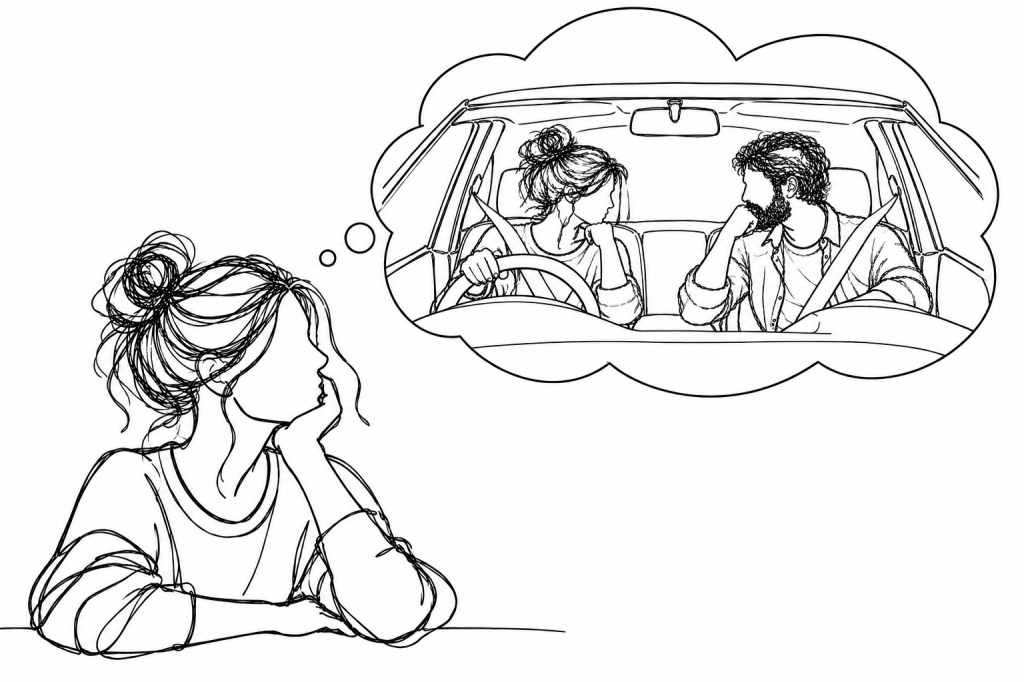
The five minutes outside Stephen’s father’s house stayed with me longer than they probably should have.
Something had changed.
Only the previous day, Stephen had seemed completely absorbed by me. Now he could barely look at me. His energy was strange — agitated, distracted, almost as though he wanted me gone.
My mind immediately supplied an explanation.
He’s changed his mind.
Then another.
He got what he wanted.
I find that reaction interesting now because, once again, my internal warning system was working perfectly well. I noticed a change in behaviour immediately. I didn’t need anybody to point it out to me.
But noticing something and understanding it are very different things.
By the time I arrived home, Stephen was messaging me normally again. He explained that living with his father was affecting him, and suddenly I had information that made the encounter easier to understand.
Perhaps that really was all it was.
I still don’t know.
He may have been overwhelmed, irritated by something that had happened inside the house, embarrassed by his circumstances or simply having a bad five minutes. People are allowed to behave strangely without it revealing some hidden truth about them.
What matters more to me now is how quickly I experienced two Stephens.
There was the man standing beside my car, difficult to read and apparently wanting distance.
Then there was the Stephen on my phone: warm, engaged, communicative and reassuringly familiar.
At that point the contradiction was tiny.
His explanation bridged the gap easily.
So I crossed it.
As the days passed, I began learning more about the life behind the man I’d found so attractive.
It was considerably more complicated than I’d imagined.
Stephen didn’t have his own home. He didn’t have a job. His relationship with his brother had broken down. His relationship with his ex-wife was difficult. He hated living with his father. There were financial problems tied up in the inherited house.
Individually, none of those things made Stephen a bad prospect for a relationship.
Collectively, though, they told me something important.
This was not the settled man I had initially imagined when I read property developer on his profile.
His life was in considerable transition.
Mine wasn’t.
I had my home. I had work. I had established routines and responsibilities. I’d come out of my previous relationship wanting companionship and security — not another complicated life to manage alongside my own.
And I noticed the mismatch.
Are we actually a good fit?
There were my instincts again.
Not screaming.
Asking.
That’s an important distinction because I don’t think instinct always arrives as certainty. Sometimes it simply presents a question and waits to see what we do with it.
The difficulty was that I was simultaneously discovering things about Stephen that pulled me in the opposite direction.
I was seeing vulnerability.
The confident man from the dating profile was becoming more complicated. There seemed to be someone underneath who wasn’t nearly as self-assured as I’d first imagined.
And vulnerability has always activated something very powerful in me.
Not pity.
Tenderness.
I didn’t want a project. I genuinely wasn’t looking for somebody to rescue. But if I saw someone struggling with circumstances I could understand, my instinct was not to judge them for struggling. It was to look at who they might be once those circumstances improved.
That distinction would become enormously important.
Because without realising it, I was beginning to assess Stephen partly on potential.
He wanted work.
He wanted somewhere of his own.
He wanted his financial situation resolved.
He wanted his life to move forward.
Those things mattered because they allowed me to interpret his instability as temporary.
I wasn’t choosing an unemployed man living unhappily with his father amid fractured family relationships.
I was getting to know a man who, as I understood it, was trying to move beyond those things.
There is a significant psychological difference between loving someone for who they are and becoming invested in who you believe they are capable of becoming.
I hadn’t crossed that line.
But perhaps I had taken my first step towards it.
Something similar may have been happening when Stephen told me about his limited experience of intimacy.
Again, I encountered something I couldn’t quite reconcile with the man in front of me.
He was attractive. Charismatic. Intensely physical with me. Yet he described himself as inexperienced.
Rather than making me suspicious, it made me curious.
Perhaps he’d simply never had the right relationship.
And then came a thought that, in retrospect, says a great deal about me.
Perhaps I could show him.
Not teach him how to have sex.
Show him what a really good relationship could feel like.
There was nothing inherently unhealthy about that thought. We all bring different experiences into relationships, and ideally we do teach one another better ways of loving, communicating and being close.
But there was something quietly seductive about the idea that Stephen might flourish with me.
It gave his vulnerability meaning.
The unsettled parts of his life didn’t necessarily have to be reasons we were incompatible. They could be circumstances we would eventually leave behind.
Perhaps with stability, love and reciprocation, a different Stephen would emerge.
I wonder what was happening for him during those same evenings.
My life must have looked very different from his.
I had a home.
I was settled in my work.
I had structure.
And, perhaps most importantly, I was responding enthusiastically to him.
If Stephen felt trapped or diminished by his circumstances, I can imagine that being seen through my eyes might have felt wonderful.
I wasn’t looking at an unemployed man living with his father.
I was looking at intelligence, humour, creativity, vulnerability and possibility.
Perhaps he liked the man he appeared to be when reflected back through me.
Perhaps I made him feel hopeful about himself.
Or perhaps that gives me too much importance.
Maybe he was simply falling for me.
I was certainly falling for him.
And then there was the chemistry.
Chemistry is difficult to write about without either romanticising it or reducing it to brain chemistry. But its psychological power is real. Strong attraction creates its own evidence.
You don’t merely think we might work.
You feel it.
Our bodies seemed remarkably certain about something our minds had barely begun investigating.
That certainty mattered.
Every evening reinforced it.
The conversations grew longer. The physical intimacy grew easier. The affection developed. I became more tired and simultaneously less willing to go home.
Nothing about that felt like sacrifice.
It felt exhilarating.
And this is where I think hindsight can once again become unfair.
I could look back at Stephen’s circumstances and construct a neat list of reasons I should have walked away.
Unemployed.
Living with his father.
Family conflict.
Financial problems.
Mental health difficulties.
A lie on his dating profile.
But people aren’t checklists.
Had I rejected Stephen solely because his life was difficult, I would have been rejecting a man I genuinely liked because he was going through a difficult period.
That wasn’t who I was.
Nor is it who I particularly want to become.
The more difficult question is one I hadn’t yet learned to ask.
Not:
Does this person have problems?
But:
How does this person take responsibility for their problems?
I was listening carefully to what Stephen wanted to change.
I hadn’t yet been around long enough to see what he actually did.
There is a world of difference between those two things.
For now, though, the evidence immediately in front of me remained compelling.
He kept messaging.
He kept turning up.
We kept talking.
We kept laughing.
The attraction was extraordinary.
And every night, I knew a little more about him than I had the night before.
Some of what I learned made me hesitate.
Some made me want to move closer.
Increasingly, I found myself doing both at once.
Perhaps that was the first real tension in our relationship.
One part of me was asking whether Stephen could fit into the life I’d already built.
Another was beginning to imagine what his life might become if we built something together.
I didn’t know it yet, but those are two very different ways of choosing someone.
And I was beginning to move from one towards the other.


