
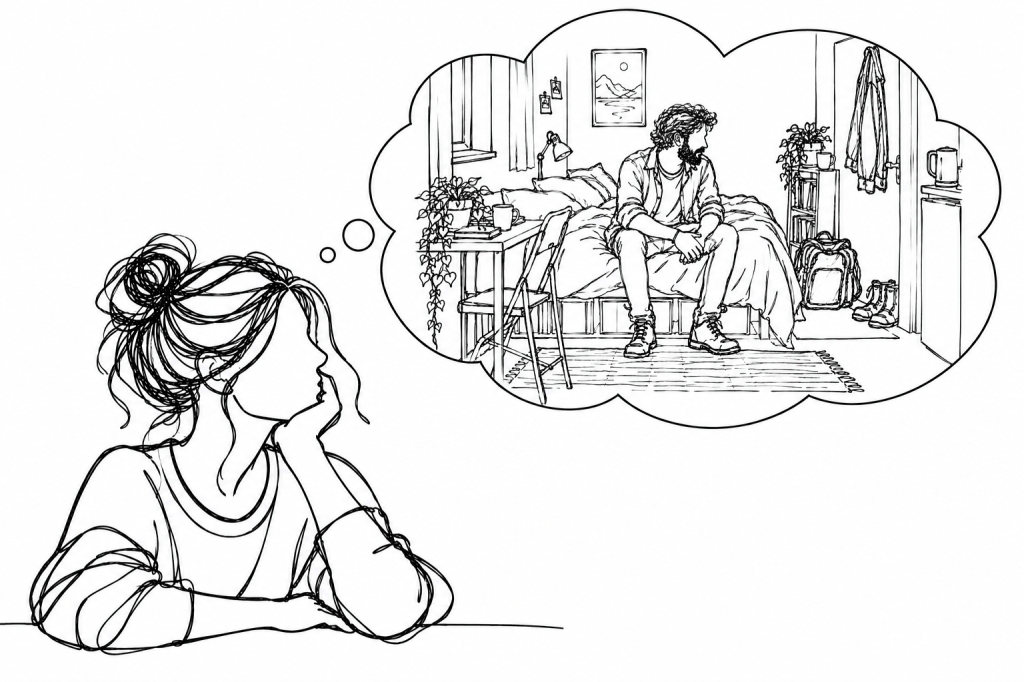
Looking back, I am struck by how clearly I could see one particular danger.
Stephen wanted to live with me.
I knew he’d moved quickly into a previous girlfriend’s home when his life had become difficult, and I could see that something remarkably similar might be developing between us.
So I stopped it.
That matters.
Once again, my instincts weren’t failing me.
I loved Stephen. I was increasingly concerned about him. I hated knowing how unhappy he was at his father’s house. But I also knew we’d barely begun our relationship and that allowing an unemployed man I’d known for such a short time to move into my home would be unwise.
So I created a condition.
Find a job first.
It was a boundary designed to protect both my independence and the pace of our relationship.
And Stephen accepted it.
The bedsit seemed like an encouraging alternative. He would have somewhere safe and private while also proving to himself, and perhaps to me, that he could establish some independence.
For a moment, it looked as though that was exactly what was happening.
Then came something I could never have anticipated.
A tiny lie.
I don’t excuse it because it was small. In fact, the reason I confessed almost immediately was that honesty mattered enormously to me. I didn’t want even something as inconsequential as pretending to have experienced something sexually that I hadn’t to become part of the way Stephen and I communicated.
So I told him the truth.
What happened next taught me something.
Not consciously.
Not all at once.
But powerfully.
Stephen experienced my admission very differently from the way I expected him to.
To me, the important part was that I’d corrected the dishonesty almost immediately because I wanted our relationship to be truthful.
To Stephen, the important part seemed to be that I had lied at all.
The distinction almost disappeared.
His reaction was so intense that I found myself trying desperately to make things right.
I apologised.
I explained.
I reassured.
And when his distress escalated later that night, I went to get him.
Once again, Stephen became overwhelmed and I responded by moving closer.
I still wonder what happened inside him that night.
Perhaps my admission touched something much older and more painful than the event itself. He explicitly connected it to experiences with his ex-wife, so perhaps dishonesty carried an emotional meaning for him that I couldn’t yet understand.
Given what I knew of his history and diagnosis, it’s also possible that something relatively small triggered feelings that became extraordinarily difficult for him to regulate.
But explanation and responsibility are different things.
That’s a distinction I hadn’t yet learned to make.
I could understand that Stephen’s reaction might have roots extending far beyond me.
What I couldn’t yet see was that this didn’t make me responsible for calming it.
At the time, however, his distress was happening directly in front of me.
And it was frightening.
The man I was falling in love with was crying, drinking, paranoid, confused and barely coherent.
Suddenly EUPD wasn’t a collection of letters Stephen had disclosed during an intimate conversation.
It was something I was experiencing beside him.
I didn’t know what was happening.
I didn’t know how serious it might become.
And I didn’t know what I was supposed to do.
So I did what came naturally.
I looked after him.
The episode eventually passed.
But something remained.
I never deliberately lied to Stephen again.
For years, I regarded that simply as evidence of how seriously I took honesty in our relationship.
Now I think there may have been something else happening too.
I had learned how costly dishonesty could be.
Psychologically, we learn remarkably quickly from intense emotional experiences. When one action is followed by an unexpectedly distressing consequence, we become motivated to avoid repeating the action.
I didn’t sit down the following morning and decide, I must manage Stephen’s emotions by never upsetting him.
Nothing so deliberate happened.
I simply knew that I never wanted to see him like that again.
Perhaps this was one of the first invisible rules I learned in our relationship.
Be completely honest with Stephen.
On its own, that sounds like an excellent rule.
But there was another lesson hiding underneath it.
Be careful what you do, because Stephen may experience it far more intensely than you expect.
That was more complicated.
Meanwhile, the bedsit was showing me something else.
My boundary had worked.
Stephen hadn’t moved into my home.
Yet somehow I was still increasingly involved in helping him cope with the consequences of living somewhere else.
He was lonely, so I stayed over.
He struggled to fill his days, so I suggested things he might do.
He was unhappy, so I worried.
He returned repeatedly to his father’s house, and I watched the independence I’d hoped he would build fail to take hold.
Again, none of those individual acts of care was unreasonable.
The pattern was what mattered.
Stephen’s discomfort increasingly generated activity in me.
If he was unhappy, I thought about how to make him happier.
If he was lonely, I considered how much time I could give him.
If something wasn’t working in his life, my mind naturally moved towards solutions.
Perhaps that felt reassuring to Stephen.
I imagine there was something comforting about having somebody who responded to his difficulties by moving towards him rather than away.
And perhaps, without either of us understanding it, we were strengthening the roles that had begun forming between us.
Stephen struggled.
I helped.
Stephen became overwhelmed.
I soothed.
The crisis passed.
We felt close again.
There is a concept in psychology called co-regulation. In healthy relationships, we naturally help one another settle when we’re distressed. A voice, a touch, someone’s presence or reassurance can help our nervous system return to calm.
There is nothing unhealthy about needing another person sometimes.
The difficulty comes when one person’s emotional regulation begins depending too heavily on the other, or when the other person begins feeling responsible for maintaining that stability.
We weren’t there yet.
But I can see the beginnings.
And then Stephen told me he was going to stay with his ex-girlfriend.
Immediately, something in me tightened.
Why two nights?
Why stay at all?
Why was she collecting him?
Why couldn’t he simply retrieve his belongings and come home?
Once again, my instincts produced questions.
And once again, I didn’t ignore them.
But another part of my identity entered the conversation.
I didn’t want to be controlling.
I didn’t want to be jealous.
I wanted to be the kind of partner who trusted.
That mattered enormously to me.
Perhaps because I believed secure love shouldn’t require policing another adult, I tried to distinguish between what I was feeling and what I could reasonably ask of him.
I couldn’t tell Stephen he wasn’t allowed to see his ex.
I didn’t want that kind of relationship.
So I reduced everything I was feeling to one boundary.
Don’t share her bed.
It was simple.
Specific.
And, to me, entirely reasonable.
Stephen didn’t hesitate.
He would sleep on the sofa.
That reassurance mattered because something important was about to be tested for the first time.
Until then, most of my doubts about Stephen had been answered with words.
He had told me he wanted me.
He had told me appearance wasn’t important.
He had told me about his diagnosis and his past.
He had explained his strange behaviour outside his father’s house.
And whenever there had been uncertainty, there had usually been an explanation I could understand.
But trust can’t ultimately be built from explanations.
At some point, words have to meet behaviour.
I didn’t need Stephen to avoid every situation that made me uncomfortable.
I didn’t need access to his phone or proof of where he was sleeping.
I didn’t want to supervise him.
I wanted something much simpler.
I wanted to be able to tell the man I loved what made me feel unsafe, hear him reassure me, and then discover that his actions matched what he’d promised.
Perhaps that was why the boundary about the bed mattered more than the bed itself.
I wasn’t really asking:
Where will you sleep?
I was asking:
When I tell you something matters to me, can I trust you to treat it as though it matters to you too?
Stephen said yes.
And I believed him.
Not because my instincts had gone quiet.
Because I was about to give him the opportunity to prove them wrong.


