
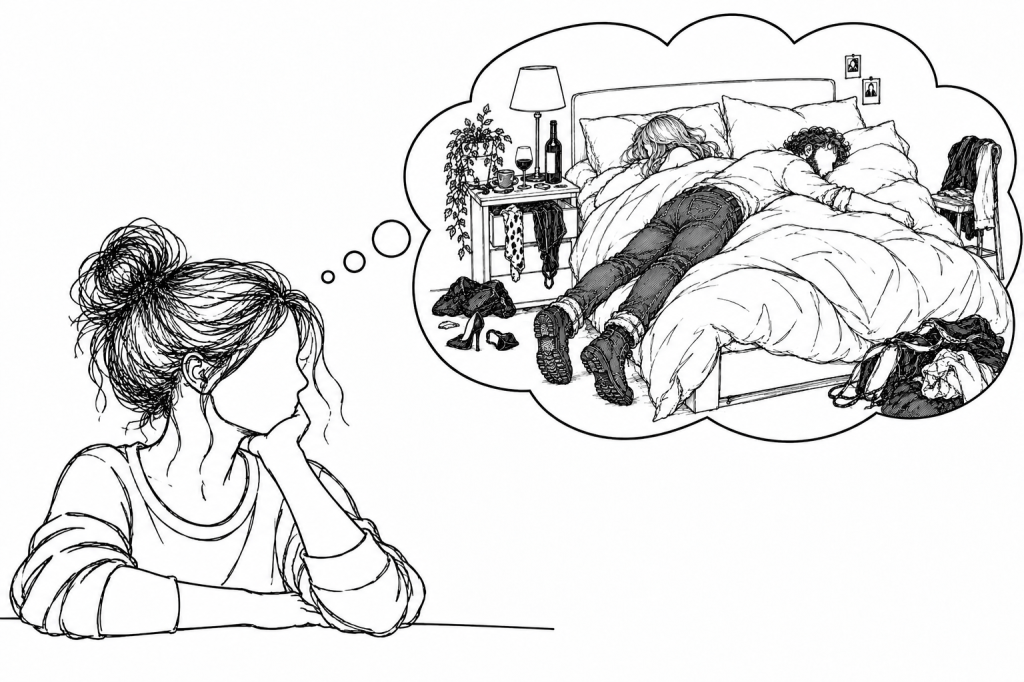
Until that night, my doubts about Stephen had mostly existed in the space between instinct and explanation.
Something would feel slightly wrong.
I would notice it.
I would question it.
Then more information would arrive and the feeling would settle.
This time, it didn’t.
What I remember most clearly about that night is the argument taking place inside my own head.
Stephen had disappeared.
That was a fact.
For almost three months, we’d been in constant contact, and on the one evening when I had specifically told him I felt uncomfortable, the pattern abruptly changed.
My instincts responded immediately.
Something isn’t right.
But I didn’t simply surrender to suspicion.
I challenged it.
His battery has probably died.
He’s busy.
You’re catastrophising.
Wait until you know what actually happened.
I was doing exactly what I believed a reasonable, emotionally mature person should do. I was separating feelings from facts. I was resisting the temptation to turn anxiety into accusation.
And then the following day, I discovered that the thing I’d been frightened of had actually happened.
Stephen had shared her bed.
That moment changed something in me.
Not because sharing a bed automatically meant something sexual had happened. I still didn’t know whether it had.
The deeper injury was that I had identified one particular situation that would make me feel unsafe, communicated it clearly, received an explicit promise — and then spent the night trying to persuade myself not to trust the very instinct that turned out to be correct.
I had told myself I was catastrophising.
I wasn’t.
At least not about the bed.
That distinction matters enormously to me now.
Because anxiety and intuition can feel remarkably similar from inside the body. Both can produce that tightening sensation, the racing thoughts, the feeling that something isn’t right.
The difficulty is knowing which one you’re experiencing.
And once you’ve mistakenly labelled an accurate perception as anxiety, something unsettling can happen to your relationship with yourself.
You become less certain which internal voice deserves your trust.
But there was another contradiction waiting for me.
Stephen told me the truth.
He could have said he’d slept on the sofa.
As far as I knew, there was nobody who could have contradicted him. Instead, when I asked him directly, he admitted he’d shared the bed.
That mattered to me.
It complicated everything.
If Stephen were simply a liar trying to deceive me, why tell me the one thing he knew would hurt me?
Perhaps his willingness to admit it meant the rest of his explanation was true.
Perhaps nothing sexual had happened.
Perhaps he really had been exhausted and overwhelmed.
Perhaps this was exactly what it looked like to love someone whose mind sometimes worked differently from mine.
I wanted to understand.
But understanding became remarkably difficult during our argument.
I wasn’t expecting perfection from Stephen. I wasn’t even demanding an explanation that made everything disappear.
I wanted accountability.
I promised you something. I broke that promise. I understand why that hurt you.
Had he been able to remain there with me, perhaps the rupture would have been easier to repair.
Instead, he seemed compelled to explain why his responsibility was smaller than I believed it was.
He’d been exhausted.
His head had gone.
His ex had taken him upstairs.
He hadn’t properly registered what was happening.
He couldn’t remember much.
He hadn’t consciously decided to betray me.
Perhaps all of that was genuinely how Stephen experienced the night.
I can’t know.
People under extreme emotional stress can experience impaired judgement, fragmented memory and states of overwhelm. Stephen also had a history and diagnosis that made me take the possibility seriously.
But even if his explanation was entirely accurate, another question remained.
What did that mean for being in a relationship with him?
If Stephen could become so overwhelmed that a promise made only hours earlier effectively disappeared, how was I supposed to know which promises I could rely upon?
That frightened me almost as much as the possibility that he was lying.
There seemed to be only two broad explanations.
Either Stephen had knowingly broken his promise and wasn’t being completely honest with me about why.
Or he genuinely could become so dysregulated that promises, boundaries and awareness of my feelings became temporarily inaccessible to him.
Neither possibility made me feel particularly safe.
And then I saw another Stephen.
He became angry.
Defensive.
Dismissive.
He told me I was blowing things out of proportion.
That was new.
Until then, I had known a man who seemed unusually attentive to my feelings. Now I was telling him I was hurt and somehow finding myself having to defend my right to be hurt.
Psychologically, defensiveness often appears when accepting responsibility threatens something we need to believe about ourselves. Shame can make accountability particularly difficult: if I did something hurtful is experienced internally as I am a terrible person, explaining, minimising or shifting responsibility can become a way of escaping an intolerable feeling.
I sometimes wonder whether something like that was happening for Stephen.
Perhaps admitting that he’d simply chosen the bed would have required him to see himself as someone who had knowingly betrayed a woman he believed he loved.
Perhaps the explanation protected him from that.
Or perhaps he was simply telling me exactly what happened.
I still don’t know.
What I do know is what happened to me while we argued.
I became increasingly certain that my boundary was reasonable.
So certain, in fact, that I ended the relationship.
That is important.
I didn’t discover that Stephen had broken his promise and immediately explain it away because I couldn’t bear to lose him.
My first response was to protect myself.
This isn’t acceptable.
I’m leaving.
Then something changed.
Stephen changed.
The anger disappeared and the vulnerable man returned.
He became tearful, overwhelmed and confused.
And almost immediately, something changed inside me too.
Anger had made separation possible.
His vulnerability made compassion return.
Suddenly I wasn’t only thinking about what Stephen had done to me.
I was thinking about what might be happening to Stephen.
His childhood.
His diagnosis.
His emotional instability.
His exhaustion.
His distress.
His history.
Perhaps I was expecting him to respond like somebody whose mind worked very differently from his.
Perhaps loving him meant learning that difference.
That thought opened the door I had just tried to close.
This is where compassion became complicated for me.
Empathy is the ability to step outside our own experience and imagine somebody else’s. It is one of the qualities I value most deeply.
But empathy has a vulnerability of its own.
If every hurtful behaviour can be understood through the pain of the person who caused it, the question can quietly shift from:
Was this acceptable to me?
to:
Did he have an understandable reason for doing it?
Those aren’t the same question.
I didn’t understand that yet.
So instead of deciding whether sharing the bed, disappearing and then dismissing my reaction were things I was willing to accept in a relationship, I became absorbed in understanding why Stephen might have behaved that way.
And because there were possible explanations, leaving became harder.
Then came four words I would remember for years.
Out of sight, out of mind.
I didn’t have a psychological framework for them.
I simply knew I didn’t like them.
They suggested something about Stephen’s experience of connection that felt profoundly different from mine.
When someone I loved wasn’t physically beside me, they didn’t disappear from my emotional world.
I carried them with me.
I thought about how my choices might affect them even when they weren’t there to witness those choices.
Was Stephen telling me that he experienced this differently?
Perhaps he only meant he’d become distracted.
Perhaps it was a throwaway remark.
Perhaps it revealed something more important about the way he held other people in mind when they weren’t immediately present.
At that stage, I had no way of knowing.
So I stored the words somewhere inside me.
Along with everything else I couldn’t yet explain.
And then the crisis ended.
This may be the most important part.
Stephen became loving again.
We laughed again.
We talked.
He was gentle and affectionate.
The relationship I thought I’d lost returned.
And the relief was enormous.
Psychologically, relief can be a remarkably powerful reinforcer. When distress is followed by warmth and reconnection, the return of safety can feel even more intense because of what immediately preceded it.
I wasn’t thinking about reinforcement.
I was thinking:
We’ve survived our first big argument.
Perhaps this was what relationships required.
People hurt one another.
They argued.
They learned.
They forgave.
And carried on.
That fitted perfectly with everything I already believed about love.
Except something had changed.
Before that night, trust had mostly been an assumption.
Afterwards, it became something I was watching.
I wanted to believe Stephen had understood.
I wanted to believe the boundary was now unmistakable.
I wanted to believe that because he had seen how deeply he’d hurt me, he would never put me in that position again.
But another part of me had learned something too.
Stephen was capable of reassuring me and then doing the thing he’d reassured me he wouldn’t do.
That knowledge couldn’t simply be argued away.
And perhaps that is where the quieter story of my instincts began to change.
Before this, when something felt wrong, I could usually reassure myself that there was probably an innocent explanation.
Now I had evidence that sometimes there wasn’t.
So I became more alert.
More watchful.
Not because I wanted to police Stephen.
Because something I had trusted had failed.
And yet, almost immediately, I was being encouraged to question whether my reaction to that failure was itself the problem.
When Stephen later suggested that perhaps I didn’t know how to truly love someone, the accusation reached somewhere particularly vulnerable in me.
Love was something I believed I was good at.
Patience.
Forgiveness.
Understanding.
Staying through difficulty.
These were qualities I was proud of.
So the suggestion that my inability to accept what had happened might represent a failure of love was deeply destabilising.
Perhaps loving Stephen really did require something different from me.
More understanding.
Less judgement.
Greater tolerance of his difficulties.
I didn’t yet realise how dangerous that question could become for someone like me.
Because if endurance could be interpreted as evidence of love, then leaving could begin to feel like evidence that I hadn’t loved enough.
I stayed.
Not because the broken promise stopped mattering.
Not because I suddenly believed every part of Stephen’s explanation.
And not because my instincts told me everything was fine.
I stayed because I loved him, because most of what we had was still wonderful, because I could see possible explanations for what had happened, and because I believed people should have the opportunity to learn from their mistakes.
That decision didn’t feel weak.
It felt compassionate.
Reasonable.
Hopeful.
Perhaps it was all three.
But something had entered the relationship that hadn’t been there before.
I had learned that Stephen could make me feel extraordinarily safe.
And I had learned that he could suddenly make me feel profoundly unsafe.
I didn’t yet understand what living between those two versions of the relationship might eventually do to me.
For now, I simply wanted the loving one back.
And when it returned, I was enormously relieved.


