
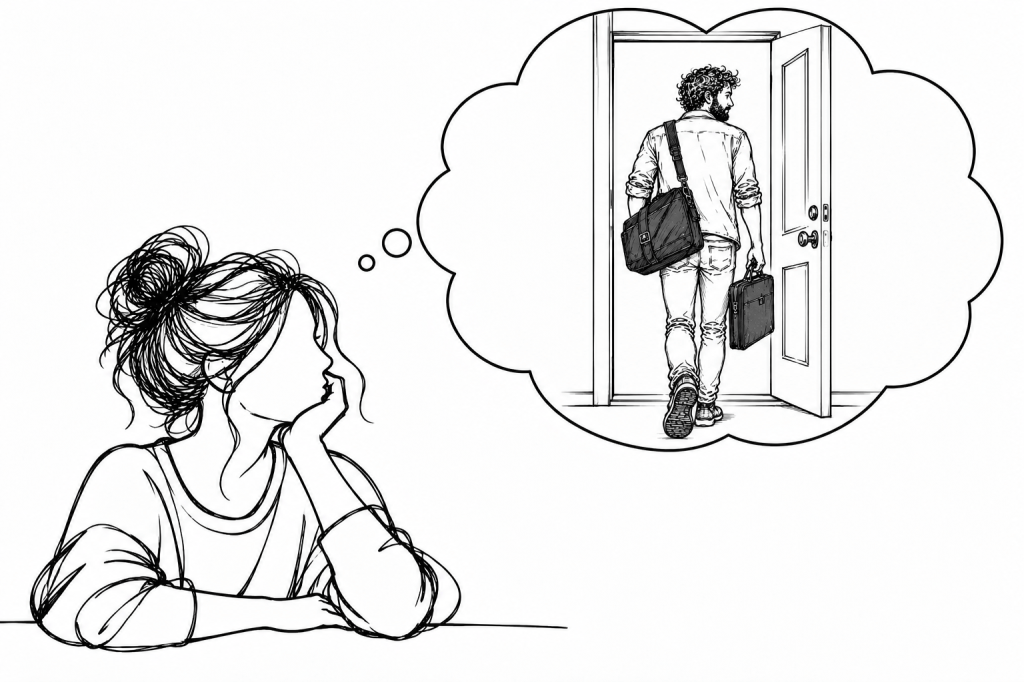
For six months, I had believed that greater stability would help Stephen become more settled.
A job.
A home.
Routine.
Purpose.
A loving relationship.
Those things seemed like answers.
And yet, once Stephen had them, he seemed to become more unsettled rather than less.
What is striking to me now is that this wasn’t something I only recognised with hindsight.
Even then, I was beginning to question whether Stephen’s unhappiness was really being caused by his circumstances.
When he told me that he thought whatever was troubling him might have something to do with work, I told him I didn’t think it was situational.
“It seems every time we remove what troubles you, you remain troubled by a new thing,” I said.
“I fear this may chase you the rest of your life.”
That is difficult to read back now.
Because somewhere inside me, I had already begun to understand something I wasn’t yet ready to fully accept.
Perhaps the instability wasn’t only around Stephen.
Perhaps some of it travelled with him.
Recognising that possibility, however, was very different from knowing what to do with it.
I was still enormously proud of him for getting the job.
On paper, it seemed to suit him. Stephen was socially confident, curious about people and capable of great compassion. I could imagine him being very good at work that involved talking to people and understanding difficult circumstances.
But applying for a job and sustaining one are very different things.
Some of the training may also have genuinely triggered painful memories for him.
When he told me he was struggling through a morning of training about domestic abuse, my instinct was to help him find a way through it. I encouraged him to think about the people he might eventually be able to help rather than allowing the subject to pull him backwards.
That was how I approached most difficulties with Stephen.
Understand the problem.
Find another way of looking at it.
Work out what might help.
Keep moving.
The difficulty was that I increasingly didn’t know how much of what I was seeing could reasonably be explained by trauma.
The smoking.
The restlessness.
Missing the beginnings of meetings.
Drinking whisky while working.
Disengaging from training.
Behaving almost adolescently when he was supposed to be working.
I didn’t know where trauma ended and responsibility began.
And because I knew what Stephen had been through, I sometimes became uncertain about how far I was entitled to challenge him.
Not because I stopped challenging him.
I didn’t.
But challenging someone becomes complicated when you are simultaneously wondering whether the behaviour upsetting you might be a symptom of something painful.
Empathy can make judgement surprisingly difficult.
The pub bothered me for a similar reason.
Going for a drink after work is hardly suspicious behaviour.
But Stephen had already told me a story about another period of his life in which going to the pub had been part of avoiding going home.
So when he did something similar after moving in with me, my brain connected the two things.
That was increasingly how my mind worked.
The night at his ex’s.
The broken promise.
My aunt.
The stories about his marriage.
The pub.
J.
Each new detail arrived carrying all the ones that had come before it.
Once trust has been damaged, very little arrives alone.
Sometimes my mind was joining dots that didn’t need joining.
Sometimes it was noticing something accurately.
The problem was that I couldn’t tell which was happening.
Even when my instincts told me something was wrong, instinct could only take me so far. It could make me ask questions. It could make me notice changes. It could tell me that an explanation didn’t quite fit.
It couldn’t give me information I didn’t have.
Collecting Stephen from work is probably one of the clearest examples of how my role in the relationship was beginning to change.
Initially, it was ordinary care.
I had deliberately arranged time off partly so that I could help settle him into our home and his new job.
Stephen himself had told me how much easier life felt when we were together.
“With you…… Even the mundane feels nice. Hard things are easy. Good things are great!”
I believed him.
And I liked making life easier for him.
So collecting him meant seeing him sooner, saving him a bus journey and helping establish the life we had planned.
Then another motive crept in.
If I collected him, he couldn’t stop at the pub.
That is such a small shift, but I think it matters.
Care had begun to mix with anxiety.
I didn’t want to be a suspicious girlfriend.
But I didn’t want to become a managing girlfriend either.
What I really wanted was a third option.
A partner whose behaviour made neither role necessary.
J created another version of the same problem.
Stephen told me she was his type.
Part of me was reassured by that openness.
Surely someone intending to do something inappropriate wouldn’t tell his girlfriend that he found another woman attractive?
I repeatedly returned to that kind of reasoning.
At least he’s telling me.
And disclosure can be a form of honesty.
But I would eventually learn that disclosure doesn’t automatically make a situation safe.
Someone can tell you that they find another person attractive and still struggle with what they do with that attraction.
Women were beginning to appear in our conversations more often.
J.
Women walking around town.
My son’s girlfriend.
Any one of those things in isolation might have meant very little.
Together, they created a feeling that Stephen was unusually preoccupied with female attractiveness.
I didn’t expect him to stop looking at women.
I didn’t expect attraction to disappear because he loved me.
I expected him to know what to do with it.
Instead, I sometimes found myself explaining boundaries that felt instinctive to me.
Don’t stare.
Don’t make somebody uncomfortable.
My son’s girlfriend belongs in a completely different mental category.
Make sure a young woman living in our home feels safe.
The fact that I quietly checked with her matters to me now.
She told me Stephen had never done anything to make her uncomfortable, and I believed her.
But I had reached a point where I felt the need to ask.
My concern was beginning to extend beyond protecting my relationship.
I was checking the environment around it too.
And still, I loved him enormously.
That is important.
I wasn’t standing outside the relationship clinically assessing Stephen’s behaviour.
I was waking up beside the man I loved.
I was attracted to him.
We laughed.
We cooked dinner.
We went shopping.
We watched television.
We made plans.
We had sex.
There were countless ordinary moments in which nothing was wrong.
And then something would happen that unsettled me again.
Love and alarm were beginning to coexist more regularly.
I think that is where hypervigilance really begins.
Not simply in noticing danger, but in the exhausting process of continually trying to decide whether something is dangerous at all.
Is this normal?
Is this his mental health?
Is this trauma?
Is he immature?
Should I challenge it?
Am I being controlling?
Am I overreacting?
Or am I seeing something important?
Those questions are exhausting when you ask them often enough.
There may have been many things happening for Stephen at once.
Perhaps the demands of a full-time job were harder for him to sustain than getting the job had been.
Perhaps living together changed our relationship from something exciting and episodic into something ordinary and accountable.
Perhaps emerging from lockdown into colleagues, offices and social freedom provided a kind of stimulation he hadn’t experienced for a long time.
Perhaps it was several things at once.
I don’t know.
What I do know is that the stable version of Stephen I had expected to emerge once his circumstances improved wasn’t appearing.
And the unsettling thing is that I had already begun to recognise that at the time.
I had told him myself that I didn’t think it was situational.
But recognising a pattern and accepting its implications are two very different things.
If circumstances were the problem, then circumstances could be changed.
A better home.
A better routine.
A different way of approaching work.
More support.
More understanding.
There was always something we could do.
If the problem was something Stephen himself needed to understand and manage, however, then there were limits to what I could change for him.
I wasn’t ready to accept those limits.
Especially because Stephen himself had given me reason to believe that my presence made a difference.
He had told me that hard things were easier with me.
That the mundane felt nice.
That being together made life more achievable.
Those were beautiful things to hear from someone I loved.
But they also reinforced an idea that was becoming increasingly important in our relationship:
If I could help create the right environment — stable enough, supportive enough, calm enough — perhaps Stephen would be okay.
So I kept trying.
Encouraging.
Collecting.
Reasoning.
Making suggestions.
Setting boundaries.
Watching.
Keeping the plan moving.
And slowly, without really noticing it, the ordinary domestic life I had wanted so badly was becoming remarkably unordinary.
By the time Stephen was preparing to go to the Lake District with his father and sons, I was looking forward to the house being quiet.
I would miss him.
I loved him.
But I wanted a few days in which I didn’t have to watch, interpret, encourage, question or wonder.
Perhaps that was the first faint understanding that loving Stephen could also be exhausting.
But I didn’t interpret my exhaustion as a reason to leave.
I interpreted it as evidence that we needed a reset.
A holiday.
Some space.
A clear head.
Then perhaps the man I had fallen in love with would come back.
I still believed he was in there.
I didn’t yet understand that I was beginning to organise my hope around the return of a version of Stephen I had already known.
And each time he returned, even briefly, it reassured me that waiting for him had been worthwhile.


