
Before Stephen left for the Lake District, we went to the cinema together for the first time since Covid restrictions had been lifted.
We saw Black Widow.
At the time, it was simply another exciting thing we could finally do together after months of restrictions. I didn’t know that going to the cinema would become one of the great shared pleasures of our relationship.
Films became more than something we watched together.
They became a language of our own.
We would talk about performances, characters, cinematography and stories long after the credits had rolled. We’d recommend things to each other, discover old films one of us had somehow missed, get excited about new releases and endlessly discuss what we’d seen.
It became a source of connection and shared joy that would last throughout our relationship.
Then Stephen returned to his father’s house in preparation for the annual Lake District holiday with his sons.
I knew I was going to miss him terribly.
His birthday would fall while he was away too, and I felt sad that I wouldn’t be there to celebrate it with him.
But if I’m truthful, I also welcomed the break.
The previous few weeks had been stressful. I’d watched Stephen become increasingly agitated and disengaged from his new job, while conversations about other women had begun appearing with uncomfortable regularity.
I hoped some time away would do him good.
Perhaps he’d come back rested and return to his training with fresh eyes.
I could probably do with some breathing space too.
Stephen’s return from the Lake District would mark the beginning of a string of gatherings and events that Covid had postponed or threatened for so long.
And we were going to begin with something spectacular.
My boss was celebrating her fiftieth birthday at Claridge’s in London with a Roaring Twenties theme.
Think The Great Gatsby.
We were invited.
Better still, we were staying overnight at Claridge’s.
Stephen needed to cut his Lake District holiday short by a day, but he didn’t mind. Neither of us wanted him to miss such an extraordinary occasion.
Looking back, I realise that during our first six months together, Stephen and I had existed largely inside our own little bubble.
Lockdown had meant relatively few parties, gatherings or social events. I’d introduced him to some family, of course, but I hadn’t really seen much of Stephen in large social situations or surrounded by strangers.
Now I would.
We had our outfits organised and headed into London.
Before checking into the hotel, I took Stephen somewhere in Soho that I knew he’d love — a place filled with interactive automata.
I was right.
He was fascinated.
And watching him explore everything reminded me of another quality I’d fallen in love with.
Stephen could embrace an experience with his whole heart.
Take him somewhere interesting and he wanted to know everything. Show him something unusual and his curiosity lit up. He didn’t stand on the sidelines pretending to be too cool to participate.
He joined in.
His enthusiasm was infectious.
Going somewhere with Stephen could make the experience itself feel bigger, and it was an absolute pleasure sharing those moments with him.
That afternoon, we arrived at Claridge’s and got ready.
I put on my long beaded evening dress, added a feathered hairpiece and bravely inserted contact lenses for only the second time in my life.
Stephen wore a black suit, bow tie and a fabulous hat.
We looked fantastic.
As we queued to enter the celebration, each couple was professionally photographed.
I love the photograph of us from that night.
We look exactly as we were.
A happy couple, dressed beautifully, excited to be somewhere extraordinary together.
The party itself was magnificent.
There were around a hundred guests, including celebrities and dignitaries, everyone dressed in their finest twenties-inspired clothes.
And Stephen handled the environment beautifully.
He showed interest without being overawed. He was enthusiastic without being inappropriate. He seemed completely comfortable talking to people from very different backgrounds.
I remember admiring him.
This was one of the reasons I’d always been so proud to introduce Stephen to people.
He could walk into almost any room and find somebody to talk to.
We ate a wonderful three-course meal and drank cocktails.
And, because Stephen was a heavy smoker and I was smoking considerably more than I had since my twenties, we spent an embarrassing amount of the evening outside.
Smokers’ corner at Claridge’s was quite a sight.
There we’d all be, dressed to the nines in evening gowns, suits, feathers and bow ties, huddled outside puffing away.
There is something oddly democratic about a smoking area.
Status seems to disappear.
Wealth becomes irrelevant.
Everybody just wants a light.
Some of the funniest, deepest and most honest conversations Stephen and I ever had with complete strangers began over cigarettes.
I wished neither of us smoked.
But I loved those moments with him.
We spoke to all sorts of people that evening, including some very attractive and interesting women.
And I was comfortable.
In fact, I noticed that Stephen seemed to have taken on board some of what we’d discussed after the incident with my aunt.
He included me.
He didn’t become completely absorbed in another woman and forget I was there.
He was warm, interested and charming, but I still felt connected to him while he was doing it.
I noticed the difference.
And it reassured me.
Then a much younger woman joined us outside.
She was probably in her early twenties.
Almost immediately, I detected subtle changes in Stephen.
Nothing dramatic.
His attention sharpened.
His gaze lingered.
There was a slight nervousness about him, almost a shyness he seemed to be trying to conceal.
He became very interested in her very quickly.
And she appeared interested in him too.
These were tiny signals.
But by now I was noticing them.
Eventually, we all returned to the party.
After dinner, we were treated to a spectacular burlesque performance.
The dancers were extraordinary — beautiful, athletic women in elaborate costumes performing incredibly polished routines.
I was completely comfortable with Stephen enjoying it.
Why wouldn’t I be?
He was a sexual man.
The women were gorgeous.
I had eyes too.
My mother had always been wonderfully relaxed about this sort of thing. If an attractive, scantily dressed woman appeared on television, she’d practically call my father into the room to make sure he didn’t miss it.
I’d inherited some of that attitude.
I didn’t want a relationship in which either of us had to pretend we’d stopped noticing attractive people.
Harmless sexual appreciation didn’t threaten me.
What troubled me was something quite different.
It was when attraction entered an actual interaction.
When attention became personal.
When sexual energy seemed reciprocal.
When I started to feel excluded from something happening directly in front of me.
That distinction was becoming increasingly important.
After the entertainment, the disco started.
I love dancing.
Stephen, surprisingly, didn’t enjoy dancing publicly.
This always amused me because in the privacy of my bedroom he could dance for me with absolutely no inhibition — and he had moves.
Those spontaneous little performances were some of my favourite moments with him.
But that night, I danced alone.
We’d only recently returned from another cigarette break when I headed onto the dance floor.
Before the first song had even finished, I glanced back towards our table.
Stephen was gone.
Surely he hasn’t gone outside for another cigarette already?
And then:
Why didn’t he wait for me?
I left the dance floor and headed towards the vestibule leading to the street.
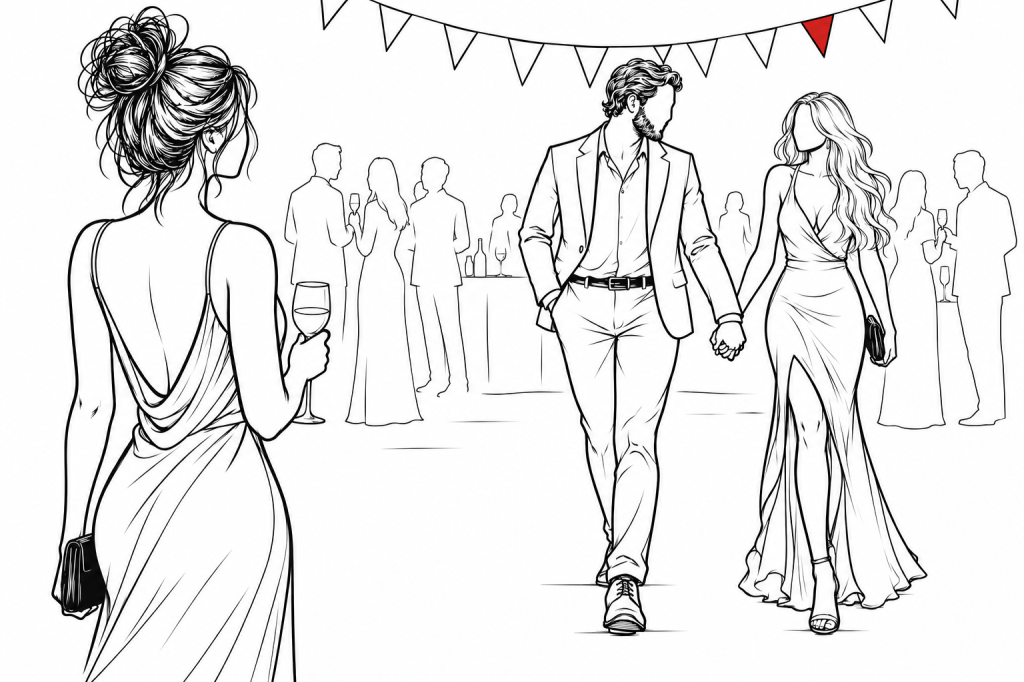
Halfway there, moving through the crowd, I saw Stephen coming towards me.
He wasn’t alone.
He was walking back into the hotel holding hands with the young woman we’d spoken to earlier.
My stomach dropped.
Perhaps in another relationship, or at another point in my life, I might not have reacted so quickly.
But there was already history.
The night with his ex.
The flirting with my aunt.
The stories about his marriage.
The increasingly frequent conversations about women.
And now this.
Then Stephen saw me.
And immediately dropped her hand.
That tiny movement changed everything for me.
Had he simply continued walking towards me with her hand in his and said, She’s had too much to drink, I’m helping her inside, perhaps I would have thought very little of it.
But he let go the instant our eyes met.
My suspicion ignited.
The young woman continued walking in the opposite direction while Stephen approached me.
I couldn’t hide my expression.
“What’s going on? Why did you leave? Why were you holding her hand?”
Stephen explained that she’d become unsteady after drinking and he’d been helping her safely back inside.
It was entirely possible.
But my mind was already interrogating the story.
She hadn’t seemed particularly drunk when we’d spoken to her only a short while earlier.
There were always plenty of people outside, so how had Stephen become the person responsible for bringing her back?
Why had he returned outside so quickly?
Why had he held her hand rather than simply walking beside her?
Why had he dropped it the moment he saw me?
And if she genuinely needed physical support, why was she suddenly capable of walking away perfectly well without it?
Perhaps there were innocent answers to every one of those questions.
That was the problem.
I didn’t know anymore.
I hated how suspicious I sounded.
I’ve never wanted to be the jealous girlfriend.
Quite the opposite.
I’d always taken pride in being relaxed and trusting in relationships.
I didn’t want to monitor a man’s eyes.
I didn’t want to analyse body language.
I didn’t want to interrogate innocent interactions between my boyfriend and other women.
Yet here I was doing exactly that.
And I couldn’t work out whether Stephen was giving me reasons to become suspicious or whether the previous incidents had simply made me hypersensitive.
Maybe he’d done nothing wrong.
Maybe he’d just helped a drunk young woman.
But I couldn’t unsee him dropping her hand when he saw me.
The incident soured the evening slightly, but I didn’t want it to ruin such a wonderful occasion.
So for the time being, I let it go.
We carried on enjoying ourselves.
When the main party finished, we were invited to a private afterparty in one of the hotel’s smaller bars.
Assuming the drinks were still complimentary, I ordered a gin and tonic and Stephen had a double whisky.
Then we finally returned to our room.
Under different circumstances, we might have had an enormous argument.
Instead, I encountered a more immediate crisis.
My contact lenses.
At three o’clock in the morning, after hours in a smoky environment, my eyes were painfully dry and I couldn’t get them out.
Stephen fell asleep while I battled with them.
Eventually, I managed to remove one.
The other tore in half.
Part of it remained stuck to my eyeball.
After what felt like an eternity of poking at a bloodshot, streaming eye, I admitted defeat and crawled into bed.
The following morning, I looked dreadful.
My eyes were red, swollen and watering.
Then, at checkout, came another surprise.
Apparently, the afterparty bar hadn’t been free after all.
That gin and tonic and double whisky had cost me somewhere in the region of £110.
At that point, I could only laugh.
We left one of London’s finest hotels and headed straight for the nearest optician, where I needed somebody to remove the remaining piece of contact lens from my eye so that I could see well enough to drive us home.
It was an absurd ending to an extraordinary couple of days.
And despite the incident with the young woman, much of the experience had been wonderful.
I’d watched Stephen embrace London, the automata, the hotel, the people, the food, the entertainment and the sheer spectacle of it all with the infectious enthusiasm I adored in him.
We had looked wonderful together.
We had laughed.
We had connected with strangers.
We had made another memory.
But there was now a familiar interruption inside all that happiness.
A tiny moment I couldn’t quite put away.
I had seen Stephen holding another woman’s hand.
Maybe his explanation was completely innocent.
Maybe I was becoming too suspicious.
But increasingly, that was the problem.
I was no longer sure whether my mistrust was something I needed to fix in myself, or something Stephen’s behaviour was teaching me to feel.


