
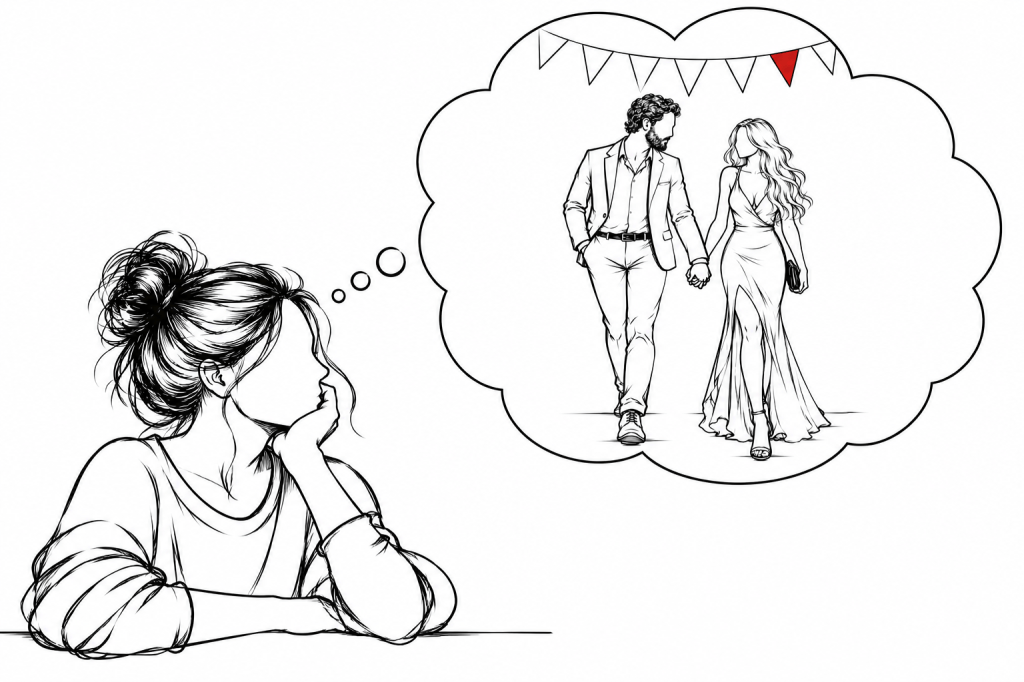
Claridge’s should have reassured me.
In many ways, it did.
I had been slightly apprehensive about seeing Stephen in such a large social environment for the first time. Until then, Covid had kept much of our relationship contained within homes, cars, walks and small gatherings.
Now I was watching him in a room filled with strangers.
And I loved what I saw.
Stephen was completely himself.
Curious.
Enthusiastic.
Socially fearless.
He could talk to somebody wealthy or important without becoming intimidated, and to somebody completely ordinary without becoming less interested. He seemed genuinely fascinated by people rather than their status.
It was one of his loveliest qualities.
It also reminded me why introducing him to people made me so proud.
And something else happened that evening that mattered enormously.
There were attractive women everywhere.
Stephen spoke to some of them.
And I was fine.
More than fine.
I noticed that he seemed to have understood what I’d tried to explain after the evening with my aunt.
He included me.
His attention moved between people naturally.
He could be charming without making me feel displaced by his charm.
I remained connected to him.
That reassured me because it appeared to confirm something I desperately wanted to believe.
We can learn from each other.
Perhaps what had happened with my aunt really had been a misunderstanding.
Perhaps Stephen genuinely hadn’t understood how his behaviour had appeared from the outside.
I’d explained it.
He’d listened.
And now his behaviour was different.
That mattered.
It supported the idea that difficulties between us didn’t necessarily reveal some terrible incompatibility.
Sometimes people simply needed to communicate.
That was exactly how I wanted relationships to work.
Then the young woman appeared.
I noticed Stephen’s response almost immediately.
His attention sharpened.
There was something slightly nervous and self-conscious about him that I hadn’t seen with the other women we’d spoken to.
I registered it.
But I didn’t make anything of it.
That’s important.
I didn’t drag Stephen away.
I didn’t become territorial.
I didn’t sulk.
I didn’t tell him he wasn’t allowed to talk to her.
I noticed something and carried on enjoying my evening.
Because I wasn’t frightened of attraction itself.
I understood that Stephen would continue finding other women attractive.
I would continue finding other men attractive.
A relationship doesn’t remove your eyes, your sexuality or your capacity to respond to another human being.
For me, loyalty wasn’t about pretending those responses didn’t exist.
It was about what happened next.
And later that evening, I saw something happen.
Stephen walked towards me holding her hand.
Even now, I can’t say with certainty what that meant.
His explanation was entirely plausible.
She’d been drinking.
She was unsteady.
He was helping her.
Maybe that is exactly what happened.
Perhaps if I could replay those minutes from somewhere above the hotel, I would watch the whole thing and discover there was absolutely nothing suspicious about it.
But there was one movement I couldn’t explain away quite so easily.
Stephen saw me.
And dropped her hand.
It was instantaneous.
That interested me more than the hand-holding itself.
Because human beings communicate enormous amounts of information through tiny automatic movements.
We withdraw a hand.
Change a facial expression.
Move away from someone.
Hide a screen.
Alter our voice.
None of those behaviours proves wrongdoing.
But sometimes they tell us that the person themselves understands that what we’re seeing might require an explanation.
Was that what happened?
Did Stephen suddenly realise how the situation would look to me?
Was he embarrassed by an entirely innocent gesture because he remembered our previous conversations?
Or did he let go because there had been something in the interaction he didn’t want me to see?
I couldn’t know.
And once again, not knowing became the problem.
Because this incident didn’t arrive in isolation.
If I’d met Stephen a week earlier and seen him helping a drunk woman into a hotel, perhaps I would have accepted the explanation without another thought.
But I wasn’t that woman anymore.
I had already spent a night unable to contact him while he was staying with an ex.
I’d already discovered that the promise I was trying to reassure myself he would keep had been broken.
I’d watched him become absorbed in my aunt and then tell me he didn’t know how to flirt.
I’d heard about infidelity during his marriage.
I’d listened to him describe the rule he’d needed to stop himself crossing a sexual line.
I’d heard him tell me that J was his type.
Every new piece of information was now landing on top of something else.
My brain was building a pattern.
The problem was that I couldn’t tell whether the pattern existed in Stephen’s behaviour or only in my increasingly anxious interpretation of it.
That distinction tormented me.
I didn’t want to become jealous.
Jealousy felt ugly to me.
Possessive.
Controlling.
Insecure.
I had always thought of myself as relaxed in relationships, and I liked that about myself.
I wanted Stephen to have female friends.
I wanted him to enjoy conversations with women.
I wanted us to be able to admire attractive people together and laugh about it.
I didn’t want to spend my relationship monitoring where his eyes went.
So whenever suspicion appeared, another part of me immediately turned the scrutiny back on myself.
Are you becoming insecure?
Are you overreacting?
Has what happened before made you hypersensitive?
Is Stephen actually doing anything wrong?
Increasingly, there were two investigations taking place at once.
I was watching Stephen.
And I was watching myself watching Stephen.
That is exhausting.
Hypervigilance can develop when the nervous system learns that safety isn’t completely predictable. Once something unexpected has happened, the brain becomes more sensitive to small changes that might help it predict the next threat.
But there was a complication in my case.
Some of the things I was noticing were real.
Stephen really had shared his ex’s bed.
He really had become absorbed in my aunt.
He really had told me about previous infidelity.
He really had told me J was his type.
And now he really had been holding another woman’s hand.
The uncertainty lay in what those facts meant.
My instincts were collecting information.
My conscious mind was trying desperately not to draw an unfair conclusion from it.
Perhaps that was why I could still enjoy the evening.
And I genuinely did.
This wasn’t a terrible night retrospectively disguised as a happy one.
It was wonderful.
We looked fantastic.
We laughed.
We met fascinating people.
We smoked far too many cigarettes.
We watched extraordinary entertainment.
We stayed at Claridge’s.
Then I spent half the night apparently attempting to remove my own eyeball before discovering I’d accidentally spent an obscene amount of money on two drinks.
Those memories still make me smile.
Stephen’s joy was real too.
His enthusiasm for experiences was one of the things that made being with him so much fun.
I don’t want what happened later to steal that from either of us.
This is one of the strange things about looking back at a complicated relationship.
We sometimes imagine that once we understand the painful parts, the happy memories must somehow become false.
I don’t believe that.
I was happy that night.
Stephen and I were good together that night.
And somewhere inside that genuinely wonderful experience was one small moment that frightened me.
Both things can be true.
Perhaps that was becoming characteristic of our relationship.
Joy wasn’t being replaced by unease.
Unease was beginning to live alongside joy.
And because the joy was so substantial, the uneasy moments remained comparatively small.
Why would I throw away everything we had because Stephen had held someone’s hand?
Especially when there was an innocent explanation.
So I let it go.
But letting something go isn’t necessarily the same as forgetting it.
My nervous system seemed to be keeping its own record.
Each unexplained moment joined the others.
Not enough to produce certainty.
Just enough to make me watch a little more closely next time.
And perhaps Stephen was learning something too.
I don’t know what.
Maybe there really was nothing more for him to learn from that encounter than that an innocent act could upset me.
Perhaps he thought my increasing sensitivity around women was becoming unreasonable.
Perhaps he was beginning to feel watched.
Or perhaps he knew there had been a little more electricity in that interaction than he was admitting, even to himself.
I can’t enter his mind and settle that question.
What I can see is what was happening inside mine.
I was beginning to lose the freedom of simply experiencing Stephen.
Increasingly, I was interpreting him.
A glance could mean something.
A disappearance could mean something.
A hand suddenly released could mean something.
And because I loved him, I didn’t want any of those things to mean what I feared they might.
So I kept searching for the interpretation that allowed trust to survive.
For the moment, I could still find one.
He had been helping her.
He had told me what happened.
Nothing else had occurred that I knew about.
We’d had a wonderful evening.
There was no reason to turn it into something it wasn’t.
And perhaps I was becoming too suspicious.
That explanation allowed me to put the incident down.
But somewhere underneath my conscious reasoning, another lesson was being absorbed.
The first time my instincts had frightened me, I’d told myself I was catastrophising.
Then I discovered Stephen had shared his ex’s bed.
Now my instincts were speaking again.
I didn’t know whether to listen to them.
And increasingly, I didn’t know whether the greater danger was mistrusting Stephen when he’d done nothing wrong…
or mistrusting myself when he had.


