
For months, I had been collecting fragments.
A broken promise.
A night of silence.
My aunt.
The stories from Stephen’s marriage.
The rule about cheating.
J.
Women in town.
A hand suddenly released when he saw me.
None of those things had given me certainty.
They had given me questions.
And because I loved Stephen, because so much of our relationship was extraordinarily happy, and because there was usually another possible explanation, I had continued living in the space between suspicion and proof.
Then Stephen told me he had been suspended from work following complaints involving two women.
Something changed.
Until then, almost everything troubling me had existed inside our relationship.
I was the person noticing.
I was the person questioning.
And increasingly, I was also the person wondering whether the problem might be me.
Had the broken promise involving his ex damaged my trust?
Was I becoming hypervigilant?
Was I connecting incidents that had nothing to do with one another?
Was I becoming jealous?
Was I interpreting ordinary friendliness as flirtation because I was frightened of being hurt again?
Then two women I barely knew stepped into the story.
They had experienced something too.
That was both validating and devastating.
There is a peculiar kind of relief in discovering that something you feared wasn’t entirely in your imagination.
But it isn’t a comforting relief.
It is the relief of discovering you may have been right about something you desperately wanted to be wrong about.
And then Stephen handed me his phone.
That changed things again.
Because I no longer had to choose between his interpretation and mine.
The messages existed.
I could read them.
What I found was more complicated than a man who had simply failed to understand that he was flirting.
Stephen knew there were boundaries.
He and H actually discussed them.
He referred to “casual flirting” himself.
He acknowledged that she was a young, attractive woman.
He knew she was twenty-two and that he was almost twice her age.
He told her that he couldn’t get her out of his mind.
He told her that if he were single and available, from his side there would not be a line.
And eventually, when H challenged the direction their conversation had taken, Stephen acknowledged it himself.
“I need to check my own emotions and behaviour.”
“I should have been more aware of boundaries.”
“I got a bit carried away.”
Those words mattered.
They made it much harder to understand what had happened simply as social clumsiness or an innocent misunderstanding.
I still couldn’t know exactly what Stephen had wanted from H.
Perhaps he hadn’t known himself.
Attraction, curiosity, excitement, validation and emotional stimulation may all have become tangled together.
I cannot retrospectively climb inside his mind and separate them.
But I no longer needed to know his precise intention in order to judge the behaviour.
That distinction was becoming important.
For so long, I had been trying to understand why Stephen did things.
Perhaps if I understood the mechanism, I thought, I could determine how seriously to take the behaviour.
But intention and effect are not the same thing.
Nor does understanding why somebody does something make the consequences disappear.
I could have compassion for whatever was happening inside Stephen and still decide that what he had done was unacceptable to me.
Perhaps the most extraordinary discovery, though, wasn’t any particular flirtatious message.
It was a date.
9 July.
I had lived that evening once already.
I remembered Stephen seeming troubled.
I remembered trying to understand what was wrong.
He had suggested that perhaps it was work.
I had told him I didn’t think it was situational.
“It seems every time we remove what troubles you, you remain troubled by a new thing.”
“I fear this may chase you the rest of your life.”
Then he told me:
“I am so confused.”
And when he stopped responding to me while remaining online, something inside me had reacted.
“Are you talking to someone else?”
“You’re staying online but not responding.”
I had no evidence.
I didn’t know about H.
I didn’t know what was happening in another WhatsApp conversation.
I just knew that something felt wrong.
Now, weeks later, I could finally see the part of that evening that had been invisible to me.
He had been talking to someone else.
He had been talking to H.
And while I was trying to understand Stephen’s strange mood, H was confronting him about comments that had made her uncomfortable.
Stephen was acknowledging to her that he needed to examine his behaviour and that he had become carried away.
The answer to the question I had asked had existed all along.
I simply hadn’t been allowed to see it.
That feels important to me now because for years afterwards I would struggle with the distinction between intuition and anxiety.
Both can feel remarkably similar in the body.
Both can make your heart race.
Both can make you search for meaning in tiny changes of behaviour.
Both can whisper that something is wrong.
And sometimes anxiety does create stories where there are none.
But sometimes the nervous system is responding to information the conscious mind hasn’t yet assembled.
A change in attention.
A delay in a response.
A slight withdrawal.
A shift in energy.
Something familiar behaving differently.
I don’t think that means I possessed some mystical ability to know Stephen was talking to another woman.
I didn’t.
I knew something without knowing what I knew.
There is a difference.
My instincts had detected the disturbance.
They could not supply the missing information.
And that distinction matters enormously when I look back at the woman I was becoming.
I wasn’t losing my mind.
I was trying to make sense of a reality from which relevant information was repeatedly missing.
There was another painful discovery in those messages too.
During the same period that Stephen’s attention was becoming increasingly focused on H, I had been trying harder and harder to settle him.
I had worried about the training.
I had encouraged him through difficult subjects.
I had come home at lunchtime.
I had tried to make our home comfortable.
I had tried to keep our emotional connection strong.
I had even thought about our sexual relationship partly in terms of helping to satisfy and settle him.
There was an assumption underneath some of that which I don’t think I fully recognised at the time.
If Stephen was happy enough with me, perhaps he wouldn’t need to look elsewhere.
If our sex life was satisfying enough.
If home was peaceful enough.
If I was supportive enough.
If he felt understood enough.
If I could help him regulate whatever restlessness was driving him.
Perhaps then he would settle.
But while I was trying to provide those things, he was still becoming preoccupied with somebody else.
That should not be interpreted as evidence that I failed.
It was evidence that my theory was wrong.
I could influence the quality of our relationship.
I could not regulate Stephen into fidelity.
That was his responsibility.
Interestingly, I was already beginning to understand that in 2021.
When Stephen explained that he tended to seek interesting, flirtatious interactions when he was bored or unhappy, I didn’t simply reassure him.
I told him:
“You will be bored and unhappy again.”
That was remarkably important.
Because I had identified the flaw in an explanation based entirely on circumstances.
There would always be another difficult day.
Another boring job.
Another period of low mood.
Another attractive woman.
Another interesting conversation.
Another opportunity to feel noticed.
A relationship could not be safe if Stephen’s loyalty depended upon never being bored, unhappy, insecure or stimulated by somebody new.
He needed another way of managing those feelings.
And I told him so.
When I was bored, I learned Danish or played Overcooked.
I didn’t create flirtatious intimacy with other men.
The solution, I told him, was to find ways of making himself happy and regaining control of his own life rather than escaping those feelings in ways that could make his life worse.
Reading that now, I am struck by how much I already understood.
There is a temptation, knowing everything that happened later, to imagine the woman I was then as somebody who simply couldn’t see what was happening.
But I could see a great deal.
What I couldn’t know was whether Stephen would do anything meaningful with what I was telling him.
That was the unknown.
And Stephen gave me reasons to believe he would.
He acknowledged that his behaviour had been inappropriate and disrespectful.
He apologised.
He said he needed to behave differently.
He told me:
“I only want you.”
And I did something else that feels extremely important now.
I gave him a way out.
I did not demand that Stephen choose monogamy because I was terrified of losing him.
I explicitly told him that if some part of him needed sexual freedom — if he felt he had missed out and needed time to “sow his wild oats” — he could take it.
Perhaps we would find one another again afterwards.
That wasn’t what I wanted.
It would have devastated me.
But I would rather have endured the truth than lived inside a commitment Stephen didn’t genuinely want.
He rejected the alternative.
“I know in my heart that I do not want any other woman.”
So I asked him directly.
Was he choosing a monogamous, devoted, loyal, long-term relationship with me over sexual and relationship freedom?
“Yes.”
“I do.”
That matters enormously when I think about why I stayed.
Because I wasn’t standing in front of a man telling me he couldn’t promise monogamy and deciding to pretend otherwise.
I asked the question.
I offered the alternative.
I made my requirements explicit.
And Stephen chose the relationship.
At least in words.
I even told him that words were no longer sufficient.
“Beautiful, sincere words aren’t enough anymore.”
I needed actions.
That may be one of the most important sentences I wrote during our relationship.
Because the problem wasn’t that I didn’t know what I deserved.
I wrote that too.
“I know I deserve integrity, truth and respect.”
The problem wasn’t that I had never established boundaries.
Or that I had never recognised danger.
Or that I had never given Stephen an opportunity to tell me that the relationship I wanted wasn’t the relationship he wanted.
I did all of those things.
What I did was believe that the answers he gave me were sincere.
And perhaps they were sincere in the moment.
That possibility is uncomfortable because it is much easier to understand betrayal if every promise preceding it was simply a calculated lie.
Human beings are more complicated than that.
Someone can desperately want to be a particular kind of person and repeatedly fail to behave like that person.
Someone can mean a promise when making it and later violate it.
Sincerity and reliability are not the same thing.
I hadn’t learned that distinction yet.
I still believed that sufficient insight, sufficient consequences and sufficient desire to change would eventually produce different behaviour.
And there were reasons for me to hope.
Stephen became quieter when confronted with the messages.
He acknowledged things.
He appeared ashamed.
He recognised that attention from other people felt good after spending much of his life believing himself unattractive and unlikeable.
He said he needed not to let it go to his head.
Those moments mattered to me because they looked like insight.
And if Stephen could see the problem, surely he could change it.
So I didn’t end the relationship.
We tried to rebuild.
That part of the chronology matters too.
There wasn’t one enormous revelation followed immediately by me forgiving everything and carrying on as though nothing had happened.
I told Stephen our relationship was on thin ice.
I told him what needed to change.
I told him beautiful words weren’t enough.
I offered him freedom if that was what he actually wanted.
He chose monogamy.
He promised action.
And I watched.
Then the full written grievances eventually arrived.
H’s account broadly corresponded with messages I had already read.
That gave it weight.
J’s complaint affected me differently because so much of it felt possible.
Some of the behaviour I had witnessed myself.
Some I already knew about.
I knew Stephen found her attractive.
I knew about the drinking while working.
I had seen the casual attitude towards online training.
Nothing about the account felt so alien to the Stephen I knew that I could dismiss it outright.
That frightened me.
Earlier in the relationship, when something unsettling happened, I had often asked whether it was out of character.
Now another question was beginning to emerge.
What if this is part of his character?
Not all of him.
That distinction matters.
The man behaving this way around women was also the man who could walk into a gathering of my oldest friends and fit beautifully amongst them.
He could be funny, clever, warm, engaging and attentive.
He could tap-dance unexpectedly in somebody’s living room.
He could make me laugh.
He could make ordinary life feel exciting.
He could understand parts of me other people missed.
He could make me feel deeply loved.
Those things weren’t necessarily fake simply because other things were also true.
That was the cognitive dissonance I was trying to resolve.
Stephen loves me.
Stephen behaves in ways that make loving him unsafe.
Both could be true.
At the time, however, I still believed the second statement could be changed without losing the first.
J’s allegation that Stephen had effectively told her he would go for her but had a girlfriend crystallised another difference between us.
The wording mattered enormously to me.
Perhaps Stephen genuinely couldn’t understand why.
But I could.
I didn’t want to be the fence separating Stephen from all the women he would otherwise pursue.
I wanted to be the choice that made pursuing them irrelevant.
I tended to understand commitment from the centre of the relationship outward.
I choose you, and therefore I protect what we have.
Stephen sometimes appeared to understand it from the boundary inward.
I may want something, but I have a girlfriend, and therefore this is where I must stop.
Perhaps that distinction is too neat.
Human desire is complicated. Loving someone doesn’t make every other human being sexually invisible.
I had never expected that.
But increasingly I was beginning to understand that attraction wasn’t really the issue.
What mattered was what happened next.
Where attention went.
What was encouraged.
What was disclosed.
What was hidden.
Whether attraction was simply experienced or actively fed.
And whether the relationship was treated as something precious to protect or merely as the line beyond which Stephen wasn’t supposed to go.
Eventually I asked him to leave.
Not because he had already been dismissed, as I later remembered the chronology.
At that point the employment process was still unfolding.
I asked him to leave because I needed space and because something fundamental between us had been damaged.
That correction matters.
I wasn’t enforcing a technical rule that he could only live with me while employed.
I was responding to what had happened between us.
Stephen asked:
“Are we splitting up?”
And I answered honestly.
“I don’t know.”
I wasn’t endlessly permissive.
I wasn’t pretending nothing had happened.
And I wasn’t incapable of acting.
I was establishing a boundary while still hoping the relationship could survive it.
Perhaps that sounds contradictory.
It didn’t feel contradictory then.
I didn’t believe I was choosing between Stephen and myself.
I believed I was creating conditions under which I might eventually be able to have both.
I could protect myself.
Stephen could reflect.
The employment process could resolve.
He could examine what had happened.
He could understand why he sought attention when bored, unhappy or insecure.
He could learn to recognise boundaries before somebody else had to enforce them.
He could become responsible for regulating himself rather than relying on me, another woman, alcohol, cigarettes or stimulation to change how he felt.
And perhaps, eventually, he could come home.
That seemed reasonable to me.
Healthy, even.
People make mistakes.
Relationships survive crises.
People learn.
People grow.
Sometimes consequences really do force us to confront things conversation has failed to change.
I had no reason then to believe that the only sensible response to somebody behaving badly was permanent abandonment.
What mattered was what happened afterwards.
Did they understand?
Did they take responsibility?
Did their behaviour change?
And I thought I was about to find out.
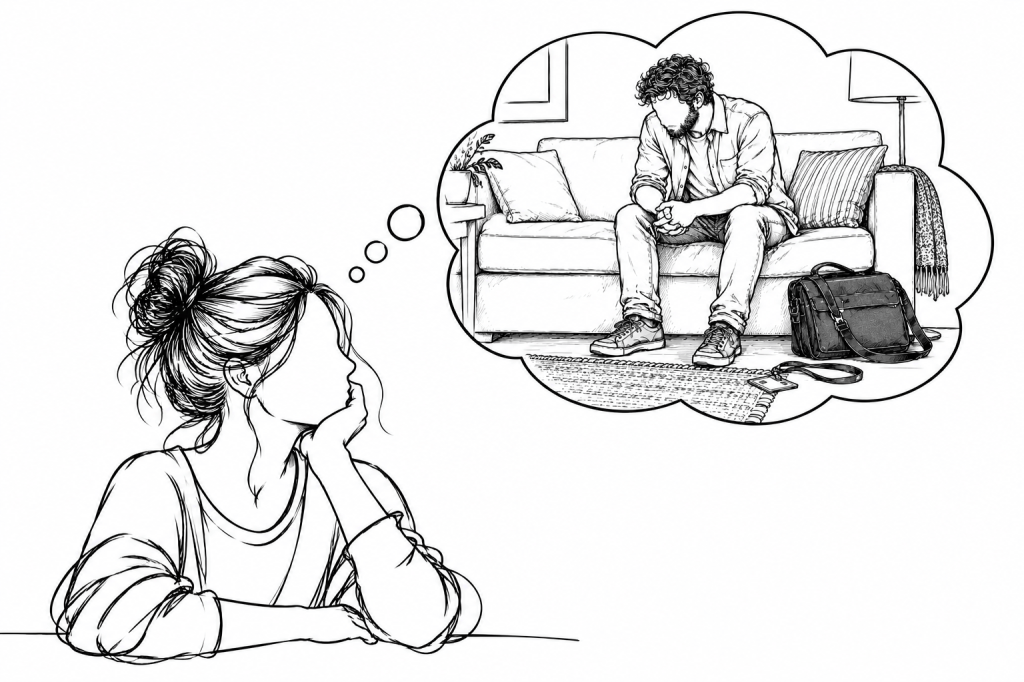
That is why his belongings remaining in my home feels so symbolic now.
I hadn’t closed the door.
But neither had I simply left it wide open.
I had placed something in the doorway.
A condition.
Change.
Looking back, perhaps the mistake wasn’t giving Stephen another chance.
It was something much harder to recognise.
I still believed insight would reliably lead to change.
I believed consequences would deepen that insight.
I believed that if Stephen finally understood how close he had come to losing our relationship, he would protect it differently.
And perhaps most importantly, I believed that because Stephen repeatedly told me he wanted the same relationship I wanted, we were ultimately working towards the same destination.
I had asked.
I had challenged.
I had offered him another path.
I had told him exactly what I needed.
He had chosen me.
So I believed him.
I didn’t yet understand that eventually I would have to judge the relationship not by the clarity of Stephen’s promises after something went wrong, but by what he did when the next opportunity arose.
For now, though, I watched him leave my home.
I still loved him.
I still believed in his capacity to change.
And somewhere amongst the sadness was hope.
Because for the first time, I thought the problem had finally become visible enough for both of us to see.
I thought seeing it would be the beginning of changing it.
I didn’t yet understand how many times I would see the same shape again.


