
By October 2021, the complaints and the investigation that followed had brought our brief period of living together to an end.
It marked the end of the first chapter of our romance.
By then, those first ten months had accumulated an uncomfortable number of things I couldn’t explain away.
A broken promise.
A night when his phone was switched off.
My aunt.
The things Stephen had told me about his marriage and previous affairs.
J and H.
Other women.
Moments when something had felt wrong, even when I couldn’t quite identify what it was.
My instinct that there was something untrustworthy about Stephen, particularly when it came to women, had not appeared from nowhere. It had grown from a succession of events, observations, comments and disappearances.
With each one, I had become increasingly anxious that Stephen was going to betray me, although I had no idea what shape that betrayal might eventually take.
When I was finally told that two women had made complaints about his behaviour at work, it came as a complete shock.
It wasn’t something I could have imagined in my wildest dreams.
And yet, once I knew, it seemed connected to the same unease those earlier incidents had created in me: that Stephen’s boundaries with women were not always where I believed they should be.
Stephen was devastated by what had happened.
When it came to the complaints themselves, however, I didn’t always feel that he was taking full responsibility for the part he had played. He believed the pressure of the training and safeguarding responsibilities had affected him, and argued that J in particular had exaggerated events in a way that portrayed him unfairly.
I struggled with that.
Whatever else had contributed to what happened, two women had independently complained about his behaviour.
I needed Stephen to look at his own part in that rather than concentrate entirely on why other people might have interpreted him unfairly.
But in our private conversations, there were also signs that he was beginning to do exactly that.
When we talked about H and his behaviour around women more generally, Stephen acknowledged that he sometimes looked for interesting conversation and stimulation from other people. He accepted that the way he had done that had been inappropriate and disrespectful to me and to our relationship.
He began trying to understand why he did it.
Stephen told me that when he became flirtatious or sought attention, it tended to happen when he was bored or unhappy, or when he felt that other parts of his life were beyond his control.
He was adamant that he wasn’t bored or unhappy with me.
And he told me that none of this was an excuse.
That distinction mattered to me.
I could understand dysregulation, stress, pressure and boredom contributing to somebody behaving badly without believing those things absolved them of responsibility.
In fact, I told Stephen exactly where I thought the problem with his explanation lay.
He was going to be bored and unhappy again.
Life would frustrate him again.
There would be difficult jobs, difficult people and periods when he felt trapped, unstimulated or out of control.
If his response to those feelings was to seek excitement, attention or validation through other women, then changing jobs wasn’t going to solve anything.
He needed to learn another way of dealing with those feelings.
And now something enormous had happened.
Stephen hadn’t simply upset me or had an uncomfortable conversation with a colleague.
Two women had complained.
There had been an investigation.
A disciplinary process.
And he had lost his job.
However painful that was, I found it difficult to imagine that somebody could experience consequences on that scale and not seriously reflect on the behaviour that had led them there.
Surely this would stay with him.
Surely the next time a conversation with another woman began drifting towards a boundary, he would remember what had happened.
Surely losing his job would make him question his own behaviour in a way that my anxiety, questions and warnings never could.
If Stephen had succeeded in keeping his job, I couldn’t reasonably see how he would have moved forward positively. As painful as his dismissal was, I thought it was probably best for everyone concerned that his employment ended.
And that was an important part of why I didn’t walk away.
I wasn’t relying solely on Stephen promising me that he would change.
I believed something had happened that might actually make him change.
It was strange to think that we had only managed to live together for less than three months.
And so much was going to happen before we would share a home again.
Stephen and I discussed how we should move forward.
He still wanted a future with me.
I wasn’t sure I wanted the same now that this version of Stephen had been revealed to me in such a devastating way.
But I wasn’t ready to end the relationship either.
Instead, I told him that while he was living with his dad, he needed to sort himself out.
That meant something quite literal to begin with.
His bedroom.
When I had first seen it at the beginning of our relationship, it had been in a terrible state. He was sleeping in his bed surrounded by piles of belongings. There was furniture, clutter, filled cases and bags bursting with possessions. The carpet was barely visible, with little more than enough room to stand beside the bed.
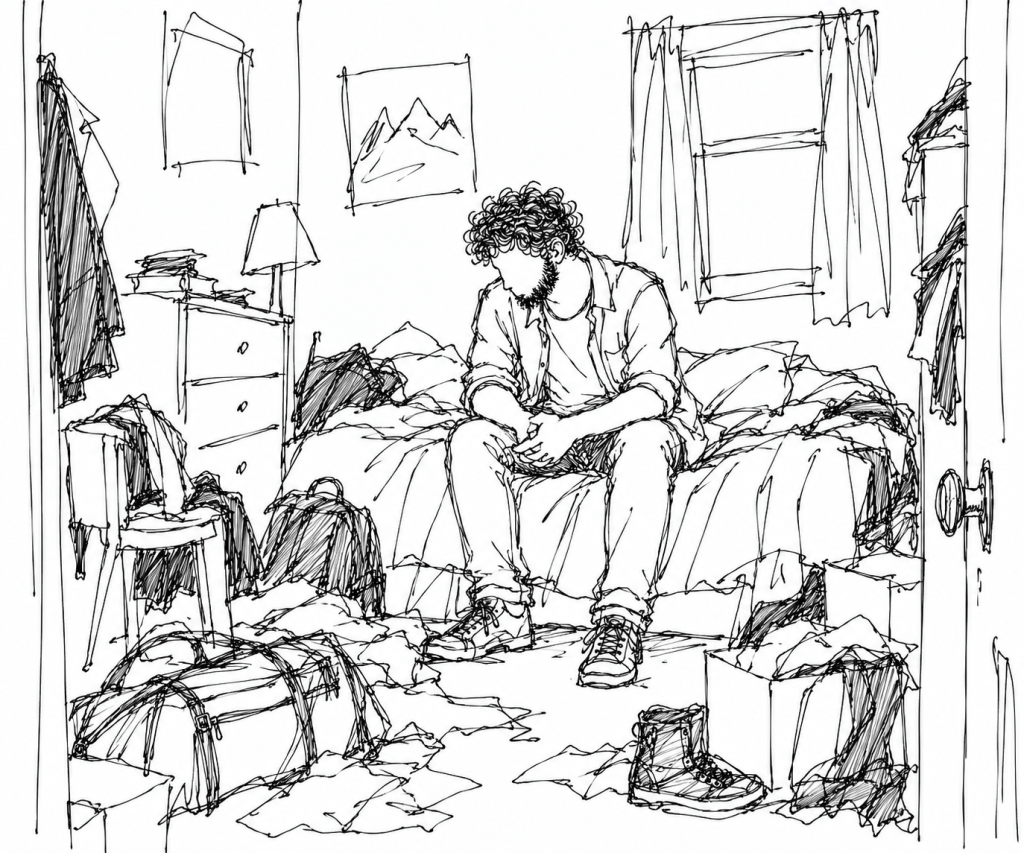
So Stephen began clearing it.
He threw things away and rearranged the furniture until there was enough room for a desk. His bed was moved beneath a windowed alcove, and somehow the room that had once seemed so chaotic began to feel cosy.
Eventually, I started staying there for the first time.
In some ways, that little room reflected what I hoped Stephen might be able to do with the rest of his life.
Clear some things out.
Create some order.
Make room for something different.
We revisited the red flags that had troubled me during those first months. Stephen couldn’t really explain all of them, but he seemed remorseful.
I reminded him that stability and security had been part of our conversations from the very beginning.
They were among the things I had been looking for when I met him.
Ten months later, I felt he had provided me with neither.
If we were going to have any future together, that had to change.
I needed Stephen to create some stability of his own, and I needed him to stop giving me reasons to feel insecure.
This mattered particularly because Stephen had presented himself to me from the beginning as somebody capable of self-reflection and change.
When we first met, he had spoken about difficulties in his past and told me that it had taken him a long time and a lot of work to get through them.
I had admired that about him.
I had even told him that working on yourself was something to be proud of.
So when I asked Stephen to use what had happened as an opportunity to look at himself, I wasn’t asking him to become somebody completely different.
I believed I was asking him to be the person he had already told me he was capable of being.
I hated telling my friends and family how Stephen had lost his job and why he had moved out.
I think it inevitably changed their opinion of him a little, but they supported me in my choices and continued to welcome him into their homes.
I wrote Stephen a letter.
He pinned it to his notice board.
It was there as a reminder of what had happened, but also of what I needed from him if we were going to have a future.
One of the things I expressed was a suspicion I had begun to develop about Stephen and women.
I wondered whether he had a need to seek female attention whenever I wasn’t physically or emotionally available to him.
I had no proof of that.
It was an educated hunch based on the pattern I thought I could see emerging, and I had no idea whether I was right.
Years later, I would understand why that instinct had been so persistent.
But at the time, it was simply another question.
By then, though, I was becoming increasingly conscious of the difference between what Stephen said and what he actually did.
Words had always come easily between us.
From the beginning, we had talked endlessly about honesty, trust, communication, commitment and the kind of relationship we wanted to build. Stephen had reassured me many times.
But after everything that had happened, reassurance alone no longer carried the weight it once had.
I told him so.
“I can’t stress enough how little the words mean to me when the actions haven’t matched.”
It wasn’t that I believed everything Stephen had ever said to me had been meaningless. I still believed that much of what he told me reflected how he genuinely felt in the moment.
But feelings and intentions were no longer enough.
“We’ve exhausted the words.”
What I needed now was evidence.
Stephen told me that he understood.
“I am making my actions match how I feel. I will continue to do that.”
For the first time in a long while, I stopped listening quite so carefully to what Stephen was promising and started watching what he actually did.
Despite everything, there were still reasons for me to believe that Stephen might be capable of doing things differently.
Only shortly before everything unravelled, we had still been talking about the future we wanted to create together.
Stephen had told me that he wanted security for both of us.
He wanted a comfortable future with me.
Those weren’t merely things I wanted and was trying to persuade him to want too.
They were things we had talked about wanting together.
And that mattered.
Because I loved him.
Because much of our relationship was extraordinarily happy.
And because the Stephen I had fallen in love with had told me from the beginning that people could work on themselves, reflect, grow and change.
So I offered him a second chance.
But it wasn’t quite the clean slate I once remembered it as.
I didn’t tell him that what had happened didn’t matter.
I didn’t invite him straight back into my home and carry on as though nothing had changed.
Quite the opposite.
Stephen went back to his dad’s house.
I remained in mine.
He needed to sort himself out.
He needed to create some stability.
And I needed to see whether the man I loved could become someone I could feel safe trusting again.
We were also about to embark on a year of plans and experiences we had already been looking forward to.
In some ways, it would be like dating for the first time.
Even living separately seemed to bring back some of the small rituals we had developed earlier in our relationship.
One evening, Stephen and I decided to watch Parasite together from our separate homes. We couldn’t get the watch-together function to work through the television, so we resorted to synchronising the film ourselves.
Stephen found a frame near the beginning where a pair of socks were hanging in the background.
“I’ve paused at the socks,” I told him when I found the same place.
Then he counted us in.
“3…”
“2….”
“1…..”
“Go, go, go!”
And we pressed play together.
It was such a small thing, but that was part of what our relationship was like too. Alongside all the difficult conversations and uncertainty, there was companionship. We could make something as ordinary as watching a film from two different houses feel like something we were doing together.
Covid had meant we hadn’t really been able to date normally at the beginning of our relationship. So much of those first months had taken place inside houses, during restrictions, while the ordinary world of restaurants, concerts, travel and spontaneous days out remained largely closed to us.
Stephen had said himself that he probably hadn’t been ready for a relationship when he met me.
Perhaps, I thought, this was our opportunity to begin again differently.
For Stephen to sort himself out.
For both of us to enjoy the things we had missed the first time around.
And for me to get to know him again without immediately rebuilding the domestic life that had just fallen apart.
At the time, I believed perhaps this was exactly what we needed.
I thought the worst might finally have been exposed.
I thought losing his job might be the consequence serious enough to make him understand where his behaviour could lead.
I thought consequences might lead to reflection.
I thought reflection might lead to change.
And I thought that, if it did, perhaps we could begin again.
I didn’t know whether Stephen had changed.
There was no way I could know that yet.
That was what the second chance was for.
It wasn’t a declaration that I trusted him again.
It was an opportunity for him to show me that one day I might.
And, for a while at least, what happened next would give me reason to believe that hope had not been misplaced.
To be continued…


