
It had been almost a year since Stephen’s dismissal and his moving out of my house, and against all my fears at the time, that year had been amazing.
There had been almost no alarm bells.
Stephen seemed to have grown. We were enjoying each other more than ever, our relationship felt calmer and more secure, and I had begun to believe that asking him to leave had achieved exactly what I had hoped it would. He still didn’t have a job, but if that year had been spent working on himself, I could live with that. I wasn’t interested in measuring his progress by a salary. What mattered to me was whether he was becoming happier, healthier and more self-aware.
And from where I was standing, it seemed that he was.
Stephen’s son had been working for me one day a week at the house I managed. When he left for his summer break after leaving college, Stephen had stepped in to fill the role.
Shortly before Denmark, Stephen had made his first trip to his friend’s hostel in Scotland, taking his eldest son with him. His son had been feeling stressed about what he would do after college, and Stephen thought a few days away together might do him good.
When he returned, we had only a few days before we flew to Denmark.
This time we had been invited to stay with my aunt, my mum’s younger sister, because the guest rooms at my grandmother’s house would be occupied by my parents and other family members coming for the party.
I had always been very fond of my aunt. She is considerably younger than my mum, so when I visited Denmark as a little girl, she was still a teenager. I looked up to her. She would style my hair, paint my fingernails and do all those little things that made an older girl seem impossibly glamorous to a child.
About twenty years earlier, she had experienced an unimaginable tragedy. Her English husband, whom she had met through my dad while staying in England as a young woman, took his own life, leaving her with four children.
It was a devastating time for the whole family, but my aunt was incredibly resilient. Forever the optimist, she somehow found a way to continue living and to create joy again. Inevitably, though, the circumstances surrounding their father’s death affected each of her four children differently—some in ways that were obvious, and others that were perhaps much harder to see.
On our second evening, my aunt took Stephen and me to an outdoor live music event. The weather was kind to us, we had drinks, listened to music and had a genuinely lovely evening. It felt like the beginning of another wonderful trip.
The following day, my aunt’s eldest daughter—I’ll call her N—came to visit with her son. Of all my cousins, N had always seemed to me to be the one most visibly affected by what had happened to their father. Over the years I had heard stories about arguments and difficult encounters between her and other members of the family, including my mum.
We talked about some of those family tensions and asked whether she was planning to come to my grandmother’s party. N wasn’t sure she would be welcome.
Rather naively, we encouraged her to come.
Put the past behind you. Come with an open heart. Start again.
It sounded reasonable at the time.
Later that evening, my aunt’s eldest and only son—I’ll call him R—dropped by and stayed for dinner. Afterwards we sat in the garden well into the night, smoking, talking, listening to music and discussing films.
I had always been very fond of R, and Stephen seemed to connect with him easily too. I wondered whether Stephen’s own history of trauma and mental-health difficulties gave him a particular empathy for some of what my cousins had experienced following their father’s death.
Everything felt easy.
Then came the party.
My sister and her family had arrived in Denmark and were staying in a rented house nearby. We all went to my grandmother’s early to help my mum set everything up, and throughout the afternoon friends and extended family began arriving.
There was a lovely atmosphere. Everyone was outside in the garden—different generations milling around, joining conversations, drifting away and joining others.
My aunt’s middle daughter—I’ll call her M—arrived. Stephen looked up.
Almost immediately, I noticed something in him.
It reminded me of the young woman at the Claridge’s party the previous year. Nothing overt happened. It was simply a slight change in him: a little more nervousness, a fixed quality to his gaze, an attentiveness that felt different.
It occurred to me that M might be his type.
She was dark-haired, tall, around thirty, fit from going to the gym and had a couple of tattoos. She had a particular look I had noticed Stephen respond to before, both in women we passed in the street and women he saw on television.
If he found her attractive, that was fine. People don’t stop finding other people attractive because they’re in a relationship.
But I noticed.
And after the relative peace of the previous year, I had also become accustomed to questioning myself when I noticed things like this.
Perhaps this was simply what trusting someone required.
My aunt’s youngest daughter and her boyfriend arrived and Stephen and I had some lovely conversations with them. R arrived too.
Then N appeared with her son.
The reaction was immediate.
I could almost feel the atmosphere change.
People who had been relaxed suddenly seemed watchful. There was surprise on faces and an apprehension I hadn’t expected. For the first time, I wondered whether we had badly underestimated the fractures within this family and whether encouraging N to come had been a mistake.
Initially everything remained civilised, but as the afternoon went on and more alcohol was consumed, tension began building between N and M.
Then it escalated frighteningly quickly.
Before we really understood what was happening, N had become aggressive and M was in tears. N and her son were encouraged to leave before things became worse, while M stormed out of the garden crying.
Stephen and I followed her.
It was then that M told us what had happened the previous Christmas. What I had understood to have been an argument and a fight between the sisters had apparently been far more serious. She showed us a photograph of her face afterwards. It was black and blue all over.
We had had no idea.
Once N had gone, M began to settle down and Stephen spent a great deal of time talking to her, calming her and listening to her talk about her relationship with her sister.
At first I understood completely.
She was distressed. Stephen could be extraordinarily compassionate when someone was struggling, and this was exactly the sensitive, caring side of him that I loved.
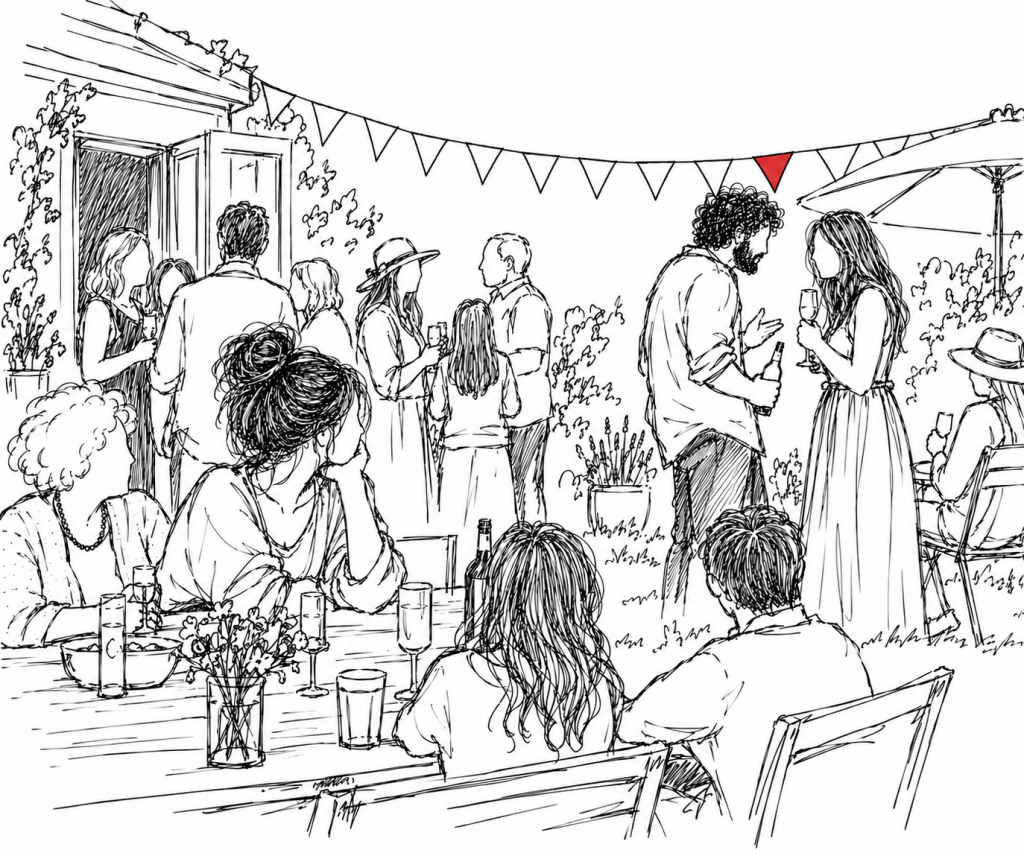
But gradually I became aware of just how invested he was becoming.
He wasn’t simply offering some comfort and then returning to the party. His attention remained with her. Conversation after conversation revolved around M, her feelings and what had happened.
And once again, I began to experience that familiar sensation of somehow disappearing from Stephen’s awareness when another woman captured his attention.
I didn’t want to make something out of nothing.
So I said nothing.
Despite the drama, the party had otherwise been a success, and when it was finally time to leave I felt relieved. I was tired and ready to return to my aunt’s house, climb into bed with Stephen and put the events of the day behind us.
Then M asked her mother if she could come back with us and stay the night.
My heart sank slightly.
I didn’t particularly want her to come. I had already noticed what I thought might be chemistry between her and Stephen, and I had watched him devote much of the evening to her.
But what could I reasonably say?
She was my cousin. She had just been through an upsetting confrontation with her sister. This was her mother’s house.
So M came back with us.
My aunt soon went to bed, leaving the three of us sitting in the conservatory with another drink.
The table was small.
Stephen sat between M and me.
We chatted for perhaps half an hour, but it was late and I was exhausted. Eventually I said I was going to bed and asked Stephen to come with me.
He said he would stay up for just a little longer.
Something in me didn’t like it.
But I also knew that if I suddenly insisted he come to bed, I would look worried. Jealous. Controlling.
And after everything we had been through, I didn’t want to be that woman anymore.
So I said goodnight.
“See you shortly,” I told him.
I climbed into bed.
And lay there awake.
Of course I couldn’t sleep.
I knew they were outside alone together, and no matter how much I tried to reason with myself, my body would not settle.
I waited.
And waited.
And waited.
Every minute seemed to make the silence outside louder.
Nearly an hour passed.
Eventually I couldn’t stand it anymore.
I quietly got out of bed and crept back towards the conservatory.
What I saw stopped me.
They weren’t talking.
M was reclined in Stephen’s arms.
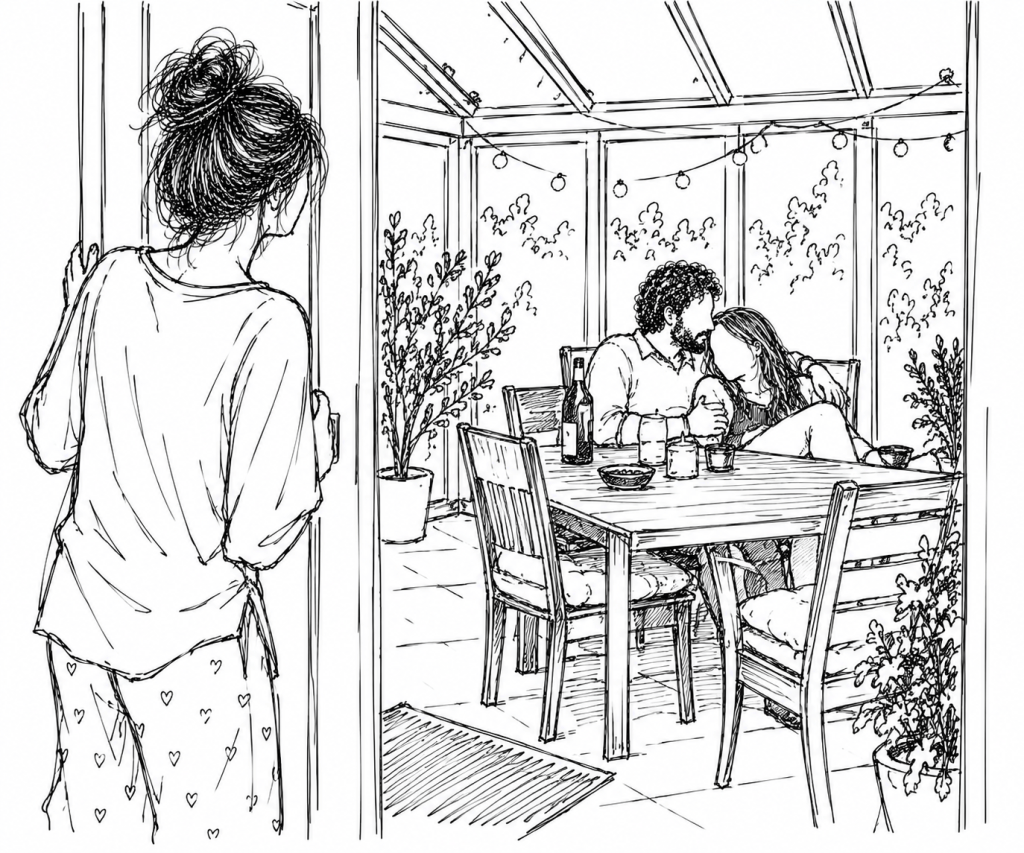
For a moment I couldn’t quite process the image in front of me.
Then something exploded inside me.
“What the hell is going on here?”
M jumped away from him and immediately pulled herself upright.
Stephen looked at me. His eyes bulging like a deer in the headlights.
I don’t remember exactly what I said next. I only remember the anger. The shock. The feeling that something I had feared without really allowing myself to fear it was suddenly happening right in front of me.
I could have stayed there.
I could have separated them.
I could have demanded Stephen to come to bed with me.
But I didn’t want to have to drag my partner away from another woman.
I wanted him to choose me.
Surely catching them like that and seeing how upset I was would be enough.
So I stormed back to the bedroom.
I expected to hear him behind me.
I waited for footsteps.
Nothing.
The house became completely quiet.
I gave it perhaps five minutes.
Still nothing.
Finally I got up again.
The conservatory was empty.
I checked the other rooms.
Nothing.
And then a horrible thought entered my head.
Don’t tell me they’ve left.
I hurried down the garden path and reached the gate. I looked one way and then the other.
There was nobody there.
They had gone.
To be continued…


