Stephen And The Red Flag (Part II)

I can’t remember the exact order of everything that happened next.

I’m fairly certain that I collected Stephen on the same day he finally contacted me and that he didn’t stay at his ex’s for another night.

He told me it was “hell there” and that he couldn’t wait to get away.

So I did what was already becoming instinctive whenever Stephen was distressed.

I went to rescue him.

I told him to gather as much of his belongings as he could and that I would come and collect him.

In a surprisingly short space of time, Stephen managed to assemble quite a lot of his things.

That bothered me.

If he could gather so much together now, why had it been impossible to do the previous day?

I understood that his ex had needed help clearing the house, but the original purpose of the visit had been to collect his belongings. The explanation still didn’t quite add up.

And neither did the explanation about the bed.

At some point — either that evening or very soon afterwards — Stephen and I had our first enormous argument.

It happened over the phone.

I told him the relationship was over.

As far as I was concerned, he had crossed a line.

It wasn’t simply that he had shared a bed with another woman. It was that we’d discussed this exact possibility beforehand. I had told him it was the one thing I was uncomfortable with, and he had repeatedly promised me it wouldn’t happen.

His first response stunned me.

“This is why I don’t make promises!”

Really?

It hadn’t been an impossible promise to keep.

From my perspective, all he’d had to do was sleep on the sofa.

Then his whole manner changed.

For the first time since meeting Stephen, I encountered a side of him I hadn’t seen before.

He became angry.

Defensive.

Dismissive.

He told me I was blowing everything out of proportion.

“I can share a bed with a woman and not do anything,” he argued. “I have self-control.”

But that wasn’t really the point.

I hadn’t accused him of being physically incapable of lying beside a woman without having sex with her.

I wanted to understand why he’d ended up in the bed at all when he’d specifically promised me that he wouldn’t.

And that was where the explanation became increasingly difficult for me to follow.

Stephen told me he’d been completely exhausted and needed to sleep in a proper bed.

But if he’d been that exhausted, I wondered, why hadn’t he simply collapsed on the sofa where he’d told me he was going to sleep?

He said his head was so “gone” that he hadn’t really registered his ex taking him upstairs.

But she hadn’t carried him.

He had walked.

He told me he couldn’t remember much about what had happened.

Yet he could remember that he had remained fully clothed.

And he was adamant that nothing sexual had happened between them.

I kept trying to make the pieces fit together.

They wouldn’t.
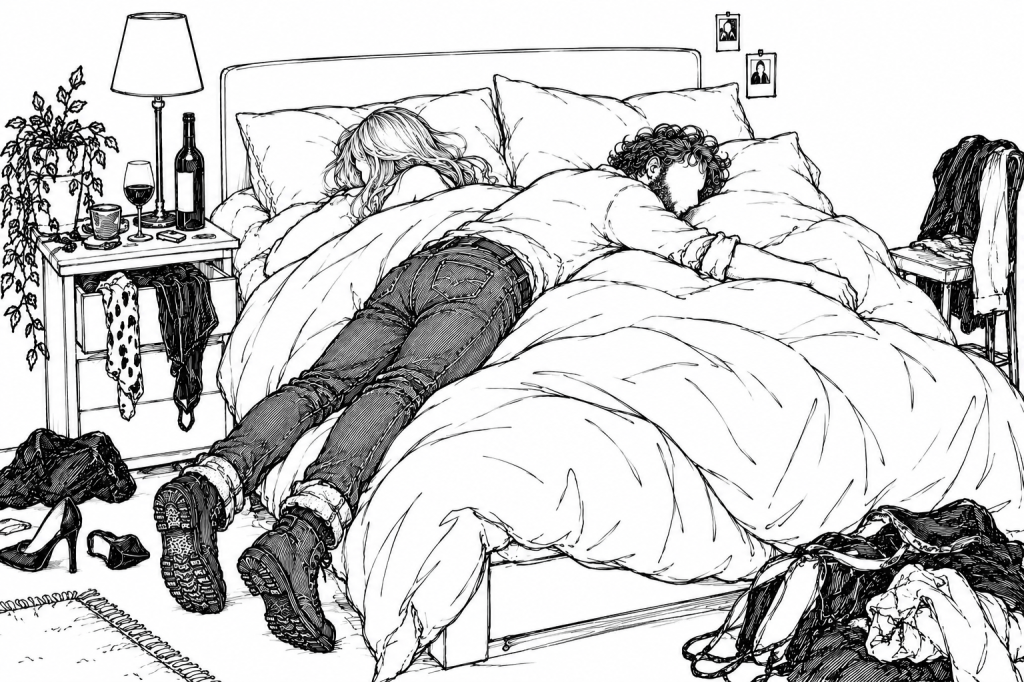
Every route through the conversation seemed to lead back to the same explanation: he had been exhausted, his head had gone, he had been barely aware of what was happening and therefore hadn’t consciously chosen to break his promise.

But I wasn’t only looking for an explanation.

I was looking for something much simpler.

Accountability.

I wanted him to say:

I promised you I wouldn’t do this. I did it anyway. I understand why you’re hurt. I’m sorry.

Instead, it felt as though most of his energy was going into proving why what happened wasn’t really his fault.

And that left me feeling increasingly unreasonable for being upset at all.

There was another part of his explanation that troubled me.

If Stephen genuinely became so mentally exhausted that he could be led somewhere without properly registering what was happening, make decisions he couldn’t later remember and lose awareness of promises he’d made only hours earlier, what did that mean for me?

What could I rely upon?

For three months, I had known Stephen as gentle, affectionate, attentive and extraordinarily loving.

During that argument, it felt as though that man had temporarily disappeared.

I tried another approach.

What if it had been the other way around?

I asked him to imagine that I’d gone to stay with an ex-boyfriend, promised Stephen I would sleep somewhere else, disappeared for the night and then admitted the following day that I’d shared my ex’s bed.

Stephen said he’d be okay with it.

I didn’t believe him.

From what I already knew of his sensitivity and jealousy, I found it almost impossible to imagine him calmly accepting the same situation from me.

Eventually, the argument began to lose its heat.

And Stephen changed again.

The anger and defensiveness faded.

He became tearful.

Confused.

Vulnerable.

He talked again about how awful it had been at the house, how exhausted he’d become and how overwhelmed he’d felt.

The explanation hadn’t really changed.

But Stephen had.

This was the man I recognised again.

The wounded, struggling Stephen I’d already become deeply protective of.

And that mattered.

His distress didn’t suddenly make me think he’d done nothing wrong. I was still angry and hurt.

But it softened me.

I began wondering whether I had been too harsh.

Perhaps I needed to take his mental health into account.

Perhaps his trauma and EUPD meant that situations affected him differently.

Perhaps loving Stephen was going to require me to understand things that I wouldn’t necessarily understand in another person.

Since meeting him, I’d already been learning to consider how his past might affect him.

For the first time, I began to wonder how it might affect me.

And whether being with him would sometimes require me to tolerate things I would ordinarily find unacceptable.

There was something else I needed to understand.

Why hadn’t he tried harder to contact me?

Even if everything he’d told me about the bed was completely true, he knew I was worried about the visit. He knew what I’d asked of him.

Why hadn’t he thought about how his silence might affect me?

Stephen shrugged.

“Out of sight, out of mind.”

The words landed strangely.

I didn’t like them.

There was something unsettling about the idea that simply because I wasn’t physically present, I could somehow disappear from his emotional awareness too.

I couldn’t know then how many times I would remember those four words during the years ahead.

For now, though, I wanted reassurance.

I asked Stephen never to leave me in the dark like that again.

And I asked him never again to share a bed with another woman.

He agreed.

We decided to stay together.

And remarkably quickly, things returned to normal.

Stephen became the kind, gentle and attentive man I’d fallen for again.

We laughed.

We talked.

He was affectionate.

I felt loved and cherished.

The intensity of the argument faded, and the warmth between us returned.

But something hadn’t returned with it.

My complete sense of trust.

Before that visit, I had been relatively relaxed in the relationship.

Now there was a question sitting quietly in the background.

Can I trust him?

The incident resurfaced occasionally in the weeks and months that followed.

Sometimes it seemed as though Stephen’s understanding of what had happened would shift. Just when I thought we’d reached some kind of resolution, he would become defensive about it again.

On one occasion, while I was at work, he said something to me over the phone that I found particularly destabilising.

“Maybe you’re not ready, or don’t know how to really love someone.”

I couldn’t understand how we’d arrived there.

He had broken a promise.

I had been hurt by it.

And somehow the conversation had moved towards whether I understood how to love properly.

It made me question whether the remorse and understanding I’d thought we’d reached had ever really existed.

But I loved Stephen.

The relationship was still new, passionate and overwhelmingly good most of the time. I had also begun to understand him as someone carrying significant wounds of his own.

So I chose to believe that this was something we could learn from.

I believed the boundary had now been made unmistakably clear.

I believed he understood how deeply the incident had affected me.

And I believed that because he loved me, he wouldn’t put me through something like that again.

I didn’t know then whether the night with his ex was an unfortunate mistake, a warning, or something more significant.

I only knew that for the first time since falling in love with Stephen, love no longer felt quite enough on its own.

Trust had entered the conversation.

And once I had started wondering whether I could trust him, I could never entirely stop.
Stephen And The Red Flag (Part I)

To understand why what happened next affected me so profoundly, you have to understand what the previous three months had been like.

Stephen and I had been in almost constant contact.

There hadn’t been a single day when we didn’t check in with each other. We knew what the other was doing, where we were going, what had happened during our day. If something amused us, we shared it. If something upset us, we talked about it.

Every evening ended in much the same way — a loving conversation, a goodnight and more excited talk about our future.

Stephen had become part of the rhythm of my day.

And I had become part of his.

So when his ex collected him from the bedsit at around three o’clock that afternoon, I naturally expected to hear from him when he arrived.

I didn’t.

A couple of hours passed.

Still nothing.

I sent a message.

No reply.

As afternoon became evening, the silence started to feel increasingly strange.

Eventually, we made contact.

But even then, something didn’t feel right.

Stephen seemed distracted and difficult to engage. He tried to explain that he hadn’t been able to collect his belongings because his ex needed his help clearing up the house before some kind of inspection the following day.

He couldn’t talk for long because they were about to order some food.

Before we ended the call, I reminded him of the one thing I had asked of him.

The promise.

“Yeah, I’ve got a bed here on the sofa,” he reassured me. “I’ll call you later.”

I relaxed a little.

He had remembered.

Everything was fine.

Except he never called.

Later that evening, I tried his phone.

The call immediately clicked off.

I tried again.

The same thing happened.

I told myself that his battery had probably died.

That was the obvious explanation.

But then another thought appeared.

Surely there’s a charger in the house he could borrow?

I tried not to let my imagination run away with me.

For three months, Stephen and I had never gone to sleep without speaking to each other. He had never simply disappeared for an entire evening without explanation.

And it was happening on the one night I had already admitted feeling uncomfortable about.

Lying in bed, my mind began filling the silence with possibilities.

What if something had happened between them?

What if he’d deliberately turned his phone off because he didn’t want me interrupting?

What if the reason I couldn’t reach him was exactly the reason I was frightened of?

Then the rational part of me would intervene.

You’re catastrophising.

His phone has probably died.

Wait until you speak to him.

I moved between suspicion and reason for most of the night.

Eventually, exhaustion won and I fell asleep.

The following morning, I woke groggy and distressed.

The first thing I did was reach for my phone.

Nothing.

No missed call.

No message.

No explanation.

My heart sank.

I went to work, but my attention was somewhere else entirely.

This was completely out of character.

All morning, I kept checking my phone. I tried calling Stephen again, but his phone remained unreachable.

I sent messages.

Probably too many.

As the hours passed, my anxiety escalated. Concern became frustration, frustration became accusation, and then another possibility entered my head.

What if something had actually happened to him?

Now I didn’t know whether I was angry or frightened.

It wasn’t until sometime after lunch that my phone finally rang.

Stephen.

I answered immediately.

I couldn’t disguise how concerned I’d been, but he quickly apologised and explained that there had been a problem with his phone.

Apparently, it was working again now.

I wasn’t entirely convinced.

But there was something much more important I needed to know.

“Where did you sleep, Stephen?”

Because despite everything he’d told me, I still had the uncomfortable feeling that the silence and that promise were somehow connected.

There was a pause.

Then he told me.

He had shared the bed with his ex.

I was furious.

The very thing I had spent the night worrying about had happened.

More importantly, it was the one thing I had specifically asked him not to do.

He hadn’t merely known that sharing a bed with her would make me uncomfortable.

He had promised me he wouldn’t.

More than once.

And only hours earlier, he had reassured me that he had somewhere to sleep on the sofa.

Now Stephen tried to explain.

He told me that they’d spent the entire day and evening clearing up a very messy house in preparation for some kind of education inspection the following day.

By the end of it, he said, he was completely exhausted.

His head had gone.

According to Stephen, his ex had taken him upstairs and laid him down on her bed.

And somehow, that was where he had stayed.

I had so many questions I barely knew which one to ask first.

Why hadn’t he slept on the sofa?

Why had he specifically told me that he would?

Why hadn’t he contacted me?

What had happened to his phone?

Why had his ex taken him upstairs and put him in her bed?

And, most importantly:

Had anything happened between them?

His explanation didn’t sit comfortably with me.

But there was something else making the situation even more confusing.

Stephen had told me the truth.

Or at least, he’d told me that he’d shared the bed with her.

If he had something terrible to hide, why admit that?

Surely it would have been easier simply to tell me he’d slept on the sofa.

And suddenly I found myself caught between two completely different interpretations of the same man.

Was Stephen fundamentally honest, but chaotic and unreliable?

Or was I only being told the parts of the truth he wanted me to know?

I didn’t know.

Only hours earlier, my biggest concern had been whether Stephen would keep one simple promise.

Now I was questioning something much bigger.

Whether I could trust him at all.

We agreed to talk properly later.

I put my phone away and carried on working.

But something had changed.

For the first time since meeting Stephen, I wasn’t simply wondering where our relationship was going.

I was wondering whether the man I was falling in love with was telling me the truth.

To be continued…

​

Stephen And The Bedsit (REFLECTION)

Looking back, I am struck by how clearly I could see one particular danger.

Stephen wanted to live with me.

I knew he’d moved quickly into a previous girlfriend’s home when his life had become difficult, and I could see that something remarkably similar might be developing between us.

So I stopped it.

That matters.

Once again, my instincts weren’t failing me.

I loved Stephen. I was increasingly concerned about him. I hated knowing how unhappy he was at his father’s house. But I also knew we’d barely begun our relationship and that allowing an unemployed man I’d known for such a short time to move into my home would be unwise.

So I created a condition.

Find a job first.

It was a boundary designed to protect both my independence and the pace of our relationship.

And Stephen accepted it.

The bedsit seemed like an encouraging alternative. He would have somewhere safe and private while also proving to himself, and perhaps to me, that he could establish some independence.

For a moment, it looked as though that was exactly what was happening.

Then came something I could never have anticipated.

A tiny lie.

I don’t excuse it because it was small. In fact, the reason I confessed almost immediately was that honesty mattered enormously to me. I didn’t want even something as inconsequential as pretending to have experienced something sexually that I hadn’t to become part of the way Stephen and I communicated.

So I told him the truth.

What happened next taught me something.

Not consciously.

Not all at once.

But powerfully.

Stephen experienced my admission very differently from the way I expected him to.

To me, the important part was that I’d corrected the dishonesty almost immediately because I wanted our relationship to be truthful.

To Stephen, the important part seemed to be that I had lied at all.

The distinction almost disappeared.

His reaction was so intense that I found myself trying desperately to make things right.

I apologised.

I explained.

I reassured.

And when his distress escalated later that night, I went to get him.

Once again, Stephen became overwhelmed and I responded by moving closer.

I still wonder what happened inside him that night.

Perhaps my admission touched something much older and more painful than the event itself. He explicitly connected it to experiences with his ex-wife, so perhaps dishonesty carried an emotional meaning for him that I couldn’t yet understand.

Given what I knew of his history and diagnosis, it’s also possible that something relatively small triggered feelings that became extraordinarily difficult for him to regulate.

But explanation and responsibility are different things.

That’s a distinction I hadn’t yet learned to make.

I could understand that Stephen’s reaction might have roots extending far beyond me.

What I couldn’t yet see was that this didn’t make me responsible for calming it.

At the time, however, his distress was happening directly in front of me.

And it was frightening.

The man I was falling in love with was crying, drinking, paranoid, confused and barely coherent.

Suddenly EUPD wasn’t a collection of letters Stephen had disclosed during an intimate conversation.

It was something I was experiencing beside him.

I didn’t know what was happening.

I didn’t know how serious it might become.

And I didn’t know what I was supposed to do.

So I did what came naturally.

I looked after him.

The episode eventually passed.

But something remained.

I never deliberately lied to Stephen again.

For years, I regarded that simply as evidence of how seriously I took honesty in our relationship.

Now I think there may have been something else happening too.

I had learned how costly dishonesty could be.

Psychologically, we learn remarkably quickly from intense emotional experiences. When one action is followed by an unexpectedly distressing consequence, we become motivated to avoid repeating the action.

I didn’t sit down the following morning and decide, I must manage Stephen’s emotions by never upsetting him.

Nothing so deliberate happened.

I simply knew that I never wanted to see him like that again.

Perhaps this was one of the first invisible rules I learned in our relationship.

Be completely honest with Stephen.

On its own, that sounds like an excellent rule.

But there was another lesson hiding underneath it.

Be careful what you do, because Stephen may experience it far more intensely than you expect.

That was more complicated.

Meanwhile, the bedsit was showing me something else.

My boundary had worked.

Stephen hadn’t moved into my home.

Yet somehow I was still increasingly involved in helping him cope with the consequences of living somewhere else.

He was lonely, so I stayed over.

He struggled to fill his days, so I suggested things he might do.

He was unhappy, so I worried.

He returned repeatedly to his father’s house, and I watched the independence I’d hoped he would build fail to take hold.

Again, none of those individual acts of care was unreasonable.

The pattern was what mattered.

Stephen’s discomfort increasingly generated activity in me.

If he was unhappy, I thought about how to make him happier.

If he was lonely, I considered how much time I could give him.

If something wasn’t working in his life, my mind naturally moved towards solutions.

Perhaps that felt reassuring to Stephen.

I imagine there was something comforting about having somebody who responded to his difficulties by moving towards him rather than away.

And perhaps, without either of us understanding it, we were strengthening the roles that had begun forming between us.

Stephen struggled.

I helped.

Stephen became overwhelmed.

I soothed.

The crisis passed.

We felt close again.

There is a concept in psychology called co-regulation. In healthy relationships, we naturally help one another settle when we’re distressed. A voice, a touch, someone’s presence or reassurance can help our nervous system return to calm.

There is nothing unhealthy about needing another person sometimes.

The difficulty comes when one person’s emotional regulation begins depending too heavily on the other, or when the other person begins feeling responsible for maintaining that stability.

We weren’t there yet.

But I can see the beginnings.

And then Stephen told me he was going to stay with his ex-girlfriend.

Immediately, something in me tightened.

Why two nights?

Why stay at all?

Why was she collecting him?

Why couldn’t he simply retrieve his belongings and come home?

Once again, my instincts produced questions.

And once again, I didn’t ignore them.

But another part of my identity entered the conversation.

I didn’t want to be controlling.

I didn’t want to be jealous.

I wanted to be the kind of partner who trusted.

That mattered enormously to me.

Perhaps because I believed secure love shouldn’t require policing another adult, I tried to distinguish between what I was feeling and what I could reasonably ask of him.

I couldn’t tell Stephen he wasn’t allowed to see his ex.

I didn’t want that kind of relationship.

So I reduced everything I was feeling to one boundary.

Don’t share her bed.

It was simple.

Specific.

And, to me, entirely reasonable.

Stephen didn’t hesitate.

He would sleep on the sofa.

That reassurance mattered because something important was about to be tested for the first time.

Until then, most of my doubts about Stephen had been answered with words.

He had told me he wanted me.

He had told me appearance wasn’t important.

He had told me about his diagnosis and his past.

He had explained his strange behaviour outside his father’s house.

And whenever there had been uncertainty, there had usually been an explanation I could understand.

But trust can’t ultimately be built from explanations.

At some point, words have to meet behaviour.

I didn’t need Stephen to avoid every situation that made me uncomfortable.

I didn’t need access to his phone or proof of where he was sleeping.

I didn’t want to supervise him.

I wanted something much simpler.

I wanted to be able to tell the man I loved what made me feel unsafe, hear him reassure me, and then discover that his actions matched what he’d promised.

Perhaps that was why the boundary about the bed mattered more than the bed itself.

I wasn’t really asking:

Where will you sleep?

I was asking:

When I tell you something matters to me, can I trust you to treat it as though it matters to you too?

Stephen said yes.

And I believed him.

Not because my instincts had gone quiet.

Because I was about to give him the opportunity to prove them wrong.

Stephen And The Bedsit

As Stephen’s unhappiness with living with his father continued, he began hinting more frequently about living with me.

I reminded him that he had told me about moving in with his former girlfriend very quickly. His story was surprisingly similar to what was now happening between us. He had been in a very difficult place mentally, and she had driven to collect him and brought him back to her home. Before long, he had effectively moved in.

I could see the temptation for Stephen to repeat that pattern with me.

So I set a boundary.

I told him that he couldn’t move into my home until he had found a job.

He accepted that, but he was becoming increasingly desperate to get away from his father’s house. Instead, he arranged to rent a bedsit.

I didn’t think it was necessarily a bad idea. In fact, I thought it might be good for him. It would give him some independence, some privacy and a place of his own while he worked out what he wanted to do next.

He put some effort into making it feel like home. He bought things he needed to cook and some nicer touches to make the little room more comfortable.

I was pleased for him.

The first time I visited, we were both excited about having somewhere of our own to spend time together. We joked that we needed to christen the new place.

What followed was an unexpectedly intense and intimate experience, and I remember leaving with a real glow of happiness.

I felt incredibly close to Stephen.

But there was something else I was carrying home with me.

I had pretended to have reached a level of sexual pleasure that I hadn’t quite reached.

It was a tiny lie, but it bothered me enormously.

The following day, I was still thinking about it at work. I felt guilty. I was falling deeply in love with this man, and the last thing I wanted was to start our relationship by hiding things from him. I didn’t want to create a pattern where I pretended everything was fine when it wasn’t.

So I decided to tell him.

I imagined we’d laugh about it.

Perhaps he’d tease me.

Perhaps we’d simply talk about it and move on.

Instead, his reaction was completely disproportionate to what I had expected.

He became extremely upset.

He compared me to his ex-wife and spoke at length about how much her lying had hurt him. He seemed to experience my admission as though I had deliberately deceived him, rather than what it was: something I had admitted to less than twenty-four hours later because I didn’t want to be dishonest with him.

I tried to explain.

I tried to reassure him.

Nothing seemed to help.

I was shocked by the intensity of his response and frightened that something so small might somehow cost me the relationship.

I went home from work that evening feeling ashamed and deeply upset.

Then things became much more serious.

Later that night, Stephen had returned to his father’s house and called me.

He was in an awful state.

He was crying, distressed and increasingly paranoid, and he had been drinking. I was so worried about him that I got in the car and went to collect him.

I brought him back to mine.

I remember him sitting on the edge of my bed, confused and barely coherent. He seemed completely overwhelmed by whatever was happening inside his head.

I didn’t know what to do.

Until then, I had known that Stephen had mental health difficulties. I knew about his EUPD and I knew about his traumatic childhood.

But this felt different.

This was the first time I began to understand that his difficulties could be much more serious than I had appreciated.

There wasn’t much I could do except stay with him, apologise for upsetting him and try to comfort him until eventually he slept.

Thankfully, the episode passed.

We got through it.

And from that point onwards, I never deliberately lied to Stephen again throughout the rest of our relationship.

The bedsit itself, however, soon became another source of difficulty.

Stephen moved in just as the UK entered its third national lockdown in January 2021. Restrictions meant that there was very little for him to do, and he quickly found the isolation difficult.

He struggled with the empty days and lonely nights.

He would try to cook, but often ended up bringing takeaway food back instead. He didn’t seem to know how to fill his time or settle into living alone.

I tried to help.

Sometimes I stayed over, even when I had work the next day, because I knew how difficult he was finding the loneliness. We still spent some weekends together when he didn’t have his sons, and I suggested different things he might do to occupy himself.

But nothing seemed to make much difference.

Within only a couple of weeks, I noticed that he was spending more and more time back at his father’s house.

When he had his sons, his father would often collect him on a Thursday, and Stephen wouldn’t return to the bedsit until the following Tuesday.

By the end of this period, my impression was that he was spending only two or three nights a week there, although I know Stephen may remember this differently.

I could see that the independence I had hoped the bedsit would give him wasn’t working out quite as I had imagined.

Then, sometime in March, Stephen told me he wanted to visit his ex-girlfriend to collect belongings he had left behind.

He planned to stay for two nights.

I wasn’t entirely comfortable with the idea.

Why did he need to stay for two nights?

Why couldn’t he collect his things and come home?

And why was he relying on her rather than asking me?

But I didn’t want to become the jealous or difficult girlfriend. I’d started this relationship wanting to be trusting and easy-going, and I wanted to maintain that part of myself.

So I didn’t make too much of it.

When the day came for his ex-girlfriend to collect him from the bedsit, I asked him for just one thing.

One promise.

“Just please don’t share the bed with her.”

He reassured me immediately.

“No way. I’ll be sleeping on the sofa.”

I believed him.

Letting Stephen In (REFLECTION)

There was something Stephen gave me during those first weeks that went deeper than attraction.

He made me feel accepted.

I had worried about my age and my body before we’d even met. Then, when I finally allowed myself to be completely exposed in front of him, he seemed to find beauty in the very things I had learned to regard as imperfections.

I still remember what he said about my stretch marks.

Scarification.

It was such an unusual comparison, but perhaps that’s why it stayed with me. He had taken something I felt self-conscious about and looked at it through an entirely different lens. Instead of damage, he saw decoration.

Whether he understood its significance or not, Stephen was beginning to change the way I experienced myself in his presence.

I felt desirable.

But increasingly, I also felt seen.

That evening with the music game mattered to me for exactly that reason. Stephen wasn’t merely interested in my body or in the excitement of a new sexual relationship. He seemed interested in my mind, my photographs, my journals, my memories, my creativity and all the strange little things that made up my world.

He wanted to look.

He wanted to know.

And I wanted to show him.

There is enormous intimacy in being curious about another person’s inner world. Perhaps that was part of why the relationship accelerated so quickly. We weren’t simply spending time together. We were exchanging ourselves.

Stephen was showing me his world too.

And his was becoming increasingly painful.

As he told me more about his childhood, I began to understand that the diagnosis he’d mentioned so matter-of-factly on Christmas Eve had a history behind it.

A child had been hurt.

That knowledge inevitably changed the way I saw the adult.

I don’t think that was wrong.

Understanding someone’s history can help us respond to them with compassion. Experiences of childhood trauma can affect attachment, trust, emotional regulation, self-worth and the ways people experience closeness in adulthood. But trauma doesn’t produce one predictable kind of person, and it certainly doesn’t explain every choice someone later makes.

I couldn’t know what Stephen’s childhood meant for Stephen.

I could only listen to what he told me.

And what I felt was enormous tenderness.

Perhaps something equally powerful was happening for him.

He had met a woman who wasn’t frightened away by his diagnosis. I didn’t recoil from his history. I listened when he spoke about his childhood. I welcomed him into my home. I wanted him physically. I was interested in his ideas.

And increasingly, when he was distressed, I came to get him.

I wonder what that felt like.

Perhaps my home became more than somewhere pleasant to spend the night.

Maybe it represented relief.

Stephen would describe the frustration and unhappiness of living with his father, and then sometimes, quite literally, I would arrive.

My car would pull up.

He would get in. 

And I would take him somewhere warm, comfortable and calm.

To my home.

To me.

There was nothing calculated about it from my side.

Someone I was falling in love with was unhappy.

I had the means to make him less unhappy.

So I did.

That equation felt remarkably simple.

It also felt like an expression of one of the qualities I valued most in myself.

Love meant showing up.

If somebody I loved was struggling, I didn’t want to stand at a safe distance explaining that their struggle belonged to them. I wanted to help.

There is nothing inherently unhealthy about that either.

Relationships require care.

The difficulty comes when care quietly begins changing into responsibility.

I didn’t notice that boundary moving.

Perhaps because nobody moved it deliberately.

Stephen was distressed.

I responded.

His distress reduced.

I felt useful.

He felt better.

Then, when distress returned, we repeated the process.

Psychologically, patterns don’t need to be consciously designed in order to become powerful. When one person’s distress repeatedly draws a soothing response from another, both people can begin learning their respective roles.

Stephen could turn towards me for regulation.

I could turn towards helping him as a way of expressing love.

Neither of us had to decide that this was how our relationship would work.

We simply had to repeat it.

And there was another ingredient that made helping Stephen particularly compelling.

I could see his vulnerability now.

The confident man I’d initially imagined was still there, but alongside him was someone much less certain and much more wounded.

The more of that person I saw, the harder it became to evaluate Stephen only in terms of whether he could meet my needs.

I began thinking about his.

That shift was subtle.

I had entered dating wanting companionship, comfort, security and somebody with whom I could thrive.

Now I was increasingly asking myself what Stephen needed in order to thrive.

Perhaps love could help.

Perhaps stability could help.

Perhaps patience could help.

Perhaps being with somebody who genuinely accepted him could give him the secure foundation from which the rest of his life could begin falling into place.

There was something deeply hopeful in that idea.

And then Stephen told me something that should have sat awkwardly beside all that hope.

He probably wasn’t ready for a relationship.

When I look back now, I think this was one of those moments when reality spoke remarkably plainly.

Stephen wasn’t necessarily warning me that he would hurt me.

He may simply have understood something about himself.

His life was unstable. He was unhappy. He had unresolved practical problems, fractured relationships and emotional difficulties. Perhaps some part of him genuinely recognised that beginning an intense new relationship in the middle of all that wasn’t sensible.

But then came the second half.

Meeting me was an opportunity he couldn’t pass up.

And that transformed the meaning completely.

I’m not ready for a relationship might have created distance.

I’m not ready, but you’re too special to lose created intimacy.

It made me the exception.

There is something extraordinarily seductive about being someone’s exception.

It suggests that ordinary rules don’t quite apply because what you’ve found is unusual.

Perhaps Stephen genuinely felt that way.

I suspect he did.

I don’t imagine him sitting there constructing a sentence designed to override my judgement. I think it is entirely possible that two contradictory things were true inside him at once.

He wasn’t ready.

And he desperately wanted me anyway.

Human beings live inside contradictions like that all the time.

The more interesting question is what I did with the information.

I heard both parts.

But emotionally, I gave more weight to the second.

Once again, my instincts hadn’t failed me.

I knew we were moving quickly.

I knew his life was complicated.

I knew his diagnosis might present challenges.

I knew I was beginning to accommodate him.

And now Stephen himself had told me that perhaps he wasn’t ready.

But I had another growing collection of evidence too.

He made me happy.

He made me laugh.

He made me feel beautiful.

He was interested in my world.

The chemistry was extraordinary.

I was beginning to love him.

And he appeared to be falling in love with me.

When he accidentally let those three words escape at the end of a phone call, I stopped him because I knew it was too soon.

That was another instinct.

Slow down.

But beneath it was another truth.

I wanted to say them too.

This is what makes the story difficult to reduce to warnings ignored.

There wasn’t one voice inside me saying danger while another foolish voice silenced it.

There were competing truths.

This is moving too quickly.

This feels extraordinary.

His life is unstable.

He wants to change it.

He may not be ready.

Neither of us wants to lose this.

And perhaps the most powerful:

Maybe with enough love, patience and security, we’ll be all right.

I didn’t yet understand how easily that belief could alter the balance of a relationship.

Because if love became something that could help Stephen become more stable, then difficulties between us could acquire a new meaning.

They wouldn’t necessarily mean the relationship was wrong.

They might simply mean he needed more understanding.

More patience.

More security.

More time.

And I had enormous reserves of all four.

The woman who had begun dating looking for somebody with whom she could build a secure life was starting, almost imperceptibly, to offer her own security as somewhere for Stephen to shelter.

At the time, that didn’t feel like losing anything.

It felt like love.

And perhaps that was why the boundary between loving Stephen and looking after Stephen became so difficult for me to see.

Letting Stephen In

The weeks that follow our first meeting are a mixture of immense joy and the first hints of things that make me uneasy.

About a week after we met, I’m becoming tired of our unconventional dates.

Meeting in my car, staying out until four in the morning and then going home to face a full day of work isn’t sustainable. I’m exhausted, and eventually I summon the courage to ask Stephen if he’d like to come back to mine.

I’m nervous.

I’m also slightly embarrassed because my house isn’t as tidy as I’d normally like it to be. Work, late-night meetings with Stephen and long conversations on the phone have left very little time for housekeeping.

But I want him to see my home.

More importantly, I want to invite him into my life.

So Stephen comes back with me.

For the first time, we have the privacy and comfort of my own bedroom. We can finally stop making out in a car and lie down together properly.

We make love for the first time.

Getting completely naked in front of him makes me a little self-conscious. I’m very aware of my middle-aged body — the stretch marks and loose skin left by two pregnancies and years of losing and gaining weight.

But Stephen makes me feel completely at ease.

He tells me that my skin is the softest he’s ever touched. When he sees my stretch marks, he compares them to scarification — something deliberately created on the skin as a form of decoration.

I remember thinking:

What a beautiful thing to say.

This man is saying things that make me feel comfortable, accepted and, somehow, beautiful.

Later, Stephen shows me a headless naked photograph of a former girlfriend who was a much larger woman than me.

I think it’s a little inappropriate to show me a photograph like that, but I understand the point he’s trying to make.

He’s telling me that bodies don’t have to conform to some particular ideal for him to find a woman attractive.

And I believe him.

His apparent lack of judgement towards women’s bodies makes me feel safe with him. It becomes something I admire about him, something I associate with his openness and acceptance.

I don’t yet understand the other side of that openness.

For now, I simply feel grateful to be with a man who seems to see beauty so differently from the way I have sometimes seen myself.

My home quickly becomes our new favourite place to spend time together.

We listen to music, talk, laugh, make love and sit smoking at my bedroom window.

Smoking isn’t something I particularly want to do, but it’s becoming increasingly obvious that Stephen is a much heavier smoker than I had initially understood.

I don’t want him having to go outside in his underwear, so I let him smoke at the window.

Before long, I’m joining him.

It’s a small thing, but I’m already beginning to accommodate his habits into my own life.

When we can’t be together, our relationship continues through our phones.

We text constantly and find ways to amuse ourselves.

One evening, we take turns photographing ourselves wearing every hat we own.

It’s silly.

It’s fun.

And it feels intimate in the way that only the early stages of falling for someone can.

I remember one particular evening when something else happens that feels significant.

For once, our time together doesn’t revolve around sex.

We play a music board game I received for Christmas, taking turns answering the questions. Each question seems to lead somewhere else — a favourite song, a memory, an artist, a story from our past.

We talk for hours.

Later, I show Stephen some of the things that make up my world: my photographs, journals and various projects I’ve worked on.

He is genuinely interested.

He asks questions. He listens. He’s enthusiastic about what I show him and complimentary about my home and my sense of style.

I feel seen.

Not simply looked at, but genuinely seen.

I can’t remember feeling that way with anyone before.

Then, at the end of one of our phone calls, Stephen quietly mumbles:

“I love you.”

I immediately pick him up on it.

It’s far too soon.

He pretends he didn’t say it.

We both know he did.

We laugh about it, but I don’t let him off quite that easily.

The truth is, I’m falling in love with him too.

I’m just not ready to say it yet.

Around this time, Stephen begins telling me more about his childhood.

He gives me more detail about the abuse he experienced and how extensive it had been. Hearing about what happened to him makes my heart ache for the child he once was.

I already know that he has EUPD, and now I’m beginning to understand that there is much more behind the diagnosis than I had previously appreciated.

I do wonder whether his past and his emotional instability might eventually become a problem.

But Stephen seems remarkably matter-of-fact about what happened to him. He doesn’t present himself as broken or helpless. He seems certain about what he wants and, more importantly, certain that he wants me.

I convince myself that love, patience and a secure relationship could help us overcome whatever difficulties might arise.

Then Stephen tells me something that, looking back, should perhaps have made me pause.

He says he probably isn’t ready for a relationship.

But meeting me is an opportunity he can’t pass up.

The way he says it makes me feel as though I’m different.

As though I’m the exception.

As though I’ve appeared at exactly the right moment and he simply can’t let me go.

I love hearing that.

I’m already smitten, and I don’t stop to consider what it might mean that the man I’m falling for is telling me he isn’t actually ready for the relationship I’m hoping to build with him.

If I’d been more detached, or more focused on what I needed rather than what I was feeling, perhaps I would have told him to take the time he needed.

Perhaps I would have said, Get yourself into a better place, and when you’re ready for a relationship, come and find me.

But I don’t.

I’m falling in love.

And I believe we can overcome whatever difficulties stand between us.

I don’t yet understand how much Stephen’s life is still unravelling.

I only know the man I’m getting to know now.

There are many evenings when we simply talk on the phone.

Increasingly, he tells me how unhappy he is living with his father. He talks about the situation with his brother, the house and the money he believes he’s owed. His frustration is growing, and some of our conversations become deeply emotional.

Sometimes, I worry about him.

Sometimes, I can’t bear the thought of him sitting there feeling miserable and alone.

So when the conversations become particularly difficult, I get in my car and drive to collect him.

Sometimes it’s late.

Sometimes it’s the small hours of the morning.

I bring him back to my house.

I give him somewhere comfortable to be, somewhere he can escape the chaos of his father’s home, and someone willing to listen.

At the time, it feels like love.

I’m simply being there for someone I care about.

I don’t realise that something is beginning to form between us — a pattern in which his distress becomes my responsibility and helping him becomes one of the ways I express my love.

I only know that he needs me.

And I want to be the person he can turn to.

The Stephen Behind The Profile (REFLECTION)

The five minutes outside Stephen’s father’s house stayed with me longer than they probably should have.

Something had changed.

Only the previous day, Stephen had seemed completely absorbed by me. Now he could barely look at me. His energy was strange — agitated, distracted, almost as though he wanted me gone.

My mind immediately supplied an explanation.

He’s changed his mind.

Then another.

He got what he wanted.

I find that reaction interesting now because, once again, my internal warning system was working perfectly well. I noticed a change in behaviour immediately. I didn’t need anybody to point it out to me.

But noticing something and understanding it are very different things.

By the time I arrived home, Stephen was messaging me normally again. He explained that living with his father was affecting him, and suddenly I had information that made the encounter easier to understand.

Perhaps that really was all it was.

I still don’t know.

He may have been overwhelmed, irritated by something that had happened inside the house, embarrassed by his circumstances or simply having a bad five minutes. People are allowed to behave strangely without it revealing some hidden truth about them.

What matters more to me now is how quickly I experienced two Stephens.

There was the man standing beside my car, difficult to read and apparently wanting distance.

Then there was the Stephen on my phone: warm, engaged, communicative and reassuringly familiar.

At that point the contradiction was tiny.

His explanation bridged the gap easily.

So I crossed it.

As the days passed, I began learning more about the life behind the man I’d found so attractive.

It was considerably more complicated than I’d imagined.

Stephen didn’t have his own home. He didn’t have a job. His relationship with his brother had broken down. His relationship with his ex-wife was difficult. He hated living with his father. There were financial problems tied up in the inherited house.

Individually, none of those things made Stephen a bad prospect for a relationship.

Collectively, though, they told me something important.

This was not the settled man I had initially imagined when I read property developer on his profile.

His life was in considerable transition.

Mine wasn’t.

I had my home. I had work. I had established routines and responsibilities. I’d come out of my previous relationship wanting companionship and security — not another complicated life to manage alongside my own.

And I noticed the mismatch.

Are we actually a good fit?

There were my instincts again.

Not screaming.

Asking.

That’s an important distinction because I don’t think instinct always arrives as certainty. Sometimes it simply presents a question and waits to see what we do with it.

The difficulty was that I was simultaneously discovering things about Stephen that pulled me in the opposite direction.

I was seeing vulnerability.

The confident man from the dating profile was becoming more complicated. There seemed to be someone underneath who wasn’t nearly as self-assured as I’d first imagined.

And vulnerability has always activated something very powerful in me.

Not pity.

Tenderness.

I didn’t want a project. I genuinely wasn’t looking for somebody to rescue. But if I saw someone struggling with circumstances I could understand, my instinct was not to judge them for struggling. It was to look at who they might be once those circumstances improved.

That distinction would become enormously important.

Because without realising it, I was beginning to assess Stephen partly on potential.

He wanted work.

He wanted somewhere of his own.

He wanted his financial situation resolved.

He wanted his life to move forward.

Those things mattered because they allowed me to interpret his instability as temporary.

I wasn’t choosing an unemployed man living unhappily with his father amid fractured family relationships.

I was getting to know a man who, as I understood it, was trying to move beyond those things.

There is a significant psychological difference between loving someone for who they are and becoming invested in who you believe they are capable of becoming.

I hadn’t crossed that line.

But perhaps I had taken my first step towards it.

Something similar may have been happening when Stephen told me about his limited experience of intimacy.

Again, I encountered something I couldn’t quite reconcile with the man in front of me.

He was attractive. Charismatic. Intensely physical with me. Yet he described himself as inexperienced.

Rather than making me suspicious, it made me curious.

Perhaps he’d simply never had the right relationship.

And then came a thought that, in retrospect, says a great deal about me.

Perhaps I could show him.

Not teach him how to have sex.

Show him what a really good relationship could feel like.

There was nothing inherently unhealthy about that thought. We all bring different experiences into relationships, and ideally we do teach one another better ways of loving, communicating and being close.

But there was something quietly seductive about the idea that Stephen might flourish with me.

It gave his vulnerability meaning.

The unsettled parts of his life didn’t necessarily have to be reasons we were incompatible. They could be circumstances we would eventually leave behind.

Perhaps with stability, love and reciprocation, a different Stephen would emerge.

I wonder what was happening for him during those same evenings.

My life must have looked very different from his.

I had a home.

I was settled in my work.

I had structure.

And, perhaps most importantly, I was responding enthusiastically to him.

If Stephen felt trapped or diminished by his circumstances, I can imagine that being seen through my eyes might have felt wonderful.

I wasn’t looking at an unemployed man living with his father.

I was looking at intelligence, humour, creativity, vulnerability and possibility.

Perhaps he liked the man he appeared to be when reflected back through me.

Perhaps I made him feel hopeful about himself.

Or perhaps that gives me too much importance.

Maybe he was simply falling for me.

I was certainly falling for him.

And then there was the chemistry.

Chemistry is difficult to write about without either romanticising it or reducing it to brain chemistry. But its psychological power is real. Strong attraction creates its own evidence.

You don’t merely think we might work.

You feel it.

Our bodies seemed remarkably certain about something our minds had barely begun investigating.

That certainty mattered.

Every evening reinforced it.

The conversations grew longer. The physical intimacy grew easier. The affection developed. I became more tired and simultaneously less willing to go home.

Nothing about that felt like sacrifice.

It felt exhilarating.

And this is where I think hindsight can once again become unfair.

I could look back at Stephen’s circumstances and construct a neat list of reasons I should have walked away.

Unemployed.

Living with his father.

Family conflict.

Financial problems.

Mental health difficulties.

A lie on his dating profile.

But people aren’t checklists.

Had I rejected Stephen solely because his life was difficult, I would have been rejecting a man I genuinely liked because he was going through a difficult period.

That wasn’t who I was.

Nor is it who I particularly want to become.

The more difficult question is one I hadn’t yet learned to ask.

Not:

Does this person have problems?

But:

How does this person take responsibility for their problems?

I was listening carefully to what Stephen wanted to change.

I hadn’t yet been around long enough to see what he actually did.

There is a world of difference between those two things.

For now, though, the evidence immediately in front of me remained compelling.

He kept messaging.

He kept turning up.

We kept talking.

We kept laughing.

The attraction was extraordinary.

And every night, I knew a little more about him than I had the night before.

Some of what I learned made me hesitate.

Some made me want to move closer.

Increasingly, I found myself doing both at once.

Perhaps that was the first real tension in our relationship.

One part of me was asking whether Stephen could fit into the life I’d already built.

Another was beginning to imagine what his life might become if we built something together.

I didn’t know it yet, but those are two very different ways of choosing someone.

And I was beginning to move from one towards the other.

Meeting Stephen For The First Time (REFLECTION)

For several days, Stephen had existed partly in my imagination.

Now he was walking towards me through the trees.

And perhaps the most important thing about that first meeting was that reality didn’t disappoint me.

He was as attractive to me as his photographs had suggested. His voice belonged perfectly to the man approaching me. The humour translated. The conversation still flowed. The chemistry I’d been so careful not to take for granted was there almost immediately.

I had been right to be cautious.

But Stephen had also been right to be confident.

We liked each other.

There is something significant about having a fear disproved.

I’d spent the previous few days reminding both of us that we could meet and feel nothing. I had deliberately resisted allowing our messages to become evidence of a relationship that didn’t yet exist.

Then we met, and instead of puncturing the fantasy, reality seemed to confirm it.

That made it easier to trust everything else.

His reaction to seeing me certainly helped.

I can still remember that little growl.

It was an extraordinary response from a man meeting me for the first time, and I noticed its intensity immediately. But I didn’t experience it as threatening. I experienced it as spontaneous.

Stephen hadn’t carefully selected words designed to flatter me. His body appeared to react before his mind had time to intervene.

After wondering why this younger, handsome man was so interested in me, suddenly I had an answer standing directly in front of me.

He fancied me.

There was something wonderfully uncomplicated about that.

And I loved it.

I’d expressed insecurities about my age and my body before we’d met, and now the man who had reassured me through a screen was looking at me as though those concerns had been completely unnecessary.

There is reassurance in words.

There is considerably more reassurance in feeling somebody’s attraction.

Looking back, I think that first meeting strengthened something that had already begun happening between us. Stephen was making me feel extraordinarily desirable, while I seemed to be making him feel extraordinarily accepted.

Those are powerful things to exchange.

Perhaps we were simply fortunate enough to meet at a moment when each of us had something the other particularly needed.

I had come from the uncertainty of dating, from being left trying to decipher mixed messages and unexplained disappearances. Stephen offered the opposite. There was no ambiguity in his attraction. No wondering whether he liked me. No careful rationing of enthusiasm.

He seemed delighted by me.

What was I giving him?

I can only wonder.

Perhaps my enthusiasm matched his in a way he hadn’t experienced for some time. Perhaps he enjoyed being with someone who was curious about him rather than frightened by the complications he’d already revealed. Perhaps my acceptance made it easier for him to relax into the intensity he was already feeling.

Or perhaps he simply fancied me enormously and was having a wonderful first date.

Not everything needs a psychological explanation.

Still, there were little moments when I noticed that Stephen and I might experience intensity differently.

The presents were one of them.

The gifts themselves were thoughtful rather than extravagant. He had listened. He remembered the gin I liked. He wanted to share a film that meant something to him.

It was the labels that caught my attention.

The words belonged, in my mind, to a relationship further along than ours.

And I noticed.

That matters to me now.

I didn’t blindly absorb everything Stephen offered because I was intoxicated by the attention. Some part of me remained capable of standing outside the experience and measuring it.

This is lovely.

This is exciting.

This is also rather a lot.

What interests me even more is Stephen’s reaction when I drew attention to it.

He became embarrassed.

He wanted the label back.

That small moment makes me reluctant to retrospectively place a sinister interpretation on his early intensity. What is sometimes called love bombing involves overwhelming someone with affection, attention or promises, and the term is now used remarkably casually. Intensity alone doesn’t tell us someone’s motivation.

Perhaps Stephen wasn’t strategically trying to accelerate intimacy at all.

Perhaps he simply felt things intensely.

Maybe he’d written something romantic while caught up in the excitement of our conversations and, once he was sitting beside the actual woman who would read it, suddenly realised how exposed he’d made himself.

His embarrassment felt genuine to me.

And my response was revealing too.

I took the label.

I kept it.

Part of me had recognised that it was too much, too soon.

Another part of me was charmed by exactly the same thing.

Those two reactions could exist simultaneously.

That would become important.

My instincts rarely arrived as enormous alarms telling me to run. More often they were small observations.

That’s a little intense.

That’s not quite what I expected.

Didn’t he say he was only an occasional smoker?

Then another piece of information would arrive and give the observation context.

The romantic label was too much—but he seemed embarrassed by it.

The physical attention was intense—but I was attracted to him too.

The cigarettes were more frequent than I’d expected—but smoking wasn’t exactly a moral failing.

Nothing required a dramatic response.

And that’s something hindsight can easily flatten.

When we know that genuinely serious things happened later, there is a temptation to line up every early imperfection and call it evidence. But life isn’t lived backwards. A man smoking two cigarettes on a first date isn’t a warning of betrayal. An overly romantic gift label isn’t proof of manipulation. Intense attraction isn’t evidence of instability.

They were simply information.

I noticed them.

Then I continued gathering more.

And most of the information I gathered that afternoon was wonderful.

Stephen was funny. Interesting. affectionate. Thoughtful. Sexy. He listened. He remembered things I’d told him. We could talk easily. We could laugh. We were physically drawn to one another.

Most importantly, I felt remarkably comfortable with him.

The woman who had walked towards those woods wondering whether she was about to be disappointed was now finding excuses to extend the date.

First the lake.

Then the canal.

Then another bench.

Then the car.

Then the promise of seeing each other again that evening.

Neither of us wanted to stop.

There is a psychological concept called reward prediction error. Put simply, when something turns out better than we expected, the difference between expectation and reality can make the reward particularly powerful.

I had deliberately lowered my expectations.

Stephen exceeded them.

Perhaps that was part of the exhilaration.

But there was something else I want to preserve when I remember that afternoon.

I was happy.

Not deceived. Not foolish. Not a future victim walking unknowingly towards disaster.

Happy.

I had taken a chance on someone and, for those few hours at least, the chance appeared to have paid off spectacularly.

Whatever I understand about our relationship now doesn’t give me the right to take that afternoon away from the woman who lived it.

She noticed the things that didn’t quite fit.

She also noticed everything that did.

And on that first afternoon, there was far more of the latter.

So when I dropped Stephen home and agreed to return later, I wasn’t overriding some enormous internal warning telling me not to go back.

I was following something else my instincts were telling me.

I really like this man.

The difficult part would come much later, when those two kinds of instinct began telling me very different things.

Meeting Stephen For The First Time

It’s the day after Boxing Day, 2020.

I’m back home after spending a lovely, quiet Christmas with my parents, and now I’m getting ready to meet Stephen for the first time.

I’ve chosen my favourite dress, added some accessories and put on a little make-up. I’ve made an effort, but I’ve stayed true to myself. I feel pretty, confident and ready to meet this new man who has somehow become such a significant part of my thoughts in such a short space of time.

I make the fifteen-minute drive to the park where we’ve arranged to meet.

I’ve never been there before, although I’ve studied the location on Google Maps so I know roughly where I’m going. The weather is good. It’s cold, but dry, and the sun is shining.

I enter the park through the gate opposite the one Stephen will use and make my way down towards the lake. According to our plan, I’ll walk anti-clockwise and he’ll walk clockwise, so we’ll eventually meet somewhere along the path.

I send him a quick message to let him know I’ve started.

And then I set off.

I’m excited, but underneath the excitement is a little apprehension. This is the moment when everything we’ve imagined through our messages has to become real.

I walk briskly around the lake, wondering when I’ll see him.

The minutes seem to stretch.

I’ve already made my way around half the lake and there’s still no sign of him. I approach a wooded section and think, It must be soon.

I’m also slightly conscious that I’m about to leave the open space around the lake and enter the trees.

Then, just seconds after I walk beneath the canopy, I see a man approaching me.

He looks like Stephen.

This looks like him.

As we get closer, I’m certain.

He ambles towards me while I’m striding towards him, and my first thought is that he’s good-looking — just as good-looking as I had imagined from his photographs.

He’s wearing a blue shirt printed with fern leaves, blue jeans, trainers and a classic tweed blazer. Across his body is a small man’s bag.

I notice his clothes immediately.

He’s clearly given some thought to what he’s wearing, but there’s also something carefree about the combination, as though he’s thrown everything together without worrying too much about whether it all matches.

I like it.

He looks effortlessly cool.

Then his face lights up when he sees me.

He smiles, and almost immediately he makes an involuntary little growling sound as he looks me up and down.

I’m slightly disarmed by the reaction.

It’s intense, but it also seems completely spontaneous, so I take it as a compliment.

He finds me attractive.

Very attractive.

We hug and exchange a quick kiss before continuing in the direction he’d just come from.

Almost immediately, he takes my hand.

As we walk through the woods, he keeps looking me up and down. I’m no stranger to a man checking me out, but I’ve never experienced anything quite like this. There’s a very obvious physical attraction between us, and although it makes me feel slightly self-conscious, I also have to admit that I love being looked at like that.

After days of talking to someone through a screen, there is something thrilling about suddenly being wanted by the person standing beside me.

Eventually, we leave the woods and make our way back towards the lake, where we find a bench.

Stephen rolls a cigarette.

I remember that we both described ourselves as occasional smokers on our dating profiles, so I’m slightly surprised that he wants to smoke so soon.

I don’t mind particularly, but I do wonder whether his idea of “occasional” might be rather different from mine.

We talk about how I look.

He tells me again how beautiful I am, that I look fit and that I’m quite small. He tells me he’s used to being with bigger women.

I laugh and tell him that I don’t consider myself particularly fit, although I appreciate that he sees me that way.

The conversation continues easily.

We’re already talking about what we might do next, and I suggest that we drive to the village where I work. I can take him for a walk along the canal and show him the lock, as well as pointing out the large house where I work every day.

It’s a simple suggestion, but neither of us seems particularly keen for the date to end.

We make the short drive and park up.

Before we get out of the car, Stephen hands me two wrapped presents.

I’m completely taken aback.

I haven’t brought him anything.

The presents have handmade labels attached to them, with words written on them that seem surprisingly intimate and romantic considering we’ve only just met.

I don’t quite know what to make of it.

The first present is a bottle of Hendrick’s gin. That makes sense because I’d mentioned during our conversations how much I like it.

The second is a DVD of The Last of the Mohicans.

Stephen knows I haven’t seen it, but it’s one of his favourite films.

They’re thoughtful gifts, but the labels make me feel a little uncomfortable. The words seem to suggest that we’re further along in our relationship than we actually are.

I say something that makes him a little embarrassed.

He shyly asks for one of the labels back, wanting to take it away and destroy it.

Before he can, I grab it.

“I’ll keep it,” I tell him.

And I do.

We leave the car and walk along the canal.

The conversation continues easily. We’re getting on remarkably well, and the chemistry that had existed through our messages is very much there in person.

There is laughter, attraction and an increasing sense that neither of us is quite ready for the afternoon to end.

We sit on another bench, and Stephen lights another cigarette.

He’s also becoming increasingly physical with me, finding reasons to touch me and making it very clear that he’s attracted to me.

I enjoy being desired.

After all the uncertainty about whether our chemistry would translate from the screen into real life, there is no question now.

It has.

Eventually, we get back into the car and drive to a disused cinema car park.

There, we fool around.

For a moment, I feel like a teenager again — excited, giddy and swept up in the thrill of something completely new.

When the afternoon finally comes to an end, I drive Stephen home.

Neither of us seems quite ready to say goodbye.

So we make arrangements for me to come back later that evening.

Our first date isn’t over yet.

Planning To Meet Stephen (REFLECTION)

When I look back at those Christmas Day conversations, one question stands out more clearly than any other.

Why me?

It wasn’t false modesty.

I knew I had things to offer. I was intelligent, independent, loving and capable of being great fun. I wasn’t sitting there believing myself unworthy of someone’s attention.

But Stephen was younger than me, extremely attractive to me, funny, intelligent and intensely enthusiastic. We hadn’t even met, yet he already seemed remarkably certain about the potential between us.

I wasn’t certain at all.

That difference matters.

There is a version of this story in which I was swept unquestioningly into an intense new romance because I desperately wanted to be loved.

That isn’t what happened.

I questioned him.

I questioned myself.

I questioned the speed.

I reminded Stephen that however extraordinary our conversations felt, we hadn’t actually stood in front of each other yet. Digital chemistry was not physical chemistry. Either one of us might take one look at the other and realise that whatever had existed through a screen simply wasn’t there in person.

Stephen seemed far less troubled by that possibility than I was.

Why?

I still can’t know.

Perhaps he was simply confident in what he felt. Perhaps attraction worked differently for him. Perhaps he was caught up in exactly the same excitement I was, only without my instinct to keep one foot on the brake.

Or perhaps Stephen had a tendency to become certain about things emotionally before reality had been given enough time to test them.

That possibility wouldn’t have occurred to me then.

What did occur to me was that he might be a player.

I find that interesting now because it tells me my instincts weren’t asleep.

Something about the intensity had registered.

I was attracted to it, certainly. I loved waking up to his messages. I loved that he wanted to speak to me on Christmas Day when I had assumed I’d barely hear from him. His attention made me feel special.

But another part of me was standing slightly outside the excitement, watching.

What does he want?

Why is he so interested?

Is this real?

I even formed two competing versions of him in my mind.

In one, Stephen was sophisticated enough to know exactly how charming he was and was perhaps using that charm to get what he wanted.

In the other, he was almost the opposite: a slightly naïve, romantic man who desperately wanted connection and had finally encountered somebody willing to reciprocate his enthusiasm.

I preferred the second explanation.

Perhaps unsurprisingly, it was also the explanation that fitted most comfortably with what I was beginning to feel.

Psychology sometimes describes this as motivated reasoning: we don’t necessarily ignore uncomfortable information, but our hopes can influence which explanation feels most convincing when several are possible.

That doesn’t mean the explanation was wrong.

Stephen may genuinely have been excited. I believe he probably was.

Those two versions of him might not even have been mutually exclusive. Human beings rarely divide neatly into innocent and calculating, sincere and selfish, confident and insecure. Stephen could be remarkably perceptive in some situations and strikingly naïve in others. He could understand the effect he had on people without necessarily understanding himself.

I was only beginning to discover those contradictions.

Something else happened that Christmas Day that would become important to me.

I showed Stephen an insecurity.

I told him I was conscious of being older. I’d had children. My body carried evidence of the life I’d lived, and I knew he could potentially choose somebody younger.

He didn’t dismiss my fear impatiently.

He reassured me.

Age was only a number. Attraction wasn’t simply about appearance. Beauty was only skin deep. His previous relationships seemed to support what he was telling me.

I believed him.

Why wouldn’t I?

There is a particular intimacy in revealing something you’re insecure about and having another person respond in exactly the way you need.

It doesn’t merely make you feel attractive.

It makes you feel safe being imperfect.

That was enormously appealing to me.

I don’t think Stephen necessarily understood the significance of what he was giving me in those conversations. I certainly don’t think every reassurance should now be reinterpreted as some calculated attempt to gain my trust. He may simply have meant what he said.

People can mean things when they say them and still struggle to live consistently by them later.

That distinction would eventually become very important to me.

But on Christmas Day, his words gave me another piece of evidence.

The unemployed man had confessed the lie about his occupation.

The man with a significant mental health diagnosis had told me about it almost immediately.

The younger man I worried might judge my ageing body was telling me that appearance wasn’t particularly important to him.

And the man I worried might disappear once Christmas arrived was messaging me throughout the day.

Every concern I raised seemed to meet a reassuring answer.

So my caution didn’t disappear.

It simply kept being satisfied.

That is different.

I sometimes wonder what Stephen was discovering about me at exactly the same time.

Perhaps he was learning that I would ask difficult questions rather than pretending not to have them.

Perhaps he was discovering that vulnerability didn’t frighten me.

Perhaps my willingness to listen made him feel unusually accepted.

And perhaps that acceptance intensified something in him too.

We were both receiving something.

I was beginning to feel desired without having to pretend to be younger, less complicated or physically perfect.

Stephen, perhaps, was beginning to feel that he could reveal imperfect parts of himself without immediately being rejected.

If that was happening, it isn’t difficult to understand why the connection accelerated.

We hadn’t met, yet intimacy was already being created.

Not physical intimacy.

Something potentially more powerful.

The feeling of being seen and still wanted.

And then we made our plan for the lake.

There is something wonderfully innocent to me about it now: two people beginning at opposite sides and walking towards one another, excited about the moment when they would finally meet.

Neither of us knew exactly where on the path that would happen.

We simply started walking.

Perhaps that’s why the memory has stayed so vivid.

At the time, the uncertainty was part of the romance.

I had no idea how much of loving Stephen would eventually involve walking towards something without knowing what I would find when I got there.